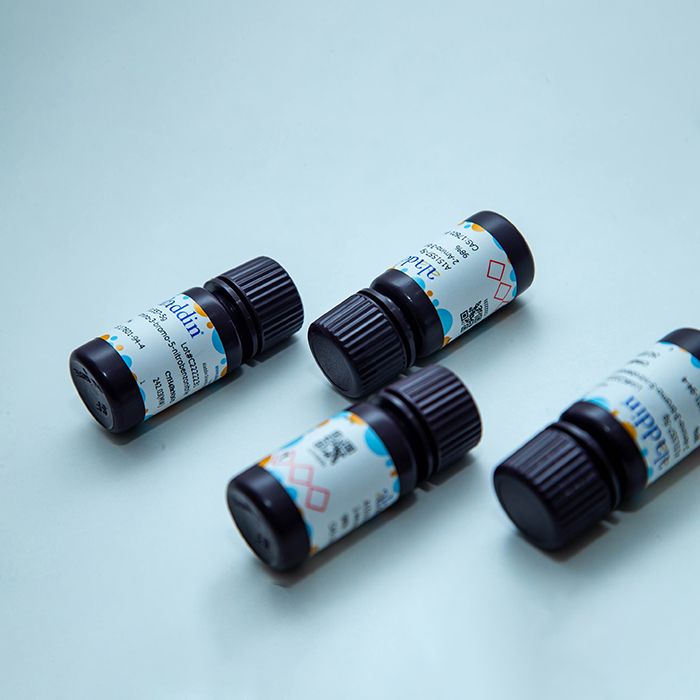
≥97% per flussi di lavoro cromatografici e analitici sensibili che richiedono un'interferenza minima della linea di base.
🌡
Stoccaggio e spedizione
Store at -20°C,Desiccated Spedizione Ice chest + Ice pads. Consultare il COA specifico del lotto per le specifiche esatte.
📋
Documenti di qualità
SDS, COA, scheda tecnica e scheda delle specifiche disponibili per il download. COA specifico del lotto accessibile tramite ricerca per numero di lotto.
📚
Prova documentale
Citato in 0 pubblicazioni peer-reviewed su cromatografia, sintesi organica e reazioni di accoppiamento incrociato.
Panoramica
Tominersen (RG6042) is a second-generation 2′-O-(2-methoxyethyl) antisense oligonucleotide that targets huntingtin protein (HTT) mRNA and potently suppresses HTT production. Tominersen improves survival and reduces brain atrophy in mice. Tominersen can be used for the research of Huntington’s disease (HD).
In Vitro
Tominersen binds to its cognate mRNA by means of Watson-Crick base-pair interactions, triggering RNase H1-mediated degradation of the target mRNA. MCE has not independently confirmed the accuracy of these methods. They are for reference only.
In Vivo
Tominersen can be detected in the neurons of most brain regions, including the frontal cortex, striatum, thalamus, midbrain, brainstem and cerebellum after delivering into the CNS. Tominersen effectively suppresses huntingtin accumulation, and generates sustained phenotypic reversal in HD-like disease after transient huntingtin reduction in rodents. MCE has not independently confirmed the accuracy of these methods. They are for reference only.
Form:Solid
Specifiche
Specifiche e purezza
≥97%
Meccanismi biochimici e fisiologici
Tominersen (RG6042) is a second-generation 2′-O-(2-methoxyethyl) antisense oligonucleotide that targets huntingtin protein (HTT) mRNA and potently suppresses HTT production. Tominersen improves survival and reduces brain atrophy in mice. Tominersen can be
Condizioni di conservazione di stoccaggio
Store at -20°C,Desiccated
Spedito in
Ice chest + Ice pads
Questo prodotto richiede spedizione a catena fredda. I servizi di terra e altri servizi economici non sono disponibili.
Purezza
≥97%
Nomi e identificatori
Sorrisi canonici
[Tominersen]
Peso molecolare
7078.00
Documentazione
📋 Scheda di dati di sicurezza (SDS)
Documento completo su pericoli, manipolazione, stoccaggio e conformità normativa.
Certificati (CoA, COO, BSE/TSE e tabella di analisi)
C of A & Other Certificates(BSE/TSE, COO):
Analytical Chart:
Proprietà chimiche e fisiche
Solubilità
H2O : 50 mg/mL (7.06 mM; Need ultrasonic)
Calcolatori di soluzioni
Molarity Calculator
Determine the necessary mass, volume, or concentration for preparing a solution.
Dilution Calculator
Determine the dilution needed to prepare a stock solution.
Reconstitution Calculator
Recensioni
Recensioni dei clienti
Application Protocols
No item-specific, tested applications or protocols are provided. The following general, literature-based procedures can guide initial method development for antisense oligonucleotides.
Stock preparation:
Warm the vial to room temperature in a desiccated environment. Briefly centrifuge to collect material. Dissolve in RNase-free water or TE to prepare a 100–1000 µM stock. Gently mix until fully dissolved. If sterility is required, 0.22 µm filter into sterile, low-bind tubes.
qPCR/Northern readouts after treatment (cells):
Deliver ASO using a suitable transfection reagent following the reagent manufacturer’s protocol. Explore ~1–100 nM (literature range) and optimize exposure time (24–72 h). Include untreated and mismatch controls. Extract RNA and quantify target levels by RT-qPCR; normalize to housekeeping genes.
Hybridization assays (membranes/microarrays):
Use SSC/SSPE buffers with defined stringency; include a control probe. Optimize temperature and salt per platform. Wash under increasing stringency and detect as appropriate (labeling method dependent).
Biophysical characterization:
Determine Tm by UV-melting in buffered saline with a complementary strand; scan 20–90°C at 0.5–1.0°C/min.
These protocols are starting points only. For this item, no validated conditions, concentrations, or performance claims are made.
Biological Roles
This section provides general, literature-based context for antisense oligonucleotides in biology; it does not ascribe any specific biological performance to this item.
Mechanistic paradigm (general): Antisense oligonucleotides (ASOs) bind complementary RNA via Watson–Crick pairing. Depending on chemistry and design, they can recruit RNase H to cleave RNA in RNA:DNA duplexes (gapmer concept) or sterically block splicing/translation without cleavage.
Determinants of activity: sequence complementarity, backbone chemistry, sugar modifications, and cellular uptake/localization are primary drivers. Phosphorothioate backbones enhance nuclease resistance and protein binding; 2′-sugar modifications tune affinity and stability (literature).
Cellular disposition: ASOs typically enter cells via endocytosis and traffic through endosomes; productive release to cytosol/nucleus is often rate-limiting.
Readouts: transcript knockdown by qPCR/Northern, changes in splicing patterns by RT-PCR, and downstream protein changes by western blot/ELISA.
Off-target considerations: partial complementarity may affect unintended transcripts; rigorous control sequences and dose–response analyses are recommended.
Note: No clinical or therapeutic claims are made. This product is supplied strictly for research use, and any biological role or performance must be established empirically within the intended experimental system.
Buffer Applications
Buffers are central to dissolving, storing, and using antisense oligonucleotides. Specific buffer details for this item are not provided; the following are general, literature-based practices.
Stock preparation:
RNase/DNase-free water for highest versatility.
TE buffer (10 mM Tris, 0.1–1 mM EDTA, pH 7.5–8.0) helps chelate divalent cations and inhibits nuclease-catalyzed degradation.
Working buffers for assays:
PBS (pH 7.2–7.6) or HEPES-buffered saline for cell culture–adjacent workflows where isotonicity matters.
SSC/SSPE buffers for nucleic acid hybridization on membranes; adjust salt concentration and temperature for stringency.
pH and ionic strength:
Maintain near-neutral pH 7.0–8.0; avoid prolonged exposure to pH <6 or >9 to limit backbone cleavage or base loss.
Monovalent salts (Na+, K+) stabilize duplexes; Mg2+ increases Tm but can enhance nuclease activity; add EDTA if nuclease contamination is a concern.
Sterility:
For cell-based assays, prepare solutions with sterile technique and pass through 0.22 µm filters post-dissolution.
Storage buffer:
For long-term aliquots, low ionic strength 10 mM Tris, 0.1 mM EDTA is common; avoid repeated freeze–thaw.
These are general guidelines; optimize buffer composition according to your assay and consult the item’s CoA for any specific recommendations.
Green Alternatives
For an oligonucleotide product like Tominersen, “green alternatives” pertain to synthesis, workup, and handling rather than solvent substitution in reactions.
Greener considerations (general, literature):
Solid-phase synthesis improvements:
Adopt reduced-piperidine or alternative deprotection chemistries that minimize hazardous amines and solvent waste.
Employ safer activators and limit excess phosphoramidite through process optimization.
Solvent footprint:
Replace high volumes of acetonitrile and dichloromethane traditionally used in synthesis with ethanol/MeOH or CPME/2-MeTHF where compatible with couplings and washing steps.
Implement solvent recovery/recycling systems to reduce total VOC emissions.
Purification and desalting:
Favor aqueous ion-exchange or membrane-based desalting to reduce organic solvent consumption.
Use ion-pairing agents sparingly and select less persistent options when RP-HPLC is required.
Packaging and use-phase:
Supply in lyophilized form to avoid cold-chain liquids, and design concentrated stock solutions to reduce packaging waste.
Tradeoffs:
Many greener solvent replacements may affect coupling efficiency or chromatographic resolution; thorough process revalidation is required.
Ion-pair RP-HPLC often provides best resolution for modified oligos; greener IEX or non-ion-pair methods may compromise selectivity for certain sequences.
These are general sustainability strategies and not item-specific process disclosures.
Pharmaceutical Uses
This product is supplied strictly for research use only. No claims are made or implied for clinical or therapeutic use.
General formulation and manufacturing context for oligonucleotides (literature; not item-specific):
Role: sequence-defined oligonucleotides serve as active pharmaceutical ingredients (APIs) in approved modalities; their research formulation principles inform lab handling.
Typical excipients: buffers (e.g., phosphate, citrate), salts (NaCl), chelators (EDTA), and surfactants (polysorbates) to modulate stability and injection compatibility in development settings.
Presentation: often lyophilized cakes or frozen liquid in sterile vials with defined pH and ionic strength; concentration typically in the mg/mL range for parenteral candidates.
Container/closure: Type I glass vials with appropriate stoppers to minimize adsorption; low-binding plastics for working solutions.
For this catalog item, no pharmaceutical grade, excipient system, sterility, endotoxin level, or GMP status is provided. Any use in drug manufacturing or administration is outside the scope of sale and responsibility. Always refer to the CoA/Spec Sheet and SDS for definitive quality and safety information.
Physical Properties
Item-specific physicochemical specifications were not provided and should be confirmed on the CoA/Spec Sheet.
Appearance: Not specified for this item; refer to CoA/Spec Sheet.
Molecular Weight: Not specified for this item; refer to CoA/Spec Sheet.
Exact sequence and counterion (e.g., Na+, TEA+): Not specified for this item; refer to CoA/Spec Sheet.
General/literature properties for antisense oligonucleotides (for planning only):
Physical form: typically an amorphous, hygroscopic solid (dry film or lyophilized powder) that is readily water-soluble.
Solubility: highly soluble in aqueous buffers (RNase/DNase-free water, PBS, TE/Tris-based buffers). Solubility can exceed tens of mg/mL for most sequences; actual solubility depends on length, modifications, and salt form (literature).
pKa/logP: Not meaningful in the classical small-molecule sense; polyanionic macromolecules exhibit multiple acidic phosphate groups, remaining anionic across physiological pH (literature).
UV characteristics: strong absorption near 260 nm due to nucleobases; sequence-specific ε260 varies and is normally calculated from the sequence and reported as OD260 or nmol/OD (literature; not item-specific).
Thermal behavior: no discrete BP/MP; may soften or char upon heating; thermal stability is sequence- and modification-dependent (literature).
Density/refractive index: not typically reported for oligonucleotides.
Note: For quantitative extinction coefficients, salt content, water content, and exact solubility limits, consult the item’s CoA/Spec Sheet.
Quality and Grades
Item-specific grade, purity, and stabilizers were not provided for this product and should be confirmed on the CoA/Spec Sheet.
What to expect for research-grade oligonucleotides (general guidance):
Purity descriptors: Desalted, cartridge-purified, HPLC-purified, or PAGE-purified. Purity is typically reported by analytical HPLC/UPLC at 260 nm and/or by LC–MS. The exact method and minimum purity threshold should be stated on the CoA.
Identity: confirmed by mass spectrometry (intact mass) and, if applicable, enzymatic digestion mapping. Sequence verification is often supported by calculated vs found mass and chromatographic homogeneity.
Quantity normalization: may be supplied by OD260 units, nmol, or mg, with extinction coefficient and nmol/OD listed when sequence is available.
Counterion and salt form: commonly sodium or triethylammonium (TEA) salt; residual salt/water content can influence mass-based dosing. These details are item-specific and should be checked on the CoA.
Endotoxin/bioburden: research-use oligos may or may not include endotoxin or sterility testing. Requirements depend on application (cell culture vs. non-biological assays); item-specific testing is not specified here.
Item-specific statements:
Grade/Purity: Not specified for this item; refer to CoA/Spec Sheet.
Stabilizers/Additives (if any): Not specified for this item; refer to CoA/Spec Sheet.
UV cutoff/absorbance background: Not specified for this item; refer to CoA/Spec Sheet.
Reaction and Applications
As an antisense oligonucleotide, Tominersen is not a small-molecule reagent for classical organic reactions. Its “applications” relate to nucleic acid hybridization and gene expression studies.
Representative research uses (general literature context):
In vitro hybridization to complementary RNA for target capture, pull-down, or RNase H–dependent assays when compatible.
Gene expression modulation studies in cell culture or lysates, evaluating sequence-specific knockdown at the RNA level by qPCR, Northern blot, or reporter assays.
Biophysical analyses of binding (e.g., melting temperature Tm determination, SPR/BLI when immobilized) to characterize hybridization thermodynamics and kinetics.
Method development for oligonucleotide analytics: LC–MS intact mass, ion-pair RP-HPLC, CE, and capillary gel electrophoresis.
Practical tips:
Use RNase-free technique throughout. Pre-wet tips, use low-retention plastics, and avoid repeated freeze–thaw.
Hybridization buffers: near-neutral pH with monovalent salts (Na+/K+). Additives (e.g., formamide) can tune stringency in membrane or microarray formats.
For cellular studies, delivery typically requires transfection reagents or specialized delivery systems; optimize dose and exposure time empirically. Include mismatch/scrambled controls for specificity assessment.
Note: No item-specific application performance claims are made here. Verify sequence, modification pattern, and purity on the CoA to ensure suitability for your intended assay.
Reaction Conditions
Classical reaction conditions (solvent, temperature, catalysts) are not applicable. Instead, consider hybridization and handling conditions for oligonucleotides (general literature guidance):
Dissolution: bring to room temperature in a desiccated environment; dissolve in RNase-free water or TE to a convenient stock (e.g., 100–1000 µM). Mix gently; avoid vortexing foams.
Hybridization: for duplex formation with complementary RNA/DNA, incubate in buffered saline, pH 7–8. A common protocol is heat to 65–70°C for 5–10 min, then slow-cool to room temperature to relieve secondary structure (more relevant for double-strand formation or structured targets).
Stringency control: adjust NaCl/SSC concentration, temperature, and formamide percentage for membrane or microarray assays (consult platform-specific guidelines).
Enzymatic assays: RNase H–dependent workflows typically run at 37°C in buffers containing Mg2+; optimize Mg2+ carefully due to competing nuclease risks.
Cell-based studies: dosing ranges often explored at ~1–100 nM with lipid-mediated delivery; optimize per cell type and monitor cytotoxicity (literature ranges; not item-specific recommendations).
All parameters above are general and should be tailored to the exact sequence, chemistry, and assay. For this item, no validated reaction or assay conditions are specified.
Safety and Handling
Hazard classification for this specific lot is not provided here; always consult the SDS.
Item-specific safety data:
Signal Word: Not specified for this item; refer to SDS.
H-Statements: Not specified for this item; refer to SDS.
GHS Classification/Pictograms: Not specified for this item; refer to SDS.
General laboratory handling guidance for synthetic oligonucleotides (research use):
Expected hazards: oligonucleotides are typically low acute toxicity materials but may cause skin/eye irritation or respiratory irritation as dust or aerosols. Avoid inhalation and contact.
PPE: lab coat, safety glasses, and appropriate gloves (nitrile). Handle powders in a clean area or biological safety cabinet if sterile applications are intended.
Hygiene: use RNase/DNase-free tools and tubes to prevent nuclease contamination. Avoid mouth pipetting; wash hands after handling.
Incompatibilities: strong oxidizers, strong acids/bases can degrade nucleic acids; avoid prolonged exposure to elevated temperature, moisture, and light.
Spill/cleanup: for solids, gently sweep with minimal dust and wipe with moist, disposable towels. For solutions, absorb with inert material; clean with aqueous ethanol and dispose per local regulations.
First aid (general): upon contact, rinse affected area with water for 15 minutes; if inhaled, move to fresh air. Seek medical attention if irritation persists. Provide SDS to medical personnel.
Waste: dispose according to institutional guidelines for non-hazardous biological/chemical waste unless SDS dictates otherwise.
Solvent Selection
Tominersen, as an oligonucleotide, is intended to be handled in aqueous media rather than organic solvents.
Primary solvents (general, literature):
RNase/DNase-free water for stock solutions.
TE buffer (10 mM Tris, 0.1–1 mM EDTA, pH 7.5–8.0) to chelate divalent cations and enhance stability.
PBS or HEPES buffers for biological assays where ionic strength and osmolality are important.
pH considerations: maintain near-neutral pH (7.0–8.0); strong acid/base can promote depurination or backbone cleavage.
Ionic strength: moderate Na+ or K+ supports duplex formation with target RNA; Mg2+ can accelerate nuclease activity and should be controlled or chelated depending on application.
Organic cosolvents: typically not required. Small percentages of sterile ethanol or isopropanol may be used for precipitation steps; avoid high organic content for stock solutions.
Filtration/sterility: if sterile solutions are needed, dissolve then 0.22 µm filter into sterile RNase-free vials.
When to choose alternatives:
For non-biological hybridization assays on membranes or biosensors, buffered saline with salts and additives (e.g., SSC/SSPE, formamide for stringency) may be employed. For cell delivery experiments, solvent selection is less critical than delivery systems (lipid nanoparticles, cationic lipids, gymnotic uptake), which are chosen based on cell type and assay requirements.
Storage and Reconstitution
Follow the item-specific conditions provided and general good practices for oligonucleotides.
Item-specific instructions:
Storage Conditions: Store at -20°C, desiccated.
Shipped In: Ice chest + ice pads.
General best practices (literature; not item-specific specifications):
Upon receipt: allow the sealed container to equilibrate to room temperature before opening to prevent moisture condensation. Briefly centrifuge to collect contents.
Reconstitution:
Dissolve in RNase/DNase-free water or TE buffer (10 mM Tris, 0.1–1 mM EDTA, pH 7.5–8.0) to the desired concentration (e.g., 100–1000 µM). Mix gently until fully dissolved.
If sterile solutions are needed, 0.22 µm filter post-dissolution into sterile, low-bind tubes.
Aliquoting and storage of solutions:
Prepare single-use aliquots to avoid repeated freeze–thaw. Store at -20°C for medium term; for extended storage, -80°C is commonly used. Protect from light and moisture.
Avoid multiple freeze–thaw cycles; thaw on ice or at 4–25°C, mix gently, and keep on ice during use.
Solid-state stability:
Keep tightly capped with desiccant. Minimize exposure to ambient humidity.
For exact concentration, counterion, water content, and any stabilizers for this item, consult the CoA/Spec Sheet. Research Use Only.
Structure and Identity
Tominersen is supplied for research use as a synthetic oligonucleotide reagent. It is a single‑stranded, sequence‑defined nucleic acid designed for Watson–Crick hybridization to a complementary RNA sequence.
Product type: Antisense oligonucleotide (ASO), single-stranded polyanion (general literature description)
Polymer architecture: Linear nucleotide chain with a sugar–phosphate backbone and nucleobases (A/C/G/T or modified analogs) arranged in a defined 5'→3' sequence (general description; specific sequence not provided here)
Key structural features (general):
Backbone: phosphodiester or modified phosphate linkages (e.g., phosphorothioate in many ASOs; literature), conferring anionic charge density
Sugar: ribose/deoxyribose or 2′-modified sugars depending on design (literature)
Stereochemistry: multiple chiral centers in sugars and at modified linkages (if present); overall macromolecular chirality (general for oligos)
Item-specific identifiers (this product):
CAS: 1709886-74-7
Molecular Formula: Not specified for this item; refer to CoA/Spec Sheet.
Molecular Weight: Not specified for this item; refer to CoA/Spec Sheet.
SMILES: Not specified for this item; refer to CoA/Spec Sheet.
InChIKey: Not specified for this item; refer to CoA/Spec Sheet.
2D description in words: a linear chain of nucleotides connected via phosphate linkages, presenting heteroaromatic bases for hybridization to complementary RNA, with potential backbone and sugar modifications typical of ASO chemistry (literature, not item-specific).
Synthetic Utility
Tominersen, as a finished antisense oligonucleotide, is not a building block for general organic synthesis. Its utility is in nucleic acid recognition.
General utility of ASOs in chemical biology (literature):
Serve as sequence-specific probes to interrogate RNA function, stability, and processing in biochemical assays.
Enable RNase H–mediated cleavage assays to study RNA accessibility and duplex formation.
Act as affinity reagents when biotinylated or otherwise labeled to capture target RNAs or ribonucleoprotein complexes.
Provide calibration standards for analytical methods (LC–MS, CE, HPLC) used in oligonucleotide QA/QC.
Common ASO designs incorporate phosphorothioate linkages, 2′-O-alkyl or 2′-F sugars, and terminal caps; these modifications tune nuclease resistance and binding.
Conjugation handles (e.g., amine, thiol, azide) may be introduced for labeling, though none are specified for this item.
If you require an oligo as a synthetic intermediate or with specific reactive handles, consult custom synthesis services. For this catalog entry, sequence, modification pattern, and reactive groups are not specified and should be verified on the CoA/Spec Sheet.
Target Specificity
Target/binding information specific to this catalog item is not provided.
Intended target, sequence, and binding region: Not specified for this item; refer to CoA/Spec Sheet.
Species selectivity and cross-reactivity: Not specified for this item; refer to CoA/Spec Sheet.
Validation data (e.g., knockdown efficiency in a given cell line or system): Not specified for this item; refer to CoA/Spec Sheet.
Note: Any discussion of targets or selectivity must be supported by item-specific documentation. Use appropriate mismatch/scramble controls in your experiments to establish specificity empirically.
Domande frequenti
How is this product shipped?
This product ships in an insulated container with ice pads. Unpack on arrival and transfer it to the storage condition stated above.
What are the CAS number, molecular formula and molecular weight?
The CAS Number is 1709886-74-7, and the molecular weight is 7078.00 g/mol.
What is the purity of this product?
This product is supplied at ≥97% purity (chemical assay). Lot-specific values are stated on the Certificate of Analysis.
How should this product be stored?
Store at ?20 °C, desiccated. Keep the container tightly closed with desiccant — the material is moisture-sensitive.
What documentation is provided?
Available product documentation, including Certificates of Analysis (COA), Safety Data Sheets (SDS), and specification sheets, is shown in the product document area. Document availability and access follow the current site policy.
Utilizziamo i cookie per garantire il corretto funzionamento del sito web e, ove consentito, per migliorare la tua esperienza. Puoi gestire le tue preferenze in qualsiasi momento nelle Impostazioni. Per saperne di più, consulta la nostra Cookie Policy.
Desidera che le inviamo un messaggio quando avremo sconti disponibili?
Ricordamelo più tardi
Grazie! Controlli la sua casella di posta per confermare.
Products are supplied to verified businesses, institutions, and qualified professionals for research and development use only. Not for use in humans, animals, diagnosis, or therapy.