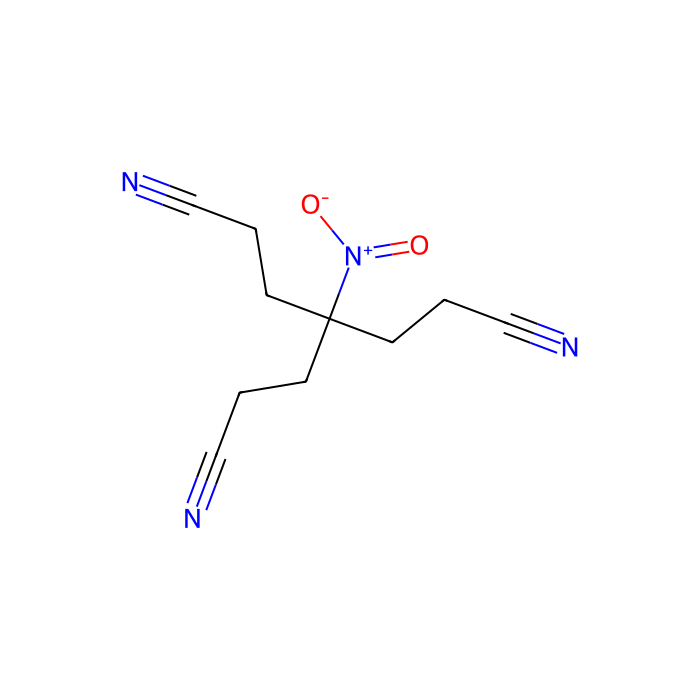
Tris(2-cyanoethyl)nitromethane - ≥95% , CAS No.1466-48-4

CAS: 1466-48-4 Cat. No.: T338585 Formula: C10H12N4O2 Peso molecolare: 220.22 Numero EC: 215-983-3 PubChem CID: 73841
Disponibile su ordine
QUALITÀ & PUREZZA ≥95%
Synonyms
Tris(2-cyanoethyl)nitromethane|1,1,1-Tris(2-cyanoethyl)nitromethane|2,2-Dimethyl-propionamide|3,3',3″-(Nitromethylidyne)tripropionitrile, 4-(2-Cyanoethyl)-4-nitroheptanedinitrile|4-(2-Cyanoethyl)-4-nitroheptanedinitrile #|Propargylmethacrylate|HETP|4-(2-Cyanoethyl)-4-nitropimelonitrile, Nitro-tris(2-cyanoethyl)methane|4-(2-Cyanoethyl)-4-nitro-1,7-heptanedinitrile|4-Cyanoethyl-4-nitropimelonitrile|dichloro(dimethyl)stannane|Toremonil|4-(2-Cyanoethyl)-4-(hydroxy(oxido)amino)heptanedinitrile|Heptanedinitrile, 4-(2-cyanoethyl)-4-nitro-|4-(2-Cyanoethyl)-4-nitroheptanedinitrile|4-(2-cyanoethyl)-4-nitro-heptanedinitrile|Heptanedinitrile,4-(2-cyanoethyl)-4-nitro-|1,5-Dicyano-3-(2-Cyanoethyl)-N-Hydroxypentan-3-Amine Oxide|4-(2-Cyanoethyl)-4-(Hydroxy-Oxido-Amino)Heptanedinitrile
Storage
Store at 2-8°C
Shipped In
Wet ice
★
Dimensione
Germania (EU)
USA*
Prezzo
Qtà
250mg
T338585-250mg
Su ordinazione · 8–12 settimane
8,59€
1g
T338585-1g
Su ordinazione · 8–12 settimane
11,19€
5g
T338585-5g
Su ordinazione · 8–12 settimane
25,95€
10g
T338585-10g
Su ordinazione · 8–12 settimane

176,93€

265,44€
Salva 88,51 € (33.34%)
25g
T338585-25g
Su ordinazione · 8–12 settimane
112,72€
Enter a quantity for the sizes you want to add.

Panoramica

Tris(2-cyanoethyl)nitromethane is a trinitrile compound useful as a reagent in 1-azoniatricyclo-(3,3,3,0)-undecane bromide synthesis. Tris(2-cyanoethyl)nitromethane is also useful as a building block for four directional C-core and in the dendritic molecule synthesis.

Specifiche

Sinonimi
Tris(2-cyanoethyl)nitromethane | 1,1,1-Tris(2-cyanoethyl)nitromethane | 2,2-Dimethyl-propionamide | 3,3',3″-(Nitromethylidyne)tripropionitrile, 4-(2-Cyanoethyl)-4-nitroheptanedinitrile | 4-(2-Cyanoethyl)-4-nitroheptanedinitrile # | Propargylmethacrylate | HETP | 4-(2-Cyanoethyl)-4-nitropimelonitrile, Nitro-tris(2-cyanoethyl)methane | 4-(2 Mostra altro
Specifiche e purezza
≥95%
Condizioni di conservazione di stoccaggio
Store at 2-8°C
Spedito in
Wet ice
Questo prodotto richiede spedizione a catena fredda. I servizi di terra e altri servizi economici non sono disponibili.
Purezza
≥95%
Nomi e identificatori
SMILES
C(CC(CCC#N)(CCC#N)[N+](=O)[O-])C#N
IUPAC Name
4-(2-cyanoethyl)-4-nitroheptanedinitrile
InChIKey
MUPJJZVGSOUSFH-UHFFFAOYSA-N
InChI
1S/C10H12N4O2/c11-7-1-4-10(14(15)16,5-2-8-12)6-3-9-13/h1-6H2
Isomeri SMILES
C(CC(CCC#N)(CCC#N)[N+](=O)[O-])C#N
WGK Germania
3
PubChem CID
73841
Peso molecolare
220.22

Dati avanzati

Taxonomic Classification

Taxonomy Tree

KingdomOrganic compounds
SuperclassOrganic 1,3-dipolar compounds
ClasseAllyl-type 1,3-dipolar organic compounds
SubclassOrganic nitro compounds
Intermediate Tree Nodes Not available
Direct ParentC-nitro compounds
Alternative Parents Propargyl-type 1,3-dipolar organic compounds  Organic oxoazanium compounds  Nitriles  Organopnictogen compounds  Organic oxides  Hydrocarbon derivatives  
Molecular FrameworkAliphatic acyclic compounds
Substituents C-nitro compound - Propargyl-type 1,3-dipolar organic compound - Organic oxoazanium - Nitrile - Carbonitrile - Organic nitrogen compound - Organic oxygen compound - Organopnictogen compound - Organic oxide - Hydrocarbon derivative - Organonitrogen compound - Aliphatic acyclic compound
DescrizioneThis compound belongs to the class of organic compounds known as c-nitro compounds. These are compounds having the nitro group, -NO2 (free valence on nitrogen), which is attached to carbon.
External Descriptors Not available
Struttura 3D
Modello di struttura chimica interattiva


Certificati (CoA, COO, BSE/TSE e tabella di analisi)
C of A & Other Certificates(BSE/TSE, COO):
Analytical Chart:

Find and download the COA for your product by matching the lot number on the packaging.

5 results found

Lot NumberCertificate TypeDataOggetto
G2607670G2607670Certificate of AnalysisJun 25, 2026 T338585
G2607671G2607671Certificate of AnalysisJun 25, 2026 T338585
G2607672G2607672Certificate of AnalysisJun 25, 2026 T338585
G2607673G2607673Certificate of AnalysisJun 25, 2026 T338585
G2607680G2607680Certificate of AnalysisJun 25, 2026 T338585
Proprietà chimiche e fisiche
Punto di ebollizione (°C)~514.6° C at 760 mmHg (Predicted)
Punto di fusione (°C)111-113° C (lit.)
Peso molecolare220.23
XLogP30.000
Hydrogen Bond Donor Count0
Hydrogen Bond Acceptor Count5
Rotatable Bond Count6
Exact Mass220.096 Da
Monoisotopic Mass220.096 Da
Topological Polar Surface Area117.000 Ų
Heavy Atom Count16
Formal Charge0
Complexity333.000
Isotope Atom Count0
Defined Atom Stereocenter Count0
Undefined Atom Stereocenter Count0
Defined Bond Stereocenter Count0
Undefined Bond Stereocenter Count0
The total count of all stereochemical bonds0
Covalently-Bonded Unit Count1
Sicurezza e pericoli (GHS)
Pictogrammi
Segnale
Warning
Indicazioni di pericolo

H302:Harmful if swallowed

H312:Harmful in contact with skin

H315:Causes skin irritation

H319:Causes serious eye irritation

H332:Harmful if inhaled

H335:May cause respiratory irritation

Precauzioni

P261:Avoid breathing dust/fume/gas/mist/vapors/spray.

P264:Wash hands [and …] thoroughly after handling.

P270:Do not eat, drink or smoke when using this product.

P271:Use only outdoors or in a well-ventilated area.

P280:Wear protective gloves/protective clothing/eye protection/face protection.

P321:Specific treatment (see ... on this label).

P330:Rinse mouth.

P302+P352:IF ON SKIN: wash with plenty of water.

P304+P340:IF INHALED: Remove person to fresh air and keep comfortable for breathing.

P305+P351+P338:IF IN EYES: Rinse cautiously with water for several minutes. Remove contact lenses if present and easy to do - continue rinsing.

P362+P364:Take off contaminated clothing and wash it before reuse.

P405:Store locked up.

P403+P233:Store in a well-ventilated place. Keep container tightly closed.

P501:Dispose of contents/container to an approved waste disposal plant.

P264+P265:Wash hands [and …] thoroughly after handling. Do not touch eyes.

P301+P317:IF SWALLOWED: Get medical help.

P317:Get emergency medical help.

P337+P317:If eye irritation persists: Get medical help.

P332+P317:If skin irritation occurs: Get medical help.

P319:Get medical help if you feel unwell.

WGK Germania
3
Calcolatori di soluzioni
Recensioni

Recensioni dei clienti

Application Protocols

Not applicable for bioassay protocols. No validated WB/IHC/IF/FC protocols are associated with this small-molecule reagent.

Synthetic usage notes:

  • For reductions/hydrolyses described in Reaction Conditions, run small-scale screens to establish chemoselectivity between nitrile and nitro groups before scale-up.
  • Maintain an inert atmosphere for air/moisture-sensitive reagents or catalysts as appropriate.
Biological Roles

This compound is a synthetic organic building block and is not a natural metabolite. No inherent biological function is expected beyond generic physicochemical interactions.

  • Endogenous roles: None known (not a physiological metabolite).
  • Biochemical interactions: Nitrile- and nitro-bearing organics can interact nonspecifically with proteins or membranes depending on lipophilicity, but this material is intended strictly for chemical synthesis.

Research use note: For research use only. Not for human or veterinary use. No clinical or diagnostic claims are made or implied.

Buffer Applications

Not typically applicable. Tris(2-cyanoethyl)nitromethane is a polyfunctional organic reagent, not a buffering agent.

  • If aqueous work is required (e.g., nitrile hydrolysis), standard laboratory buffers/acids/bases (e.g., HCl, H2SO4, NaOH) may be used as reaction media, but the compound itself does not constitute a buffer system.
Green Alternatives

Because this product is a polyfunctional building block rather than a solvent, “green alternatives” focus on synthetic strategy, solvent choice for its use, and safer transforming agents.

Greener strategy considerations (literature/general):

  • Hydrogenations: Prefer heterogeneous catalytic hydrogenation (H2 with Raney Ni, Pd/C) over stoichiometric metal hydrides where feasible, using benign solvents (EtOH, i-PrOH) to reduce waste and hazards.
  • Nitrile reductions: Replace LiAlH4 or borane with catalytic hydrogenation or transfer hydrogenation (e.g., Raney Ni/EtOH/NH3 or Ru-catalyzed systems) when compatible with the nitro group.
  • Hydrolysis: Use aqueous processing with recyclable polar solvents (water/EtOH or water/MeCN) and catalytic acid/base rather than concentrated mineral acids/bases when reaction rates permit.
  • Protection strategies: Minimize protecting-group steps by exploiting inherent chemoselectivity (e.g., selective nitrile hydrogenation under conditions that leave –NO2 intact, or vice versa), reducing step count and solvent usage.

Small comparison (conceptual):

  • Reducing agents: LAH (non-green, pyrophoric) vs H2/Raney Ni (greener, recyclable catalyst). Tradeoff: pressure equipment and hydrogen safety required.
  • Solvents: DMF/DMSO (effective but problematic in scale-up) vs EtOH/i-PrOH/2-MeTHF (improved environmental profiles). Tradeoff: solubility and rate may vary.

Waste and safety:

  • Nitro/nitrile transformations can generate nitrogen oxides or ammonium salts; plan scrubbing and neutralization strategies. Opt for solvent recovery and catalyst recycling whenever possible.
Pharmaceutical Uses

This item is supplied for research and development only.

  • Role in formulations: Not typically used as an excipient. Its functionality (nitrile and nitro groups) is more aligned with synthetic intermediates than with formulation components.
  • Pharmacopeia status: No pharmacopeial monograph is indicated for this substance.

Any use in drug discovery would be as a synthetic building block or intermediate under standard process chemistry controls, not as an API or clinical material.

Physical Properties

Item-specific specifications (appearance, exact density, refractive index, residuals): Not specified for this item; refer to CoA/Spec Sheet.

Literature/computed properties and expectations (for guidance only):

  • Molecular formula: C10H12N4O2 (literature)
  • Molecular weight: ~220.23 g/mol (calculated)
  • State/appearance: Often reported as a low-melting solid or viscous oil; exact form is batch- and temperature-dependent (literature general). Item-specific appearance: Not specified for this item; refer to CoA/Spec Sheet.
  • Polarity/functional profile: Polyfunctional, strongly electron-deficient due to three nitriles and one nitro group; non-protic, polarizable.
  • Solubility (qualitative, literature): Expected to be sparingly soluble in water; soluble in polar organic solvents such as acetonitrile, DMF, DMSO, acetone, and moderately in alcohols; lower solubility in nonpolar hydrocarbons. Exact solubility values: Not specified for this item; refer to CoA/Spec Sheet.
  • Boiling/melting points, density, refractive index, logP, pKa: Not specified for this item; consult primary literature or CoA/Spec Sheet for batch-specific data if available.

Notes for handling based on properties (general):

  • Hygroscopicity is typically low-to-moderate for nitrile-rich compounds, but uptake of moisture can affect downstream reactions; keep tightly closed.
  • Viscosity may increase at low temperature; gentle warming to ambient can aid transfer (do not exceed recommended storage guidance without SDS review).
Quality and Grades
  • Grade/Purity: Not specified for this item; refer to CoA/Spec Sheet.
  • Appearance: Not specified for this item; refer to CoA/Spec Sheet.

Guidance on grades (general, for context):

  • Research-grade organics are typically suitable for synthetic and analytical R&D. When listed as ≥98% or higher, they are generally adequate for most transformations without pre-purification.
  • If HPLC grade or LC/MS grade is stated for solvents/reagents, this implies stringent limits on UV-active impurities and metal content. No such grade is specified for this item.
  • Stabilizers/inhibitors: None are indicated in the Product Data. If present in a specific batch, stabilizers would be disclosed on the CoA.

Quality control suggestions for end users:

  • Verify identity by 1H/13C NMR and HRMS. Key resonances: methylene protons adjacent to the quaternary center and to nitriles typically appear downfield (literature general). IR shows strong C≡N stretch (~2250 cm−1) and asymmetric/symmetric NO2 stretches (~1550/1350 cm−1) (literature general).
  • For trace-metal sensitive catalysis (e.g., hydrogenations), consider a short silica plug or recrystallization if solid. Record water content by Karl Fischer when moisture-sensitive chemistry is planned.

Always confirm batch-specific specs on the CoA/Spec Sheet for your lot.

Reaction and Applications

Tris(2-cyanoethyl)nitromethane (TCNM) is a dense electrophile-rich scaffold useful in multistep syntheses where convergent installation of three pendant 2-carbon chains is desired.

Representative application families (literature/general):

  • Global or selective reduction of nitriles to primary amines, furnishing polyamine precursors. Hydrogenation (H2, Raney Ni or Pd/C) or borane-mediated reductions (BH3·THF) can convert –CH2–CH2–C≡N to –CH2–CH2–CH2–NH2. In the presence of a nitro group, stepwise chemoselective strategies are advised.
  • Nitro group transformations: catalytic hydrogenation (H2/Pd, H2/Rh) or metal/acid reductions (Fe/HCl, SnCl2) can reduce –NO2 to –NH2, enabling access to quaternary-carbon-centered amines or further elaboration (e.g., conversion to hydroxylamine/oxime under controlled conditions). Alternatively, Nef-like pathways under strongly acidic/oxidative conditions can modify nitroalkanes, though quaternary centers demand tailored conditions.
  • Nitrile hydrolysis to amides/acids (acidic or basic conditions), enabling orthogonal derivatization at each arm (amide coupling, amidoxime formation, esterification after acid formation).
  • Addition chemistry at the nitrile: organometallic addition to form imines/ketimines followed by hydrolysis or reductive workup, allowing installation of carbonyl-equivalents distal from the quaternary center.
  • Polymer/ligand precursor: after converting nitriles to amines/amidines, TCNM serves as a tri-functional node for crosslinkers, ion-exchange materials, or chelating ligand frameworks (literature precedents for polyamine construction).

Practical tips:

  • Stage-selective strategies (reduce nitriles first, protect, then address the nitro, or vice versa) improve chemoselectivity.
  • Monitor by IR (C≡N 2200–2260 cm−1, NO2 1300–1600 cm−1) and 13C NMR (nitrile carbon ~115–125 ppm).
Reaction Conditions

Guidance below is literature-general for nitrile/nitro transformations; optimize per your setup and substrate solubility.

  • Catalytic hydrogenation of nitriles to primary amines:
    • Typical: H2 (10–50 bar), Raney Ni or Pd/C (5–10 wt%), EtOH or i-PrOH, 25–80°C, 4–24 h. Ammonia or base additive can suppress secondary amine formation. The nitro group may also reduce; to favor nitrile-first reduction, lower temperature and carefully control catalyst choice/loading (literature general).
  • Borane reduction of nitriles:
    • BH3·THF (1.5–2.5 eq per nitrile), 0–25°C to reflux, 2–18 h; quench with MeOH/H2O then basic hydrolysis to amine salts. Avoid if nitro sensitivity is a concern.
  • Hydrolysis of nitriles:
    • Acidic: 6 M HCl or 50–80% H2SO4, 80–120°C, 6–24 h → amides/acids depending on time/conditions. Include a polar cosolvent if needed for solubility. Basic: 2–6 M NaOH/KOH, 80–120°C, 6–24 h; follow with acidification.
  • Formation of amidoximes:
    • NH2OH·HCl (3–5 eq per nitrile), base (Na2CO3 or Et3N), MeOH/H2O or EtOH, 20–60°C, 2–12 h; useful for subsequent cyclizations.
  • Nitro reduction:
    • H2 (1–5 bar), Pd/C (5–10 wt%), EtOH/EtOAc, 20–40°C, 1–6 h; or Fe/HCl (3–6 eq Fe), EtOH/H2O, reflux, 2–6 h. In presence of nitriles, chemoselectivity must be validated; stepwise reduction recommended.

Monitoring and workup:

  • Monitor by IR (C≡N ~2250 cm−1; NO2 1300–1600 cm−1) and NMR; GC/MS may be less suitable for nonvolatile products—use LC/MS.
  • Neutralize and carefully vent when reducing nitro/nitriles; nitrogenous off-gases possible.
Safety and Handling

Authoritative safety classification for this catalog item:

  • GHS classification, signal word, hazard and precautionary statements, and pictograms: Not specified for this item; refer to SDS.

General safety considerations for nitrile/nitro multifunctional organics (literature/generic; not item-specific):

  • Potential hazards: Irritation to skin/eyes/respiratory tract; harmful if swallowed; nitrile- and nitro-bearing organics can present combustion hazards. Avoid dust/aerosol formation.
  • PPE: Wear chemical-resistant gloves (e.g., nitrile), lab coat, and splash goggles. Use in a chemical fume hood to avoid inhalation of vapors/mists.
  • Incompatibilities: Strong bases and strong nucleophiles can promote unwanted side reactions (e.g., conjugate additions or nitrile hydrolysis). Strong reducing agents (e.g., hydrides) and catalytic hydrogenation conditions will reduce nitrile and/or nitro groups. Strong oxidizers may react vigorously with organic substrates.
  • Peroxide formation: Not associated with classical peroxide-forming solvents; nonetheless, follow standard solvent safety for any co-solvents used.
  • First aid (overview; defer to SDS): Eye/skin contact—rinse with water for at least 15 minutes, remove contaminated clothing. Inhalation—move to fresh air, seek medical attention if symptoms persist. Ingestion—rinse mouth, do not induce vomiting; seek medical attention.
  • Fire safety: Use CO2, dry chemical, or foam. Combustion may produce nitrogen oxides and hydrogen cyanide—firefighters should wear SCBA.

Always consult the product SDS for authoritative, item-specific hazard classification and response measures.

Solvent Selection

This product is a multifunctional organic building block (not primarily used as a solvent). However, solvent choice is critical for its transformations.

General solvent compatibility and selection (literature/general):

  • Polar aprotic solvents (e.g., acetonitrile, DMF, DMSO, NMP) typically dissolve nitrile-rich compounds well and support reactions such as nucleophilic additions, condensations, and metal-catalyzed hydrogenations (with appropriate heterogenized catalysts).
  • Alcohols (MeOH, EtOH, i-PrOH) can be suitable for catalytic hydrogenation of nitriles to primary amines; they may participate in imine/alcohol equilibria—monitor for side reactions.
  • Aqueous-organic mixtures are used for hydrolysis of nitriles to amides/acids under acidic or basic conditions; consider cosolvents (MeCN, THF) to maintain solubility.
  • Nonpolar solvents (toluene, heptane) generally show limited solubility; may be useful for crystallizations or phase separations.

Practical notes:

  • For reductions of nitriles, protic solvents (EtOH, i-PrOH) with Raney Ni or Pd/C under H2 are common; for chemoselectivity in the presence of a nitro group, use milder catalysts or stepwise strategies.
  • For nitrile hydrolysis, aqueous mineral acid (H2SO4/HCl) or base (NaOH/KOH) with heat is typical; include a polar cosolvent to maintain homogeneity.
  • For organometallic additions to nitriles (forming imines/ketimines), use dry, aprotic solvents (THF, Et2O, toluene) under inert atmosphere.

Always tailor solvent choice to the targeted transformation and substrate solubility profile.

Storage and Reconstitution
  • Storage conditions (item-specific): Store at 2–8°C (as provided). Keep container tightly closed in a dry, well-ventilated place. Protect from heat and direct sunlight.
  • Shipping: Shipped on wet ice (as provided).
  • Reconstitution: Not applicable. This product is supplied as a neat organic reagent. If solid or highly viscous at 2–8°C, allow to equilibrate to ambient temperature before dispensing; if necessary, dissolve in a compatible solvent (e.g., acetonitrile, DMF, DMSO, alcohols) according to your application.
  • Freeze–thaw: Not relevant. Avoid repeated warming/cooling cycles that may introduce condensation; purge headspace with inert gas after opening if long-term storage is anticipated.
  • Shelf life: Not specified for this item; refer to CoA/Spec Sheet. Inspect periodically by NMR/IR for integrity if stored long term.

General handling: Close promptly after use. Segregate from strong oxidizers/reducers and strong acids/bases unless used deliberately under controlled conditions. Consult the SDS for any additional storage incompatibilities or precautions.

Structure and Identity

Tris(2-cyanoethyl)nitromethane is a multifunctional organic building block bearing three terminal nitriles appended to a quaternary carbon that also carries a nitro group.

  • SKU: T338585
  • Product name: Tris(2-cyanoethyl)nitromethane
  • CAS: 1466-48-4
  • PubChem CID: 73841 (literature)
  • InChIKey: 228897 (as provided in Product Data)
  • SMILES: O=N+C(CC#N)(CC#N)CC#N (literature)
  • Molecular formula: C10H12N4O2 (literature)
  • Molecular weight: ~220.23 g/mol (literature, calculated from formula)

Structural features (descriptive):

  • Central quaternary carbon bearing one nitro group (–NO2) and three identical –CH2–CH2–C≡N substituents.
  • Functional groups: three nitriles (electron-withdrawing, polar aprotic) and one nitro group (strong –I/–M withdrawing). No stereogenic centers; achiral.
  • 2D description: a tetra-substituted carbon core with one short –NO2 vector and three extended 2-carbon linkers terminating in nitriles arranged approximately tetrahedrally around the central carbon.

Item-specific identifiers not provided above: any additional registry identifiers, batch-specific descriptors, or analytical IDs: Not specified for this item; refer to CoA/Spec Sheet.

Synthetic Utility

Functional handle summary:

  • Three terminal nitriles enable divergent transformations (reduction to primary amines, hydrolysis to amides/acids, addition to form imines/ketimines, cyclizations via amidoximes/imidates).
  • One nitro group on a quaternary carbon is transformable (reduction to amine, conversion to oxime/hydroxylamine derivatives, or other nitroalkane chemistry under tailored conditions).

Retrosynthetic value (literature/general):

  • Serves as a convergent node to introduce three 2-carbon tethers in a single scaffold. After orthogonal manipulation of nitriles, one can access tri-amine, tri-amide, or mixed-functionality architectures useful for polymer crosslinkers, dendrimer wedges, ion-exchange materials, and multidentate ligands.

Representative transformations:

  • Nitrile → primary amine: H2/Raney Ni or Pd/C; or BH3·THF followed by hydrolysis.
  • Nitrile → amide/acid: Acidic (H2SO4, HCl) or basic (NaOH, KOH) hydrolysis; stepwise to amide under milder conditions.
  • Nitrile → amidoxime: Reaction with hydroxylamine; useful intermediate to imidates or amidines.
  • Nitro → amine: Catalytic hydrogenation or metal/acid (Fe/HCl, SnCl2); choose conditions mindful of concurrent nitriles.

Selectivity strategy:

  • Reduce or derivatize the nitriles first under conditions that leave –NO2 intact (e.g., Raney Ni at lower temperature/pressure), then address the nitro group; or protect nascent amines (Boc, Cbz) before nitro reduction to avoid overreaction/cyclization.
Target Specificity

Not applicable. This product is a small-molecule reagent, not a biological targeting agent (e.g., antibody, ligand with defined biomolecular target). No antigen/epitope or species reactivity information applies.

Desidera che le inviamo un messaggio quando avremo sconti disponibili?

Ricordamelo più tardi

Grazie! Controlli la sua casella di posta per confermare.

Ops! Le notifiche sono disabilitate.