Determine the necessary mass, volume, or concentration for preparing a solution.
| Activity Type | Relation | Activity value | Units | Action Type | Journal | PubMed Id | doi | Assay Aladdin ID |
|---|

TrkA-IN-1 is a potent and selective Tropomyosin-related kinase A (TrkA) inhibitor with an IC 50 of 99 nM in a cell-based assay. TrkA-IN-1 has analgesic activity
Form:Solid
IC50& Target:TrkA 99 nM (IC 50 ) TrkB 81 μM (IC 50 ) TrkC 25 μM (IC 50 )
Taxonomy Tree
| Kingdom | Organic compounds |
|---|---|
| Superclass | Benzenoids |
| Classe | Fluorenes |
| Subclass | Not available |
| Intermediate Tree Nodes | Not available |
| Direct Parent | Fluorenes |
| Alternative Parents | Phenylpyrimidines Benzene and substituted derivatives Heteroaromatic compounds Ureas Azacyclic compounds Organopnictogen compounds Organonitrogen compounds Organic oxides Hydrocarbon derivatives Carbonyl compounds |
| Molecular Framework | Aromatic heteropolycyclic compounds |
| Substituents | Fluorene - 5-phenylpyrimidine - 4-phenylpyrimidine - Pyrimidine - Monocyclic benzene moiety - Heteroaromatic compound - Urea - Carbonic acid derivative - Azacycle - Organoheterocyclic compound - Organic nitrogen compound - Organic oxygen compound - Organopnictogen compound - Organic oxide - Hydrocarbon derivative - Organooxygen compound - Organonitrogen compound - Carbonyl group - Aromatic heteropolycyclic compound |
| Descrizione | This compound belongs to the class of organic compounds known as fluorenes. These are compounds containing a fluorene moiety, which consists of two benzene rings connected through either a cyclopentane, cyclopentene, or cyclopenta-1,3-diene. |
| External Descriptors | Not available |
| Activity Type | Relation | Activity value | Units | Action Type | Journal | PubMed Id | doi | Assay Aladdin ID |
|---|
| Activity Type | Relation | Activity value | Units | Action Type | Journal | PubMed Id | doi | Assay Aladdin ID |
|---|
| Solubilità | DMSO : 8.33 mg/mL (21.23 mM; Need ultrasonic) |
|---|---|
| Peso molecolare | 392.500 g/mol |
| XLogP3 | 4.200 |
| Hydrogen Bond Donor Count | 2 |
| Hydrogen Bond Acceptor Count | 3 |
| Rotatable Bond Count | 3 |
| Exact Mass | 392.164 Da |
| Monoisotopic Mass | 392.164 Da |
| Topological Polar Surface Area | 66.900 Ų |
| Heavy Atom Count | 30 |
| Formal Charge | 0 |
| Complexity | 570.000 |
| Isotope Atom Count | 0 |
| Defined Atom Stereocenter Count | 0 |
| Undefined Atom Stereocenter Count | 0 |
| Defined Bond Stereocenter Count | 0 |
| Undefined Bond Stereocenter Count | 0 |
| The total count of all stereochemical bonds | 0 |
| Covalently-Bonded Unit Count | 1 |
No tested applications or validated protocols are provided in the product data for this SKU.
General research-use guidance (not item-specific; adapt to your system):
Please consult the CoA/Spec Sheet and SDS for any item-specific instructions when available.
Context and mechanism (general literature; not item-specific claims):
Use cases in research (general):
Notes for experimental design:
This item is a small‑molecule kinase inhibitor, not a buffering agent. Therefore, classic buffer system guidance (pKa, buffer capacity, recipes) is not applicable.
Practical notes for assay buffers (general, not item‑specific):
This product is a bioactive tool compound used at micro- to milligram scales in biochemical and cellular assays; “green alternatives” are less about replacing the compound itself and more about optimizing solvents and workflows.
General recommendations (not item-specific):
Trade-offs:
Waste minimization:
No clinical or therapeutic uses are claimed for this catalog item. It is supplied strictly for research use only.
Relevant nonclinical/formulation contexts (general; not item-specific):
Regulatory note:
Only item-specific details provided by the catalog are reported below. Numerical specifications not listed here are not established for this item.
General considerations (literature/good practice, not item-specific):
Interpretation and guidance:
This SKU is a finished bioactive small molecule intended as a tool compound, not a synthetic reagent. As such, traditional synthetic “reaction applications” (e.g., serving as a coupling partner, catalyst, or reagent) are not typically applicable.
Relevant applications instead focus on biochemical and cellular assay contexts (see Biological Roles and Application Protocols):
If chemical modification is desired (e.g., to prepare a probe or conjugate), consult the primary literature for the exact scaffold of TrkA-IN-1 to identify vector positions tolerant to substitution. Such derivatization is outside the intended use of this catalog item and may require custom synthesis.
Not applicable in the classical synthetic sense, as this product is a ready‑to‑use bioactive small molecule rather than a reagent. No catalytic or stoichiometric reaction conditions are associated with its use in chemistry.
Assay-related conditions (general guidance, literature-based; not item-specific):
These are general literature norms for kinase inhibitors and should be adapted to the user’s specific protocols and controls.
Safety overview for research use only compounds of this class. Always consult the SDS for authoritative information.
This product is a hydrophobic small-molecule kinase inhibitor; solvent choice is critical for preparing concentrated stocks and for assay compatibility.
Item-specific solubility is not provided; guidance below is general/literature-based and not a specification for this SKU.
Comparison (general):
Practical tips:
Notes:
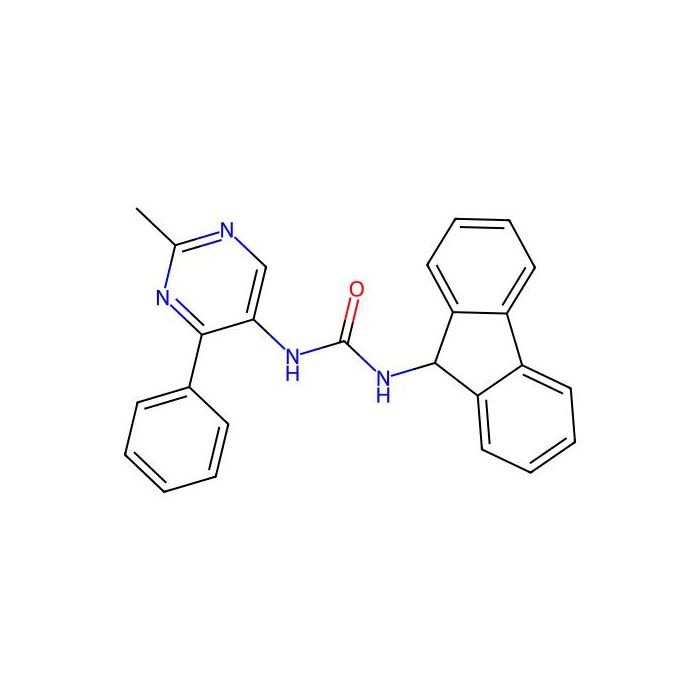
Brief overview: TrkA-IN-1 (CAS 1680179-43-4) is a small-molecule research inhibitor named for activity against the TrkA (NTRK1) tyrosine kinase. Item-specific structural identifiers are incomplete in the provided data; consult the CoA/SDS for definitive identifiers.
Structural features (general context, literature):
2D structure description (general):
This SKU is a finished bioactive compound and is not typically used as a building block or reagent in synthetic chemistry.
General retrosynthetic considerations (literature context for kinase inhibitors; not item-specific):
If derivatization or probe synthesis is planned, consult primary literature on TrkA-IN-1 to identify positions tolerant to modification and to avoid disrupting hinge interactions critical for potency.
Item-specific target details have not been provided beyond the product name.
Users should verify target engagement under their specific assay conditions (e.g., enzymatic IC50, cellular phospho‑TrkA readouts) before relying on this compound as a reference standard.