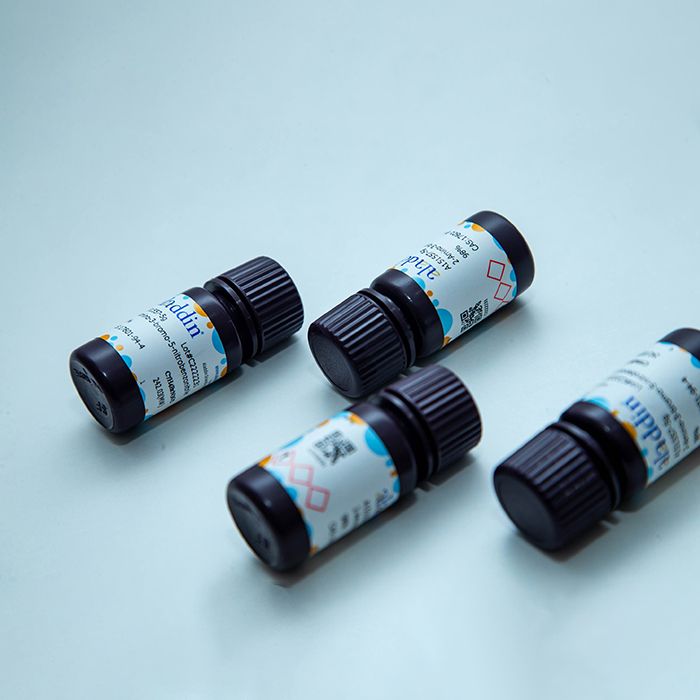
TrkA-IN-4, a potent, orally active and allosteric TrkA inhibitor, is a proagent of TrkA-IN-3 ( HY-151948 ). TrkA-IN-4 exhibits potent antinociceptive effects.
Appearance:Solid
IC50& Target:TrkA
In Vitro:TrkA-IN-4 (compound 39) demonstrates 65.1% and 46.3% of kinase inhibition towards TrkA at concentrations of 1 μM and 0.1 μM, respectively. MCE has not independently confirmed the accuracy of these methods. They are for reference only.
In Vivo:TrkA-IN-4 (compound 39) (0.9375-120mg/kg; i.g.) exhibits stronger maximum antinociceptive effects 3 h after administration, with an ED 50 of 7.836mg/kg in hot plate testing on male mice. MCE has not independently confirmed the accuracy of these met
Biological Activity:TrkA-IN-4, a potent, orally active and allosteric TrkA inhibitor, is a proagent of TrkA-IN-3 ( HY-151948 ). TrkA-IN-4 exhibits potent antinociceptive effects.
Specifiche
Specifiche e purezza
≥99%
Condizioni di conservazione di stoccaggio
Store at -20°C
Spedito in
Ice chest + Ice pads
Questo prodotto richiede spedizione a catena fredda. I servizi di terra e altri servizi economici non sono disponibili.
Certificati (CoA, COO, BSE/TSE e tabella di analisi)
C of A & Other Certificates(BSE/TSE, COO):
Analytical Chart:
Proprietà chimiche e fisiche
Solubilità
DMSO : 50 mg/mL (92.86 mM; ultrasonic and warming and heat to 60°C)
Calcolatori di soluzioni
Molarity Calculator
Determine the necessary mass, volume, or concentration for preparing a solution.
Dilution Calculator
Determine the dilution needed to prepare a stock solution.
Reconstitution Calculator
Recensioni
Recensioni dei clienti
Application Protocols
Item-specific tested applications/dilutions: Not specified for this item; refer to CoA/Spec Sheet.
Example protocols (general guidance; adjust to your system)
Enzyme inhibition (ADP-Glo format)
Prepare 10 mM DMSO stock; serially dilute 1:3–1:5 in DMSO to generate a 10-point curve.
Pre-incubate TrkA enzyme with inhibitor for 15–30 min at room temperature in assay buffer (e.g., 50 mM HEPES pH 7.5, 10 mM MgCl2, 0.01% Tween-20, 1 mM DTT).
Initiate with ATP/substrate; incubate 30–60 min; develop and read luminescence. Fit IC50 with appropriate models accounting for ATP concentration.
Cellular phospho-TrkA readout (WB/ELISA)
Seed cells expressing TrkA; serum-starve as needed.
Treat with inhibitor (e.g., 0.01–10 μM final; constant DMSO) for 30–60 min; stimulate with NGF.
Lyse cells; quantify p-TrkA (Tyr490) and downstream markers (e.g., p-ERK) with normalization to total protein.
Thermal shift (DSF)
Mix purified TrkA with dye (e.g., SYPRO Orange) and inhibitor at varying concentrations; ramp temperature; analyze Tm shifts to infer binding.
Controls
Include a reference Trk inhibitor as positive control and vehicle-only negative control. Replicate across plates to assess robustness (Z′-factor).
Biological Roles
Target context (general literature; not item-specific claims)
TrkA (NTRK1) is a receptor tyrosine kinase activated by nerve growth factor (NGF), initiating downstream signaling through MAPK/ERK, PI3K/AKT, and PLCγ pathways.
Small-molecule TrkA inhibitors are used as chemical tools to dissect NGF/TrkA signaling, study receptor phosphorylation dynamics, and parse pathway crosstalk with TrkB/TrkC.
Research utility of TrkA chemical probes (general)
Enable temporal control of pathway inhibition in cells and tissues, complementing genetic knockdown/knockout approaches.
Facilitate structure–activity relationship (SAR) studies when screened across Trk family variants and mutants.
Support target engagement measurements via thermal shift (DSF/CETSA) and phospho-proteomics.
Note on biological activity
Potency, selectivity, and cellular permeability for TrkA-IN-4 are not specified for this item; consult CoA/Spec Sheet and primary references where available.
All uses are for research purposes only. No medical or clinical claims are made.
Buffer Applications
This product is not a buffering agent. However, buffers are integral to its use in biochemical assays (general guidance):
Kinase assay buffers commonly contain HEPES or Tris (pH 7.0–7.5), Mg2+ (e.g., 5–10 mM MgCl2), ATP (varied to probe competition), and reducing agents (e.g., 1–2 mM DTT) as appropriate.
For cell-based studies, use physiologically compatible media and serum conditions; maintain constant DMSO across treatments.
Include detergent (e.g., 0.01–0.05% Tween-20) to reduce nonspecific adsorption in microplates when needed.
Item-specific buffer compatibility: Not specified for this item; verify empirically and consult CoA/SDS.
Green Alternatives
As a screening compound, the concept of a greener alternative pertains primarily to solvent and process choices during handling and assay preparation rather than substitution of the active entity.
Greener solvent considerations (general guidance)
Prefer aqueous buffers with minimal DMSO (e.g., 0.1–0.5% v/v) where solubility permits.
When organic dissolution is required, consider ethanol or propylene carbonate as alternatives to DMF/NMP if compatible with your assay; verify solubility and biological tolerance.
For purification (if needed), replace acetonitrile-rich mobile phases with methanol where chromatographic performance allows; employ water-rich gradients.
Waste minimization
Prepare the smallest feasible volumes of concentrated stock solutions to limit DMSO waste.
Use microscale assays (384/1536-well formats) to reduce solvent consumption.
Comparison snapshot (general)
DMSO: Excellent solubilizer; moderate environmental impact; widely accepted in assays.
DMF/NMP: Powerful solvents; higher regulatory scrutiny and worker exposure concerns—avoid when possible.
Ethanol/MeOH: More benign but may limit solubility and can perturb biological systems at lower concentrations.
Pharmaceutical Uses
This product is supplied strictly for research use only.
No pharmacopeial status, excipient role, or manufacturing specifications are provided for this item.
While small-molecule TrkA inhibitors are of interest as research tools in drug discovery, no formulation or clinical use information is claimed or provided here for TrkA-IN-4.
Any development toward dosage forms would require separate studies (solubility, stability, polymorph screening, salt selection), which are outside the scope of this listing.
Physical Properties
Item-specific values
Appearance: Not specified for this item; refer to CoA/Spec Sheet.
Grade/Purity: Not specified for this item; refer to CoA/Spec Sheet.
Molecular Weight: Not specified for this item; refer to CoA/Spec Sheet.
Melting point, boiling point, density, refractive index, UV cutoff, water/peroxide/metal content: Not specified for this item; refer to CoA/Spec Sheet.
General expectations for small-molecule kinase inhibitors (literature/general, not item-specific)
Physical state: Frequently supplied as off-white to yellow crystalline solids or amorphous powders.
Solubility: Often sparingly soluble in water; typically soluble in polar aprotic organics such as DMSO and DMF, and variably in methanol/ethanol and acetonitrile.
Ionization: Many TrkA-site binders are weakly basic or neutral; salt forms may be prepared to improve aqueous handling.
Practical notes
For analytical characterization, LC–MS with water/acetonitrile + 0.1% formic acid and UV detection at 210–280 nm is commonly effective for heteroaromatic inhibitors (general guidance).
If solid, differential scanning calorimetry (DSC) can aid in assessing thermal behavior and polymorphism (general guidance).
Quality and Grades
Item-specific grade/purity
Grade/Purity: Not specified for this item; refer to CoA/Spec Sheet.
Guidance on grades for screening compounds (general information)
Research-grade small molecules are typically supplied at ≥95% purity by HPLC for biochemical/cellular screening. Higher purities (≥98%) can reduce assay background and off-target artifacts.
Documentation: A Certificate of Analysis (CoA) commonly includes identity confirmation (1H NMR and/or HRMS), purity by HPLC/UPLC, and sometimes water content by Karl Fischer.
Stabilizers and form
Not specified for this item; refer to CoA/Spec Sheet. Inhibitors are generally supplied neat as solid or as a defined salt. If a stabilizer is present, it will be listed on the CoA/SDS.
What to verify upon receipt (best practices)
Check lot-specific purity, counterion (if salt form), and assay for polymorph/solvate if relevant to your application.
Verify solubility in your assay vehicle (e.g., DMSO) and absence of particulates by visual inspection and test injections on LC before screening.
Reaction and Applications
This product is a small-molecule screening compound and is not typically used as a synthetic reagent or catalyst.
Research applications (general guidance; not item-specific claims)
Target class: Tropomyosin receptor kinase A (TrkA, NTRK1) inhibitor candidate for biochemical enzymology, kinase profiling, and mechanistic studies.
Representative assay types: ATP-competitive kinase activity assays (radiometric, ADP-Glo, mobility shift), binding assays (thermal shift/DSF, CETSA), and cell-based pathway readouts (e.g., NGF-stimulated TrkA phosphorylation level by Western blot or ELISA).
Selectivity assessment: Evaluate against TrkB/TrkC and a kinome panel to quantify off-target activity (general practice for kinase probes).
Practical notes
Maintain final DMSO concentration consistently across assay wells (commonly ≤0.5–1.0% v/v) to avoid solvent artifacts.
Use serial dilutions spanning at least 3–4 orders of magnitude to define IC50 with confidence; include appropriate positive/negative controls and a reference inhibitor.
Confirm reversibility/ATP-competition via shift in IC50 with ATP concentration (general mechanistic check).
Reaction Conditions
Not typically applicable: TrkA-IN-4 is a screening compound, not a reagent for chemical transformations.
General handling/solution preparation conditions for assays (guidance)
Stock solutions: Prepare at 10–50 mM in anhydrous DMSO. Vortex and, if needed, gently warm (≤40 °C) to aid dissolution; avoid prolonged heating.
Working concentrations: Commonly 0.1 nM–50 μM in biochemical assays; 10 nM–10 μM in cell assays, depending on potency and cytotoxicity of the specific compound (ranges are general literature values, not item-specific).
Vehicle limits: Keep final DMSO ≤0.5–1.0% v/v in biological systems to minimize solvent effects.
Filtration: Optional 0.22 μm PTFE filtration for clarity if compatible; avoid binding-prone membranes for hydrophobic compounds.
Light/moisture: Prepare fresh aqueous dilutions immediately before use; protect from strong light if chromophoric groups are suspected.
For any genuine chemical reactions using this molecule (e.g., conjugation), consult primary literature after confirming structure; no item-specific reaction data are provided.
Safety and Handling
Item-specific hazard data
Signal Word: Not specified for this item; refer to SDS.
H-Statements: Not specified for this item; refer to SDS.
GHS Classification/Pictograms: Not specified for this item; refer to SDS.
General laboratory precautions (general guidance; always defer to SDS)
Handle in a chemical fume hood; avoid inhalation of dust/aerosols and contact with skin or eyes.
Recommended PPE: lab coat, safety glasses, and appropriate chemical-resistant gloves (e.g., nitrile). Use respiratory protection if dusts/vapors cannot be controlled.
Avoid ingestion and environmental release. Collect spills with inert absorbent; dispose according to institutional and local regulations.
Incompatibilities and stability (general)
Unknown for this specific item; check SDS. As with many heteroaromatic small molecules, avoid strong oxidizers and strong acids/bases during storage and handling unless compatibility is confirmed.
Protect from light and moisture as a precaution. Minimize repeated freeze–thaw of DMSO stocks.
First-aid overview (general)
Skin/eye contact: Rinse with water for at least 15 minutes; remove contaminated clothing; seek medical attention as needed.
Inhalation: Move to fresh air; seek medical attention if symptoms persist.
Ingestion: Rinse mouth; do not induce vomiting; seek medical attention.
Authoritative source: Always consult the product’s SDS for definitive safety information.
Solvent Selection
Item-specific solubility: Not specified for this item; refer to CoA/Spec Sheet.
General solvent guidance for hydrophobic kinase inhibitors (literature/general)
Primary stock solvent: DMSO is the standard due to excellent solvating power for aromatic heterocycles and compatibility with most biochemical and cell assays.
Co-solvents for assay dilution: Aqueous buffers (e.g., PBS, HEPES) with 0.1–1% DMSO v/v are commonly used; surfactants (0.01–0.05% Tween-20) can mitigate adsorption to plastics (general guidance).
Alternative organic solvents: DMF and NMP dissolve challenging solids but may be less assay-friendly; ethanol or methanol can work for some structures but may impact cells/enzymes at lower thresholds than DMSO.
Practical tips
Prepare concentrated DMSO stocks (e.g., 10–50 mM) and confirm homogeneity by inspection and, where critical, UV/Vis or HPLC.
Filter through 0.22 μm PTFE if particles persist and compatibility is confirmed.
Avoid prolonged exposure to aqueous buffers if hydrolytic liability is unknown; prepare fresh working solutions immediately prior to use.
Storage and Reconstitution
Item-specific storage and shipping
Storage Conditions: Store at -20°C (from Product Data).
General reconstitution guidance (not item-specific)
Allow vial to equilibrate to room temperature in a desiccator before opening to avoid moisture condensation.
For solid material: Dissolve in anhydrous DMSO to make a concentrated stock (e.g., 10–50 mM). If a specific solvent or concentration is required, refer to the CoA/Spec Sheet.
For solution format: Vortex gently; if precipitation is observed, warm mildly (≤40 °C) and sonicate briefly if needed.
Aliquoting and stability (general)
Aliquot DMSO stocks into amber vials or low-bind tubes to minimize freeze–thaw cycles and adsorption.
Store aliquots at -20°C to -80°C. Avoid repeated freeze–thaw; thaw on ice and return promptly after use.
Aqueous working solutions should be prepared fresh and used promptly; discard remaining diluted solutions after the experiment unless stability has been validated.
Specifications not provided
Appearance, purity, and exact solubility limits: Not specified for this item; refer to CoA/Spec Sheet.
Structure and Identity
Item-specific (from Product Data)
Product Name: TrkA-IN-4 (SKU: T658654)
CAS: Not specified for this item; refer to CoA/Spec Sheet.
Molecular Formula: Not specified for this item; refer to CoA/Spec Sheet.
Molecular Weight: Not specified for this item; refer to CoA/Spec Sheet.
SMILES: Not specified for this item; refer to CoA/Spec Sheet.
InChIKey: Not specified for this item; refer to CoA/Spec Sheet.
Structural features (general/literature context for TrkA inhibitors, not item-specific)
TrkA inhibitors commonly feature heteroaromatic cores (e.g., pyridines, quinazolines, indazoles) that form hinge-binding H-bonds within the kinase ATP site.
Typical motifs include one or two H-bond donors/acceptors arranged to engage the hinge region and a hydrophobic substituent projecting into the selectivity pocket.
Many members are moderately lipophilic small molecules (often cLogP 2–5) with limited ionizable groups to favor cell permeability.
2D structure description
Not available for this specific item. Without a provided SMILES/InChI, a definitive 2D/functional-group description cannot be given. Please consult the CoA/Spec Sheet or SDS for definitive identity attributes.
Synthetic Utility
This product is a target-specific small-molecule inhibitor candidate and is not typically employed as a reagent or building block in organic synthesis.
General comments (for context only)
Many kinase inhibitors contain heteroaromatic scaffolds amenable to late-stage diversification (e.g., palladium-catalyzed cross-couplings on aryl/heteroaryl halides, nucleophilic aromatic substitution on activated rings). However, without the structure of TrkA-IN-4, no specific transformations can be recommended.
If analog synthesis is pursued, typical routes include assembling the hinge-binding core followed by selective installation of solubilizing appendages and fine-tuning lipophilicity.
Conclusion
Treat TrkA-IN-4 as a finished probe molecule rather than a synthetic intermediate unless its detailed structure is available and a retrosynthetic plan has been validated.
Target Specificity
Item-specific data are not provided for this product.
Target: Designation suggests inhibition of TrkA (NTRK1), but potency, selectivity versus TrkB/TrkC and broader kinome, and mode of inhibition are not specified for this item; refer to CoA/Spec Sheet and primary literature.
General guidance for characterizing specificity (not item-specific)
Perform kinase panel profiling to quantify off-target interactions.
Use competition assays varying ATP to determine ATP-competitive behavior.
Apply CETSA or NanoBRET target engagement assays in cells to confirm on-target action.
Utilizziamo i cookie per garantire il corretto funzionamento del sito web e, ove consentito, per migliorare la tua esperienza. Puoi gestire le tue preferenze in qualsiasi momento nelle Impostazioni. Per saperne di più, consulta la nostra Cookie Policy.
Desidera che le inviamo un messaggio quando avremo sconti disponibili?
Ricordamelo più tardi
Grazie! Controlli la sua casella di posta per confermare.
Products are supplied to verified businesses, institutions, and qualified professionals for research and development use only. Not for use in humans, animals, diagnosis, or therapy.