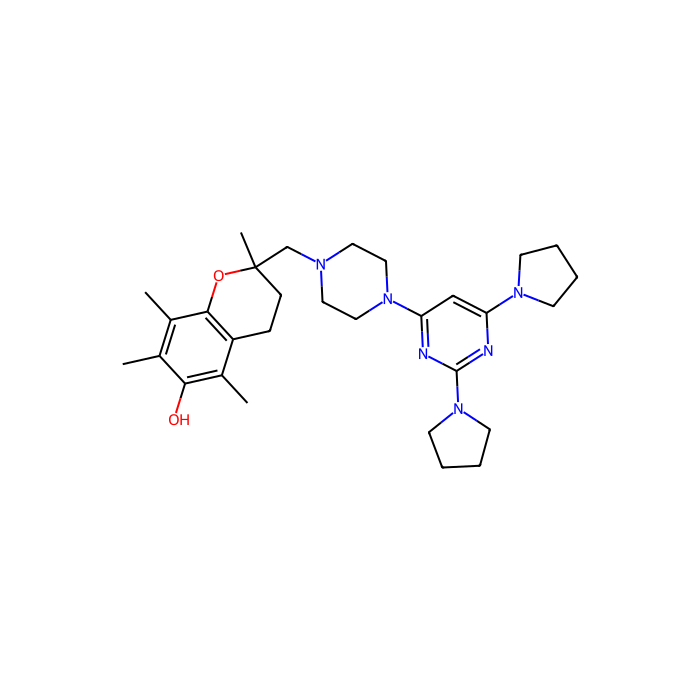
U-83836E - ≥98% , CAS No.122003-11-6

CAS: 122003-11-6 Cat. No.: U275768 Formula: C30H44N6O2.2HCl Peso molecolare: 593.63 PubChem CID: 5624
Disponibile su ordine
QUALITÀ & PUREZZA ≥98%
Synonyms
2-[[4-(2,6-Dipyrrolidin-1-ylpyrimidin-4-yl)piperazin-1-yl]methyl]-2,5,7,8-tetramethyl-3,4-dihydrochromen-6-oldihydrochloride
Storage
Store at -20°C,Desiccated
Shipped In
Ice chest + Ice pads
★
Dimensione
Germania (EU)
USA*
Prezzo
Qtà
100mg
U275768-100mg
Su ordinazione · 8–12 settimane
145,69€
Enter a quantity for the sizes you want to add.

Panoramica

Store at -20°C. Store under desiccating conditions. The product can be stored for up to 12 months.

Specifiche

Sinonimi
2-[[4-(2,6-Dipyrrolidin-1-ylpyrimidin-4-yl)piperazin-1-yl]methyl]-2,5,7,8-tetramethyl-3,4-dihydrochromen-6-oldihydrochloride
Specifiche e purezza
≥98%
Meccanismi biochimici e fisiologici
Lazaroid antioxidant, a steroid compound that inhibits lipid peroxidation. Inhibits cell proliferation (IC 50 = 6.30 mM). Potent free radical scavenger. Significantly protects against LPS induced lethality.
Condizioni di conservazione di stoccaggio
Store at -20°C,Desiccated
Spedito in
Ice chest + Ice pads
Questo prodotto richiede spedizione a catena fredda. I servizi di terra e altri servizi economici non sono disponibili.
Nota
Wherever possible, you should prepare and use solutions on the same day. However, if you need to make up stock solutions in advance, we recommend that you store the solution as aliquots in tightly sealed vials at -20°C. Generally, these will be useable for up to one month. Before use, and prior to opening the vial we recommend that you allow your product to equilibrate to room temperature for at least 1 hour. Need more advice on solubility, usage and handling? Please visit our frequently asked questions (FAQ) page for more details.
Purezza
≥98%
Nomi e identificatori
Sorrisi canonici
CC1=C(C2=C(CCC(O2)(C)CN3CCN(CC3)C4=NC(=NC(=C4)N5CCCC5)N6CCCC6)C(=C1O)C)C
IUPAC Name
2-[[4-(2,6-dipyrrolidin-1-ylpyrimidin-4-yl)piperazin-1-yl]methyl]-2,5,7,8-tetramethyl-3,4-dihydrochromen-6-ol
InChIKey
KPZQRBACZSLMPH-UHFFFAOYSA-N
INCHI
1S/C30H44N6O2/c1-21-22(2)28-24(23(3)27(21)37)9-10-30(4,38-28)20-33-15-17-35(18-16-33)26-19-25(34-11-5-6-12-34)31-29(32-26)36-13-7-8-14-36/h19,37H,5-18,20H2,1-4H3
Isomeri SMILES
CC1=C(C2=C(CCC(O2)(C)CN3CCN(CC3)C4=NC(=NC(=C4)N5CCCC5)N6CCCC6)C(=C1O)C)C
PubChem CID
5624
Peso molecolare
593.63

Dati avanzati

Taxonomic Classification

Taxonomy Tree

KingdomOrganic compounds
SuperclassOrganoheterocyclic compounds
ClasseDiazinanes
SubclassPiperazines
Intermediate Tree Nodes Not available
Direct ParentN-arylpiperazines
Alternative Parents 1-benzopyrans  Dialkylarylamines  N-alkylpiperazines  Aralkylamines  Aminopyrimidines and derivatives  Alkyl aryl ethers  Imidolactams  Benzenoids  Pyrrolidines  Heteroaromatic compounds  Trialkylamines  Oxacyclic compounds  Azacyclic compounds  Organopnictogen compounds  Hydrocarbon derivatives  
Molecular FrameworkAromatic heteropolycyclic compounds
Substituents N-arylpiperazine - Chromane - Benzopyran - 1-benzopyran - Dialkylarylamine - Alkyl aryl ether - Aminopyrimidine - N-alkylpiperazine - Aralkylamine - Imidolactam - Benzenoid - Pyrimidine - Heteroaromatic compound - Pyrrolidine - Tertiary aliphatic amine - Tertiary amine - Oxacycle - Azacycle - Ether - Hydrocarbon derivative - Organonitrogen compound - Organooxygen compound - Organic oxygen compound - Organic nitrogen compound - Amine - Organopnictogen compound - Aromatic heteropolycyclic compound
DescrizioneThis compound belongs to the class of organic compounds known as n-arylpiperazines. These are organic compounds containing a piperazine ring where the nitrogen ring atom carries an aryl group.
External Descriptors Not available
Struttura 3D
Modello di struttura chimica interattiva


Obiettivi associati (umani)
PDE5A Tclin Phosphodiesterase 5A (5113 Activities)
Activity TypeRelationActivity valueUnitsAction TypeJournalPubMed IddoiAssay Aladdin ID
EGFR Tclin Epidermal growth factor receptor erbB1 (33727 Activities)
Activity TypeRelationActivity valueUnitsAction TypeJournalPubMed IddoiAssay Aladdin ID
CA2 Tclin Carbonic anhydrase II (17698 Activities)
Activity TypeRelationActivity valueUnitsAction TypeJournalPubMed IddoiAssay Aladdin ID
ESR1 Tclin Estrogen receptor alpha (17718 Activities)
Activity TypeRelationActivity valueUnitsAction TypeJournalPubMed IddoiAssay Aladdin ID
HMGCR Tclin HMG-CoA reductase (2475 Activities)
Activity TypeRelationActivity valueUnitsAction TypeJournalPubMed IddoiAssay Aladdin ID
NR3C1 Tclin Glucocorticoid receptor (14987 Activities)
Activity TypeRelationActivity valueUnitsAction TypeJournalPubMed IddoiAssay Aladdin ID
INSR Tclin Insulin receptor (5558 Activities)
Activity TypeRelationActivity valueUnitsAction TypeJournalPubMed IddoiAssay Aladdin ID
PGR Tclin Progesterone receptor (8562 Activities)
Activity TypeRelationActivity valueUnitsAction TypeJournalPubMed IddoiAssay Aladdin ID
ADRB2 Tclin Beta-2 adrenergic receptor (11824 Activities)
Activity TypeRelationActivity valueUnitsAction TypeJournalPubMed IddoiAssay Aladdin ID
CHRM2 Tclin Muscarinic acetylcholine receptor M2 (10671 Activities)
Activity TypeRelationActivity valueUnitsAction TypeJournalPubMed IddoiAssay Aladdin ID
ADRB1 Tclin Beta-1 adrenergic receptor (6630 Activities)
Activity TypeRelationActivity valueUnitsAction TypeJournalPubMed IddoiAssay Aladdin ID
HTR1A Tclin Serotonin 1a (5-HT1a) receptor (14969 Activities)
Activity TypeRelationActivity valueUnitsAction TypeJournalPubMed IddoiAssay Aladdin ID
ADRA2A Tclin Alpha-2a adrenergic receptor (9450 Activities)
Activity TypeRelationActivity valueUnitsAction TypeJournalPubMed IddoiAssay Aladdin ID
AR Tclin Androgen Receptor (11781 Activities)
Activity TypeRelationActivity valueUnitsAction TypeJournalPubMed IddoiAssay Aladdin ID
CHRM1 Tclin Muscarinic acetylcholine receptor M1 (12690 Activities)
Activity TypeRelationActivity valueUnitsAction TypeJournalPubMed IddoiAssay Aladdin ID
ACE Tclin Angiotensin-converting enzyme (1423 Activities)
Activity TypeRelationActivity valueUnitsAction TypeJournalPubMed IddoiAssay Aladdin ID
DRD2 Tclin Dopamine D2 receptor (23596 Activities)
Activity TypeRelationActivity valueUnitsAction TypeJournalPubMed IddoiAssay Aladdin ID
MAOA Tclin Monoamine oxidase A (11911 Activities)
Activity TypeRelationActivity valueUnitsAction TypeJournalPubMed IddoiAssay Aladdin ID
CNR1 Tclin Cannabinoid CB1 receptor (20913 Activities)
Activity TypeRelationActivity valueUnitsAction TypeJournalPubMed IddoiAssay Aladdin ID
DRD1 Tclin Dopamine D1 receptor (9720 Activities)
Activity TypeRelationActivity valueUnitsAction TypeJournalPubMed IddoiAssay Aladdin ID
DRD4 Tchem Dopamine D4 receptor (7907 Activities)
Activity TypeRelationActivity valueUnitsAction TypeJournalPubMed IddoiAssay Aladdin ID
ACHE Tclin Acetylcholinesterase (18204 Activities)
Activity TypeRelationActivity valueUnitsAction TypeJournalPubMed IddoiAssay Aladdin ID
PTGS1 Tclin Cyclooxygenase-1 (9233 Activities)
Activity TypeRelationActivity valueUnitsAction TypeJournalPubMed IddoiAssay Aladdin ID
SLC6A2 Tclin Norepinephrine transporter (10102 Activities)
Activity TypeRelationActivity valueUnitsAction TypeJournalPubMed IddoiAssay Aladdin ID
HRH2 Tclin Histamine H2 receptor (5428 Activities)
Activity TypeRelationActivity valueUnitsAction TypeJournalPubMed IddoiAssay Aladdin ID
ADRA1D Tclin Alpha-1d adrenergic receptor (4171 Activities)
Activity TypeRelationActivity valueUnitsAction TypeJournalPubMed IddoiAssay Aladdin ID
HTR1B Tclin Serotonin 1b (5-HT1b) receptor (2801 Activities)
Activity TypeRelationActivity valueUnitsAction TypeJournalPubMed IddoiAssay Aladdin ID
HTR2A Tclin Serotonin 2a (5-HT2a) receptor (14758 Activities)
Activity TypeRelationActivity valueUnitsAction TypeJournalPubMed IddoiAssay Aladdin ID
HTR2C Tclin Serotonin 2c (5-HT2c) receptor (11471 Activities)
Activity TypeRelationActivity valueUnitsAction TypeJournalPubMed IddoiAssay Aladdin ID
ADORA1 Tclin Adenosine A1 receptor (17603 Activities)
Activity TypeRelationActivity valueUnitsAction TypeJournalPubMed IddoiAssay Aladdin ID
CALCR Tclin Calcitonin receptor (2215 Activities)
Activity TypeRelationActivity valueUnitsAction TypeJournalPubMed IddoiAssay Aladdin ID
SLC6A4 Tclin Serotonin transporter (12625 Activities)
Activity TypeRelationActivity valueUnitsAction TypeJournalPubMed IddoiAssay Aladdin ID
ADRA1A Tclin Alpha-1a adrenergic receptor (8359 Activities)
Activity TypeRelationActivity valueUnitsAction TypeJournalPubMed IddoiAssay Aladdin ID
PTGS2 Tclin Cyclooxygenase-2 (13999 Activities)
Activity TypeRelationActivity valueUnitsAction TypeJournalPubMed IddoiAssay Aladdin ID
HRH1 Tclin Histamine H1 receptor (7573 Activities)
Activity TypeRelationActivity valueUnitsAction TypeJournalPubMed IddoiAssay Aladdin ID
ADRA1B Tclin Alpha-1b adrenergic receptor (2912 Activities)
Activity TypeRelationActivity valueUnitsAction TypeJournalPubMed IddoiAssay Aladdin ID
OPRM1 Tclin Mu opioid receptor (19785 Activities)
Activity TypeRelationActivity valueUnitsAction TypeJournalPubMed IddoiAssay Aladdin ID
DRD3 Tclin Dopamine D3 receptor (14368 Activities)
Activity TypeRelationActivity valueUnitsAction TypeJournalPubMed IddoiAssay Aladdin ID
AVPR1A Tclin Vasopressin V1a receptor (5412 Activities)
Activity TypeRelationActivity valueUnitsAction TypeJournalPubMed IddoiAssay Aladdin ID
OPRD1 Tclin Delta opioid receptor (15096 Activities)
Activity TypeRelationActivity valueUnitsAction TypeJournalPubMed IddoiAssay Aladdin ID
OPRK1 Tclin Kappa opioid receptor (16155 Activities)
Activity TypeRelationActivity valueUnitsAction TypeJournalPubMed IddoiAssay Aladdin ID
SLC6A3 Tclin Dopamine transporter (10535 Activities)
Activity TypeRelationActivity valueUnitsAction TypeJournalPubMed IddoiAssay Aladdin ID
KCNH2 Tclin HERG (29587 Activities)
Activity TypeRelationActivity valueUnitsAction TypeJournalPubMed IddoiAssay Aladdin ID
HTR4 Tclin Serotonin 4 (5-HT4) receptor (2068 Activities)
Activity TypeRelationActivity valueUnitsAction TypeJournalPubMed IddoiAssay Aladdin ID
ESR2 Tclin Estrogen receptor beta (9272 Activities)
Activity TypeRelationActivity valueUnitsAction TypeJournalPubMed IddoiAssay Aladdin ID
CYSLTR1 Tclin Cysteinyl leukotriene receptor 1 (2118 Activities)
Activity TypeRelationActivity valueUnitsAction TypeJournalPubMed IddoiAssay Aladdin ID
ERBB2 Tclin Receptor protein-tyrosine kinase erbB-2 (7851 Activities)
Activity TypeRelationActivity valueUnitsAction TypeJournalPubMed IddoiAssay Aladdin ID
CHRM4 Tclin Muscarinic acetylcholine receptor M4 (6041 Activities)
Activity TypeRelationActivity valueUnitsAction TypeJournalPubMed IddoiAssay Aladdin ID
CHRM5 Tclin Muscarinic acetylcholine receptor M5 (4677 Activities)
Activity TypeRelationActivity valueUnitsAction TypeJournalPubMed IddoiAssay Aladdin ID
ADRA2B Tclin Alpha-2b adrenergic receptor (4412 Activities)
Activity TypeRelationActivity valueUnitsAction TypeJournalPubMed IddoiAssay Aladdin ID
Obiettivi associati (non umani)
Agtr2 Angiotensin II type 2 (AT-2) receptor (803 Activities)
Activity TypeRelationActivity valueUnitsAction TypeJournalPubMed IddoiAssay Aladdin ID
Mc4r Melanocortin receptor 4 (1205 Activities)
Activity TypeRelationActivity valueUnitsAction TypeJournalPubMed IddoiAssay Aladdin ID
Ltc4s Leukotriene C4 synthase (1 Activities)
Activity TypeRelationActivity valueUnitsAction TypeJournalPubMed IddoiAssay Aladdin ID
Sigmar1 Sigma opioid receptor (160 Activities)
Activity TypeRelationActivity valueUnitsAction TypeJournalPubMed IddoiAssay Aladdin ID
Npy1r Neuropeptide Y receptor type 1 (8 Activities)
Activity TypeRelationActivity valueUnitsAction TypeJournalPubMed IddoiAssay Aladdin ID
Cckar Cholecystokinin A receptor (90 Activities)
Activity TypeRelationActivity valueUnitsAction TypeJournalPubMed IddoiAssay Aladdin ID
Nos2 Nitric oxide synthase, inducible (3573 Activities)
Activity TypeRelationActivity valueUnitsAction TypeJournalPubMed IddoiAssay Aladdin ID
Mapk1 MAP kinase ERK2 (650 Activities)
Activity TypeRelationActivity valueUnitsAction TypeJournalPubMed IddoiAssay Aladdin ID
Mmp9 Matrix metalloproteinase 9 (38 Activities)
Activity TypeRelationActivity valueUnitsAction TypeJournalPubMed IddoiAssay Aladdin ID
Trypanosoma cruzi (99888 Activities)
Activity TypeRelationActivity valueUnitsAction TypeJournalPubMed IddoiAssay Aladdin ID
Meccanismi d'azione
Certificati (CoA, COO, BSE/TSE e tabella di analisi)
C of A & Other Certificates(BSE/TSE, COO):
Analytical Chart:
Proprietà chimiche e fisiche
SolubilitàSoluble in water to 50 mM and in ethanol to 75 mM
Peso molecolare520.700 g/mol
XLogP35.400
Hydrogen Bond Donor Count1
Hydrogen Bond Acceptor Count8
Rotatable Bond Count5
Exact Mass520.353 Da
Monoisotopic Mass520.353 Da
Topological Polar Surface Area68.200 Ų
Heavy Atom Count38
Formal Charge0
Complexity783.000
Isotope Atom Count0
Defined Atom Stereocenter Count0
Undefined Atom Stereocenter Count1
Defined Bond Stereocenter Count0
Undefined Bond Stereocenter Count0
The total count of all stereochemical bonds0
Covalently-Bonded Unit Count1
Calcolatori di soluzioni
Recensioni

Recensioni dei clienti

Application Protocols

No vendor-validated protocols are provided for this item. The following are general best practices for preparing and using small-molecule research reagents:

  • Stock solution preparation: If soluble, prepare a concentrated stock in anhydrous DMSO or MeCN under dry conditions. Filter through 0.22 µm PTFE if particulate is present. Record exact concentration by weight and volume; verify by UV or quantitative NMR when needed.
  • Aliquoting: Dispense into single-use aliquots to avoid repeated freeze–thaw. Label with concentration, solvent, date, and lot number.
  • Assay dilution: Add stock to buffered systems slowly with vigorous mixing to avoid local supersaturation and precipitation. Keep final organic solvent ≤0.1–1% v/v unless validated.
  • Stability checks: Reassess solution integrity by LC–MS after storage or exposure to assay conditions. Replace stocks that show new peaks or color changes.
  • Documentation: Retain CoA, SDS, and any in-house analytical confirmations with your ELN entry for traceability.

For application-specific SOPs (e.g., enzymatic inhibition, cell-based assays), develop method parameters based on your system’s performance characteristics and confirm the absence of assay artifacts.

Biological Roles

Specific biological functions or targets for U-83836E are not provided in this listing. As such, no item-specific mechanistic or pathway annotations can be made here.

General guidance for small-molecule research tools:

  • If the compound is employed as a probe or modulator, validate activity in your biological system with orthogonal assays and concentration–response curves, including counterscreens for assay interference (fluorescence quenching, redox cycling, aggregation).
  • Consider physicochemical liabilities that drive bioavailability in vitro: solubility limits, nonspecific binding to serum proteins or plastics, and chemical instability in buffers (hydrolysis, oxidation). Conduct stability-indicating LC–MS in the exact media and temperature used.
  • If stereochemistry is relevant, assess enantiopurity and potential racemization over storage or in biological matrices.
  • For cell-based work, maintain solvent carrier (e.g., DMSO) below 0.1–0.5% v/v to limit cytotoxic or signaling artifacts, unless your assay validates higher levels.

Note: This product is for research use only and is not intended for diagnostic, therapeutic, or in vivo clinical applications. Consult the CoA and SDS for any additional handling constraints before introducing into biological systems.

Buffer Applications

This product is not presented as a buffering agent, and no acid–base parameters (pKa values or buffering ranges) are provided. Therefore, buffer formulation guidance is not typically applicable.

  • If the compound must be dissolved into buffers for assays, first establish its ionization profile (if available) and stability across pH 2–10.
  • Use minimal organic co-solvent (e.g., ≤0.1–1% DMSO/MeCN) and confirm absence of precipitation upon dilution into the buffer or media.
  • For long incubations, verify chemical stability in the selected buffer by time-course LC–MS.
Green Alternatives

Item-specific function is not disclosed in this listing, so green substitution must be guided by your intended use (solvent, reagent, reference standard). Below are general strategies to reduce environmental impact while maintaining performance.

  • If using as a solvent or solvent component:
    • Prefer bio-based or safer solvents when performance allows: 2-methyltetrahydrofuran (2-MeTHF), cyclopentyl methyl ether (CPME), dimethyl carbonate (DMC), propylene carbonate (PC), ethyl acetate, ethanol.
    • Replace chlorinated solvents (DCM, chloroform) where possible with EtOAc/Heptane, MeTHF, or toluene/MeCN mixtures.
  • If using as a reagent or standard:
    • Minimize scale and waste; design high-atom-economy protocols; apply in-line or at-line analytics to avoid overprocessing.
    • Use catalytic versus stoichiometric alternatives when feasible.

Compact comparison (general guidance):

  • 2-MeTHF vs THF: Similar solvency; 2-MeTHF offers higher hydrophobicity and partial water immiscibility, facilitating extractions; often from renewable feedstocks. Trade-off: broader peroxide concerns and variable odor.
  • CPME vs Et2O/THF: Low peroxide formation rate and wider liquid range; good for azeotropic drying. Trade-off: may require longer reaction times in polar reactions.

Implement closed-loop solvent recovery, segregate halogenated waste, and quantify E-factors to benchmark improvements.

Pharmaceutical Uses

No pharmacopeial status, excipient role, or GMP applicability is provided for this listing. The material is sold strictly for research use only.

General considerations (non-clinical, pre-formulation context):

  • If used as a discovery-stage tool compound, evaluate solid-state form (salt, polymorph, solvate) as these can influence solubility and stability in screening cascades.
  • For non-clinical formulations (in vitro or exploratory in vivo research only), typical vehicles include PEG400, captisol, polysorbate-containing systems, or lipid vehicles—selection depends on the compound’s solubility and stability profile. Establish compatibility independently.
  • Avoid implying therapeutic use. Any scale-up, GMP manufacturing, or IND-enabling activities require fully qualified materials and documentation beyond the scope of this research-only product.
Physical Properties

Item-specific physical constants were not provided for this listing. Where exact values are required, consult the CoA/Spec Sheet for the shipped lot.

  • Appearance: Not specified for this item; refer to CoA/Spec Sheet.
  • Purity/Grade: Not specified for this item; refer to CoA/Spec Sheet.
  • Melting point (MP): Not specified for this item; refer to CoA/Spec Sheet.
  • Boiling point (BP): Not specified for this item; refer to CoA/Spec Sheet.
  • Density: Not specified for this item; refer to CoA/Spec Sheet.
  • Refractive index: Not specified for this item; refer to CoA/Spec Sheet.
  • Solubility: Not specified for this item; refer to CoA/Spec Sheet.
  • logP/logD, pKa: Not specified for this item; refer to CoA/Spec Sheet.

Practical characterization guidance (general, literature-style approach):

  • Solubility screening: Evaluate in small volumes of common analytical-grade solvents at RT (e.g., DMSO, DMF, MeCN, MeOH, EtOH, water, phosphate buffer), escalating gentle heat (≤40–50°C) and sonication as appropriate. Record clarity and stability over 24–48 h.
  • Hygroscopicity: Item ships desiccated; treat as potentially moisture sensitive. Assess mass gain vs. %RH if accurate dosing is critical.
  • Thermal profile: If no MP is available, perform a small-scale DSC/TGA to understand onset of thermal events and guideline storage temperatures.
  • Spectral fingerprints: Acquire 1H/13C NMR, LC–MS, and IR to confirm identity and assess impurities prior to critical use.
Quality and Grades
  • Grade/Purity: Not specified for this item; refer to CoA/Spec Sheet.

Interpreting typical grades (general guidance):

  • Research/Biochemical grade: Suitable for most chemical biology and discovery applications; impurity thresholds vary by supplier. Check CoA for related substances and residual solvents.
  • Analytical/Reagent (AR) grade: Tight limits on inorganic/organic impurities for routine analytical work but not necessarily low-UV background.
  • HPLC/LC–MS grade solvents or reagents: Formulated or qualified for low UV background and LC–MS compatibility (volatile buffers, low trace metals); applicable only if explicitly stated on item CoA.
  • High-purity/≥98–99%: Indicates assay by HPLC/GC/NMR; verify method and reference standard.

What is specific to this listing:

  • No stabilizers, inhibitors, or salt form are specified in the product data. If the compound is known to require an antioxidant, base, or hydrate control, those details will be provided in the CoA/SDS for the shipped lot.
  • For trace analyses (metals, water, residual solvents), exact specification limits are not stated here. Use the CoA for quality release criteria and to set method suitability for regulated workflows.
Reaction and Applications

Manufacturer-supplied application details for this specific code are not provided. The compound is offered for research use; typical use-cases may include chemical biology studies, analytical method development, or as a reference standard depending on the end user’s protocol.

General considerations for small-molecule research reagents:

  • Identity and purity verification: Confirm by LC–MS and 1H/13C NMR upon receipt, especially when material will be used in SAR, mechanistic, or quantitative assays.
  • Stock preparation: If soluble, prepare concentrated anhydrous DMSO or MeCN stocks, aliquot, and store at −20°C to minimize freeze–thaw and hydrolysis.
  • Adsorption/instability: If the molecule is lipophilic or amphiphilic, surface adsorption to plastics can occur at low µM; use low-bind polypropylene or glass vials. Track degradation by LC–MS over storage time.
  • Assay interference: Screen for optical interference (UV/fluorescence) and redox reactivity if using reporter-based assays; include orthogonal readouts where feasible.
  • Reference control: If a literature identity exists (via CAS), consult peer-reviewed sources to understand known reactivity, stability, or biochemical behaviors. Validate against your specific buffer and temperature conditions.

Note: In the absence of item-specific mechanistic roles, users should develop fit-for-purpose controls and matrix blanks to ensure data quality.

Reaction Conditions

No reaction condition set-points are provided for this item. Without structural information, recommending specific catalysts, temperatures, or solvents would be speculative.

General guidance for method development when handling unknown or new small molecules:

  • Start with neutral to mildly basic conditions for solution manipulations unless literature indicates acid/base sensitivity.
  • Use anhydrous, oxygen-free conditions if the material appears air/moisture sensitive (ships desiccated), purging vessels with nitrogen/argon and employing dry solvents.
  • Temperature: Begin at ambient and increase cautiously while monitoring by TLC/LC–MS. Employ jacketed reactors or parallel screening blocks for condition scouting.
  • Monitoring: Prefer LC–MS for rapid assessment of conversion and byproducts; complement with 1H NMR for mass balance.
  • Workup: To avoid losses, consider solid-phase extraction or minimal-aqueous workups if the compound is highly polar or water-unstable.

Expected yields and times: Not applicable—consult primary literature tied to the CAS and confirm the structure and context before adopting reported conditions.

Safety and Handling

GHS safety elements are not provided in this listing. Always consult the product SDS for authoritative hazard classification and first-aid guidance.

  • Signal word: Not specified for this item; refer to SDS.
  • Hazard statements (H-codes): Not specified for this item; refer to SDS.
  • Pictograms/GHS classification: Not specified for this item; refer to SDS.

General laboratory precautions (good practice):

  • PPE: Lab coat, safety glasses or splash goggles, and appropriate chemically resistant gloves. Use a certified chemical fume hood when handling powders, volatile solvents, or during weighing and solution preparation.
  • Incompatibilities: Unknown for this item; until confirmed, avoid strong oxidizers/reductants, strong acids/bases, and reactive metals. Do not heat in closed systems. Prevent contact with moisture if the item is moisture sensitive (ships desiccated).
  • First-aid overview: Inhalation—move to fresh air; Skin/Eye—flush with water for ≥15 min; Ingestion—rinse mouth, seek medical attention. Provide responders the SDS.
  • Spill response: Avoid dust formation and aerosolization. Absorb with inert material, collect in appropriate waste. Decontaminate surfaces with compatible solvent/detergent.
  • Waste: Dispose per local regulations for organic chemical waste. Segregate halogenated vs non-halogenated if applicable.

Note: This product is for research use only. No food, drug, cosmetic, or household use.

Solvent Selection

Solubility and polarity data are not specified for this item. The guidance below describes a practical workflow to identify a suitable solvent system for handling, stock solutions, and reactions.

  • Initial screen (analytical grade): DMSO, DMF, MeCN, MeOH, EtOH, isopropanol, acetone, ethyl acetate, dichloromethane, toluene, and water/buffer (pH 2–10). Start with 5–10 mg/mL targets at room temperature; apply gentle warming and brief sonication if needed.
  • Moisture sensitivity: Item is shipped desiccated; prioritize anhydrous solvents (DMSO-d6, anhydrous MeCN, dry EtOAc, dry THF) and work under dry nitrogen/argon if material shows clumping or deliquescence.
  • pH adjustment: If ionizable, modest pH shifts can dramatically alter aqueous solubility. Prepare acidic or basic aqueous co-solvent systems (e.g., 0.1% TFA in water/MeCN; 0.1% NH4OH in water/MeOH) as appropriate.
  • Co-solvent strategies: For bioassays, prepare concentrated DMSO stocks (e.g., 10–100 mM), then dilute into assay media to ≤0.1–1% DMSO v/v to minimize solvent effects.
  • Filtration: Use 0.22 µm PTFE/nylon filters; avoid cellulose nitrate for aggressive solvents. Warm solutions may reduce microprecipitation.

Comparison notes (general):

  • DMSO offers widest solubilization but can interfere in some screens; MeCN and MeOH provide lower viscosity and faster evaporation; EtOAc/DCM/toluene are useful for extractions and nonpolar matrices but are often unsuitable for aqueous assay dilution.
Storage and Reconstitution

Storage conditions for this item are specified by the supplier.

  • Supplier storage guidance (item-specific): Store at −20°C, desiccated.
  • Shipping condition (item-specific): Shipped in ice chest with ice pads.

Best practices:

  • Primary container: Keep tightly sealed in original container with desiccant. Purge headspace with dry inert gas after each use if feasible.
  • Light and moisture protection: Store in the dark and protect from ambient humidity. Allow container to equilibrate to room temperature before opening to prevent condensation.
  • Reconstitution: Solvent choice is not specified; screen compatible solvents (e.g., anhydrous DMSO, MeCN, alcohols, or buffer systems) at small scale. Use glass vials for aggressive solvents. Record exact solvent, concentration, and date.
  • Aliquoting and freeze–thaw: Prepare single-use aliquots of stock solutions and return immediately to −20°C. Avoid repeated freeze–thaw cycles.
  • Shelf life: Not specified for this item; monitor by LC–MS/NMR for degradation on a defined interval (e.g., monthly for solutions, quarterly for solids) and discard if impurity growth is observed.

Always refer to the lot-specific CoA and SDS for any additional constraints (e.g., known hydrolysis or oxidation liabilities, recommended diluents).

Structure and Identity

Overview for SKU U275768 (U-83836E). Due to limited item-specific data on this listing, structural identifiers are not fully disclosed here. Refer to the CoA/Spec Sheet or SDS for definitive structural information.

  • Product name: U-83836E (research chemical)
  • CAS: 122003-11-6
  • PubChem CID: 5624 (literature identifier; confirm against CoA)
  • Molecular formula: Not specified for this item; refer to CoA/Spec Sheet.
  • Molecular weight: Not specified for this item; refer to CoA/Spec Sheet.
  • SMILES: Not specified for this item; refer to CoA/Spec Sheet.
  • InChIKey: Not specified for this item; refer to CoA/Spec Sheet.

Structural features (general guidance):

  • Functional groups, ring systems, and stereochemistry are not provided in the current product data. If you require precise structural attributes (e.g., heterocycles, aromatic systems, chiral centers), consult the Certificate of Analysis or the manufacturer’s specification sheet linked to this lot.

2D/descriptor narrative:

  • Without the structural string (SMILES/InChI), a descriptive 2D summary cannot be provided here. If you plan analytical identity verification (NMR, LC–MS, HRMS), we recommend cross-referencing with authenticated spectral libraries and the CoA values for chemical shift, exact mass, and retention behavior.
Synthetic Utility

Synthetic transformation roles for U-83836E cannot be detailed without a disclosed structure. No functional group information is provided in this listing.

General strategy if used as an intermediate or reference standard:

  • Verify identity and potency of the lot by orthogonal analytics (LC–MS, NMR) before entering multistep sequences.
  • If derivatization is intended, first map reactive handles via small-scale scouting (e.g., electrophile/nucleophile tests, stability to acids/bases/oxidants/reductants) to understand compatibility windows.
  • For impurity profiling, conduct stress studies (acid/base, oxidative, thermal, photolytic) to identify potential degradants and to design purification solutions.

Where synthetic elaboration is required, gather primary literature by CAS and confirm that reported procedures match spectral data for this exact substance and salt/form.

Target Specificity

This product is not an antibody or biological affinity reagent in this listing, and no target binding data are provided.

  • Antigen/epitope: Not applicable.
  • Species reactivity, clone, isotype: Not applicable.

If the compound is intended as a biochemical probe, target engagement and selectivity must be established empirically in your system using appropriate controls (inactive analogs, counterscreens, CETSA/DSF, SPR/ITC, enzymology as relevant). No target-specific claims are made here.

Domande frequenti

What is the purity of this product?
This product is supplied at ≥98% purity (chemical assay). Lot-specific values are stated on the Certificate of Analysis.
How should this product be stored?
Store at ?20 °C, desiccated. Keep the container tightly closed with desiccant — the material is moisture-sensitive.
How is this product shipped?
This product ships in an insulated container with ice pads. Unpack on arrival and transfer it to the storage condition stated above.
What are the CAS number, molecular formula and molecular weight?
The CAS Number is 122003-11-6, the molecular formula is C30H44N6O2.2HCl, and the molecular weight is 593.63 g/mol. InChIKey KPZQRBACZSLMPH-UHFFFAOYSA-N.
What documentation is provided?
Available product documentation, including Certificates of Analysis (COA), Safety Data Sheets (SDS), and specification sheets, is shown in the product document area. Document availability and access follow the current site policy.

Desidera che le inviamo un messaggio quando avremo sconti disponibili?

Ricordamelo più tardi

Grazie! Controlli la sua casella di posta per confermare.

Ops! Le notifiche sono disabilitate.