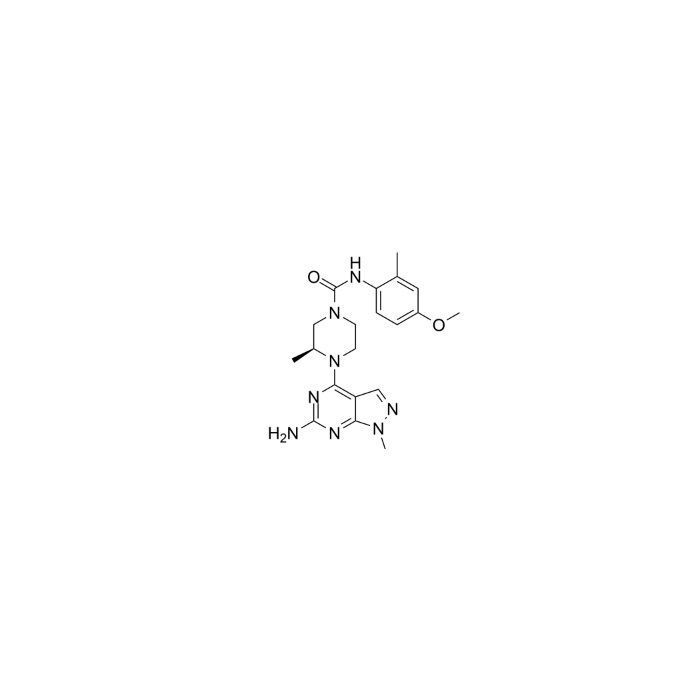
UCB9608 - Moligand™,≥98% , CAS No.1616413-96-7

CAS: 1616413-96-7 Cat. No.: U412144 Formula: C20H26N8O2 Peso molecolare: 410.47
Disponibile su ordine
QUALITÀ & PUREZZA Moligand™ ? Moligand™ — Aladdin's line of ligands and bioactive small molecules. Use for receptor, pathway, and binding studies needing defined small-molecule tools. ≥98%
Synonyms
1-​Piperazinecarboxamid​e,4-​(6-​amino-​1-​methyl-​1H-​pyrazolo[3,​4-​d]​pyrimidin-​4-​yl)​-​N-​(4-​methoxy-​2-​methylphenyl)​-​3-​methyl-​,(3S)​- | (S)-4-(6-Amino-1-methyl-1H-pyrazolo[3,4-d]pyrimidin-4-yl)-N-(4-methoxy-2-methylphenyl)-3-methylpiperazine-
Storage
Protected from light,Store at -20°C,Argon charged
Shipped In
Ice chest + Ice pads
★
Dimensione
Germania (EU)
USA*
Prezzo
Qtà
5mg
U412144-5mg
Su ordinazione · 8–12 settimane

39,83€

59,79€
Salva 19,96 € (33.38%)
25mg
U412144-25mg
Su ordinazione · 8–12 settimane

102,31€

153,50€
Salva 51,20 € (33.35%)
100mg
U412144-100mg
Su ordinazione · 8–12 settimane
260,23€
Enter a quantity for the sizes you want to add.
🧪
Perché questa qualità

Moligand™,≥98% Moligand™ per flussi di lavoro cromatografici e analitici sensibili che richiedono un'interferenza minima della linea di base.

🌡

Stoccaggio e spedizione

Protected from light,Store at -20°C,Argon charged Spedizione Ice chest + Ice pads. Consultare il COA specifico del lotto per le specifiche esatte.

📋

Documenti di qualità

SDS, COA, scheda tecnica e scheda delle specifiche disponibili per il download. COA specifico del lotto accessibile tramite ricerca per numero di lotto.

📚

Prova documentale

Citato in 0 pubblicazioni peer-reviewed su cromatografia, sintesi organica e reazioni di accoppiamento incrociato.

Panoramica

UCB9608 is a potent, selective PI4KIIIβ inhibitor, with an IC50 of 11 nM, selective over PI3KC2 α, β, and γ lipid kinases. UCB9608 improves metabolic stability and exhibits excellent pharmacokinetic profile, acts as a potent immunosuppressive agent.

Specifiche

Sinonimi
1-​Piperazinecarboxamid​e,4-​(6-​amino-​1-​methyl-​1H-​pyrazolo[3,​4-​d]​pyrimidin-​4-​yl)​-​N-​(4-​methoxy-​2-​methylphenyl)​-​3-​methyl-​,(3S)​- | (S)-4-(6-Amino-1-methyl-1H-pyrazolo[3,4-d]pyrimidin-4-yl)-N-(4-methoxy-2-methylphenyl)-3-methylpiperazine-
Specifiche e purezza
Moligand™,≥98%
Meccanismi biochimici e fisiologici
UCB9608 (compound 44) is a potent, selective and orally bioavailable inhibitor of PI4KIIIβ with IC50 of 11 nM. UCB9608 is a potent immunosuppressive agent that improves metabolic stability and exhibits excellent pharmacokinetic profile.
Condizioni di conservazione di stoccaggio
Protected from light,Store at -20°C,Argon charged
Spedito in
Ice chest + Ice pads
Questo prodotto richiede spedizione a catena fredda. I servizi di terra e altri servizi economici non sono disponibili.
Grado
Moligand™
Tipo di azione
INHIBITOR
Purezza
≥98%
Nomi e identificatori
Sorrisi canonici
CC1CN(CCN1C2=NC(=NC3=C2C=NN3C)N)C(=O)NC4=C(C=C(C=C4)OC)C
IUPAC Name
(3S)-4-(6-amino-1-methylpyrazolo[3,4-d]pyrimidin-4-yl)-N-(4-methoxy-2-methylphenyl)-3-methylpiperazine-1-carboxamide
InChIKey
WRONAJQPZWDYAR-ZDUSSCGKSA-N
INCHI
1S/C20H26N8O2/c1-12-9-14(30-4)5-6-16(12)23-20(29)27-7-8-28(13(2)11-27)18-15-10-22-26(3)17(15)24-19(21)25-18/h5-6,9-10,13H,7-8,11H2,1-4H3,(H,23,29)(H2,21,24,25)/t13-/m0/s1
Isomeri SMILES
C[C@H]1CN(CCN1C2=NC(=NC3=C2C=NN3C)N)C(=O)NC4=C(C=C(C=C4)OC)C
Peso molecolare
410.47

Documentazione

📋 Scheda di dati di sicurezza (SDS)

Documento completo su pericoli, manipolazione, stoccaggio e conformità normativa.

<<<<<<< HEAD Scarica SDS → ======= Scarica SDS → >>>>>>> release248-p3

✅ Certificato di analisi (COA)

Dati di qualità specifici del lotto. Inserisci il numero di lotto per recuperare il COA esatto.

Cerca COA →

📊 Scheda tecnica

Riepilogo di riferimento rapido delle specifiche e applicazioni del prodotto.

Visualizza scheda tecnica →

🔬 Scheda delle specifiche

Attributi di qualità completi e criteri di accettazione per questa qualità.

Visualizza scheda delle specifiche →

Dati avanzati

Taxonomic Classification

Taxonomy Tree

KingdomOrganic compounds
SuperclassOrganoheterocyclic compounds
ClasseDiazinanes
SubclassPiperazines
Intermediate Tree Nodes Not available
Direct ParentN-arylpiperazines
Alternative Parents N-phenylureas  Methoxyanilines  Pyrazolo[3,4-d]pyrimidines  Piperazine carboxamides  Anisoles  Dialkylarylamines  Methoxybenzenes  Phenoxy compounds  Toluenes  Alkyl aryl ethers  Aminopyrimidines and derivatives  Imidolactams  Heteroaromatic compounds  Pyrazoles  Ureas  Azacyclic compounds  Hydrocarbon derivatives  Carbonyl compounds  Organic oxides  Primary amines  
Molecular FrameworkAromatic heteropolycyclic compounds
Substituents N-arylpiperazine - N-phenylurea - Pyrazolo[3,4-d]pyrimidine - Piperazine-1-carboxamide - Methoxyaniline - Pyrazolopyrimidine - Phenoxy compound - Anisole - Phenol ether - Methoxybenzene - Dialkylarylamine - Alkyl aryl ether - Aminopyrimidine - Toluene - Monocyclic benzene moiety - Imidolactam - Pyrimidine - Benzenoid - Pyrazole - Heteroaromatic compound - Azole - Urea - Azacycle - Ether - Primary amine - Organooxygen compound - Organonitrogen compound - Hydrocarbon derivative - Carbonyl group - Organic nitrogen compound - Amine - Organic oxygen compound - Organic oxide - Aromatic heteropolycyclic compound
DescrizioneThis compound belongs to the class of organic compounds known as n-arylpiperazines. These are organic compounds containing a piperazine ring where the nitrogen ring atom carries an aryl group.
External Descriptors Not available
Struttura 3D
Modello di struttura chimica interattiva


Obiettivi associati (umani)
PI4KB Tchem Phosphatidylinositol 4-kinase beta (2 Activities)
Activity TypeActivity Value -log(M)Mechanism of ActionActivity ReferencePublications (PubMed IDs)
KCNH2 Tclin HERG (29587 Activities)
Activity TypeRelationActivity valueUnitsAction TypeJournalPubMed IddoiAssay Aladdin ID
PI4KB Tchem PI4-kinase beta subunit (1593 Activities)
Activity TypeRelationActivity valueUnitsAction TypeJournalPubMed IddoiAssay Aladdin ID
CYP3A4 Tclin Cytochrome P450 3A4 (53859 Activities)
Activity TypeRelationActivity valueUnitsAction TypeJournalPubMed IddoiAssay Aladdin ID
PIK3C2B Tchem Phosphatidylinositol-4-phosphate 3-kinase C2 domain-containing beta polypeptide (438 Activities)
Activity TypeRelationActivity valueUnitsAction TypeJournalPubMed IddoiAssay Aladdin ID
PIK3C2A Tchem Phosphatidylinositol-4-phosphate 3-kinase C2 domain-containing subunit alpha (139 Activities)
Activity TypeRelationActivity valueUnitsAction TypeJournalPubMed IddoiAssay Aladdin ID
Obiettivi associati (non umani)
Salmonella typhimurium (15756 Activities)
Activity TypeRelationActivity valueUnitsAction TypeJournalPubMed IddoiAssay Aladdin ID
Escherichia coli (133304 Activities)
Activity TypeRelationActivity valueUnitsAction TypeJournalPubMed IddoiAssay Aladdin ID
Mus musculus (284745 Activities)
Activity TypeRelationActivity valueUnitsAction TypeJournalPubMed IddoiAssay Aladdin ID
Meccanismi d'azione
Certificati (CoA, COO, BSE/TSE e tabella di analisi)
C of A & Other Certificates(BSE/TSE, COO):
Analytical Chart:

Find and download the COA for your product by matching the lot number on the packaging.

3 results found

Lot NumberCertificate TypeDataOggetto
I2604743I2604743Certificate of AnalysisMar 30, 2026 U412144
I2604744I2604744Certificate of AnalysisMar 30, 2026 U412144
I2604781I2604781Certificate of AnalysisMar 30, 2026 U412144
Proprietà chimiche e fisiche
SolubilitàSolubility (25°C) In vitro DMSO: 82 mg/mL (199.77 mM); Water: Insoluble; Ethanol: Insoluble;
Sensibilitàair sensitive
Peso molecolare410.500 g/mol
XLogP31.700
Hydrogen Bond Donor Count2
Hydrogen Bond Acceptor Count7
Rotatable Bond Count3
Exact Mass410.218 Da
Monoisotopic Mass410.218 Da
Topological Polar Surface Area114.000 Ų
Heavy Atom Count30
Formal Charge0
Complexity609.000
Isotope Atom Count0
Defined Atom Stereocenter Count1
Undefined Atom Stereocenter Count0
Defined Bond Stereocenter Count0
Undefined Bond Stereocenter Count0
The total count of all stereochemical bonds0
Covalently-Bonded Unit Count1
Calcolatori di soluzioni
Recensioni

Recensioni dei clienti

Application Protocols

No tested applications or recommended protocols are provided for this item.

General assay handling protocol (non-item-specific example for small molecules):

  • Stock preparation: Dissolve the compound in anhydrous DMSO to 10 mM under inert gas and minimal light. Vortex and, if needed, sonicate briefly. Filter through 0.22 µm PTFE if particulates remain.
  • Aliquoting: Dispense into single-use, amber vials or plate wells; purge headspace with argon or nitrogen. Store at −20°C protected from light.
  • Dosing: Thaw once, keep on ice and protected from light. Dilute into assay buffer to desired concentrations, maintaining constant final DMSO across all wells.
  • Controls: Include vehicle control and, where applicable, known actives. Run a serial dilution (e.g., 1:3 or 1:2) to generate a concentration–response curve.
  • Post-assay: Document lot number, stock age, and handling to aid in reproducibility.

For any specific protocol (WB, IF, IHC, FC, enzymatic assays, binding assays), consult internal SOPs and adapt based on your target biology. No item-specific conditions are provided here.

Biological Roles

No biological function, target, or pathway annotation is provided for UCB9608 in the Product Data. As supplied, it is a research-use-only small molecule intended for screening and discovery.

General considerations for small-molecule library members:

  • Potential roles can span enzyme inhibition/activation, receptor modulation, protein–protein interaction perturbation, or pathway probes; however, none are specified for this item.
  • If the structure becomes available, in silico profiling (substructure, similarity, PAINS/REOS filters, and chemotype alerts) can help prioritize assay selection and anticipate liabilities.
  • Orthogonal validation across biochemical and cellular contexts is recommended to distinguish on-target effects from assay interference (fluorescence/absorbance overlap, redox cycling, aggregation).

Assay design tips (general):

  • Implement counter-screens for fluorescence quenching/enhancement and colloidal aggregation (e.g., nonionic detergent controls, dynamic light scattering).
  • Titrate carefully to map potency and solubility ceilings; include DMSO-matched vehicle controls.
  • Confirm chemical stability under assay conditions (light, temperature, oxygen) due to the product’s light-protection and inert-atmosphere handling notes.

For any claim of biological activity, rely on your internal data, peer-reviewed literature tied to the exact CAS/CID, and the lot-specific CoA. No biological roles are specified for this item.

Buffer Applications

This product is a discrete small-molecule library member and is not a buffering agent. Accordingly, it has no standard role in preparing biochemical buffers.

Practical notes for assay buffers (general):

  • When dosing small-molecule stocks into buffers, maintain consistent final DMSO content across wells/samples.
  • Include nonionic surfactant (e.g., 0.01–0.05% Tween-20 or Pluronic F-127) if aggregation is suspected.
  • Use light-protective labware (amber tubes/plates) if the compound is light sensitive, as indicated by the storage instructions.

For buffer recipes, pH ranges, and ionic strengths, refer to standard buffering systems (PBS, HEPES, Tris, MOPS) relevant to your assay; none are specific to this item.

Green Alternatives

As UCB9608 is a discrete small-molecule library member rather than a commodity solvent or reagent, “green substitution” typically pertains to its handling solvents and workflows rather than replacement of the compound itself.

Greener handling considerations (general guidance):

  • Prefer aqueous-compatible assay formats with minimal DMSO (<0.5% v/v in final wells) to reduce organic solvent use.
  • Consider greener solvent choices for solution prep where feasible: ethanol or water with solubilizing excipients for compatible scaffolds, recognizing solubility/instability trade-offs.
  • Minimize waste by preparing small, single-use aliquots; avoid repeated thaw–freeze cycles that lead to disposal of degraded material.
  • Use amber polypropylene microtubes or glass vials with low extractables to reduce the need for repeat preparations due to adsorption losses.

Illustrative solvent comparison (general, not item-specific):

  • DMSO: Excellent solvating power; not particularly green, but low volatility reduces inhalation exposure; widely accepted in screening.
  • Ethanol/IPA: Greener, but may not dissolve hydrophobic or ionizable scaffolds well; volatile and can affect biological readouts at higher percentages.
  • Water + cyclodextrins/surfactants: Greenest matrix; requires formulation development and careful control experiments.

Because compound-specific environmental fate and hazard data are not provided, users should follow institutional green-chemistry policies and consult the SDS for disposal and hazard classification.

Pharmaceutical Uses

No excipient or manufacturing role is provided for this item. UCB9608 is supplied for research use only and is not intended for clinical, diagnostic, or therapeutic applications.

Context for discovery workflows (general):

  • Compounds like this may be evaluated in early discovery as chemical probes or leads; however, no pharmacopeial status, GMP compliance, or formulation specifications are provided for this item.
  • If formulating for in vivo research, ensure compliance with institutional and regulatory guidelines and establish full analytical characterization, stability, and impurity profiles independently. Such use falls outside the scope of this catalog listing.

Item-specific notes:

  • Pharmacopeia status: Not specified for this item; refer to CoA/Spec Sheet.
  • Residual solvent/elemental impurity limits: Not specified for this item; refer to CoA/Spec Sheet.
  • Acceptable daily exposure (ADE/PDE), safety qualification: Not applicable; research use only.
Physical Properties

Only item-specific facts from Product Data are listed; no physicochemical constants were provided for this compound.

  • Appearance: Not specified for this item; refer to CoA/Spec Sheet.
  • Physical state: Not specified for this item; refer to CoA/Spec Sheet.
  • Melting point: Not specified for this item; refer to CoA/Spec Sheet.
  • Boiling point: Not specified for this item; refer to CoA/Spec Sheet.
  • Density: Not specified for this item; refer to CoA/Spec Sheet.
  • Solubility: Not specified for this item; refer to CoA/Spec Sheet.
  • LogP/logD: Not specified for this item; refer to CoA/Spec Sheet.
  • pKa: Not specified for this item; refer to CoA/Spec Sheet.
  • Refractive index: Not applicable/unknown for solids; not specified here.
  • UV-Vis characteristics: Not specified for this item; refer to CoA/Spec Sheet.

Practical considerations (general guidance for library compounds):

  • Many screening molecules are formulated or dissolved in anhydrous DMSO at 10–50 mM for assay use. If the structure is amphiphilic or contains ionizable groups, co-solvents (e.g., DMF) or aqueous dilution with surfactant carriers may be required. Conduct a small solubility scout before preparing bulk stocks.
  • Protect from light per storage guidance; photolabile moieties (if present) may degrade under ambient light. Without structural details, treat as potentially light-sensitive.

Note: Where precise physical constants are required for experimental design (e.g., extinction coefficients, solubility limits), consult the lot-specific CoA/Spec Sheet or contact technical support with the CAS and SKU.

Quality and Grades
  • Grade/Purity: Moligand™ (as provided). While detailed specifications are not listed for this item, Moligand generally denotes small-molecule ligands intended for research screening and probe discovery workflows.

What Moligand-grade typically implies (general information):

  • Emphasis on suitability for biochemical/cellular screening and chemical biology assays.
  • Often supplied with identity confirmation (e.g., LC–MS, and/or NMR). For this specific item: Not specified; refer to CoA/Spec Sheet.
  • Purity threshold and residual solvent/metals: Not specified for this item; refer to CoA/Spec Sheet.
  • Counter-ions, salt form, and polymorph: Not specified for this item; refer to CoA/Spec Sheet.

Relevance of provided handling/packaging:

  • Storage under inert gas and light protection aligns with maintenance of chemical integrity for libraries containing potentially air- or light-sensitive motifs.
  • Cold shipment (ice chest + ice pads) supports stability during transit.

Best practices for quality verification (user-side):

  • Record appearance upon receipt and compare with CoA.
  • If critical, perform a quick-check LC–MS for mass confirmation and a single-point purity screen; verify absence of significant degradation after thaw/dilution.
  • For SAR studies, document lot number and maintain consistent solvent and dilution history to avoid confounding by peroxide/moisture uptake or photodecomposition.

All item-specific numerical specifications (purity %, residuals, water content, UV cutoff, etc.) are Not specified for this item; refer to CoA/Spec Sheet.

Reaction and Applications

This product is presented as a Moligand small-molecule library member intended for research and screening rather than as a synthetic reagent. Consequently, classical synthetic “reaction applications” (e.g., as a base, catalyst, coupling partner) are not typically applicable without structural disclosure.

Potential research applications (general, non-item-specific):

  • As a candidate ligand or small-molecule probe in biochemical binding assays (e.g., SPR, DSF, ITC) or cellular phenotypic screens.
  • Use in chemoproteomics workflows if reactive handles or photoaffinity tags are part of the scaffold (not specified for this item).
  • Structure–activity relationship (SAR) exploration in parallel with analogs, where UCB9608 serves as one member of a focused set.

Practical tips for assay deployment:

  • Prepare fresh DMSO stocks in inert, light-protected conditions per Storage guidance. Aliquot to single-use vials or plates.
  • Validate compound integrity via LC–MS before critical assays and after prolonged storage or thermal stress.
  • Include solvent controls and, where known, positive/negative controls for the target class under study.

Because no mode-of-action or target annotation is provided, end users should perform their own in-house profiling (biochemical, cellular, off-target panels) to contextualize activity. For any synthetic transformations using this compound as a substrate or intermediate, consult the structure and apply standard condition scouting; no item-specific reactivity can be inferred here.

Reaction Conditions

Typical reaction conditions are not applicable here because UCB9608 is offered as a research screening small molecule, not as a reagent or catalyst. No item-specific data on reactivity, catalytic use, or transformation conditions are provided.

If you intend to subject UCB9608 to chemical transformations:

  • First secure the structure and functional group map (from CoA/Spec Sheet or technical support), then consult literature precedent for that scaffold.
  • Start with mild, orthogonal conditions and small-scale trials to probe stability under acid/base, redox, and photolytic conditions, as the storage guidance hints at potential sensitivity to oxygen/moisture and light.
  • Maintain inert atmosphere when heating or using strong nucleophiles/electrophiles if the compound is air- or moisture-sensitive.

No general yields, temperatures, or catalysts can be responsibly recommended without structural information. Defer to primary literature for the exact CAS/CID once confirmed.

Safety and Handling

Hazard data are not provided in the Product Data for this item; always consult the SDS for the authoritative, up-to-date safety profile.

  • GHS classification: Not specified for this item; refer to SDS.
  • Signal word / pictograms / H-statements: Not specified for this item; refer to SDS.

General laboratory precautions for small-molecule research reagents:

  • PPE: Use lab coat, safety glasses, and appropriate chemical-resistant gloves. Handle powders or volatile solutions in a certified chemical fume hood.
  • Avoid inhalation, ingestion, and skin/eye contact. Wash thoroughly after handling.
  • Storage incompatibilities: Until specific functional groups are known, avoid strong oxidizers, strong acids/bases, and nucleophiles/electrophiles that could cause unwanted reactions. Keep container tightly closed under inert gas as specified.
  • Photostability: Product data indicate “Protected from light”; minimize exposure during handling and storage (use amber vials or foil wrap).
  • Inert atmosphere: “Argon charged” suggests sensitivity to moisture/oxygen; purge headspace with inert gas after each use.
  • First aid (overview; defer to SDS): In case of skin/eye contact, rinse with plenty of water for at least 15 minutes; remove contaminated clothing. If inhaled, move to fresh air. If ingested, rinse mouth; seek medical attention in all cases of exposure.
  • Spill response: Absorb liquids with inert material; avoid dust formation. Dispose according to local regulations and the SDS.

Note: This product is for research use only. No assessment for food, drug, cosmetic, or household use is implied.

Solvent Selection

Given the absence of disclosed structure/solubility data, the following guidance reflects common practice for small-molecule screening compounds rather than item-specific specifications.

  • Primary stock solvent (general): Anhydrous DMSO is the default for many discovery compounds. Prepare 10–50 mM stocks based on expected assay needs, then store in aliquots to avoid freeze–thaw.
  • Alternative solvents: DMF or acetonitrile can assist when DMSO solubility is limited. A co-solvent approach (e.g., DMSO:water 1:9 to 2:8) may be used for aqueous assays following a DMSO concentrate.
  • Aqueous compatibility: Maintain final DMSO below the assay tolerance (commonly 0.1–1% v/v) to minimize biological interference.
  • Polarity considerations: Without a structure, do a quick solubility screen across DMSO, DMF, MeOH, ACN, PBS (with and without 0.01–0.05% nonionic surfactant) to map workable conditions.
  • Filtration: Use 0.22 µm PTFE or PES filters for solution clarification; pre-rinse the membrane with solvent to minimize extractables.

When to choose alternatives:

  • For acid/base-sensitive molecules, use aprotic solvents (DMSO, DMF, ACN) and avoid prolonged exposure to basic glass surfaces if hydrolysis is suspected.
  • For light-sensitive compounds (likely here), use amber vials and minimize UV exposure regardless of solvent.

Note: No item-specific solvent or solubility data were provided; verify empirically and consult the CoA/Spec Sheet.

Storage and Reconstitution

Item-specific storage/handling from Product Data:

  • Storage conditions: Protected from light; Store at −20°C; Argon charged (maintain inert headspace).
  • Shipped in: Ice chest + ice pads.

Recommended practices (general, aligned with item-specific guidance):

  • Upon receipt: Allow the sealed container to equilibrate to room temperature before opening to minimize moisture condensation. Open in a low-humidity environment or glovebox if feasible.
  • Aliquoting: If supplied as a solid, quickly subdivide into single-use portions under inert gas and minimal light. If supplied in solution, keep exposure to air brief and re-purge with argon after use.
  • Reconstitution: If solubility is unknown, begin with anhydrous DMSO to prepare a 10 mM stock. If insoluble, explore DMF or ACN, then consider co-solvent or formulation strategies. Record the exact solvent lot and concentration.
  • Light protection: Use amber vials or wrap with foil during handling and storage.
  • Freeze–thaw: Avoid repeated cycles. Store aliquots at −20°C; for longer-term stability studies, consider −80°C pending compound-specific data.
  • Stability/expiration: Not specified for this item; refer to CoA/Spec Sheet. Verify integrity by LC–MS/NMR before critical experiments and after extended storage.

Note: This product is for research use only. Dispose of any unused material and waste according to institutional and regulatory requirements.

Structure and Identity

Brief overview: UCB9608 is listed as a small-molecule library member under the Moligand grade. Item-specific structural identifiers are largely not provided in the product data.

  • Product name: UCB9608 (SKU: U412144)
  • CAS: 1616413-96-7 (as provided)
  • PubChem CID: 76282073 (as provided)
  • InChIKey: 406267 (as provided; note: this appears truncated relative to standard InChIKey length)
  • SMILES: Not specified for this item; refer to CoA/Spec Sheet.
  • Molecular formula: Not specified for this item; refer to CoA/Spec Sheet.
  • Molecular weight: Not specified for this item; refer to CoA/Spec Sheet.
  • Synonyms/aliases: Not specified for this item; refer to CoA/Spec Sheet.

Structural features (general note):

  • Specific functional groups, ring systems, and stereochemistry are not available from the provided data. Please consult the CoA/Spec Sheet or SDS for the definitive structure file (SMILES/SDF) and any stereochemical annotations.

2D structure description (general):

  • Without a SMILES or structural diagram disclosed here, a descriptive 2D structural summary cannot be provided. If you require cheminformatics-ready identifiers (SMILES, InChI, SDF), request the latest lot CoA or structure disclosure from technical support, referencing CAS 1616413-96-7 and CID 76282073.

Identity confirmation practices (general guidance):

  • For small-molecule library members, identity is typically confirmed by LC–MS and/or NMR; however, test methods and acceptance criteria are lot-specific. For this item: Not specified; refer to CoA/Spec Sheet.
Synthetic Utility

Because the structure and functional groups of UCB9608 are not provided in the Product Data, specific synthetic transformations, reactivity patterns, and named-reaction participation cannot be detailed for this item.

General guidance if using as a synthetic intermediate (user-determined):

  • Obtain the full structure and assess key functional groups (e.g., halogens, heteroaromatics, carbonyls, amines) to plan protection strategies and orthogonal transformations.
  • If air/light sensitive (as the storage notes suggest), employ inert-atmosphere techniques (Schlenk or glovebox) and amberized glassware during reactions and workup.
  • Conduct a stability scout (solvent, base/acid sensitivity, temperature) before multistep use.

Analytical control:

  • Track reaction progress by LC–MS to monitor the parent and potential degradants.
  • Use 1H/13C NMR and, if relevant, 19F/31P NMR depending on heteroatom content.

Without the structural disclosure, no further synthetic utility claims can be made. Please consult the CoA/Spec Sheet or request structural information before planning synthetic chemistry involving this compound.

Target Specificity

No target, pathway, enzyme, receptor, or organism specificity is provided for UCB9608 in the Product Data.

  • Target/epitope: Not specified for this item; refer to CoA/Spec Sheet.
  • Species reactivity: Not applicable; small-molecule ligands are generally cross-species, but no item-specific data are provided.
  • Assay-validated targets or panels: Not specified for this item; refer to CoA/Spec Sheet.

Users should establish target engagement using appropriate biochemical/biophysical assays (e.g., ITC, SPR, DSF, CETSA) and confirm functional effects in cellular models with orthogonal methods. No claims of specificity can be made from the current data.

Domande frequenti

What is the purity of this product?
This product is supplied at ≥98% purity (chemical assay). Lot-specific values are stated on the Certificate of Analysis.
What is Moligand??
Moligand? is one of Aladdin Scientific's premium product lines, formulated for high-purity applications across multiple workflows. Compared to standard grades in the same workflow, Moligand? products typically offer tighter specifications, more rigorous QC, and stronger lot-to-lot consistency.
How should this product be stored?
Store at ?20 °C, protected from light, under argon. It is supplied under an argon blanket; reseal under inert gas after each use.
How is this product shipped?
This product ships in an insulated container with ice pads. Unpack on arrival and transfer it to the storage condition stated above.
What are the CAS number, molecular formula and molecular weight?
The CAS Number is 1616413-96-7, the molecular formula is C20H26N8O2, and the molecular weight is 410.47 g/mol. InChIKey WRONAJQPZWDYAR-ZDUSSCGKSA-N.
What documentation is provided?
Available product documentation, including Certificates of Analysis (COA), Safety Data Sheets (SDS), and specification sheets, is shown in the product document area. Document availability and access follow the current site policy.

Hai bisogno di aiuto per scegliere la qualità?

La nostra guida alla selezione delle qualità copre purezza, stato dello stabilizzatore e idoneità all'applicazione per tutte le varianti del nostro catalogo.

Visualizza la guida alle qualità Moligand™ →

Desidera che le inviamo un messaggio quando avremo sconti disponibili?

Ricordamelo più tardi

Grazie! Controlli la sua casella di posta per confermare.

Ops! Le notifiche sono disabilitate.