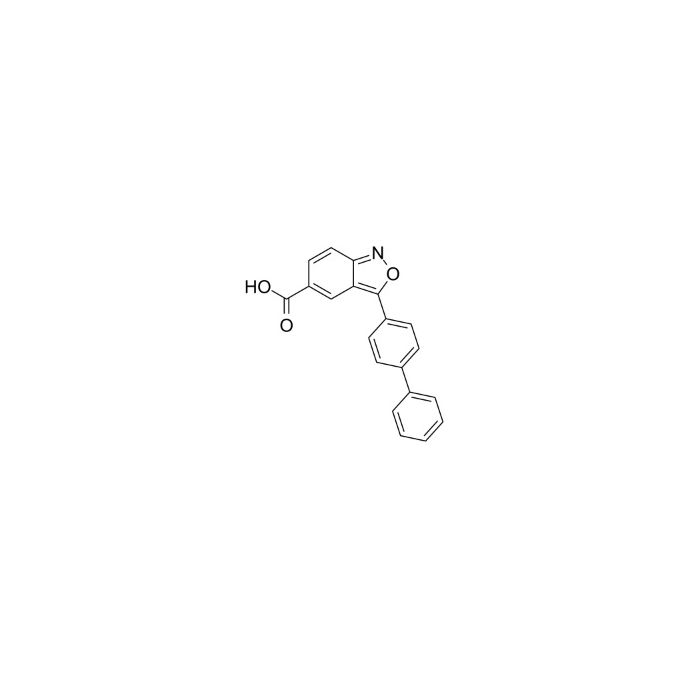
UNC7467 is a potent IP6K inhibitor with values of 4.9, 8.9 and 1320 nM for IP6K2, IP6K1 and IP6K6, respectively. UNC7467 reduces levels of inositol pyrophosphates. UNC7467 can be used for obesity research.
Specifiche
Specifiche e purezza
≥98%
Condizioni di conservazione di stoccaggio
Store at -20°C
Spedito in
Ice chest + Ice pads
Questo prodotto richiede spedizione a catena fredda. I servizi di terra e altri servizi economici non sono disponibili.
Purezza
≥98%
Nomi e identificatori
Peso molecolare
315.32
Dati avanzati
Certificati (CoA, COO, BSE/TSE e tabella di analisi)
C of A & Other Certificates(BSE/TSE, COO):
Analytical Chart:
Find and download the COA for your product by matching the lot number on the packaging.
DMSO : 14.29 mg/mL (45.32 mM; ultrasonic and warming and heat to 60°C)
Calcolatori di soluzioni
Molarity Calculator
Determine the necessary mass, volume, or concentration for preparing a solution.
Dilution Calculator
Determine the dilution needed to prepare a stock solution.
Reconstitution Calculator
Recensioni
Recensioni dei clienti
Application Protocols
No manufacturer-validated protocols are provided for this item.
General small-molecule handling protocol (not item-specific):
Equilibrate vial to room temperature in a desiccator before opening to prevent condensation.
Quickly weigh required amount and immediately recap. Prepare a concentrated stock in dry DMSO under inert gas if possible.
Vortex and sonicate gently to aid dissolution. Filter through 0.22 μm PTFE if needed.
Store working aliquots at −20 °C or per SDS guidance. Avoid multiple freeze–thaw cycles by preparing single-use aliquots.
For cell assays, limit final DMSO to assay-tolerated levels (commonly ≤0.1–0.5%). Include solvent-only controls.
For analytical QC:
Run UPLC-UV/MS to verify purity and identity before critical experiments. Track stability with time-course chromatograms under your assay conditions.
Biological Roles
Biological function/target: Not specified for this item; refer to CoA/Spec Sheet and peer-reviewed literature.
General guidance for coded research compounds:
If a target class is disclosed in supporting documentation, map the compound’s putative mechanism to relevant pathways and use established positive/negative controls to benchmark activity.
Confirm on-target effects via orthogonal assays (e.g., biochemical vs cellular), time-dependence, and, when possible, genetic perturbation (knockdown/knockout rescue) to exclude off-target or assay-artifact behavior.
ADME considerations for cellular work (general practice): check permeability proxies (PAMPA/MDCK), efflux liability, and microsomal stability to interpret cell potency vs biochemical potency gaps.
Aggregation/colloidal behavior: Screen with low levels of nonionic detergent and dynamic light scattering when false positives are a concern.
Note: No therapeutic or clinical claims are made for this product. It is provided strictly for research use. Any biological role or target specificity must be established by the end user or supported by documentation furnished with the batch.
Buffer Applications
This product is a small-molecule research compound rather than a buffering reagent. It is not typically used to control pH or ionic strength.
Practical notes:
If dissolution into aqueous buffers is required for assays, buffer choice should be dictated by the biology (e.g., HEPES or phosphate at physiological pH) and compound stability. Validate that the buffer components do not react with or precipitate the compound.
Maintain consistent co-solvent content (e.g., 0.1–1% DMSO) across control and treated samples to avoid solvent-driven artifacts.
Green Alternatives
Green chemistry considerations primarily concern solvent choice and handling, since the compound structure and hazards are not disclosed.
Greener practice recommendations (general):
Stock preparation: Favor DMSO or ethanol over DMF/NMP where assay compatibility allows. Minimize stock concentration to the lowest practical value that maintains stability to reduce solvent mass.
Analytical methods: Use water/ACN gradients instead of halogenated solvents. Optimize LC to reduce run times and solvent consumption.
Workup and cleaning: Prefer aqueous/EtOH cleaning protocols for glassware and instruments. Collect DMSO/DMF waste separately for appropriate disposal.
Energy: Store at the recommended −20 °C but avoid unnecessary freeze–thaw cycles by aliquoting; this reduces re-synthesis and waste.
Illustrative comparison (general, not item-specific):
DMF/NMP (high boiling, reproductive toxicity concerns) vs DMSO/EtOH (lower toxicity profile, easier handling): choose DMSO/EtOH when solubility and assay tolerance permit.
Dichloromethane/chloroform vs ethyl acetate/MTBE/2-MeTHF in purification: if purification is required in your workflow, select greener eluents consistent with compound stability.
Always evaluate greener substitutions for impacts on assay signal, solubility, and stability before full adoption.
Pharmaceutical Uses
No excipient/formulation roles, pharmacopeial status, or manufacturing uses are specified for this item. It is offered for research use only.
General considerations if used in formulation research (not a claim for this item):
Early pre-formulation screening often evaluates solubility across pH, stability in biorelevant media, and compatibility with common excipients (cyclodextrins, PEGs). Any such work should be guided by disclosed structure and is outside the scope of this listing.
Note: This product is not intended for human or veterinary use, drug substance manufacturing, or clinical applications.
Physical Properties
Item-specific physicochemical parameters have not been provided in this listing.
Physical state/appearance: Not specified for this item; refer to CoA/Spec Sheet.
Melting point (literature/computed): Not specified for this item; refer to CoA/Spec Sheet.
Boiling point (literature/computed): Not applicable/unknown for a generic small molecule solid; refer to CoA/Spec Sheet.
Density: Not specified for this item; refer to CoA/Spec Sheet.
Solubility: Not specified for this item; refer to CoA/Spec Sheet. General guidance (literature/good practice): many screening compounds are soluble in DMSO at 10–50 mM; aqueous solubility is highly structure-dependent.
LogP/logD, pKa, refractive index: Not specified for this item; refer to CoA/Spec Sheet.
General laboratory guidance (not item-specific; literature best practices):
Perform a small-scale solubility screen (DMSO, DMF, MeOH, EtOH, PBS with co-solvent) to identify a working stock solvent. Sonication and gentle warming (≤40 °C) can assist dissolution; avoid prolonged heating.
If hygroscopicity or polymorphism is suspected, verify by TGA/DSC and PXRD as needed for formulation/workflow robustness.
For assay prep, filter stock solutions (0.22 μm PTFE) to remove particulates before use.
Always defer to the item’s CoA/SDS for authoritative physical data once available.
Quality and Grades
Grade/Purity: Not specified for this item; refer to CoA/Spec Sheet.
Guidance on grades and analytical expectations (general information for discovery compounds):
Discovery/screening quality: Typically provided with LC–MS identity confirmation and chromatographic purity (e.g., HPLC/UPLC) suitable for biochemical/cell-based assays. UV cutoff and trace impurities are usually not controlled to chromatography-grade solvent standards unless stated.
Analytical data package: For small-molecule tools, a standard CoA often includes structure, purity, LC–MS, and sometimes 1H NMR. If you require residual solvent levels, water content (KF), salt form confirmation, or polymorph information, request expanded documentation.
Salt form and counterion: If applicable, can affect solubility and pH in assays. Verify the exact form on the CoA before preparing stocks.
Stabilizers/inhibitors: Not specified for this item; refer to CoA/Spec Sheet.
Recommendations:
For quantitative biology/chemistry, confirm purity by an orthogonal method in-house (e.g., qNMR vs. ERETIC, UPLC-UV at multiple wavelengths) and verify absence of interfering UV/fluorescent impurities for optical assays.
If the material will be used for SAR or as an internal standard, consider obtaining batch-specific spectroscopic data and impurity profiling.
Reaction and Applications
This item is part of a small-molecule/compound library offering and is typically used as a research tool compound. No manufacturer application text beyond this has been provided for this specific code name.
Common uses for coded discovery compounds (general guidance):
Biochemical or cell-based screening as a putative probe or hit-like molecule. Establish concentration–response behavior, cytotoxicity windows, and stability in the chosen assay matrix.
Method development standards for LC–MS or HPLC, including retention time bracketing and system suitability, once structure and chromophores are known from the CoA.
Chemical biology workflows (target engagement assays such as CETSA/DSF, pull-down when derivatizable) if structural handles exist; applicability depends on disclosed structure.
Practical tips:
Prepare a DMSO master stock, verify clarity at working dilutions, and monitor for time-dependent precipitation or adsorption in plates.
Assess compound stability: incubate in assay media at 37 °C and analyze by LC–MS over time (literature practice) to detect hydrolysis/oxidation.
For orthogonal confirmation of activity, use counterscreens and interference assays (e.g., redox cycling/PAINS filters, detergent sensitivity) to avoid false positives.
Note: In the absence of a disclosed structure, avoid inferring a target class or mechanism. Consult the CoA/tech note for any target annotation that may be available for UNC7467.
Reaction Conditions
No reaction conditions are applicable here, as the compound is provided as a finished small molecule for research use, and no synthetic transformations are specified for this item.
General notes (if derivatization is contemplated by the end user):
Establish the structure and functional groups from the CoA before attempting coupling, protection, or labeling.
Verify stability to bases/acids, oxidants/reductants, and heat with small-scale stress tests, then choose solvent and temperature accordingly.
Because the structure is undisclosed in this listing, specific temperatures, catalysts, or yields cannot be responsibly provided.
Safety and Handling
Safety classification details are not provided in this listing.
GHS/CLP: Not specified for this item; refer to SDS.
Signal word, hazard statements, pictograms: Not specified for this item; refer to SDS.
General laboratory precautions for small-molecule research compounds (good practice):
PPE: Lab coat, safety glasses, and appropriate chemical-resistant gloves (e.g., nitrile). Work in a certified fume hood to avoid inhalation of dust/aerosols.
Avoid ingestion/inhalation/skin contact. Wash thoroughly after handling. Prevent release to the environment.
Storage incompatibilities: Until specific functional groups are known, segregate from strong oxidizers, strong acids/bases, and reducing agents. Store in the original container, tightly closed, under inert headspace if feasible.
Spill/accident: Collect solids by gentle sweeping with minimal dust generation; for solutions, absorb with inert material. Dispose as hazardous chemical waste.
First aid overview: If inhaled—move to fresh air; skin contact—wash with soap and water; eye contact—rinse cautiously with water for several minutes; ingestion—rinse mouth, seek medical attention. Always consult the SDS for item-specific instructions.
Note: Unknown toxicological properties warrant conservative handling. For weighing and reconstitution, minimize exposure and use disposable weigh boats and antistatic tools to limit aerosolization.
Solvent Selection
Item-specific solvent compatibility is not provided. Without a disclosed structure, select solvents using a tiered screen and knowledge of common solubilization behavior of discovery compounds.
General selection strategy (not item-specific):
Primary stock solvent: DMSO is the default for small-molecule screening (target 10–50 mM). If precipitation occurs upon dilution to assay buffer, add co-solvent (0.1–1% DMSO) and/or surfactant (e.g., 0.01–0.05% nonionic), per assay tolerance.
Alternative solvents: DMF, NMP for very polar/poorly soluble compounds; MeOH/EtOH/IPA for moderately lipophilic analytes. For QC analytics, ACN/H2O with formic acid or ammonium buffers is typical.
Aqueous handling: If ionizable, pH adjustment can dramatically increase solubility. Perform a pH solubility map (literature practice) using Britton–Robinson or simple citrate/phosphate buffers.
Material compatibility: Use glass vials or high-quality polypropylene; avoid polystyrene microplates for lipophilic compounds due to adsorption.
Comparative notes:
DMSO vs DMF: DMSO is generally less volatile and more assay-compatible; DMF can plasticize some plastics and has greater toxicity concerns.
ACN vs MeOH for LC: ACN often provides lower backpressure and sharper peaks; MeOH may improve solubility for some polar compounds.
Always validate solvent effects on your assay readout (control wells with matching solvent concentrations).
Storage and Reconstitution
Storage conditions (item-specific): Store at −20 °C. Shipped in an ice chest with ice pads to maintain cold chain.
Container: Keep tightly closed in original vial. Protect from moisture and prolonged light exposure until more details are known from the CoA/SDS.
Reconstitution guidance (general best practice; not item-specific):
Solvent: DMSO is commonly used for small-molecule screening stocks. If needed, evaluate alternative solvents (DMF, ethanol) on a small scale.
Concentration: Prepare the lowest concentration that meets assay needs (often 10–50 mM for DMSO stocks). Verify complete dissolution visually; use sonication briefly if required.
Aliquoting: Dispense into single-use aliquots (amber or clear, low-bind tubes). Flush headspace with inert gas if oxidative sensitivity is suspected.
Freeze–thaw: Minimize cycles; thaw at room temperature, mix gently, and promptly return unused aliquots to −20 °C.
Stability checks: Periodically assess by LC–MS/HPLC for degradation, especially after 1–3 months of storage or repeated handling.
Disposal: Follow institutional guidelines for organic chemical waste. Refer to the SDS for definitive storage and handling instructions once available.
Structure and Identity
This product is offered as a research small molecule under an internal code name. Limited structural metadata is available in the current listing.
Product name: UNC7467 (SKU: U659176)
CAS: 2922283-43-8
Category: Small molecules and compound libraries (screening compound)
Molecular formula: Not specified for this item; refer to CoA/Spec Sheet.
Molecular weight: Not specified for this item; refer to CoA/Spec Sheet.
SMILES: Not specified for this item; refer to CoA/Spec Sheet.
InChIKey: Not specified for this item; refer to CoA/Spec Sheet.
Structural features:
Item-specific functional groups, ring systems, and stereochemistry: Not specified for this item; refer to CoA/Spec Sheet.
Notes for users:
“UNC” identifiers commonly denote university-derived tool compounds in discovery research collections. Without an explicit structure, treat this as a coded small molecule intended for biochemical/cellular screening and method development.
If you require unambiguous structure identity (e.g., for SAR, analytical qualification, or IP review), please request the CoA/Spec Sheet or contact Technical Support for the latest structure disclosure and characterization (NMR, LC–MS, HPLC purity, etc.).
For analytical onboarding in your lab, consider orthogonal ID confirmation (e.g., LC–MS retention/HRMS) once reference spectra are provided by the CoA.
Synthetic Utility
Synthetic building-block utility cannot be assessed without structural information.
General guidance:
If UNC7467 is intended as a reference standard or intermediate in your synthesis program, request the disclosed structure and spectral data (CoA) to plan protecting group strategies and functional group interconversions.
For impurity profiling or metabolite synthesis, orthogonal synthesis routes are recommended to confirm structure by independent preparation.
Absent a known functional group map, it is not appropriate to ascribe reactivity patterns, named-reaction suitability, or derivatization routes for this item.
Target Specificity
Target/epitope/clone/isotype: Not applicable. This product is a small-molecule compound, not an antibody or biologic.
Any target annotation for UNC7467 is not specified for this item; refer to CoA/Spec Sheet and supporting literature if available.
If a molecular target is disclosed elsewhere, establish specificity via:
Orthogonal assay formats (biochemical vs cellular)
Counterscreens against close homologs
Concentration–response curves and kinetic profiling
Chemical controls (inactive analogs) where available.
Domande frequenti
What is the purity of this product?
This product is supplied at ≥98% purity (chemical assay). Lot-specific values are stated on the Certificate of Analysis.
How should this product be stored?
Store at ?20 °C. Freezer storage is required to maintain the specified shelf life.
How is this product shipped?
This product ships in an insulated container with ice pads. Unpack on arrival and transfer it to the storage condition stated above.
What are the CAS number, molecular formula and molecular weight?
The CAS Number is 2922283-43-8, the molecular formula is C20H13NO3, and the molecular weight is 315.32 g/mol.
What documentation is provided?
Available product documentation, including Certificates of Analysis (COA), Safety Data Sheets (SDS), and specification sheets, is shown in the product document area. Document availability and access follow the current site policy.
Utilizziamo i cookie per garantire il corretto funzionamento del sito web e, ove consentito, per migliorare la tua esperienza. Puoi gestire le tue preferenze in qualsiasi momento nelle Impostazioni. Per saperne di più, consulta la nostra Cookie Policy.
Desidera che le inviamo un messaggio quando avremo sconti disponibili?
Ricordamelo più tardi
Grazie! Controlli la sua casella di posta per confermare.
Products are supplied to verified businesses, institutions, and qualified professionals for research and development use only. Not for use in humans, animals, diagnosis, or therapy.

 G2417498