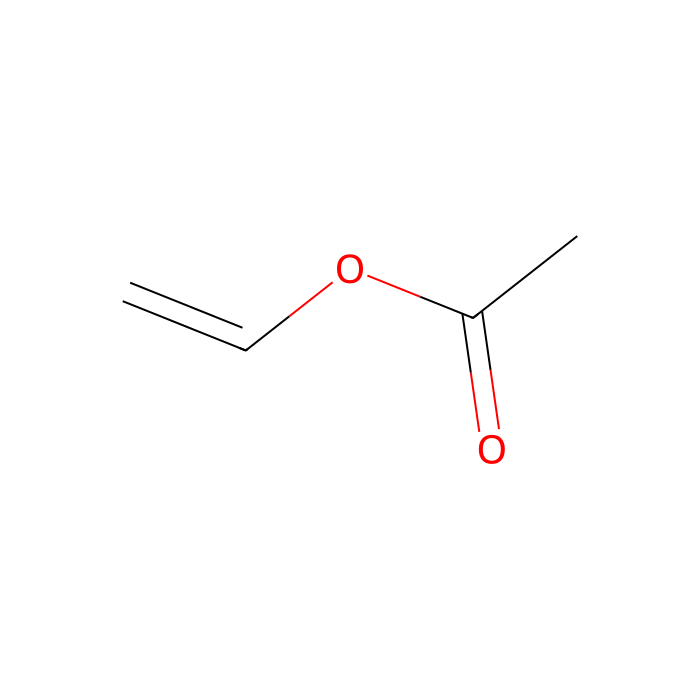
Vinyl acetate - Standard for GC, ≥99.5%(GC) , CAS No.108-05-4

CAS: 108-05-4 Cat. No.: V104470 Formula: C4H6O2 Peso molecolare: 86.09 Beilstein Registry Number: 1209327 Numero EC: 686-890-7 PubChem CID: 7904
Disponibile su ordine
QUALITÀ & PUREZZA Standard for GC ? GC reference standard — characterized compound for calibrating GC methods. Use to build calibration curves and verify GC quantitation. ≥99.5%(GC)
Synonyms
Vinyl ethanoate|Vinyle (acetate de)|Acetic acid vinyl ester|Ethanoic acid, ethenyl ester|VINYL ACETATE (IARC)|Vinyl acetate, inhibited|Acetic acid ethenyl ester|Vinile|Vinnapas A 50|Acetic Acid Vinyl Ester Monomer|VINYL ACETATE HQ|Vinyle|Ethenyl ethanoate|Vinile(acetato di)|VINYL ACETATE [HSDB]|Vinylazetat|Vinyl acetate monomer|Ethenyl acetate, 9CI|Vinyle (acetate de) [French]|Essigsaeurevinylester|Vinylester kyseliny octove [Czech]|VyAc|Vinyl A monomer|Unocal 76 Res S-55|Vinylacetate|Acetate de vinyle|Acetic acid, ethylene ether|VINYL ACETATE, STABILIZED|Vinylacetaat [Dutch]|VINYL ACETATE|VINYL ACETATE [MI]|1-Acetoxyethylene|Acetoxyethene|RP 251 (ESTER)|Vinyl ester of acetic acid|Vinyle(acetate de)|Vinile (acetato di) [Italian]|Zeset T|Acetic acid, ethenyl ester|Unocal 76 Res 6206|COPOVIDONE IMPURITY C [EP IMPURITY]|Ethenyl acetate|RP 251|UN 1301 (Salt/Mix)|Vinylacetat [German]|Vinylacetat(german)|VyAr|Vinylacetat|Acetic acid, vinyl ester|VINYL ACETATE [IARC]|VINYL ACETATE [INCI]|Vinyl acetate H.Q.|Vinyl acetate, CP|Octan winylu|Plyamul 40305-00|Acetate de vinyle [French]|VAC|Vinyl acetate, inhibited [UN1301] [Flammable liquid]|Vinylacetaat|Vinylester kyseliny octove
Storage
Protected from light,Room temperature
Shipped In
FedEx DG Service
★
Dimensione
Germania (EU)
USA*
Prezzo
Qtà
5ml
V104470-5ml
—
5 Disponibile

17,27€

22,47€
Salva 5,21 € (23.17%)
Enter a quantity for the sizes you want to add.

Specifiche

Sinonimi
Vinyl ethanoate | Vinyle (acetate de) | Acetic acid vinyl ester | Ethanoic acid, ethenyl ester | VINYL ACETATE (IARC) | Vinyl acetate, inhibited | Acetic acid ethenyl ester | Vinile | Vinnapas A 50 | Acetic Acid Vinyl Ester Monomer | VINYL ACETATE HQ | Vinyle | Ethenyl ethanoate | Vinile(acetato di) | VINYL ACETATE [HSDB] | Vinylazetat | Mostra altro
Specifiche e purezza
Standard for GC, ≥99.5%(GC)
Condizioni di conservazione di stoccaggio
Protected from light,Room temperature
Spedito in
FedEx DG Service
Grado
Standard for GC
Purezza
≥99.5%(GC)
Nomi e identificatori
Pubchem Sid
SMILES
CC(=O)OC=C
IUPAC Name
ethenyl acetate
InChIKey
XTXRWKRVRITETP-UHFFFAOYSA-N
InChI
1S/C4H6O2/c1-3-6-4(2)5/h3H,1H2,2H3
Isomeri SMILES
CC(=O)OC=C
WGK Germania
2
PubChem CID
7904
Numero UN
1301
Gruppo di imballaggio
II
Peso molecolare
86.09
Beilstein
1209327

Dati avanzati

Taxonomic Classification

Taxonomy Tree

KingdomOrganic compounds
SuperclassOrganic acids and derivatives
ClasseCarboxylic acids and derivatives
SubclassCarboxylic acid derivatives
Intermediate Tree Nodes Carboxylic acid esters
Direct ParentEnol esters
Alternative Parents Monocarboxylic acids and derivatives  Organic oxides  Hydrocarbon derivatives  Carbonyl compounds  
Molecular FrameworkAliphatic acyclic compounds
Substituents Enol ester - Monocarboxylic acid or derivatives - Organic oxygen compound - Organic oxide - Hydrocarbon derivative - Organooxygen compound - Carbonyl group - Aliphatic acyclic compound
DescrizioneThis compound belongs to the class of organic compounds known as enol esters. These are ester derivatives of enols. They have the general formula RC=COC(=O)R' where R, R' = H or organyl group.
External Descriptors acetate ester
Struttura 3D
Modello di struttura chimica interattiva


Obiettivi associati (umani)
PPARG Tclin Peroxisome proliferator-activated receptor gamma (15191 Activities)
Activity TypeRelationActivity valueUnitsAction TypeJournalPubMed IddoiAssay Aladdin ID
Lymphoblastoid cell (5959 Activities)
Activity TypeRelationActivity valueUnitsAction TypeJournalPubMed IddoiAssay Aladdin ID
Obiettivi associati (non umani)
Ppard Peroxisome proliferator-activated receptor delta (358 Activities)
Activity TypeRelationActivity valueUnitsAction TypeJournalPubMed IddoiAssay Aladdin ID
Meccanismi d'azione
Certificati (CoA, COO, BSE/TSE e tabella di analisi)
C of A & Other Certificates(BSE/TSE, COO):
Analytical Chart:

Find and download the COA for your product by matching the lot number on the packaging.

3 results found

Lot NumberCertificate TypeDataOggetto
G2516623G2516623Certificate of AnalysisOct 13, 2026 V104470
J2228717J2228717Certificate of AnalysisJul 30, 2026 V104470
H2212208H2212208Certificate of AnalysisAug 16, 2022 V104470
Proprietà chimiche e fisiche
SolubilitàSlightly soluble in water, soluble in alcohol, ether, acetone, benzene, and chloroform.
SensibilitàLight sensitive.
Indice di rifrazione1.3941
Punto di infiammabilità (°F)17.6 °F
Punto di infiammabilità (°C)-8℃
Punto di ebollizione (°C)72-73°C
Punto di fusione (°C)-93 °C
Peso molecolare86.09
XLogP30.700
Hydrogen Bond Donor Count0
Hydrogen Bond Acceptor Count2
Rotatable Bond Count2
Exact Mass86.0368 Da
Monoisotopic Mass86.0368 Da
Topological Polar Surface Area26.300 Ų
Heavy Atom Count6
Formal Charge0
Complexity65.900
Isotope Atom Count0
Defined Atom Stereocenter Count0
Undefined Atom Stereocenter Count0
Defined Bond Stereocenter Count0
Undefined Bond Stereocenter Count0
The total count of all stereochemical bonds0
Covalently-Bonded Unit Count1
Sicurezza e pericoli (GHS)
Pictogrammi
GHS02,   GHS07,   GHS08
Segnale
Danger
Indicazioni di pericolo

H225:Highly Flammable liquid and vapor

H303:May be harmful if swallowed

H332:Harmful if inhaled

H335:May cause respiratory irritation

H351:Suspected of causing cancer

H412:Harmful to aquatic life with long lasting effects

Precauzioni

P210:Keep away from heat, hot surface, sparks, open flames and other ignition sources. - No smoking.

P233:Keep container tightly closed.

P240:Ground/bond container and receiving equipment.

P241:Use explosion-proof [electrical/ventilating/lighting/.../] equipment.

P242:Use only non-sparking tools.

P243:Take precautionary measures against static discharge.

P261:Avoid breathing dust/fume/gas/mist/vapors/spray.

P271:Use only outdoors or in a well-ventilated area.

P280:Wear protective gloves/protective clothing/eye protection/face protection.

P303+P361+P353:IF ON SKIN (or hair): Take off Immediately all contaminated clothing. Rinse SKIN with water [or shower].

P304+P340:IF INHALED: Remove person to fresh air and keep comfortable for breathing.

P370+P378:In case of fire: Use ... to extinguish.

P405:Store locked up.

P403+P233:Store in a well-ventilated place. Keep container tightly closed.

P403+P235:Store in a well-ventilated place. Keep cool.

P501:Dispose of contents/container to an approved waste disposal plant.

P203:Obtain, read and follow all safety instructions before use.

P318:if exposed or concerned, get medical advice.

P317:Get emergency medical help.

P319:Get medical help if you feel unwell.

WGK Germania
2
Classe
3
Indice Merck
9992
RIDADR
UN1301 - class 3 - PG 2 - Vinyl acetate, stabilized
Domande frequenti e articoli
Standard for GC: A Practical Guide
Vinyl Acetate-Acrylic Emulsion (Vinyl Acrylic Emulsion): A Cost-Performance Balance Solution for Architectural Coatings
VC/VAc Resins and Their Modification: An Analysis of VC/VAc Vinyl Resins for Coatings and Inks
PVAc, VAE, and Vinyl Acetate-Based Emulsions: Film-Forming Logic and Performance Boundaries in Architectural Coatings
How to Select Vinyl-Related Resins: Building Formulation Judgment Based on Substrate, Performance Targets, and Failure Risks
Waterborne Resin Technology Explained: Waterborne Forms, Performance Balance, and a Technology Map
Guide to Common Waterborne Resin Types and Application-Based Selection: How to Choose Acrylics, PUD, Waterborne Epoxy, Waterborne Alkyd, VAE, and Related Chemicals
From Water to Film: Film-Formation Mechanisms and Performance Development of Waterborne Emulsions and Dispersions
Resin Polarity in Coating Formulations: From Molecular Structure to Dissolution, Compatibility, Interfacial Interactions, and Formulation Design
Analysis of the Production Process of Hydroxypropyl Methylcellulose (HPMC) for Putty: Understanding Differences in Substitution Structure and Gelation Temperature from High-Ratio and Low-Ratio Formulations
What Are the Differences Between Polyvinyl Alcohol 1788, 2488, and 2699? Understanding Workability, Bonding Strength, and Relative Water Resistance from the Perspective of Degree of Polymerization and Degree of Hydrolysis
Citations of This Product
Calcolatori di soluzioni
Recensioni

Recensioni dei clienti

Desidera che le inviamo un messaggio quando avremo sconti disponibili?

Ricordamelo più tardi

Grazie! Controlli la sua casella di posta per confermare.

Ops! Le notifiche sono disabilitate.