This compound belongs to the class of organic compounds known as alanine and derivatives. These are compounds containing alanine or a derivative thereof resulting from reaction of alanine at the amino group or the carboxy group, or from the replacement of any hydrogen of glycine by a heteroatom.
External Descriptors
Not available
1. Djoumbou Feunang Y, Eisner R, Knox C, Chepelev L, Hastings J, Owen G, Fahy E, Steinbeck C, Subramanian S, Bolton E, Greiner R, and Wishart DS. ClassyFire: Automated Chemical Classification With A Comprehensive, Computable Taxonomy. Journal of Cheminformatics, 2016, 8:61.
Determine the necessary mass, volume, or concentration for preparing a solution.
Dilution Calculator
Determine the dilution needed to prepare a stock solution.
Reconstitution Calculator
Recensioni
Recensioni dei clienti
Application Protocols
Tested applications, recommended dilutions, and positive controls: Not specified for this item.
Guidance:
For practical use cases (peptide coupling, deprotection), see the Reaction Conditions and Synthetic Utility sections for general literature procedures. Adapt conditions to your substrate scope, scale, and EHS requirements.
Always confirm solubility and coupling efficiency on small scale before committing to scale‑up.
Note: Only protocols validated for this specific catalog item would be listed here; none are provided in the Product Data.
Biological Roles
Item-specific biological testing/uses: Not specified for this item; for research use only.
General context (biochemistry of the D‑alanine motif; literature):
D‑Alanine residues are key components in bacterial peptidoglycan cross‑linking (e.g., D‑Ala‑D‑Ala termini), influencing cell wall architecture and resistance to proteolysis. Incorporation of D‑residues in peptides can modulate conformation, stability, and resistance to enzymatic degradation.
Protected derivatives like Z‑D‑Ala‑OH are synthetic precursors; they are not native metabolites. The Cbz group is removed post‑assembly to expose the amine for biological function.
In peptide design, selective placement of D‑Ala can induce β‑turns or disrupt protease recognition sites, aiding mechanistic studies of folding and binding.
Caution: No clinical/therapeutic claims are made here. Any biological evaluation should be conducted under appropriate research protocols after deprotection/derivatization as required.
Buffer Applications
Z‑D‑Ala‑OH is not a dedicated buffering reagent. It lacks a free primary amine (blocked as Cbz carbamate) and presents only a single carboxylic acid moiety, providing limited buffering capacity and a narrow effective pH domain.
Practical guidance:
Not typically used to prepare laboratory buffers or electrophoresis running solutions.
For peptide work, prepare buffers with established systems (e.g., phosphate, acetate, HEPES, MOPS) and dissolve Z‑D‑Ala‑OH separately in an appropriate organic solvent for coupling or in mixed solvent systems if needed.
For exact buffer suitability with this specific item: Not specified for this item; refer to CoA/Spec Sheet and your method SOPs.
Green Alternatives
Solvent choices:
Replace DCM with EtOAc or 2‑MeTHF where solubility permits (workups, solution‑phase couplings).
Consider NBP or Cyrene/GBL blends as partial substitutes for DMF/NMP in coupling steps after compatibility validation with your coupling system.
Coupling reagents/additives:
Favor OxymaPure with carbodiimides (EDC or DIC) to reduce the hazards associated with HOBt/HOAt while maintaining low racemization.
COMU can be an alternative to HATU; assess for scale‑up EHS and waste minimization.
Hydrogenolysis:
Perform Cbz deprotection in EtOH/EtOAc or MeOH under H2/Pd at ambient temperature/pressure where possible; minimize use of chlorinated solvents.
Small comparison (general, literature-based):
DCM vs EtOAc: EtOAc is less toxic, biodegradable; DCM offers higher solubility but is a VOC of concern.
DMF/NMP vs NBP/Cyrene: greener replacements can reduce reproductive toxicity flags; note viscosity/solubility tradeoffs and potential reagent stability issues.
HATU vs COMU/EDC+Oxyma: comparable coupling efficiency; greener systems may yield easier waste handling and lower explosion risk (avoid dry HOBt/HOAt).
Pharmaceutical Uses
Item-specific regulatory status: Not specified for this item; refer to CoA/Spec Sheet. Supplied strictly for research and laboratory use.
General formulation/manufacturing context (no therapeutic claims):
Z‑D‑Ala‑OH serves as a chiral building block in the synthesis of peptide intermediates and peptidomimetics during process development. The Cbz group is orthogonal to base‑labile protections and is typically removed via catalytic hydrogenolysis, facilitating late‑stage deprotection under mild conditions.
Applications include preparation of D‑residue‑containing APIs or intermediates where inversion enhances proteolytic stability or modulates binding. The protected acid can be converted into esters or activated species for convergent fragment coupling in multi‑step sequences.
Considerations for manufacturing: control of enantiopurity (chiral HPLC), low residual metals (post‑hydrogenation), residual solvents, and tight water content to ensure reproducible crystallization and solid‑handling performance.
Excipient role: None typical; Z‑D‑Ala‑OH is a synthetic intermediate/building block rather than an excipient.
Physical Properties
Item-specific values: Not specified for this item; refer to CoA/Spec Sheet.
Literature/general characteristics (for Cbz‑amino acids like Z‑D‑Ala‑OH):
Physical state: typically a white to off‑white crystalline solid (literature)
Solubility profile: sparingly soluble in water; soluble to miscible in polar aprotic organic solvents (DMF, DMSO), moderately soluble in EtOAc, MeOH, and dioxane; limited in nonpolar hydrocarbons (literature). Solubility may increase in the presence of organic base (e.g., DIPEA) due to carboxylate formation.
Acid/base features: weak carboxylic acid (pKa for the terminal –CO2H of protected amino acids typically ~3–4; literature, compound‑class estimate). The carbamate NH is significantly less basic/nucleophilic than a free amine.
Partitioning: aromatic Cbz group increases hydrophobicity relative to unprotected D‑alanine; logP for Cbz‑Ala derivatives is moderate (literature, qualitative).
UV: aromatic benzyl chromophore gives UV absorption in the 200–220 nm region and a weaker band near 254–260 nm (literature, qualitative). No item-specific UV cutoff provided.
Notes:
Do not treat the above as product specifications. For exact MP/BP, residual solvents, water content, metal content, or UV cutoff: Not specified for this item; refer to CoA/Spec Sheet.
Quality and Grades
Item-specific grade/purity: Not specified for this item; refer to CoA/Spec Sheet.
Typical grades for peptide building blocks (general guidance):
Peptide/ synthesis grade: controlled for low inorganic/organic impurities; optimized for high coupling efficiency; often accompanied by specific tests (optical rotation, chiral HPLC, residual solvents).
Analytical grade: suitable for research use; not necessarily optimized for SPPS.
Low-water specifications and low residual amines/acids are advantageous to reduce side reactions in coupling.
What to check on the CoA/Spec Sheet for Z‑D‑Ala‑OH:
Identity: NMR, MS; sometimes IR with carbamate and carboxylic acid bands.
Assay/purity (HPLC area%): confirms the level of main component.
Appearance and loss on drying (LOD): moisture content can affect accurate weighing and coupling stoichiometry.
Residual solvents / inorganic ash: helpful for sensitive synthetic routes.
Stabilizers/additives:
No stabilizer is typically required for Cbz‑protected amino acids. If any additive is present in this item: Not specified for this item; refer to CoA/Spec Sheet.
Reaction and Applications
Primary use: chiral building block for peptide synthesis and fragment ligation where the D‑configuration of alanine is required (e.g., D‑residues in peptidomimetics, resistance to proteolysis studies).
Peptide coupling: activation with HATU/HOAt or COMU/Oxyma, or carbodiimides (EDC·HCl, DIC) with additives (Oxyma/HOAt/HOBt) in DMF or NMP, base (DIPEA). The free carboxyl of Z‑D‑Ala‑OH couples to an amine (free N‑terminus) on resins or solution‑phase partners.
Esterification: conversion to methyl/benzyl esters for orthogonal protection strategies (e.g., via DCC/DMAP or Fischer esterification).
Acid chloride/mixed anhydride formation: for challenging couplings, transient activation as acid chloride (SOCl2 or Ghosez reagent) or mixed anhydride (isobutyl chloroformate) at low temperature can be employed, monitoring racemization.
Hydrogenolysis: Cbz removal (H2, Pd/C) to yield D‑Ala derivatives with a free amine, leaving other base‑labile protections intact.
Practical tips:
Racemization control: minimize base strength, activation time, and temperature; OxymaPure or HOAt can lower epimerization vs HOBt‑free systems.
For SPPS, pre‑dissolve Z‑D‑Ala‑OH in dry DMF; ensure resin is fully swollen; consider double coupling for hindered sequences.
Monitor by TLC (UV 254 nm due to benzyl) or LC‑MS; for SPPS, Kaiser/Chloranil tests may be limited due to protected amines.
Reaction Conditions
General literature guidance for Z‑protected amino acid couplings and manipulations (not item‑specific specifications):
Amide coupling (to a free amine):
Solvent: DMF or NMP (0.05–0.2 M). Alternative: DCM/DMF or EtOAc/DMF mixtures if soluble.
Reagents: HATU (1.0–1.2 eq) or COMU (1.0–1.2 eq) or EDC·HCl/DIC (1.1–1.5 eq) with Oxyma (1.0–1.2 eq).
Base: DIPEA (2.0–3.0 eq) or NMM (2.0–3.0 eq).
Temperature/time: 0–25 °C, 0.5–4 h for solution phase; 30–90 min per coupling cycle in SPPS.
Notes: pre‑activate briefly (≤5–10 min) to reduce racemization; monitor by LC‑MS/TLC.
Esterification (Fischer):
Solvent: anhydrous MeOH or EtOH with catalytic H2SO4/HCl(g); 0–25 °C to reflux as needed.
Caution: avoid prolonged strong acid to limit carbamate cleavage.
Cbz deprotection (hydrogenolysis):
Catalyst: 5–10% Pd/C (5–10 wt% relative to substrate) under H2 (1–3 atm) at 20–25 °C in MeOH/EtOH/EtOAc or mixtures; 1–6 h typical.
Additives: small amounts of acid (e.g., AcOH) can maintain amine as ammonium and suppress transcarbamoylation.
Workup: filter catalyst (Celite), concentrate, and proceed without chromatography when used in SPPS workflows.
GHS classification, signal word, pictograms, and H‑statements: Not specified for this item; refer to the product SDS for authoritative hazard information.
General handling (class-based guidance for protected amino acids):
Use in a fume hood to minimize exposure to dust or solvent vapors from solutions.
Recommended PPE: lab coat, safety glasses, and appropriate chemical-resistant gloves (e.g., nitrile). Avoid inhalation of dust and contact with skin/eyes.
Avoid strong oxidizers and strong bases for prolonged periods; strong base can promote carbamate cleavage or epimerization at the α‑center under coupling conditions.
Incompatible materials: strong oxidants; strong acids/bases that may hydrolyze the carbamate; moisture may lead to clumping though the compound is generally stable as a solid.
First aid (overview; defer to SDS):
Inhalation: move to fresh air; seek medical attention if symptoms persist.
Skin/eye contact: rinse with water for at least 15 minutes; remove contaminated clothing; obtain medical advice for persistent irritation.
Ingestion: rinse mouth; seek medical advice.
Special risks/notes:
Not an ether—no particular peroxide formation risk.
Epimerization risk during peptide coupling under basic/activated conditions; control base strength, temperature, and activation time to minimize racemization.
Waste: collect solid and solution waste according to institutional organic/peptide waste procedures.
Solvent Selection
Z‑D‑Ala‑OH is a moderately polar, aromatic carbamate‑bearing carboxylic acid. Solvent choice is dictated by application (solution‑phase vs. solid‑phase peptide synthesis) and activation strategy.
Polarity/miscibility (general):
Good solubility: DMF, NMP, DMSO, dioxane; moderate in MeOH/EtOH and EtOAc; limited in ACN; poor in aliphatic hydrocarbons.
For SPPS: DMF or NMP are traditional; greener swaps include NBP or Cyrene/GBL blends when compatible with reagents.
Selection guidance:
Coupling solutions: DMF or NMP provide high solubility for Z‑D‑Ala‑OH and coupling reagents (HATU, COMU, EDCI, DIC) and bases (DIPEA).
Solution-phase esterification: use DCM/EtOAc/THF with catalytic DMAP and carbodiimide; or MeOH/EtOH for direct alkyl ester formation under acid catalysis.
Hydrogenolysis (Cbz removal): alcoholic solvents (MeOH, EtOH) or mixtures with EtOAc/THF under H2/Pd; avoid strong base.
Small comparison (general):
DMF vs NMP: both dissolve reagents well; NMP is higher boiling (easier to heat), DMF is more common but has stricter EH&S considerations.
DCM vs EtOAc: DCM offers higher solubility for aromatic carbamates but poorer EHS profile; EtOAc is greener and often adequate.
2-MeTHF/CPME: greener, water-tolerant alternatives to DCM/THF for extractions and certain couplings.
Storage and Reconstitution
Item-specific storage and shipping (from Product Data):
Storage Conditions: Store at 2–8 °C.
Shipped In: Wet ice.
Additional handling guidance (general):
Keep container tightly closed in a dry place; protect from prolonged exposure to moisture which can lead to clumping or variable weighing.
Desiccant storage is recommended for long‑term stability of peptide building blocks.
Bring to room temperature in a sealed container before opening to minimize moisture uptake.
Reconstitution/use (general suggestions; not item-specific specifications):
For solution preparation, dissolve in dry DMF, NMP, or DMSO to make stock solutions for coupling; typical working concentrations 0.05–0.5 M depending on application.
For hydrogenolysis, prepare solutions in MeOH/EtOH/EtOAc or THF mixtures compatible with Pd/C and your substrate.
Filter solutions (0.2 µm PTFE) if particulate is present before automated dispensing/SPPS.
Stability notes:
Avoid prolonged exposure to strong acids/bases and elevated temperatures which may promote hydrolysis or racemization.
For exact shelf life, assay, and re-test periods: Not specified for this item; refer to CoA/Spec Sheet.
Structure and Identity
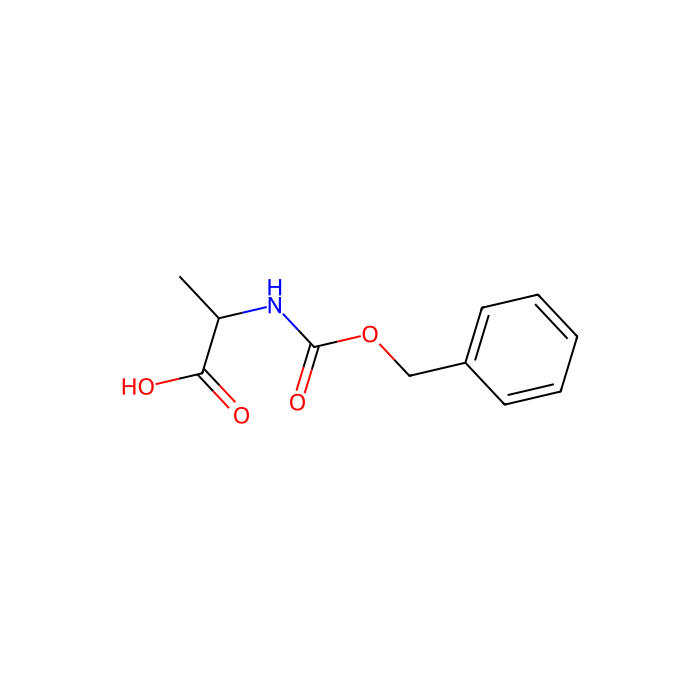
Short description: Z‑D‑Ala‑OH is the N‑benzyloxycarbonyl (Cbz/Z) protected, enantiopure D‑alanine bearing a free carboxylic acid. It is a standard chiral building block for peptide synthesis and fragment coupling.
Example SMILES (literature): CC@@HC(=O)O (stereochemistry denotes D)
Structural description in words (general):
The molecule contains an alanine backbone with the α‑amino group protected as an N‑carbamate (Cbz). The carbamate connects the α‑nitrogen to a benzyloxyl carbonyl, featuring a benzyl ether (–O–CH2–Ph) linked to a carbonyl (–C(=O)–). The α‑carboxyl remains free (–CO2H). The sole stereocenter is configured as D; the side chain is a methyl group, and the backbone presents the typical zwitterion-capable acid/base sites when unprotected at the nitrogen (here, nitrogen is blocked by Cbz).
Synthetic Utility
Functional group set:
Free carboxylic acid (–CO2H): amenable to activation (acid chloride, anhydride, active esters) and esterification.
N‑Carbamate (Cbz): protects the amine, reduces nucleophilicity/basicity; removable by hydrogenolysis (H2/Pd) orthogonal to base‑labile protections (e.g., tBu‑based side chains).
Single stereocenter (D): enantiopure handle for stereochemically defined assemblies.
Typical transformations (literature):
Couplings: HATU/COMU/EDC/DIC with Oxyma/HOAt/HOBt in DMF/NMP to form amide bonds to amines on resins or in solution.
Ester formation: MeOH/EtOH with acid catalysts or DCC/DMAP protocols; benzyl ester formation for further orthogonality.
Mixed anhydride/acid chloride routes: iBuOCOCl/NMM at low temperature; Ghosez reagent for mild chlorination—monitor for racemization.
Global/Selective deprotection: Cbz cleavage by hydrogenolysis; retain acid or transform to derivatives prior to deprotection according to route design.
Retrosynthetic value:
Serves as the N‑protected equivalent of D‑alanine for convergent assembly of di‑/oligo‑peptides bearing D‑residues; enables late‑stage unveiling of the amine while preserving other protections.
Practical: ensure dry solvents and controlled base to limit epimerization; verify stereochemical integrity by chiral HPLC or optical rotation after key steps.
Target Specificity
This product is a small‑molecule building block (protected amino acid), not an antibody, enzyme, or affinity reagent.
Target/epitope/clone/isotype: Not applicable.
Species reactivity: Not applicable.
If you require biological targeting information, please refer to the appropriate biomolecule product class rather than this synthetic intermediate.
Utilizziamo i cookie per garantire il corretto funzionamento del sito web e, ove consentito, per migliorare la tua esperienza. Puoi gestire le tue preferenze in qualsiasi momento nelle Impostazioni. Per saperne di più, consulta la nostra Cookie Policy.
Desidera che le inviamo un messaggio quando avremo sconti disponibili?
Ricordamelo più tardi
Grazie! Controlli la sua casella di posta per confermare.
Products are supplied to verified businesses, institutions, and qualified professionals for research and development use only. Not for use in humans, animals, diagnosis, or therapy.

 C2616108