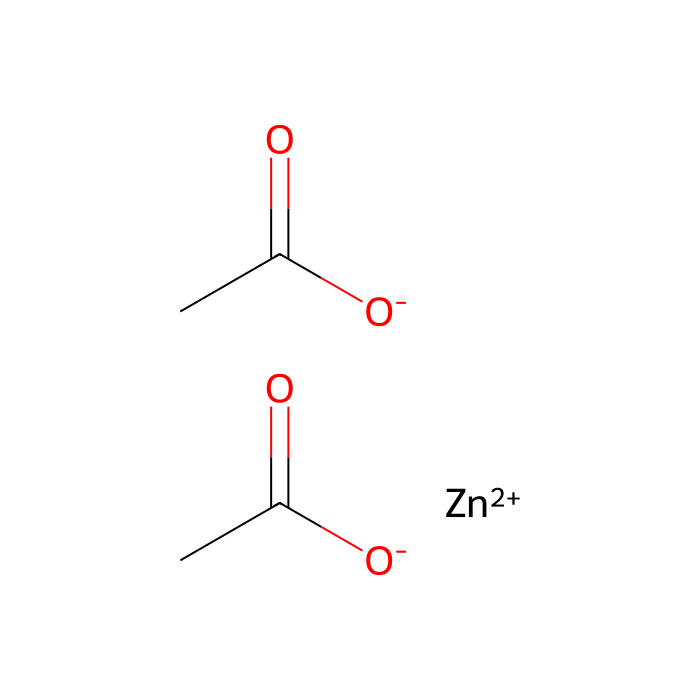
Determine the necessary mass, volume, or concentration for preparing a solution.
| Activity Type | Relation | Activity value | Units | Action Type | Journal | PubMed Id | doi | Assay Aladdin ID |
|---|

10mM in DMSO for sensitive chromatographic and analytical workflows requiring minimal baseline interference.
Store at -80°C Ships Dry ice packs + Cold packs Check lot-specific COA for exact specifications.
SDS, COA, datasheet, and spec sheet available for download. Lot-specific COA accessible via lot number lookup.
Cited in 622 peer-reviewed publications across chromatography, organic synthesis, and cross-coupling reactions.
Zinc acetate is primarily utilized as a precursor or catalyst in various synthetic reactions. In organic chemistry, zinc acetate finds application as a reagent in the formation of carbon-carbon bonds. It can facilitate the synthesis of esters, allylic alcohols, and acetals. For example, it can promote the acylation of alcohols, phenols, and amines to form esters, such as the Fischer esterification reaction. Zinc acetate has also been used in the synthesis of metal-organic frameworks (MOFs). MOFs are porous materials consisting of metal ions or clusters coordinated to organic ligands. Zinc acetate can act as a precursor for the formation of MOFs due to its ability to coordinate with organic linkers and form robust networks.
Application:
Zinc acetate anhydrous is used in the synthesis of layered Zn-arylphosphonates with potential application in sorption, ion exchange or catalysis. It is utilized in the ultrasonic preparation of zinc sulfide nanoparticles coated on silica particles. It is administered orally or parenterally as a nutritional supplement. It finds an application in the field of industries such as wood preservation, manufacturing other zinc salts, polymers, manufacture of ethylene acetate, as a dye mordant, and analytical reagent. It also acts as a plating inhibitor on primary water piping.
Comprehensive hazard, handling, storage, and regulatory compliance document.
Download SDS →Lot-specific quality data. Enter your lot number to retrieve the exact COA.
Look up COA →Full quality attributes and acceptance criteria for this grade.
View spec sheet →Taxonomy Tree
| Kingdom | Organic compounds |
|---|---|
| Superclass | Organic acids and derivatives |
| Classe | Carboxylic acids and derivatives |
| Subclass | Carboxylic acids |
| Intermediate Tree Nodes | Not available |
| Direct Parent | Carboxylic acids |
| Alternative Parents | Monocarboxylic acids and derivatives Organic salts Organic oxides Hydrocarbon derivatives Carbonyl compounds |
| Molecular Framework | Not available |
| Substituents | Monocarboxylic acid or derivatives - Carboxylic acid - Organic oxygen compound - Organic oxide - Hydrocarbon derivative - Organic salt - Organooxygen compound - Carbonyl group - Aliphatic acyclic compound |
| Descrizione | This compound belongs to the class of organic compounds known as carboxylic acids. These are compounds containing a carboxylic acid group with the formula -C(=O)OH. |
| External Descriptors | zinc molecular entity - acetate salt |
| Activity Type | Relation | Activity value | Units | Action Type | Journal | PubMed Id | doi | Assay Aladdin ID |
|---|
| Sensibilità | Hygroscopic |
|---|---|
| Punto di fusione (°C) | 200℃ |
| Peso molecolare | 183.500 g/mol |
| XLogP3 | |
| Hydrogen Bond Donor Count | 0 |
| Hydrogen Bond Acceptor Count | 4 |
| Rotatable Bond Count | 0 |
| Exact Mass | 181.956 Da |
| Monoisotopic Mass | 181.956 Da |
| Topological Polar Surface Area | 80.300 Ų |
| Heavy Atom Count | 9 |
| Formal Charge | 0 |
| Complexity | 25.500 |
| Isotope Atom Count | 0 |
| Defined Atom Stereocenter Count | 0 |
| Undefined Atom Stereocenter Count | 0 |
| Defined Bond Stereocenter Count | 0 |
| Undefined Bond Stereocenter Count | 0 |
| The total count of all stereochemical bonds | 0 |
| Covalently-Bonded Unit Count | 3 |