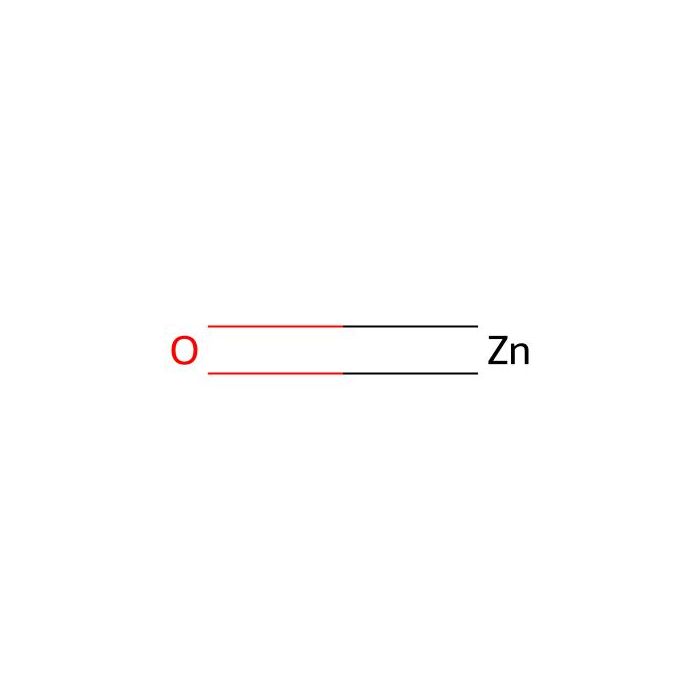
Zinc oxide - high-purity, Reagent grade, ≥99.9% metals basis, powder,<5μm , CAS No.1314-13-2

CAS: 1314-13-2 Cat. No.: Z431819 Formula: ZnO Peso molecolare: 81.39 Numero EC: 215-222-5
Disponibile su ordine
QUALITÀ & PUREZZA Reagent Grade ? General reagent-grade purity suitable for most laboratory work. Use as a dependable default when no specific higher grade is required. High-purity ? High-purity grade with substantially reduced impurity levels. Use when trace contaminants would interfere with your measurement or process. ≥99.9% metals basis powder,<5μm
Storage
Room temperature
Shipped In
Normal
★
Dimensione
Germania (EU)
USA*
Prezzo
Qtà
100g
Z431819-100g
—
2 Disponibile

99,70€

125,74€
Salva 26,03 € (20.70%)
Enter a quantity for the sizes you want to add.
🧪
Perché questa qualità

high-purity, Reagent grade, ≥99.9% metals basis, powder,<5μm High-purity,Reagent Grade per flussi di lavoro cromatografici e analitici sensibili che richiedono un'interferenza minima della linea di base.

🌡

Stoccaggio e spedizione

Room temperature Spedizione Normal. Consultare il COA specifico del lotto per le specifiche esatte.

📋

Documenti di qualità

SDS, COA, scheda tecnica e scheda delle specifiche disponibili per il download. COA specifico del lotto accessibile tramite ricerca per numero di lotto.

📚

Prova documentale

Citato in 1358 pubblicazioni peer-reviewed su cromatografia, sintesi organica e reazioni di accoppiamento incrociato.

Panoramica

Application

Employed in the preparation of NaZnSiO 3 OH, a novel chiral framework material which has potential application in ion exchange, adsorption or catalysis.

Specifiche

Specifiche e purezza
high-purity, Reagent grade, ≥99.9% metals basis, powder,<5μm
Condizioni di conservazione di stoccaggio
Room temperature
Spedito in
Normal
Grado
High-purity, Reagent Grade
Purezza
≥99.9% metals basis
Nomi e identificatori
Pubchem Sid
Isomeri SMILES
O=[Zn]
Numero UN
3077
Gruppo di imballaggio
III
Peso molecolare
81.39

Documentazione

📋 Scheda di dati di sicurezza (SDS)

Documento completo su pericoli, manipolazione, stoccaggio e conformità normativa.

<<<<<<< HEAD Scarica SDS → ======= Scarica SDS → >>>>>>> release248-p3

✅ Certificato di analisi (COA)

Dati di qualità specifici del lotto. Inserisci il numero di lotto per recuperare il COA esatto.

Cerca COA →

📊 Scheda tecnica

Riepilogo di riferimento rapido delle specifiche e applicazioni del prodotto.

Visualizza scheda tecnica →

🔬 Scheda delle specifiche

Attributi di qualità completi e criteri di accettazione per questa qualità.

Visualizza scheda delle specifiche →

Dati avanzati

Certificati (CoA, COO, BSE/TSE e tabella di analisi)
C of A & Other Certificates(BSE/TSE, COO):
Analytical Chart:

Find and download the COA for your product by matching the lot number on the packaging.

13 results found

Lot NumberCertificate TypeDataOggetto
E2609131E2609131Certificate of AnalysisSep 26, 2025 Z431819
J2521759J2521759Certificate of AnalysisSep 26, 2025 Z431819
J2521760J2521760Certificate of AnalysisSep 26, 2025 Z431819
J2521775J2521775Certificate of AnalysisSep 26, 2025 Z431819
C2525572C2525572Certificate of AnalysisMar 11, 2025 Z431819
C2525573C2525573Certificate of AnalysisMar 11, 2025 Z431819
D2508810D2508810Certificate of AnalysisMar 11, 2025 Z431819
E2512094E2512094Certificate of AnalysisMar 11, 2025 Z431819
G2426543G2426543Certificate of AnalysisJul 13, 2024 Z431819
G2426544G2426544Certificate of AnalysisJul 13, 2024 Z431819
G2426545G2426545Certificate of AnalysisJul 13, 2024 Z431819
G2426546G2426546Certificate of AnalysisJul 13, 2024 Z431819
L2313373L2313373Certificate of AnalysisDec 02, 2023 Z431819
Proprietà chimiche e fisiche
Punto di fusione (°C)1975℃
Peso molecolare81.400 g/mol
XLogP3
Hydrogen Bond Donor Count0
Hydrogen Bond Acceptor Count1
Rotatable Bond Count0
Exact Mass79.9241 Da
Monoisotopic Mass79.9241 Da
Topological Polar Surface Area17.100 Ų
Heavy Atom Count2
Formal Charge0
Complexity2.000
Isotope Atom Count0
Defined Atom Stereocenter Count0
Undefined Atom Stereocenter Count0
Defined Bond Stereocenter Count0
Undefined Bond Stereocenter Count0
The total count of all stereochemical bonds0
Covalently-Bonded Unit Count1
Domande frequenti e articoli
Solvothermal Synthesis of Nanoparticles
High-Purity Reagents: Overview and Aladdin Product Selection Guide
How to Choose Reagent Grades in Scientific Research? A Practical Guide to Reagent Grade
Applications of Nanoclay in Materials and Formulations: Dispersion Mechanisms, Performance Enhancement, and Product Selection
The Complete Guide to UV Absorbers: Definition & Scope, Key Engineering Metrics, Validation Methods, and Selection Navigation (Tables 1–3)
Light-Emitting Polymers (LEPs): A Practical Panorama - A Core PL/EL Mechanistic Framework, Material Family Map, and Structural “Design Knobs” (including Product Tables 1–4 and a selection guide)
Thermoelectric Materials Selection Guide: Evaluation Framework, Temperature-Range–System Map, and Modularization Gatekeeping Criteria (with Product Navigation Tables 1–4)
Ceramic Materials Guide: Basic Definitions, Classification Framework, and Research-Task-Oriented Selection (with Product Navigation and Tables 1–4)
Self-Assembled Nanodielectrics (SANDs): Self-Assembled Nanodielectric Layers for Low-Voltage Thin-Film Transistors (with Product Selection Guide)
Liquid Polyisoprene: Material Characteristics, Application Directions, and Selection Considerations
TCA-KTTS, a Titanate Coupling Agent Suitable for Use in Cosmetics: Basic Information, Application Characteristics, and Differences from 130 and 105
Structure–Property Relationship of Silicone Resins: Mechanisms of Heat Resistance, Weatherability, Hydrophobicity, and Coating Performance Analysis
From Molecular Design to Morphology Control: How Small-Molecule Donors Improve the Efficiency, Stability, and Processability of Organic Solar Cells
How ZnO Nanoparticle Electron Transport Layers Reduce Dark Current in Organic Photodetectors: Mechanisms, Film Quality, and Material Selection
How Should Montmorillonite Be Rationally Modified? Organic Modification, Inorganic Modification, and Application-Oriented Selection and Validation
Application Positioning, Scenario Selection, and Key Use Considerations for Chlorinated Rubber Resin in Coatings
Formulation Design of Chlorinated Rubber Coatings: Component Synergy and Performance Control
Waterborne Resin Application Guide: Formulation Synergy, Troubleshooting, and Technology Development Trends
Mechanisms and Control of Coating Yellowing: From Chromophoric Structure Formation to Source Diagnosis and Formulation Optimization
Resin Polarity in Coating Formulations: From Molecular Structure to Dissolution, Compatibility, Interfacial Interactions, and Formulation Design
Why Do Daily Chemical Products Become Opaque? Formation Mechanisms of Milky Turbidity, Pearlescence, and Coverage, and How to Select the Right Ingredients
Color-Development Mechanisms, Formulation Forms, and Selection/Application Logic of Colorants in Personal Care Products
Zinc–Bismuth Composite Catalysts for Polyurethane: Cure Control, Selection Methods, and Blend-Ratio Design
Mechanism of Kojic Acid in Reducing Hyperpigmentation: From Tyrosinase Inhibition to Melanin Production Regulation
The Dual-Targeted Skin-Brightening Mechanism of 4-MSK: Inhibiting Melanin Production and Reducing Epidermal Pigment Retention
Molecular Structure, Photochemical Behavior, and Role of Octocrylene in Sunscreen Formulations
UVA Absorption Mechanism of Avobenzone: Keto–Enol Tautomerism, Photochemical Instability, and Formulation Photostabilization Strategies
Anti-Photoaging Potential of Artemia Extract: UV-Induced Damage Cascades, HSP70-Related Stress Protection, and GP4G Metabolic Insights
The Sebum-Regulating Potential of Zinc PCA and Its Relationship with Stratum Corneum Hydration
Mechanism of Action of Tranexamic Acid in Pigmentation Care: From the Plasmin System to Regulation of Inflammation-Driven Pro-Melanogenic Signaling
Citations of This Product
Calcolatori di soluzioni
Recensioni

Recensioni dei clienti

Hai bisogno di aiuto per scegliere la qualità?

La nostra guida alla selezione delle qualità copre purezza, stato dello stabilizzatore e idoneità all'applicazione per tutte le varianti del nostro catalogo.

Visualizza la guida alle qualità Reagent Grade → Visualizza la guida alle qualità High-purity →

Prodotti correlati

Zinc oxide - PrimorTrace™, ≥99.999% metals basis , CAS No.1314-13-2
Zinc oxide - ≥99.8% metals basis, 50±10 nm , CAS No.1314-13-2
Zinc oxide - nanoparticles,≤50 nm particle size ,40 wt. % in Isopropanol , CAS No.1314-13-2
Zinc oxide - AR, ≥99% , CAS No.1314-13-2
Zinc oxide - nanoparticles,30 nm particle size ,30 wt. % in 1,2-propanediol monomethyl ether acetate , CAS No.1314-13-2
Zinc oxide - nanoparticles,50 nm particle size ,30 wt. % in 1,2-propanediol monomethyl ether acetate , CAS No.1314-13-2
Zinc oxide - PharmPure™, USP, BP, Ph.Eur., ≥99%(calc. for dried substance) , CAS No.1314-13-2
Zinc oxide - analytical standard, complexation capacity:12.280mmol/g , CAS No.1314-13-2
Zinc oxide - ≥99.9% metals basis, 30±10nm , CAS No.1314-13-2
Ossido di zinco - nanoparticelle, dimensioni ≤50 nm, 40 wt. % in H2O , CAS No.1314-13-2
Zinc oxide - ≥99.8% metals basis, 90±10nm particle size (BET), 99.8% metals basis , CAS No.1314-13-2
Zinc oxide - ≥99%, powder,≤100nm , CAS No.1314-13-2
Zinc oxide - PrimorTrace™, ≥99.99% metals basis, used for Zinc oxide can be used as a starting material to prepare: Schottky diodes that are applied in radio-frequency energy-harvesting circuits. ZnO nanostructures for sensing applications. For example, i
Zinc oxide - nanoparticles,≤50nm,30 wt. % in H2O , CAS No.1314-13-2
Zinc Hydroxide - 98% , CAS No.20427-58-1
Zinc oxide - nanoparticles,≤50nm,20 wt. % in H2O , CAS No.1314-13-2
Zinc oxide ink for inkjet printing
Zinc oxide - ≥98% , CAS No.1314-13-2
Zinc oxide nanoparticle ink
Zinc oxide - PrimorTrace™, ≥99.999% metals basis, powder,max. particle size 45 micron,weight 200g,high purity 99.999%
Zinc oxide - PrimorTrace™, ≥99.999% metals basis, powder,≤ 45 μ m , CAS No.1314-13-2
Zinc oxide - Ph.Eur., Suitable for Analysis, ACS, Premium pure , CAS No.1314-13-2
Zinc oxide - puriss. p.a., ACS, ≥99%(KT) , CAS No.1314-13-2
Zinc oxide - ≥97%, nanopowder,<50nm particle size (bET) , CAS No.1314-13-2
Zinc oxide - Particle size 30-45nm, 36 wt.% 1,2-propanediol monomethyl ether acetate solution , CAS No.1314-13-2
Aluminum-doped zinc oxide ink for inkjet printing
Aluminum-doped zinc oxide ink for spin coating/slot-die coating
Zinc oxide - Dispersion,

Desidera che le inviamo un messaggio quando avremo sconti disponibili?

Ricordamelo più tardi

Grazie! Controlli la sua casella di posta per confermare.

Ops! Le notifiche sono disabilitate.