Certificati (CoA, COO, BSE/TSE e tabella di analisi)
C of A & Other Certificates(BSE/TSE, COO):
Analytical Chart:
Calcolatori di soluzioni
Molarity Calculator
Determine the necessary mass, volume, or concentration for preparing a solution.
Dilution Calculator
Determine the dilution needed to prepare a stock solution.
Reconstitution Calculator
Recensioni
Recensioni dei clienti
Application Protocols
Per instruction, only protocols explicitly provided in the Product Data may be listed. None are provided for this item.
Tested applications: Not specified for this item; refer to CoA/Spec Sheet.
Recommended working concentrations/dilutions: Not specified for this item; refer to CoA/Spec Sheet.
Positive controls/assay conditions: Not specified for this item; refer to CoA/Spec Sheet.
Users should follow internal SOPs or peer-reviewed literature appropriate to their assay platform.
Biological Roles
Item-specific biological targets, pathways, and modes of action: Not specified for this item; refer to CoA/Spec Sheet or internal screening data.
General context for small-molecule library members:
Compounds in discovery libraries are used as chemical matter for target discovery, validation, and structure–activity relationship (SAR) development. Their biological roles, if any, are established empirically through biochemical, biophysical, and cell-based assays.
Absent an annotated target, such compounds should be treated as research probes with unknown specificity, and evaluated for assay interferences (fluorescence, redox cycling, aggregation) using orthogonal assays and control conditions (e.g., detergent-sensitive aggregation tests, redox probe counterscreens).
Stability in biological matrices (e.g., microsomes, plasma) and permeability/efflux profiles are typically determined via ADME screening; no such data are provided for this item.
Caution:
Do not infer any therapeutic function or biological efficacy from catalog inclusion alone. All experimentation should follow institutional biosafety and research-only usage policies.
Buffer Applications
This product is a small-molecule library compound, not a buffering agent. Therefore, classic buffer formulation (defined pKa and pH range) is not applicable.
Practical notes for assay buffers (general guidance):
When dosing from DMSO stocks, maintain final DMSO ≤0.1–1% v/v depending on assay tolerance to minimize solvent effects on proteins/cells.
Use detergent (e.g., 0.01% Tween-20) cautiously to mitigate aggregation artifacts, verifying no interference with the readout.
To assess compound stability, prepare buffers at relevant pH values (e.g., pH 6.0, 7.4, 8.0) and monitor by LC–MS over the assay window.
Item-specific pKa, solubility, or buffer compatibility are not available; consult the CoA/Spec Sheet and perform small-scale pretests.
Green Alternatives
When preparing solutions of undisclosed small molecules, solvent choice drives most of the environmental footprint. Where feasible, consider greener options while maintaining assay integrity.
Greener solvent considerations (general):
Prefer ethanol or isopropanol as co-solvents when the compound remains soluble upon aqueous dilution; they are renewable-compatible and lower-toxicity compared with DMF/ACN. Verify assay tolerance.
Evaluate 2-methyltetrahydrofuran (2-MeTHF) or Cyrene (dihydrolevoglucosenone) for synthetic or preparative work-up contexts when DMSO/DMF are not mandatory (not typically used for biological stock solutions).
For chromatography, ethyl acetate/hexane can be partially replaced by heptane/EtOAc or supercritical CO2 (for preparative SFC) to reduce VOC impact.
Tradeoffs (balanced view):
DMSO remains the most reliable for solubility; greener substitutes may fail for highly lipophilic or multifunctional compounds.
Alcohol co-solvents can precipitate hydrophobic compounds on dilution; conduct kinetic solubility checks.
DMF/ACN: analytical workhorses; higher health/environmental concerns; minimize use and ensure proper capture.
Note: No item-specific solvent guidance is provided; select the least hazardous solvent that meets performance requirements and document justification per green chemistry best practices.
Pharmaceutical Uses
No excipient role or pharmacopeial status is provided for this item.
Applicability:
This product is supplied for research use only and is positioned as a discovery/screening compound. It is not supplied with documentation or regulatory designations suitable for clinical, diagnostic, or GMP manufacturing use.
Formulation context (general, non-clinical):
For preclinical research assays, compounds are commonly formulated as DMSO stocks and diluted into aqueous media. For in vivo investigative research, specialized formulation screens (e.g., Captisol, microemulsions) are used, but such uses are outside the scope of catalog specifications and require independent validation and approvals.
Documentation:
Any consideration of advanced formulation or scale-up requires lot-specific CoA, impurity profiles, and stability data; none are specified here.
Physical Properties
Item-specific values are not provided in the Product Data. Do not infer properties without documentation.
Reported for this item:
Appearance: Not specified for this item; refer to CoA/Spec Sheet.
Molecular Weight: Not specified for this item; refer to CoA/Spec Sheet.
Commonly referenced properties (literature/computed, not item-specific unless in CoA):
Melting point / Boiling point: Not specified for this item; refer to CoA/Spec Sheet.
Density / Refractive index: Not specified for this item; refer to CoA/Spec Sheet.
pKa / logP / logD: Not specified for this item; refer to CoA/Spec Sheet.
Solubility: Not specified for this item; refer to CoA/Spec Sheet.
Practical guidance for unknowns (general):
Begin solubility screening with anhydrous DMSO (10–50 mg/mL), then test co-solvents (DMF, ethanol) and buffered aqueous media via dilution, monitoring for precipitation or turbidity.
If hygroscopicity or polymorphism is suspected, perform Karl Fischer (for water content) and DSC/TGA to assess phase behavior. These are general techniques and not specifications.
For UV-enabled assays, collect a UV–Vis scan (200–400 nm) to identify absorbance maxima and potential interference; verify extinction coefficients experimentally.
Reminder:
Treat any property values not explicitly listed on the CoA/Spec Sheet as unknown for this specific item.
Quality and Grades
Item-specific grade/purity: Not specified for this item; refer to CoA/Spec Sheet.
Typical expectations for small-molecule library members (general guidance, not item specifications):
Purity by HPLC (often ≥95% for screening compounds) with chromatogram and method conditions.
LC–MS data for molecular ion confirmation and impurity profiling.
Where applicable, 1H NMR (and 13C NMR) to confirm structure; for salts or solvates, data may include counterion and solvent of crystallization.
If chirality is relevant, enantiomeric excess by chiral HPLC.
What the grade implies (general definitions):
"Screening/Discovery grade" typically prioritizes high purity suitable for in vitro assays and plate-based screening; UV background and residual solvents may be reported but are not controlled to chromatographic solvent grades.
Stabilizers/additives:
None are disclosed in the Product Data. If stabilizers or salt forms are present, these will be listed on the CoA. Do not assume their presence/absence without documentation.
Practical recommendation:
For sensitive biophysical methods (SPR, ITC, DSF) or photoactive targets, request full analytical pack (HPLC trace, LC–MS, water content) and, if necessary, perform in-house repurification prior to key studies.
Reaction and Applications
Item-specific manufacturer applications: None provided beyond category assignment to a small-molecule/compound library.
Practical research uses (general, non-clinical):
Biochemical and cell-based screening as a test article or chemical probe candidate in target validation, phenotypic assays, and SAR initiation.
Counter-screening to assess assay interference (e.g., fluorescence quenching, redox cycling) and off-target liability, provided appropriate controls are included.
Analytical reference for method development (LC–MS retention scouting, stability-indicating methods) when structure is known under CDA.
Not typically applicable:
Without disclosed functional groups, this material is not positioned here as a synthetic reagent for named reactions. If the structure is available under separate documentation, standard synthetic applications should be evaluated case-by-case.
Practical tips (general):
Verify chemical stability in the intended matrix (buffer, media) across assay time and temperature using time-course LC–MS.
Assess adsorption losses to plastics by comparing recovery from PP vs. glass vials/plates; add 0.01–0.1% surfactant (e.g., Tween-20) only if assay-tolerated.
Implement light protection (amber ware) until photostability is confirmed.
All uses are for research purposes only; no medical or diagnostic applications are implied.
Reaction Conditions
Not applicable in a specific sense: the Product Data do not disclose functional groups or reactivity, and the item is positioned as a small-molecule library member rather than a general-purpose reagent.
General guidance if derivatization is pursued after structural disclosure:
Choose conditions based on functional group mapping (e.g., Suzuki for aryl–B/Br/I; HATU/EDC for carboxylic acids to amides; Buchwald–Hartwig for aryl amination; reductive amination for carbonyl–amine coupling).
Control moisture/air where required (Schlenk/argon) and monitor by LC–MS. Typical temperatures range from rt to 120°C depending on the transformation and solvent; reaction times vary 0.5–24 h.
These are generic literature practices and are not specifications for this item.
Safety and Handling
Regulatory status: For research use only (per Product Data). Not for human or veterinary use.
GHS information (item-specific):
Signal Word: Not specified for this item; refer to SDS.
Hazard Statements (H-): Not specified for this item; refer to SDS.
GHS Classification/Pictograms: Not specified for this item; refer to SDS.
General laboratory precautions (professional best practice):
Handle in a chemical fume hood with appropriate PPE: lab coat, safety glasses, and nitrile gloves. For powders, avoid dust generation; for solutions, avoid skin contact—especially with DMSO, which can enhance dermal transport.
Prevent cross-contamination of screening libraries by using dedicated tips, low-retention consumables, and maintaining traceability (barcode/plate maps).
Incompatibilities are unknown; as a precaution, separate from strong oxidizers/reducers and acids/bases until compatibility is confirmed.
Avoid heat/light exposure unless stability data indicate tolerance. Follow the specified storage of −80°C.
First-aid overview (consult SDS for authoritative guidance):
Inhalation: Move to fresh air; seek medical attention if symptoms persist.
Skin/eye contact: Rinse with water for at least 15 minutes; remove contaminated clothing; obtain medical advice.
Ingestion: Rinse mouth; do not induce vomiting; seek medical attention.
Spill/Disposal:
Contain with inert absorbent, collect in sealed container, and dispose per institutional hazardous waste protocols and local regulations.
Solvent Selection
Because the structure and ionization profile are not disclosed in the Product Data, solvent selection should follow a staged, evidence-based approach suitable for small-molecule screening stocks.
Primary stock solvent (general best practice):
DMSO (anhydrous) is the default for discovery compounds owing to broad solvency and biological assay compatibility at low final %.
Secondary/co-solvents (when DMSO is insufficient or undesirable):
DMF (high solvency, similar miscibility to DMSO),
Ethanol or isopropanol (volatile, easier removal; watch aqueous miscibility and precipitation on dilution),
Acetonitrile (good for HPLC-driven workflows),
Water/buffer only after confirming ionization/pKa and kinetic solubility.
Dilution into assay media (general):
Prepare concentrated stock (e.g., 10–50 mM in DMSO), then dilute into buffer or media to a final ≤0.1–1% v/v DMSO depending on assay tolerance. Visually inspect for precipitation; if observed, adjust co-solvent ratio or concentration.
Practical tests:
Conduct a kinetic solubility assay (dilute DMSO stock 1:100–1:1000 into buffer) and monitor turbidity/UV. For equilibrium solubility, use shake-flask or miniaturized variants at target pH.
Small comparison (general considerations):
DMSO: widest solvency, low vapor pressure; may affect enzyme activity at >1%.
EtOH/IPA: faster drying; can disrupt membranes/cells at modest %.
DMF/ACN: analytical compatibility; cytotoxic at low %.
Note: No item-specific solubility, pKa, or dielectric data are provided—consult CoA/Spec Sheet for any available metrics.
Storage and Reconstitution
Item-specific storage and shipping (from Product Data):
Storage Conditions: Store at −80°C.
Shipped In:Dry ice packs + Cold packs.
General best practices for small-molecule library compounds (supplementary, not item-specific specs):
Keep material desiccated and protected from light in tightly sealed containers. If provided in plates or tubes, minimize freeze–thaw by aliquoting into single-use portions.
For solution stocks, use anhydrous DMSO unless otherwise indicated. Typical concentrations for screening libraries are 10–50 mM; filter through 0.2 µm PTFE if needed and compatible.
Record preparation details (solvent, concentration, date, lot) and store solutions at −20 to −80°C depending on stability; validate by periodic LC–MS/HPLC checks.
Reconstitution (item-specific details not provided):
Solvent choice, target concentration, and any sonication/heating steps are not specified for this item; refer to CoA/Spec Sheet. If solubility is uncertain, begin with a small-scale test in dry DMSO, then evaluate aqueous dilution behavior.
Always defer to the batch CoA and SDS for authoritative instructions on handling, stability, and storage.
InChIKey: Not specified for this item; refer to CoA/Spec Sheet.
SMILES: Not specified for this item; refer to CoA/Spec Sheet.
Molecular Formula: Not specified for this item; refer to CoA/Spec Sheet.
Molecular Weight: Not specified for this item; refer to CoA/Spec Sheet.
Structural features:
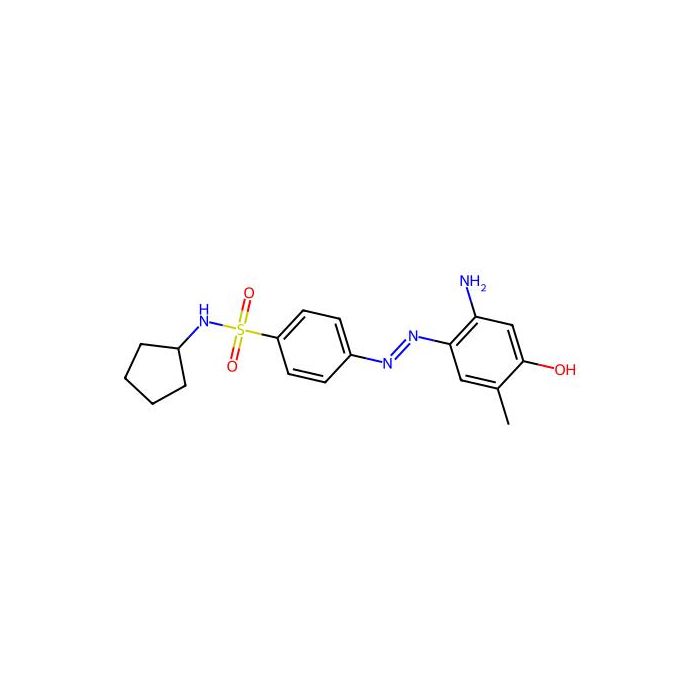
2D/3D structural details, ring systems, heteroatoms, and stereochemistry are not provided in the Product Data. Consult the CoA/Spec Sheet or the associated PubChem CID (137285009) for structure confirmation.
Typical orthogonal ID methods for small-molecule library members include LC–MS (exact mass, isotopic pattern), 1H/13C NMR, and, where relevant, HPLC purity profiling. If chiral, chiral HPLC or optical rotation may be used. These are general methods and not specifications for this item.
Notes:
This product is part of a small-molecule/compound library category; structural disclosure may be limited in catalog listings. Always verify identity and purity from the supplied batch-specific documentation.
Synthetic Utility
Item-specific functional groups and reactivity are not disclosed in the Product Data; thus, no specific synthetic transformations can be recommended.
General perspective:
Library compounds may or may not possess handles (e.g., aryl halides, boronates, amines, acids) amenable to late-stage diversification. If derivatization is intended, consult the full structure and assess feasibility for cross-coupling, amide coupling, N-alkylation/acylation, or heterocycle functionalization as applicable.
Prior to synthesis, confirm salt form/solvate, moisture sensitivity, and thermal stability by NMR (with D2O shake), KF, DSC/TGA.
Practical tip (general):
For unknown or complex scaffolds, perform a compatibility mini-screen (small-scale reactions across bases, solvents, and temperatures) to identify stable conditions before committing material.
Because functional data are absent, treat all synthetic uses as exploratory and verify independently.
Target Specificity
Only include information explicitly provided in Product Data.
Target/Pathway: Not specified for this item; refer to CoA/Spec Sheet.
Mode of action: Not specified for this item; refer to CoA/Spec Sheet.
Species selectivity: Not specified for this item; refer to CoA/Spec Sheet.
Assay validation data: Not specified for this item; refer to CoA/Spec Sheet.
No target specificity claims are made for this product listing.
Utilizziamo i cookie per garantire il corretto funzionamento del sito web e, ove consentito, per migliorare la tua esperienza. Puoi gestire le tue preferenze in qualsiasi momento nelle Impostazioni. Per saperne di più, consulta la nostra Cookie Policy.
Desidera che le inviamo un messaggio quando avremo sconti disponibili?
Ricordamelo più tardi
Grazie! Controlli la sua casella di posta per confermare.
Products are supplied to verified businesses, institutions, and qualified professionals for research and development use only. Not for use in humans, animals, diagnosis, or therapy.