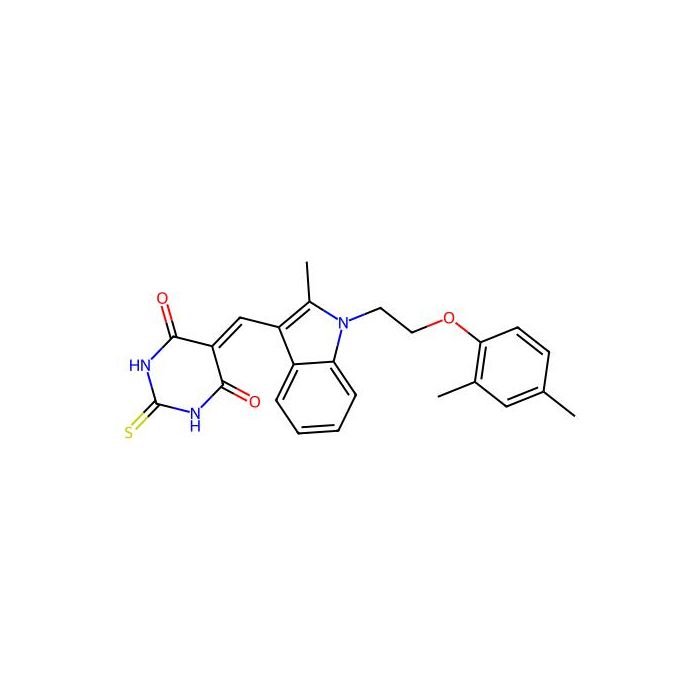
ZLDI-8 - 10mM in DMSO , CAS No.667880-38-8

CAS: 667880-38-8 Cat. No.: Z655325 Formula: C24H23N3O3S Peso molecolare: 433.5 PubChem CID: 989566
Disponibile su ordine
QUALITÀ & PUREZZA 10mM in DMSO
Storage
Store at -80°C
Shipped In
Dry ice packs + Cold packs
★
Dimensione
Germania (EU)
USA*
Prezzo
Qtà
1ml
Z655325-1ml
Su ordinazione · 8–12 settimane
111,85€
Enter a quantity for the sizes you want to add.

Panoramica

ZLDI-8 is a Notch activating/cleaving enzyme ADAM-17 inhibitor and inhibits the cleavage of Notch protein. ZLDI-8 decreases the expression of pro-survival/anti-apoptosis and epithelial-mesenchymal transition (EMT) related proteins. ZLDI-8 is also a competitive and irreversible tyrosine phosphatase (Lyp) inhibitor with an IC 50 of 31.6 μM and a K i of 26.22 μM. ZLDI-8 inhibits the growth of MHCC97-H cells with an IC 50 of 5.32 μM

In Vitro

ZLDI-8 (0.03-30 μM; 6-72 hours; MHCC97-H cells) treatment reduces cell viability in a time- and dose-dependent manner. ZLDI-8 (1-10 μM; 6-72 hours; MHCC97-H cells) significantly decreases the level of NICD and the accumulation of NICD in the nucleus. ZLDI-8 could also reduce the expression of pro-survival/anti-apoptosis regulators, Survivin and cIAP1/2. And also increases the expression of epithelial marker E-Cadherin and reduced mesenchymal markers N-Cadherin and Vimentin. ZLDI-8 enhances chemotherapy effects on tumor cell proliferation blockage, induction of apoptosis and cell-cycle arrest by inhibiting Notch pathway and blocking chemical resistance. MCE has not independently confirmed the accuracy of these methods. They are for reference only. Cell Viability AssayCell Line: MHCC97-H cells Concentration: 0.03 μM, 0.1 μM, 0.3 μM, 1 μM, 3 μM, 10 μM, 30 μM Incubation Time: 6 hours, 12 hours, 24 hours, 48 hours, 72 hours Result: Emerged cytotoxic effect on MHCC97-H cells in a time- and dose-dependent manner. Western Blot AnalysisCell Line: MHCC97-H cells Concentration: 1 μM, 3 μM, 10 μM Incubation Time: 6 hours, 12 hours, 24 hours, 48 hours, 72 hours Result: Significantly decreased the level of NICD and the accumulation of NICD in the nucleus. Also reduced the expression of pro-survival/anti-apoptosis regulators, Survivin and cIAP1/2

In Vivo

ZLDI-8 (0.2-2 mg/kg; intraperitoneal injection; every two days; for 20 days; nude mice) treatment enhances the effect of Sorafenib on inhibiting tumor growth in nude HCC-bearing mice model . MCE has not independently confirmed the accuracy of these methods. They are for reference only. Animal Model: Nude mice with MHCC-97H cells Dosage: 2 mg/kg, 1 mg/kg, 500 μg/kg, or 200 μg/kg Administration: Intraperitoneal injection; every two days; for 20 days Result: Inhibited tumor growth in nude HCC-bearing mice model.

IC50& Target:ADAM-17, IC50: 31.6 μM (Tyrosine phosphatase), Ki: 26.22 μM (Tyrosine phosphatase)

Specifiche

Specifiche e purezza
10mM in DMSO
Meccanismi biochimici e fisiologici
ZLDI-8 is a Notch activating/cleaving enzyme ADAM-17 inhibitor and inhibits the cleavage of Notch protein. ZLDI-8 decreases the expression of pro-survival/anti-apoptosis and epithelial-mesenchymal transition (EMT) related proteins. ZLDI-8 is also a compet
Condizioni di conservazione di stoccaggio
Store at -80°C
Spedito in
Dry ice packs + Cold packs
Questo prodotto richiede spedizione a catena fredda. I servizi di terra e altri servizi economici non sono disponibili.
Nomi e identificatori
Isomeri SMILES
CC1=CC(=C(C=C1)OCCN2C(=C(C3=CC=CC=C32)C=C4C(=O)NC(=S)NC4=O)C)C
PubChem CID
989566
Peso molecolare
433.5

Dati avanzati

Certificati (CoA, COO, BSE/TSE e tabella di analisi)
C of A & Other Certificates(BSE/TSE, COO):
Analytical Chart:
Calcolatori di soluzioni
Recensioni

Recensioni dei clienti

Application Protocols

No tested application protocols are provided in this listing.

  • Recommended assay types, dilutions, or detection methods: Not specified for this item; refer to CoA/Spec Sheet.

General protocol framework for screening compounds:

  • Prepare a 10–50 mM DMSO stock; verify concentration by UV or qNMR if feasible.
  • Perform serial dilutions (e.g., 1:3 or 1:10) in DMSO, then back-dilute into assay buffer to the desired top concentration while matching vehicle across all wells.
  • Include solubility/aggregation controls: detergent control wells, light scattering checks, and post-assay inspection for precipitate.
  • Record plate maps and maintain cold-chain for stability-sensitive compounds; minimize light exposure if chromophores are suspected.
  • Confirm identity/purity of working stocks by LC–MS before and after the assay campaign.
Biological Roles

No definitive biological function, target, or pathway information is provided for this product entry. Any target specificity or mode-of-action claims must be derived from peer-reviewed literature associated with the exact structure corresponding to CAS 667880-38-8.

General considerations for research-use small molecules:

  • Screen compounds are often employed as chemical probes to interrogate biological pathways. Prior to use, verify identity/purity, confirm absence of pan-assay interference (PAINS) motifs, and assess colloidal aggregation risks.
  • Establish baseline data: solubility in assay buffer, cytotoxicity window, and potential fluorescence/absorbance interference at readout wavelengths.
  • Where a target is hypothesized from literature, perform orthogonal assays (biochemical vs cellular) to corroborate on-target activity and rule out redox cycling or membrane disruption artifacts.
  • For mechanism exploration, complement activity data with target engagement assays (e.g., CETSA, DARTS) and structure–activity relationship (SAR) controls if analogs are available.

Important: This product is supplied strictly for research use only. It is not intended for use in humans, animals, diagnostics, or therapeutic applications.

Buffer Applications

This item is a small-molecule screening compound and is not a buffering reagent. No buffer system or pKa data are provided.

Practical assay-related notes (general):

  • Prepare concentrated DMSO stocks and dilute into your assay buffer (e.g., PBS, HEPES, Tris) to the lowest feasible final DMSO% that maintains solubility and does not perturb the biology.
  • If precipitation occurs upon dilution, consider: (a) warming to ambient temperature; (b) brief sonication; (c) adding non-ionic surfactant (e.g., 0.01–0.05% Tween-20); or (d) using cyclodextrin carriers.
  • Maintain constant vehicle control across wells to account for solvent effects.

Item-specific buffer recipes, buffering ranges, or compatibility data: Not specified for this item; refer to CoA/Spec Sheet.

Green Alternatives

As a screening compound, ZLDI-8 is typically handled in micro- to milligram quantities; the main greenness levers involve solvent choice and waste minimization rather than replacement of the compound itself.

Greener handling strategies (general):

  • Prefer DMSO–water mixtures over purely aprotic polar solvents (DMF, NMP) when compatible with assay and stability.
  • Minimize organic solvent volumes by using high-concentration stocks and acoustic dispensing for plate setup.
  • For analytical workflows, consider acetonitrile over halogenated solvents; use aqueous buffered mobile phases when possible.
  • Implement closed, low-dead-volume systems to reduce evaporative losses and emissions.

Illustrative comparison (general solvent considerations):

  • DMSO vs DMF/NMP: DMSO offers comparable solvency with a more favorable environmental and toxicological profile; DMF/NMP carry stricter hazard classifications.
  • MeOH/EtOH vs CH2Cl2/THF: Alcohols are generally greener than chlorinated solvents; THF poses peroxide risk and may require stabilizers.

Operational tips:

  • Consolidate waste streams and label DMSO-rich aqueous waste appropriately.
  • Validate that greener solvent choices do not compromise compound stability (monitor by LC–MS over time).

Note: No item-specific environmental metrics or life-cycle data are available for this compound.

Pharmaceutical Uses

No pharmacopeial status, excipient role, or formulation use is provided for this product. ZLDI-8 is supplied strictly as a research-use compound.

General notes (non-clinical, non-therapeutic):

  • If used in preclinical discovery experiments, ensure compound quality and stability are suitable for the intended in vitro studies. Establish forced-degradation profiles to understand storage and handling limits.
  • For any in vivo exploratory research (institutional approvals required), comprehensive ADME/tox characterization and GMP-grade sourcing would be necessary; this catalog entry does not provide such specifications.

Item-specific regulatory/compendial information: Not specified for this item; refer to CoA/Spec Sheet.

Physical Properties

Item-specific physical constants are not provided in this listing.

  • Appearance: Not specified for this item; refer to CoA/Spec Sheet.
  • Melting point (mp): Not specified for this item; refer to CoA/Spec Sheet.
  • Boiling point (bp): Not applicable/unknown for a library solid; refer to CoA.
  • Density: Not specified for this item; refer to CoA/Spec Sheet.
  • Refractive index: Not applicable to solids; if oil, refer to CoA.
  • Solubility: Not specified for this item; refer to CoA/Spec Sheet.
  • LogP/logD: Not specified for this item; refer to CoA/Spec Sheet.
  • pKa(s): Not specified for this item; refer to CoA/Spec Sheet.

General guidance for small-molecule screening compounds (literature/practice):

  • Many drug-like solids are sparingly soluble in water but dissolve well in DMSO (≥10–50 mM stocks). If aqueous use is required, employ co-solvents (DMSO 0.1–1% v/v in assay), surfactants (0.01–0.05% Tween-20), or cyclodextrin complexation.
  • Assess solubility empirically via incremental DMSO addition and visual clarity checks, or nephelometry.
  • For hygroscopic or polymorphic materials, equilibrate to room temperature in a sealed container before opening to avoid moisture condensation.
  • If LC-UV quantitation is planned, determine the UV-spectrum to select appropriate detection wavelengths (general; not item-specific).
Quality and Grades

This listing does not include an explicit grade or purity specification.

  • Grade/Purity: Not specified for this item; refer to CoA/Spec Sheet.

Interpretation and guidance:

  • In screening libraries, materials are typically supplied at research grade, accompanied by analytical data (e.g., purity by HPLC/UPLC and identity by MS/NMR). Confirm acceptance criteria on the CoA provided with the lot you receive.
  • If supplying pre-dissolved DMSO stocks or plate formats, verify concentration by quantitative NMR (qNMR) or UV-Vis (if chromophore present) to supplement HPLC area-percent.
  • For applications sensitive to trace impurities (e.g., target engagement biophysics), request or perform additional analyses (e.g., LC–MS purity across multiple wavelengths, residual solvent screening, water content by KF), as relevant.
  • If a stabilizer or antioxidant is present, it will be declared on the CoA/label; none is specified here. Absence of a declared stabilizer does not imply stability—validate stability under your storage and assay conditions.

Documentation:

  • Always rely on the lot-specific CoA/Spec Sheet for definitive purity, assay, and analytical details. Contact Technical Support for higher-grade requirements or custom QC.
Reaction and Applications

This catalog entry is positioned as a small-molecule screening compound, not a synthetic reagent. There are no item-specific reaction use-cases provided.

Practical applications relevant to screening compounds (general guidance):

  • Biochemical and cell-based assays: Use as a test article to probe target pathways in discovery research. Validate concentration-response relationships and compound integrity throughout the assay window.
  • Biophysical binding methods: Suitable for techniques such as DSF, MST, ITC, SPR provided sufficient solubility and absence of aggregation. Pre-screen for PAINS and colloidal aggregation using detergent controls and DLS.
  • Analytical applications: Employ in LC–MS/MS method development as a test analyte for gradient and ionization optimization when structure is known.

If you intend to use ZLDI-8 in chemical synthesis:

  • No literature-supported transformations or reagent roles are provided here. Treat as an end-product rather than a synthon, unless you possess route-specific knowledge of its functional groups (which are not specified in this listing).

Always consult the primary literature or the CoA for any structure-dependent application claims.

Reaction Conditions

Not applicable. ZLDI-8 is not supplied as a reagent with defined reaction roles, and no item-specific synthetic or transformation conditions are provided in this listing.

General notes relevant to handling in experimental workflows:

  • For assay preparation, dissolve in anhydrous DMSO to make a high-concentration stock, then dilute into buffered media while keeping final DMSO low (typically ≤0.1–1% v/v).
  • Monitor chemical stability under your assay conditions (temperature, light exposure, pH) by LC–MS or HPLC. Reassess potency after storage to detect degradation.
  • If analytical derivatization is required for detection, optimize conditions empirically with small aliquots; do not assume compatibility without structure-specific information.
Safety and Handling

Hazard data are not provided for this specific item. Handle as a potentially hazardous laboratory chemical and defer to the SDS for authoritative guidance.

  • Signal word (GHS): Not specified for this item; refer to SDS.
  • Hazard statements/Pictograms/GHS class: Not specified for this item; refer to SDS.

General laboratory precautions (best practice):

  • Use in a chemical fume hood; avoid inhalation, ingestion, and skin/eye contact.
  • Wear appropriate PPE: lab coat, safety glasses, and nitrile gloves (double-glove if handling DMSO stocks). Change gloves regularly.
  • Prevent aerosol formation during plate dispensing; use filtered tips and closed systems where possible.
  • Incompatibilities (general): Strong oxidizers and strong bases/acids may cause degradation depending on structure; avoid prolonged exposure to moisture and light until stability is known.
  • First aid (overview): In case of contact, rinse skin/eyes with water for ≥15 min; remove contaminated clothing. If inhaled, move to fresh air. If ingested, rinse mouth. Seek medical attention per SDS.
  • Waste: Dispose as organic laboratory waste according to institutional and local regulations. Collect DMSO solutions as halogen-free organic waste unless otherwise classified.
  • Always consult the SDS specific to ZLDI-8 (CAS 667880-38-8) prior to use.
Solvent Selection

This product is a small-molecule screening solid; dissolution strategy is central to usage. No item-specific solubility data are provided.

General dissolution guidance (practice/literature):

  • Primary solvent: DMSO for stock solutions (commonly 10–50 mM), due to broad solvency for heteroaromatic and drug-like scaffolds.
  • Alternative polar aprotics: DMF, NMP when DMSO is unsuitable; evaluate assay compatibility and cytotoxicity if used in biological systems.
  • Aqueous use: Prepare DMSO stocks then dilute into assay buffer to a final DMSO of ≤0.1–1% v/v, depending on assay tolerance. Consider cosolvent systems (DMSO:water 1:1) or cyclodextrins to enhance aqueous solubility.
  • Volatile organics: Acetonitrile, methanol, ethanol are useful for analytical sample prep; confirm compound stability to protic solvents.

Selection considerations:

  • If the compound is suspected to have acid/base functionality, adjust pH of aqueous media to favor ionization (for solubility) or neutrality (for permeability), as needed.
  • For storage stocks, prefer anhydrous, oxygen-limited conditions; avoid repeated freeze–thaw cycles.

Mini comparison (general):

  • DMSO: highest solvency; low volatility; widely assay-compatible at low %.
  • DMF/NMP: strong solvency; higher toxicity concerns; use sparingly.
  • MeOH/EtOH: convenient; may cause acetal/ester exchange or solvolysis in sensitive chemotypes—verify stability.
Storage and Reconstitution

Follow the item-specific storage instructions and shipping conditions below.

  • Storage Conditions (item-specific): Store at -80°C.
  • Shipped In (item-specific): Dry ice packs + Cold packs.

General best practices for small-molecule screening solids and DMSO stocks:

  • Upon arrival, allow the sealed container to equilibrate to room temperature before opening to prevent moisture condensation.
  • If supplied as a solid: subdivide into single-use aliquots under dry, inert atmosphere where possible. Protect from light and moisture until stability is known.
  • For reconstitution: dissolve in anhydrous DMSO to prepare a concentrated stock (e.g., 10–50 mM). Filter through a 0.2 μm PTFE syringe filter if particulates are present and compatible.
  • Store DMSO stocks at -20 to -80°C in amber vials; avoid frost-free freezers and minimize freeze–thaw cycles by aliquoting. Record make-date and perform periodic LC–MS checks for degradation.
  • Avoid prolonged exposure to air and humidity; recap promptly. Do not store aqueous working solutions beyond their verified stability window without analytical confirmation.

Item-specific stabilizers, excipients, or formulation details: Not specified for this item; refer to CoA/Spec Sheet.

Research Use Note: For research use only.

Structure and Identity

Brief overview: ZLDI-8 is listed as a research-use small molecule in our screening compound collection. The structural identifiers for this specific catalog entry are incomplete in the present record.

  • Product Name: ZLDI-8 (screening compound)
  • SKU: Z655325
  • CAS: 667880-38-8
  • PubChem CID: 989566
  • InChIKey: Not specified for this item; refer to CoA/Spec Sheet.
  • SMILES: Not specified for this item; refer to CoA/Spec Sheet.
  • Molecular Formula: Not specified for this item; refer to CoA/Spec Sheet.
  • Molecular Weight: Not specified for this item; refer to CoA/Spec Sheet.

Structural description (general):

  • Item-specific ring systems, heteroatoms, stereochemistry, and functional group pattern are not provided in this entry. Consult the Certificate of Analysis (CoA) or an authoritative structure database keyed to the provided CAS or CID for a definitive 2D structure.

Notes for identity verification (general best practices):

  • Verify identity by HRMS (exact mass), 1H/13C NMR, and, where applicable, HPLC/UPLC retention time against a reference.
  • If the compound contains potential stereocenters or atropisomers, confirmation by chiral HPLC or VCD/ECD may be warranted (general guidance; not item-specific).
  • For plate-based libraries, confirm well mapping and barcode traceability before biological testing.
Synthetic Utility

This product is offered as a discrete small molecule for screening and is not positioned as a general synthetic reagent or building block in this listing.

General guidance if derivatization is contemplated (structure-dependent, not item-specific):

  • If functional handles exist (e.g., aryl halide, anilide, carboxyl, nitrile), typical transformations may include cross-coupling (Suzuki/ Buchwald–Hartwig), amide coupling, nitrile reductions, or heteroaromatic functionalization. However, no such handles are confirmed here.
  • Protect potentially labile moieties before multi-step manipulations, and monitor for tautomerism or atropisomerism if the scaffold suggests these features.
  • For SAR exploration, consider parallel synthesis using microscale automated platforms with rapid LC–MS QC.

Item-specific functional groups and reactivity: Not specified for this item; refer to CoA/Spec Sheet and primary literature tied to CAS 667880-38-8.

Target Specificity

Target, pathway, or biochemical specificity is not provided for this catalog entry.

  • Item-specific target/epitope/assay-validated activity: Not specified for this item; refer to CoA/Spec Sheet and peer-reviewed literature associated with CAS 667880-38-8 or CID 989566.

Guidance (general):

  • Establish specificity using orthogonal assays and counter-screens against related targets. Include negative controls and, where available, a structural analog lacking activity.
  • Evaluate potential off-target liabilities with profiling panels or chemoproteomics when advancing hits.

Desidera che le inviamo un messaggio quando avremo sconti disponibili?

Ricordamelo più tardi

Grazie! Controlli la sua casella di posta per confermare.

Ops! Le notifiche sono disabilitate.