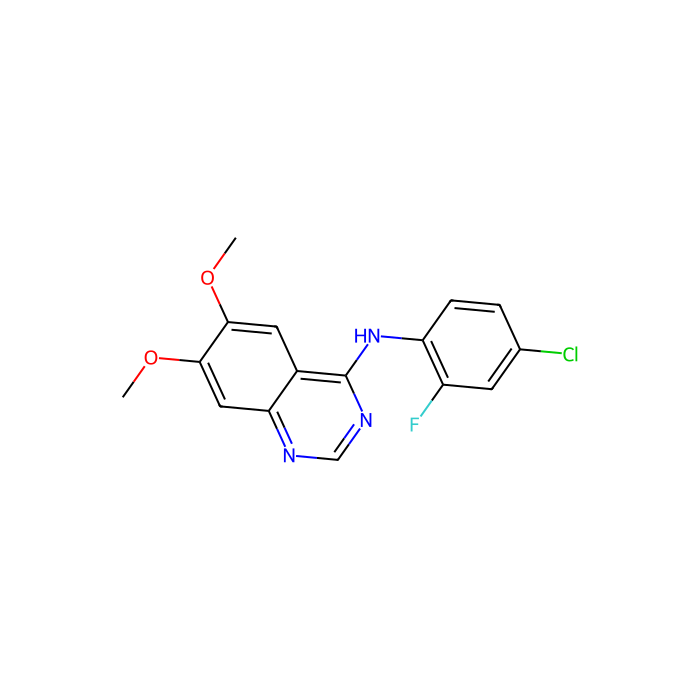
ZM 306416 - Moligand™, 10mM in DMSO , Inhibitor of epidermal growth factor receptor;Inhibitor of fms related receptor tyrosine kinase 1;Inhibitor of kinase insert domain receptor, CAS No.690206-97-4, Inhibitor of epidermal growth factor receptor;Inhibitor of fms related receptor tyrosine kinase 1;Inhibitor of kinase insert domain receptor

CAS: 690206-97-4 Cat. No.: Z409010 Formula: C16H13ClFN3O2 Peso molecolare: 333.74 PubChem CID: 5329006
Disponibile su ordine
GRADE & PURITY Moligand™ ? Moligand™ — Aladdin's line of ligands and bioactive small molecules. Use for receptor, pathway, and binding studies needing defined small-molecule tools. 10mM in DMSO
Synonyms
CB 676475 | 4-Quinazolinamine, N-(4-chloro-2-fluorophenyl)-6,7-dimethoxy-
Storage
Store at -80°C
Shipped In
Dry ice packs + Cold packs
★
Size
Germania (EU)
USA*
Price
Qty
1ml
Z409010-1ml
Su ordinazione · 8–12 settimane
154,37€
Enter a quantity for the sizes you want to add.
🧪
Why this grade

Moligand™, 10mM in DMSO Moligand™ for sensitive chromatographic and analytical workflows requiring minimal baseline interference.

🌡

Storage & shipping

Store at -80°C Ships Dry ice packs + Cold packs Check lot-specific COA for exact specifications.

📋

Quality documents

SDS, COA, datasheet, and spec sheet available for download. Lot-specific COA accessible via lot number lookup.

📚

Literature proof

Cited in 0 peer-reviewed publications across chromatography, organic synthesis, and cross-coupling reactions.

Panoramica

Information

ZM 306416 (CB 676475) is a VEGFR (Flt and KDR) inhibitor forVEGFR1withIC50of 0.33 μM, but also found to inhibit EGFR with IC50 of <10 nM.
In vitro

ZM-306416 induces selective antiproliferative effect toward the EGFR-addicted NSCLC cell lines H3255 and HCC4011 with IC50 of 0.09 µM and 0.072 µM, respectively. ZM-306416 inhibits granule formation with IC50 of 0.67 μM. ZM-306416 significantly inhibits the ERRα assay with IC50 of 7.3 μM in the GeneBLAzer T-Rex RORγ-UAS-bla HEK293T cell line. ZM306416 (300 nM) completely inhibits PAA secretion and stimulates [125]I uptake in human thyroid follicular cells. ZM306416 (300 nM) abolishes pVEGFR2 (Y1214) expression in human thyroid follicular cells. ZM306416 (< 10 μM) has marked inhibitory effects on the steady state phosphorylation of p42/44 MAPK but does not affect the expression of the unphosphorylated form. ZM306416 (3 μM) significantly increases cell death in human thyroid follicular cells. ZM306416 (3 μM) significantly increases cell death in human thyroid follicular cells. ZM306416 weakly inhibits the secretion of VEGF and increases the production of PlGF. ZM306416 (1 μM) enhances follicle formation and decreased nuclear distribution in human thyroid follicular cells.

In vivo


Cell Data

cell lines:

Concentrations:

Incubation Time:

Powder Purity:≥99%

Specifications

Sinonimi
CB 676475 | 4-Quinazolinamine, N-(4-chloro-2-fluorophenyl)-6,7-dimethoxy-
Specifiche e purezza
Moligand™, 10mM in DMSO
Meccanismi biochimici e fisiologici
ZM 306416 (CB 676475) is a VEGFR (Flt and KDR) inhibitor for VEGFR1 with IC50 of 0.33 μM, but also found to inhibit EGFR with IC50 of <10 nM.
Condizioni di conservazione di stoccaggio
Store at -80°C
Spedito in
Dry ice packs + Cold packs
Questo prodotto richiede spedizione a catena fredda. I servizi di terra e altri servizi economici non sono disponibili.
Grado
Moligand™
Tipo di azione
INHIBITOR
Meccanismo d'azione
Inhibitor of epidermal growth factor receptor;Inhibitor of fms related receptor tyrosine kinase 1;Inhibitor of kinase insert domain receptor
Nomi e identificatori
Isomeri SMILES
COC1=C(C=C2C(=C1)C(=NC=N2)NC3=C(C=C(C=C3)Cl)F)OC
PubChem CID
5329006
Peso molecolare
333.74

Documentazione

📋 Safety Data Sheet (SDS)

Comprehensive hazard, handling, storage, and regulatory compliance document.

Download SDS →

✅ Certificate of Analysis (COA)

Lot-specific quality data. Enter your lot number to retrieve the exact COA.

Look up COA →

📊 Datasheet

Quick-reference summary of product specifications and applications.

View datasheet →

🔬 Specification Sheet

Full quality attributes and acceptance criteria for this grade.

View spec sheet →

Advanced Data

Obiettivi associati (umani)
EGFR Tclin Epidermal growth factor receptor (1 Activities)
Activity TypeActivity Value -log(M)Mechanism of ActionActivity ReferencePublications (PubMed IDs)
KDR Tclin Vascular endothelial growth factor receptor 2 (1 Activities)
Activity TypeActivity Value -log(M)Mechanism of ActionActivity ReferencePublications (PubMed IDs)
Certificati (CoA, COO, BSE/TSE e tabella di analisi)
C of A & Other Certificates(BSE/TSE, COO):
Analytical Chart:
Proprietà chimiche e fisiche
SolubilitàSolubility (25°C) In vitro DMSO: 4 mg/mL (14.69 mM); Water: Insoluble; Ethanol: Insoluble;
Calcolatori di soluzioni
Recensioni

Recensioni dei clienti

Application Protocols

No validated application protocols are supplied in the Product Data. The following outlines general, non-item-specific procedures for small-molecule screening.

  • Stock preparation (general)

    • Allow vial to equilibrate to room temperature in a desiccator before opening to prevent condensation.
    • Prepare a 10–50 mM stock in anhydrous DMSO. Vortex and sonicate briefly if needed. Record exact concentration by weight-in or by UV if a reliable ε is available.
    • Aliquot into low-bind tubes or plates (10–50 μL) to avoid repeated freeze–thaw.
  • Working solutions (general)

    • Serially dilute stocks in DMSO to create intermediate plates, then back-dilute into assay buffer to 0.1–1.0% final DMSO.
    • Include vehicle controls that exactly match the highest DMSO content.
  • Artifact controls (general)

    • Add 0.01–0.05% nonionic detergent to reduce colloidal aggregation where compatible.
    • For fluorescence assays, check intrinsic compound fluorescence/absorbance to set appropriate excitation/emission and inner-filter controls.
  • Documentation

    • Capture lot number, preparation date, solvent, concentration, and storage conditions in ELN/LIMS. Attach intake LC–MS/HPLC traces.
Biological Roles

No biological target, pathway, or role is provided for this item.

  • Item-specific

    • Target specificity/biological function: Not specified for this item; refer to CoA/Spec Sheet.
  • General considerations for small-molecule ligands (literature/general)

    • Small molecules can modulate protein function via orthosteric or allosteric binding, covalent modification (if electrophilic warheads are present), or by affecting protein–protein interactions.
    • Implement orthogonal assays (biophysical plus functional) to confirm true target engagement and rule out assay interference.
    • Apply PAINS/REOS filters and aggregator detection; include counterscreens against redox activity (e.g., horseradish peroxidase/Amplex assays) and fluorescence interference controls.
    • Assess basic ADME-relevant properties early (solubility at pH 7.4, logD7.4, microsomal stability) to contextualize phenotypic outcomes. These should be generated experimentally for this item if needed.
  • Important note

    • This product is for research use only and not for human or veterinary applications. Do not infer therapeutic relevance without comprehensive target validation.
Buffer Applications

This product is not a buffering agent. No buffer system role is specified.

  • Item-specific

    • Buffer usage: Not specified for this item; refer to CoA/Spec Sheet.
  • Practical notes for assay buffers with small-molecule stocks (general)

    • Maintain consistent final DMSO across wells/conditions (commonly 0.1–1.0% v/v) to avoid solvent-driven artifacts.
    • Use standard biological buffers appropriate to the assay: PBS (pH 7.2–7.4), HEPES (pH 7.0–8.0), Tris (pH 7.0–9.0), acetate (pH 4–5.5), or citrate (pH 3–6). Include 0.01–0.05% nonionic detergent for aggregation-prone chemotypes when compatible.
    • Filter buffers (0.22 μm) and degas for sensitive biophysical methods (ITC, SPR) to improve baseline stability.
Green Alternatives

Without item-specific solvent or process data, the dominant environmental consideration is solvent choice during stock preparation, assays, and analytical work.

  • Prefer greener solvents where compatible (literature/general)

    • Favor water or buffered aqueous systems wherever feasible.
    • Use ethanol (preferably bio-based) instead of isopropanol/methanol when assay tolerance allows.
    • Limit DMF, NMP, and dichloromethane due to toxicity and regulatory burdens; if used, minimize volumes and ensure closed systems.
  • Example comparison for stock/dilution workflows (literature/general)

| Use case | Conventional | Greener option | Trade-offs | |---|---|---|---| | Primary stock | DMSO | Water/ethanol (if soluble) | Solubility may be lower; stability can differ | | Analytical mobile phase | ACN/water | MeOH/water | Higher backpressure/viscosity with MeOH | | Workup/extraction | DCM/EtOAc | EtOAc/MTBE | Partition behavior can change |

  • Operational practices
    • Right-size aliquots to reduce waste from freeze–thaw losses.
    • Use microplate formats compatible with low dead volume to minimize solvent consumption.
    • Capture solvent usage in ELN/LIMS for continuous improvement and reporting.
Pharmaceutical Uses

No pharmaceutical or excipient use is claimed or specified for this product. It is supplied strictly for research use.

  • Item-specific

    • Compendial status (USP/EP/JP), GMP applicability, formulation roles: Not specified for this item; refer to CoA/Spec Sheet.
  • General context (literature/general)

    • In early discovery, compounds of this type may be used as tool molecules in preclinical research to explore target biology. Any progression toward development requires comprehensive CMC, safety, and efficacy studies—not covered by this research-use product.
    • Do not use in human or veterinary formulations. No clinical claims are made or implied.
Physical Properties

No item-specific physicochemical constants are provided in the Product Data for this Moligand library compound.

  • Item-specific

    • Appearance: Not specified for this item; refer to CoA/Spec Sheet.
    • Molecular weight: Not specified for this item; refer to CoA/Spec Sheet.
    • Melting/boiling point, density, refractive index, pKa, logP/logD, UV cutoff: Not specified for this item; refer to CoA/Spec Sheet.
    • Solubility: Not specified for this item; refer to CoA/Spec Sheet.
  • Practical characterization workflow (general guidance)

    • Solubility screening (literature/general): Begin with dry DMSO at 10–50 mM; if insoluble, try DMF or a minimal amount of EtOH or MeOH before aqueous dilution. Record maximum achievable concentration at room temperature.
    • Aqueous handling (literature/general): Prepare assay dilutions by spiking DMSO stocks into buffer to a final 0.1–1% DMSO (v/v), ensuring the compound remains in solution (visual check + nephelometry or plate reader light scatter).
    • UV/Vis profile (literature/general): Scan 200–400 nm in dilute MeOH or ACN/water (isocratic 60:40) to establish detection wavelengths for routine HPLC/UPLC tracking.
    • Ionization behavior (literature/general): If the structure contains ionizable groups, determine pKa by potentiometric titration or UV–pH profiling; use logD7.4 for biophysical comparisons.
    • Solid-state form (literature/general): If crystalline, determine polymorph/solvate state by PXRD/DSC; hygroscopicity by DVS. Note that such properties can affect dissolution and assay reproducibility.
Quality and Grades

This product is supplied as Moligand™ grade, suitable for small‑molecule screening and discovery workflows.

  • Item-specific

    • Grade: Moligand™.
    • Purity and analytical specifications: Not specified for this item; refer to CoA/Spec Sheet.
    • Stabilizers/format, residual solvents, water/peroxide/metal limits, UV cutoff: Not specified for this item; refer to CoA/Spec Sheet.
  • What Moligand™ typically denotes (general description; not item-specific specs)

    • Intended for hit-finding, ligand characterization, and SAR exploration in biochemical, biophysical, and cell-based assays.
    • Supplied with identity confirmation (commonly LC–MS) and a chromatographic purity trace (e.g., HPLC/UPLC). Exact methods/thresholds vary by item—verify on the CoA.
    • Packaging is optimized for low-temperature storage and minimal freeze–thaw cycling (e.g., small aliquots or plate formats where applicable).
  • Quality verification on receipt (practical guidance)

    • Cross-check CAS/CID, batch/lot, and any spectral data on the CoA.
    • Run an intake LC–MS and orthogonal purity check (e.g., evaporative light scattering or CAD + UV) to confirm match to CoA before broad distribution in screening.
    • Document salt form and hydration state; normalize concentrations to free‑base/free‑acid when reporting assay data.
Reaction and Applications

This catalog entry is supplied as a discovery library small molecule. No synthetic or transformation applications are specified.

  • Item-specific

    • Manufacturer applications: Not specified for this item; refer to CoA/Spec Sheet.
  • Practical research applications (general/literature)

    • Ligand screening: Use in biochemical or biophysical assays (e.g., enzyme inhibition, receptor binding, DSF/TSA, MST, SPR) to identify hits.
    • Cellular assays: Test for phenotypic responses with appropriate controls for cytotoxicity and off-target effects; maintain consistent DMSO levels across wells.
    • Analytical reference: May serve as an LC–MS/UPLC method development standard for retention behavior comparators within a library subset.
  • Not typically applicable

    • Named organic reactions or reagent roles are not typically relevant unless the structure is intended as a building block. No reaction reactivity data are provided for this item.
  • Good practices

    • Track lot/batch across experiments. Capture raw dose–response data, curve fits, and counterscreen outcomes to rule out assay interference (e.g., redox cycling, aggregation). Employ detergent (e.g., 0.01–0.05% Tween‑20) or BSA where compatible to mitigate colloidal artifacts.
Reaction Conditions

No reaction conditions or synthetic transformations are specified or applicable for this product in its intended use (screening library member).

  • Item-specific

    • Reaction conditions, catalysts, yields: Not specified for this item; refer to CoA/Spec Sheet.
  • General guidance

    • If the compound is repurposed as a substrate or building block, select reaction conditions based on its verified functional groups and stability profile (thermolabile motifs, acid/base sensitivity, redox behavior). Without structure, reaction guidance would be speculative and is not provided here.
Safety and Handling

Handle as a research-use-only small molecule of unknown hazard profile. No GHS details are provided in the Product Data; defer to the SDS for authoritative information.

  • Item-specific

    • Research Use Note: For research use only.
    • Storage: Store at −80 °C.
    • Shipping: Dry ice packs + cold packs.
    • GHS classification, signal word, pictograms, hazard statements: Not specified for this item; refer to SDS.
  • General precautions (literature/general)

    • Work in a chemical fume hood. Wear appropriate PPE: lab coat, safety glasses, and nitrile gloves. Avoid inhalation, ingestion, and skin/eye contact.
    • Assume unknown acute/chronic toxicity; minimize exposure. DMSO solutions can enhance dermal absorption—avoid skin contact with solutions.
    • Incompatibilities (unknown item-specific): Until data are available, avoid contact with strong oxidizers/reducers and reactive acids/bases. Keep away from ignition sources if volatile solvents are used.
    • First aid (overview; consult SDS): Skin/eye contact—rinse with water for ≥15 min; remove contaminated clothing. Inhalation—move to fresh air. Ingestion—rinse mouth; seek medical attention. Provide SDS to responders.
    • Spill/cleanup: Absorb with inert material (vermiculite), collect in labeled waste for disposal per institutional and local regulations.
    • Waste: Dispose of solids/solutions as organic chemical waste; segregate halogenated/non‑halogenated solvent streams as applicable.
Solvent Selection

No solvent or solubility specifications are provided for this compound. For discovery library members, DMSO is the default stock solvent, followed by aqueous dilution into assay buffers.

  • Item-specific

    • Solvent recommendations: Not specified for this item; refer to CoA/Spec Sheet.
  • General solvent strategy for screening compounds (literature/general)

    • Primary stock: Dry DMSO at 10–50 mM; vortex, brief sonication if needed. Filter through 0.2 μm PTFE if particulates persist.
    • Assay dilution: Titrate DMSO stocks into buffer (e.g., PBS, HEPES) to 0.1–1.0% final DMSO, verifying solubility (no precipitation/turbidity).
    • Alternatives: If DMSO fails, test DMF, MeOH, or EtOH for stock preparation; confirm assay tolerance to co‑solvent. For basic/acidic compounds, adjust buffer pH to favor ionization and solubility.
  • Miscibility and polarity comparison (literature/general)

| Solvent | Dielectric constant (25 °C) | Notes | |---|---:|---| | DMSO | ~47 | Excellent solubilizer; widely tolerated up to 0.5–1% in assays | | DMF | ~38 | Strong solvent; consider toxicity/assay effects | | Ethanol | ~25 | Volatile; often tolerated ≤1–2% | | Methanol | ~33 | Useful for analytical prep; cytotoxic in cells | | Water | ~80 | Ideal if compound is sufficiently polar/ionized |

  • Tips
    • Pre-warm stubborn solids to 30–40 °C to aid dissolution (avoid degradation). Record final solvent composition in all assay reports.
Storage and Reconstitution
  • Item-specific

    • Storage conditions: Store at −80 °C.
    • Shipping: Dry ice packs + cold packs.
    • Stabilizers, shelf-life, and re-test interval: Not specified for this item; refer to CoA/Spec Sheet.
  • Reconstitution and handling (general guidance)

    • Before opening, allow the container to warm to room temperature in a desiccator to prevent moisture condensation, especially if the compound is hygroscopic.
    • Dissolve in dry, anhydrous solvent (commonly DMSO) to prepare a concentrated stock (10–50 mM). If insoluble, evaluate DMF, MeOH, or EtOH. Record final concentration and solvent.
    • Filter sterile if needed for cell-based work using 0.2 μm PTFE (for organic stocks) or PES (for aqueous solutions).
    • Aliquot into single-use portions to avoid freeze–thaw cycles. Store aliquots tightly sealed, desiccated, and protected from light if the compound is chromophoric (unknown—verify on CoA/SDS).
  • Stability monitoring (general)

    • Periodically check integrity by LC–MS and HPLC purity after extended storage or multiple freeze–thaw events.
    • For aqueous working solutions, use fresh preparations and limit room-temperature exposure to minimize hydrolysis/oxidation risks.
  • Not specified for this item

    • Solubility limits in common solvents, long-term stability data, and compatibility with plastics/glass: Not specified for this item; refer to CoA/Spec Sheet.
Structure and Identity

Concise identification information for this Moligand library member. Because structure details are not provided in the Product Data, treat this item as an unspecified small molecule intended for screening and discovery workflows.

  • Item-specific (from Product Data)

    • Product Name: ZM 306416 (SKU: Z409010)
    • CAS: 690206-97-4
    • PubChem CID: 5329006
    • Grade: Moligand™ (small-molecule ligand library)
    • Molecular formula: Not specified for this item; refer to CoA/Spec Sheet.
    • Molecular weight: Not specified for this item; refer to CoA/Spec Sheet.
    • SMILES: Not specified for this item; refer to CoA/Spec Sheet.
    • InChIKey: Not specified for this item; refer to CoA/Spec Sheet.
  • Structural features (general guidance)

    • No structural diagram or descriptors are supplied in the listing. Upon receipt, consult the CoA/Spec Sheet or vendor SDS for the exact structure, functional groups, and stereochemistry.
    • For internal records, capture: 2D structure (functional groups, ring systems), any chiral centers, and salt/solvate form. If the item is a salt, record the counterion and stoichiometry.
  • Practical identity checks (literature/general)

    • Recommended identity confirmation upon intake: LC–MS (exact mass), 1H NMR (DMSO‑d6 or CDCl3 as appropriate), and HPLC purity profile. Retain raw data in your compound registration system.
    • If multiple tautomers/protomers are possible, note the dominant form under your storage and assay conditions.
Synthetic Utility

This catalog entry is positioned as a screening library small molecule; no role as a reagent or building block is provided.

  • Item-specific

    • Synthetic applications, functional group handles, protecting-group compatibility: Not specified for this item; refer to CoA/Spec Sheet.
  • General notes (literature/guidance)

    • If internal use as a building block is contemplated, first confirm the exact structure and available handles (e.g., aryl halides for cross-coupling, amines/acids for amide couplings, aldehydes/ketones for condensation). Optimize coupling conditions based on the functional group manifold.
    • Absent structural information, no specific retrosynthetic or named-reaction guidance can be provided for this item.
Target Specificity

No target, pathway, or binding profile is provided in the Product Data.

  • Item-specific

    • Intended target(s), selectivity panel results, species reactivity: Not specified for this item; refer to CoA/Spec Sheet.
  • General guidance (literature)

    • Establish primary activity in a well-controlled assay, then run orthogonal and counterscreen panels to assess selectivity and liability against common off-targets (CYPs, hERG, kinases, etc.) as context dictates. Record AC50/IC50/Kd with full curve parameters and replicate statistics.

Need help choosing the grade?

Our grade selection guide covers purity, stabilizer status, and application suitability for all variants in our catalog.

View Moligand™ grade guide →

Shall we send you a message when we have discounts available?

Remind me later

Thank you! Please check your email inbox to confirm.

Oops! Notifications are disabled.