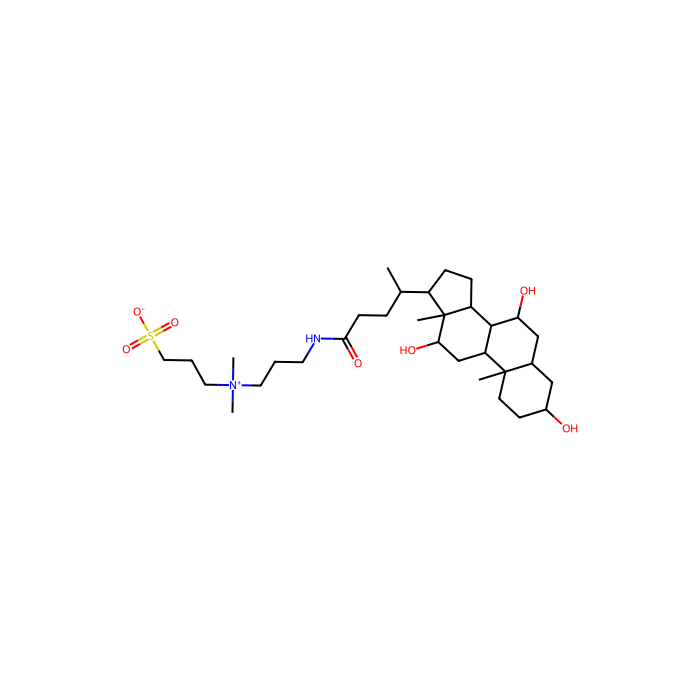
CHAPS - AR, ≥96% , CAS No.75621-03-3

CAS: 75621-03-3 Cat. No.: C141274 Molecular Weight: 614.88 EC Number: 616-246-2
AVAILABLE TO ORDER
GRADE & PURITY AR ? Analytical Reagent grade — high-purity chemicals meeting strict assay limits for lab analysis. Use when accuracy matters and trace impurities could skew results. ≥96%
Synonyms
1-Propanaminium, N,N-dimethyl-N-(3-sulfopropyl)-3-(((3alpha,5beta,7alpha,12alpha)-3,7,12-trihydroxy-24-oxocholan-24-yl)amino)-, hydroxide, inner salt | A865651 | QBP25342AG | 3-[(3-cholamidopropyl)dimethylammonio]-1-propanesulphonate | 3-((3-Cholamidoprop
Storage
Room temperature,Argon charged
Shipped In
Normal
 ·  off list, applied to all prices below.
Size
Status
Price
Qty
1g
C141274-1g
2
$9.90
5g
C141274-5g
2
$29.90
25g
C141274-25g
3
$109.90
100g
C141274-100g
1
$349.90
Enter a quantity for the sizes you want to add.
🧪

Why this grade

AR, ≥96% AR for sensitive chromatographic and analytical workflows requiring minimal baseline interference.

🌡

Storage & shipping

Room temperature,Argon charged Ships Normal Check lot-specific COA for exact specifications.

📋

Quality documents

SDS, COA, datasheet, and spec sheet available for download. Lot-specific COA accessible via lot number lookup.

📚

Literature proof

Cited in 8 peer-reviewed publications across chromatography, organic synthesis, and cross-coupling reactions.

Overview

CHAPS is a non-denaturing, zwitterionic detergent derived from cholic acid. CHAPS is often used as a detergent in the solubilization and purification of membrane proteins for several advantageous reasons. CHAPS detergent is non-denaturing to membrane proteins, can solubilize proteins, disaggregate protein-protein interactions and is electrically neutral. CHAPS is also useful in ion exchange chromatography and isoelectric focusing as it is zwitterionic and does not exhibit a net charge between pH 2 to 12. The critical micelle concentration of CHAPS is 6-10mM.
A non-denaturing, zwitterionic detergent for membrane proteins

Specifications

Synonyms
1-Propanaminium, N, N-dimethyl-N-(3-sulfopropyl)-3-(((3alpha, 5beta, 7alpha, 12alpha)-3, 7, 12-trihydroxy-24-oxocholan-24-yl)amino)-, hydroxide, inner salt | A865651 | QBP25342AG | 3-[(3-cholamidopropyl)dimethylammonio]-1-propanesulphonate | 3-((3-Cholamidoprop
Specifications & Purity
AR, ≥96%
Biochemical and Physiological Mechanisms
Zwitterionic non-denaturing detergent that protects the native state of proteins, able to disrupt non-specific protein interactions and has less protein aggregation than non-ionic detergents. It is electrically neutral and easily removed by dialysis.
Storage
Room temperature, Argon charged
Shipped In
Normal
Grade
AR
Note
Wherever possible, you should prepare and use solutions on the same day. However, if you need to make up stock solutions in advance, we recommend that you store the solution as aliquots in tightly sealed vials at -20°C. Generally, these will be useable for up to one month. Before use, and prior to opening the vial we recommend that you allow your product to equilibrate to room temperature for at least 1 hour. Need more advice on solubility, usage and handling? Please visit our frequently asked questions (FAQ) page for more details.
Purity
≥96%
Names and Identifiers
Canonical SmilesCC(CCC(=O)NCCC[N+](C)(C)CCCS(=O)(=O)[O-])C1CCC2C1(C(CC3C2C(CC4C3(CCC(C4)O)C)O)O)C
IUPAC Name3-[dimethyl-[3-[[(4R)-4-[(3R,5S,7R,8R,9S,10S,12S,13R,14S,17R)-3,7,12-trihydroxy-10,13-dimethyl-2,3,4,5,6,7,8,9,11,12,14,15,16,17-tetradecahydro-1H-cyclopenta[a]phenanthren-17-yl]pentanoyl]amino]propyl]azaniumyl]propane-1-sulfonate
InChIKeyUMCMPZBLKLEWAF-BCTGSCMUSA-N
INCHI1S/C32H58N2O7S/c1-21(8-11-29(38)33-14-6-15-34(4,5)16-7-17-42(39,40)41)24-9-10-25-30-26(20-28(37)32(24,25)3)31(2)13-12-23(35)18-22(31)19-27(30)36/h21-28,30,35-37H,6-20H2,1-5H3,(H-,33,38,39,40,41)/t21-,22+,23-,24-,25+,26+,27-,28+,30+,31+,32-/m1/s1
Isomeric SMILES C[C@H](CCC(=O)NCCC[N+](C)(C)CCCS(=O)(=O)[O-])[C@H]1CC[C@@H]2[C@@]1([C@H](C[C@H]3[C@H]2[C@@H](C[C@H]4[C@@]3(CC[C@H](C4)O)C)O)O)C
WGK Germany 3
Molecular Weight 614.88
Reaxy-Rn 32174087
Reaxys-RN_link_address https://www.reaxys.com/reaxys/secured/hopinto.do?context=S&query=IDE.XRN=32174087&ln=

Documentation

📋 Safety Data Sheet (SDS)

Comprehensive hazard, handling, storage, and regulatory compliance document.

Download SDS →

✅ Certificate of Analysis (COA)

Lot-specific quality data. Enter your lot number to retrieve the exact COA.

Look up COA →

📊 Datasheet

Quick-reference summary of product specifications and applications.

View datasheet →

🔬 Specification Sheet

Full quality attributes and acceptance criteria for this grade.

View spec sheet →

Advanced Data

Taxonomic Classification

Taxonomy Tree

KingdomOrganic compounds
SuperclassLipids and lipid-like molecules
ClassSteroids and steroid derivatives
SubclassBile acids, alcohols and derivatives
Intermediate Tree Nodes Hydroxy bile acids, alcohols and derivatives
Direct ParentTrihydroxy bile acids, alcohols and derivatives
Alternative Parents 12-hydroxysteroids  3-alpha-hydroxysteroids  7-hydroxysteroids  Tetraalkylammonium salts  Sulfonyls  Organosulfonic acids  Alkanesulfonic acids  Secondary alcohols  Cyclic alcohols and derivatives  Propargyl-type 1,3-dipolar organic compounds  Polyols  Carboximidic acids  Hydrocarbon derivatives  Amines  Organic oxides  Organic salts  Organic zwitterions  Organopnictogen compounds  
Molecular FrameworkAliphatic homopolycyclic compounds
Substituents Trihydroxy bile acid, alcohol, or derivatives - 3-hydroxysteroid - 12-hydroxysteroid - Hydroxysteroid - 3-alpha-hydroxysteroid - 7-hydroxysteroid - Cyclic alcohol - Quaternary ammonium salt - Organic sulfonic acid or derivatives - Organosulfonic acid or derivatives - Organosulfonic acid - Sulfonyl - Tetraalkylammonium salt - Alkanesulfonic acid - Secondary alcohol - Carboximidic acid derivative - Carboximidic acid - Organic 1,3-dipolar compound - Propargyl-type 1,3-dipolar organic compound - Polyol - Organic salt - Alcohol - Organosulfur compound - Organooxygen compound - Organonitrogen compound - Organopnictogen compound - Organic oxide - Organic nitrogen compound - Hydrocarbon derivative - Organic oxygen compound - Organic zwitterion - Amine - Aliphatic homopolycyclic compound
DescriptionThis compound belongs to the class of organic compounds known as trihydroxy bile acids, alcohols and derivatives. These are prenol lipids structurally characterized by a bile acid or alcohol which bears three hydroxyl groups.
External Descriptors 1,1-diunsubstituted alkanesulfonate
3D Structure
Interactive Chemical Structure Model


Mechanisms of Action
Certificates(CoA,COO,BSE/TSE and Analysis Chart)
C of A & Other Certificates(BSE/TSE, COO):
Analytical Chart:

Find and download the COA for your product by matching the lot number on the packaging.

22 results found

Lot NumberCertificate TypeDateItem
E2615271Certificate of AnalysisMay 20, 2026 C141274
G2222467Certificate of AnalysisMay 09, 2026 C141274
G2222456Certificate of AnalysisMay 09, 2026 C141274
J2509272Certificate of AnalysisOct 10, 2025 C141274
J2509271Certificate of AnalysisOct 10, 2025 C141274
J2509270Certificate of AnalysisOct 10, 2025 C141274
I2504836Certificate of AnalysisSep 06, 2025 C141274
I2504835Certificate of AnalysisSep 06, 2025 C141274
I2108187Certificate of AnalysisJun 09, 2025 C141274
D2503507Certificate of AnalysisApr 10, 2025 C141274
D2503567Certificate of AnalysisApr 10, 2025 C141274
E2110176Certificate of AnalysisFeb 07, 2025 C141274
E2428180Certificate of AnalysisJun 06, 2024 C141274
E2428156Certificate of AnalysisJun 06, 2024 C141274
D2409030Certificate of AnalysisMar 18, 2024 C141274
C2415010Certificate of AnalysisMar 18, 2024 C141274
G23261005Certificate of AnalysisJul 27, 2023 C141274
E2305660Certificate of AnalysisMay 06, 2023 C141274
B2302926Certificate of AnalysisFeb 07, 2023 C141274
B23021222Certificate of AnalysisFeb 07, 2023 C141274
B2212183Certificate of AnalysisFeb 19, 2022 C141274
B2212184Certificate of AnalysisFeb 19, 2022 C141274

Show more ⌵

Chemical and Physical Properties
SolubilitySoluble in water (10 mg/ml).
Sensitivitymoisture sensitive
Melt Point(°C)156-158℃
Molecular Weight614.900 g/mol
XLogP32.900
Hydrogen Bond Donor Count4
Hydrogen Bond Acceptor Count7
Rotatable Bond Count11
Exact Mass614.396 Da
Monoisotopic Mass614.396 Da
Topological Polar Surface Area155.000 Ų
Heavy Atom Count42
Formal Charge0
Complexity1030.000
Isotope Atom Count0
Defined Atom Stereocenter Count11
Undefined Atom Stereocenter Count0
Defined Bond Stereocenter Count0
Undefined Bond Stereocenter Count0
The total count of all stereochemical bonds0
Covalently-Bonded Unit Count1
Documents & Articles
Buffer Additives to Prevent Protein Precipitation
Eight Common Lysis Buffers
FAQ on Molecular Interaction Assays
A Panoramic Guide to Surfactants: Definitions & Mechanisms, Key Metrics, Application Scenarios, and Selection Navigation (Tables 1–3)
Protein Tags Demystified: Classification, Properties, and Suitable Experimental Applications
Plant Omics Panorama: Workflow Frameworks and Multi-Omics Integration from Genomics to Transcriptomics, Proteomics, and Metabolomics
dsDNase-Mediated Hydrolysis of Double-Stranded DNA: Enzymatic Characteristics, Methodological Strategies, and Bioanalytical Applications
Review of Chymotrypsin: Enzymological Properties, Catalytic Mechanism, and Research Applications
Research Framework for Multi-Enzyme Digestion Strategies and Optimization of Proteomic Coverage
Citations of This Product
References
1. Li Guanglei, Chen Yao, Liu Fei, Bi Wenhua, Wang Chenxin, Lu Danfeng, Wen Dan.  (2023)  Portable visual and electrochemical detection of hydrogen peroxide release from living cells based on dual-functional Pt-Ni hydrogels.  Microsystems & Nanoengineering,  (1): (1-10).  [PMID:38033990] [10.1038/s41378-023-00623-y]
2. Xu Daokun, Huang Haolun, Liu Zhen, Wang Yumei, Liu Qinan, Jiang Xing, Yang Jun, Ling Rui.  (2023)  Comprehensive characterization and detection of nut allergens in bakery foods using Q–TOF mass spectrometry and bioinformatics.  Food Quality and Safety,      [PMID:] [10.1093/fqsafe/fyad061]
3. Jie Zhao, Shuaiqian Wang, Diandian Jiang, Yan Lu, Yu Chen, Yong Tang, Jie Tang, Zhenju Jiang, Hongbin Lin, Wei Dong.  (2023)  Unravelling the interaction between α-SOH and myofibrillar protein based on spectroscopy and molecular dynamics simulation.  Food Chemistry-X,      [PMID:38144868] [10.1016/j.fochx.2023.100986]
4. Zhe Chen, Yunxia Wang.  (2023)  A label- and enzyme-free fluorescence assay based on thioflavin T–induced G-quadruplexes for the detection of telomerase activity.  JOURNAL OF CHEMICAL RESEARCH,      [PMID:] [10.1177/17475198221139085]
5. Pengfei Dong, Longyi Zhu, Jing Huang, Jujie Ren, Jianping Lei.  (2019)  Electrocatalysis of cerium metal-organic frameworks for ratiometric electrochemical detection of telomerase activity.  BIOSENSORS & BIOELECTRONICS,      [PMID:31108380] [10.1016/j.bios.2019.05.018]
6. Min Zhang, Chong-sheng Peng, Xiao-bo Li.  (2017)  Human intestine and liver microsomal metabolic differences between C19-diester and monoester diterpenoid alkaloids from the roots of Aconitum carmichaelii Debx..  TOXICOLOGY IN VITRO,      [PMID:28919359] [10.1016/j.tiv.2017.09.011]
7. Feifei Gong, Huaxin Yang, Wen Sun, Junzi Cao, Wanhui Liu.  (2015)  Development and validation of a micellar electrokinetic capillary chromatography method for the determination of goserelin and related substances.  ELECTROPHORESIS,  37  (4): (623-629).  [PMID:26635325] [10.1002/elps.201500328]
8. Fu Zeng, Lian Huang, Ding Han, Renjie Liu, Kongjia Zhang, Yuwen Su, Tong Su, Yarong Lin, Jianbo Xiu.  (2025)  An Improved SHANEL Procedure for Clearing and Staining Brain Tissue from Multiple Species.  INTERNATIONAL JOURNAL OF MOLECULAR SCIENCES,  26  (8): (3569).  [PMID:40332069] [10.3390/ijms26083569]
Solution Calculators
Reviews

Customer Reviews

Need help choosing the grade?

Our grade selection guide covers purity, stabilizer status, and application suitability for all variants in our catalog.

View AR grade guide →

Shall we send you a message when we have discounts available?

Remind me later

Thank you! Please check your email inbox to confirm.

Oops! Notifications are disabled.