QUALITÉ & PURETÉCarrier Free?Carrier-free — supplied without added carrier protein/stabilizer. Use when carriers (e.g. BSA) would interfere with conjugation or sensitive assays.ExactAb™?ExactAb™ — Aladdin's antibody line emphasizing precision and validated quality. Use for reliable, specificity-validated antibody applications.Azide Free?Azide-free — without sodium azide preservative. Use in conjugations, cell work, or assays where azide is toxic or inhibitory.Validated?Validated grade — performance confirmed in defined applications before release. Use when you want documented assurance the reagent works as stated.High Performance?High-performance grade with optimized purity and performance characteristics. Use for sensitive analyses where ordinary grades fall short.PBS Only?PBS-only formulation — supplied in phosphate-buffered saline with no other additives. Use when you need a clean PBS buffer free of stabilizers/carriers.≥95%(SDS-PAGE)1.0 mg/mL
Carrier Free,ExactAb™,Azide Free,Validated,High Performance,PBS Only,≥95%(SDS-PAGE),1.0 mg/mL Azide Free,Carrier Free,ExactAb™,High Performance,PBS Only,Validated pour les flux de travail chromatographiques et analytiques sensibles nécessitant une interférence de ligne de base minimale.
🌡
Stockage & expédition
Store at -20°C,Avoid repeated freezing and thawing Expédition Ice chest + Ice pads. Consultez le COA spécifique au lot pour les spécifications exactes.
📋
Documents qualité
SDS, COA, fiche technique et fiche de spécifications disponibles au téléchargement. COA spécifique au lot accessible via la recherche par numéro de lot.
📚
Preuve documentaire
Cité dans 0 publications à comité de lecture couvrant la chromatographie, la synthèse organique et les réactions de couplage croisé.
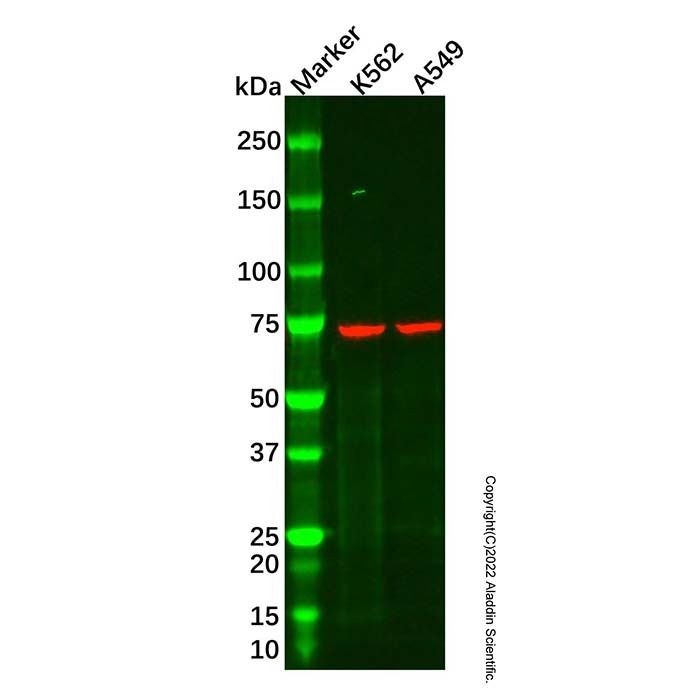
WB: HeLa, HEK293, A549 and K562 whole cell lysates
Conjugation
Unconjugated
Grade
Azide Free, Carrier Free, ExactAb™, High Performance, PBS Only, Validated
Isotype
Mouse IgG2a
Type de chaîne lumineuse
kappa
SDS-PAGE
150.0 KDa
Méthode de purification
Protein A purified
Concentration
1.0 mg/mL
Product Line
Produits biologiques
Stockage et expédition
Conditions de stockage de stockage
Store at -20°C,Avoid repeated freezing and thawing
Expédié en
Ice chest + Ice pads
Stabilité et stockage
Store at 4°C short term (1-2 weeks). Store at -20°C or -80°C. Avoid freeze / thaw cycle.
Images
Hsp70 Mouse mAb (Ab187005) - Western Blot All lanes: Hsp70 Mouse Antibody (Ab187005) at 1/2000 dilution Samples: Lysates at 20 µg per lane Secondary: Goat Anti-Mouse IgG H&L (HRP) at 1/20000 dilution
Predicted band size: 70 kDa Observed band size: 72 kDa Exposure time: 1.5 s
Hsp70 Mouse mAb (Ab187005) - Western Blot All lanes: Hsp70 Mouse Antibody (Ab187005) at 1/2000 dilution Samples: Lysates at 20 µg per lane Secondary: Goat Anti-Mouse IgG H&L (HRP) at 1/20000 dilution
Predicted band size: 70 kDa Observed band size: 71 kDa Exposure time: 1.5 s
Determine the necessary mass, volume, or concentration for preparing a solution.
Dilution Calculator
Determine the dilution needed to prepare a stock solution.
Reconstitution Calculator
Avis
Avis des clients
Application Protocols
Only information from Product Data may be listed here.
Tested applications (e.g., WB, IHC, IF, FC), recommended dilutions, antigen retrieval methods, positive control samples, and sample preparation protocols: Not specified for this item; refer to CoA/Spec Sheet.
General note
For protocol development, start with standard conditions for monoclonal primary antibodies in your assay format and titrate empirically. However, item-specific parameters must be confirmed from the CoA/Spec Sheet.
Biological Roles
Context for the target (general literature; not item-specific)
Hsp70 (Heat shock protein 70 family) comprises ATP-dependent molecular chaperones central to proteostasis. Family members assist co-/post-translational folding, prevent aggregation, and facilitate refolding or triage to degradation pathways.
Mechanistic cycle: Alternation between ATP-bound (low substrate affinity) and ADP-bound (high affinity) states, regulated by J-domain cochaperones (Hsp40/DNAJ) and nucleotide exchange factors (e.g., BAG, Hsp110).
Cellular localization: Predominantly cytosolic for inducible Hsp70s; constitutive Hsc70 variants are abundant; organelle-specific homologs exist (mitochondrial mtHsp70, ER BiP/GRP78 as Hsp70 family members) with compartmental stress responses.
Biological readouts: Induction under heat shock, oxidative stress, proteasome inhibition, or misfolded protein accumulation; serves as a robust biomarker of cellular stress responses and protein quality control.
Interactome: Engages nascent chains, misfolded proteins, and co-chaperones; coordinates with Hsp90 and proteasomal/autophagic pathways.
Note specific to this item
The precise isoform specificity, epitope, and cross-reactivity profile of this particular monoclonal antibody are Not specified for this item; refer to CoA/Spec Sheet.
Buffer Applications
Item-specific buffer information
Supplied in PBS Only; Carrier Free; Azide Free (Product Data).
General/literature guidance for buffer usage with antibodies (not item-specific)
Working buffers: PBS or TBS, pH ~7.2–7.6. Include 0.05–0.1% Tween-20 for wash buffers in immunoassays to reduce nonspecific interactions.
Blocking agents: 1–5% BSA, non-fat dry milk, or casein depending on assay and detection system. Since the product is carrier free, blocking components are added externally at point-of-use as needed.
Storage buffer optimization: For longer-term storage post-aliquoting, users sometimes add stabilizers (e.g., 10–50% glycerol) if compatible with downstream applications; note this item is supplied Azide Free—if microbial control is needed and compatible, users may add preservatives; verify assay compatibility first.
Live-cell compatibility: Azide-free PBS is suitable for workflows that must avoid respiratory chain inhibitors such as azide.
Recipes (general)
10× PBS stock: 80 g NaCl, 2 g KCl, 14.4 g Na2HPO4, 2.4 g KH2PO4; bring to 1 L with water, pH to 7.4; dilute to 1× for use. Adjust ionic strength if assay requires.
Green Alternatives
Applicability
This product is a protein antibody reagent, not an organic solvent or synthetic reagent. Traditional green-chemistry solvent substitutions are not directly applicable.
Sustainability considerations for antibody use (general guidance)
Azide Free/PBS Only formulation reduces reliance on toxic preservatives and organic cosolvents.
Minimize waste by planning aliquots to avoid freeze–thaw cycles and product loss.
Use reusable secondary containers and cold packs during in-lab transport; maintain cold chain to prevent spoilage.
For conjugation, select aqueous-compatible chemistries to avoid anhydrous organic solvents when possible.
Comparison (general, not item-specific)
Preserved buffers (with sodium azide) vs Azide Free: Azide-free improves biocompatibility and reduces toxic preservative use, but requires stricter aseptic handling to prevent contamination.
Pharmaceutical Uses
Scope
This reagent is for research use only (Product Data). No clinical or diagnostic claims are made.
Research/manufacturing context (general; not item-specific)
Analytical reagent: Anti-Hsp70 antibodies are commonly used as in-process controls or release-testing reagents in bioprocess development to monitor cellular stress in production cell lines.
Platform development: Useful in assay development (ELISA, Western blot) to characterize stress responses during upstream process optimization (temperature shift, feed strategies) or during stability studies of biologics (heat/oxidative stress models).
Reference standards: May be incorporated into qualification of stress-marker panels used in QC laboratories for cell bank characterization (non-GMP unless otherwise specified by documentation; not specified for this item).
Regulatory note
Pharmacopeial status, lot traceability, endotoxin specifications, and GMP suitability are Not specified for this item; refer to CoA/Spec Sheet if required by your quality system.
Physical Properties
Item-specific properties
Formulation/buffer: PBS Only (Product Data). Additional excipients (e.g., BSA, glycerol) are absent due to Carrier Free/Azide Free designations.
Concentration, pH, protein content, extinction coefficient: Not specified for this item; refer to CoA/Spec Sheet.
General/literature properties for monoclonal IgG (not item-specific)
Isoelectric point (pI): Broadly ~6–9 depending on isotype/glycosylation (literature).
Solubility: Readily soluble in isotonic aqueous buffers (e.g., PBS) across neutral pH; sensitive to aggregation at extremes of pH/ionic strength.
Stability: Enhanced by neutral pH, moderate ionic strength (0.1–0.3 M salts), low temperature, and minimal freeze–thaw cycles; surfactants (e.g., 0.01% Tween-20) can mitigate surface-induced aggregation if compatible with the application (literature).
UV characteristics: Strong A280 due to Trp/Tyr; typical A280 1.0 ≈ 0.7–1.5 mg/mL depending on ε (literature). Exact ε depends on sequence; not specified for this item.
Shipping & storage conditions (Product Data)
Shipped: Ice chest + ice pads.
Storage: −20°C; avoid repeated freezing and thawing.
Quality and Grades
Item-specific designations (from Product Data) and their implications
Carrier Free: Supplied without protein carriers (e.g., BSA) or cryoprotectants (e.g., glycerol). Advantages: precise protein quantification; compatibility with conjugation/labeling; reduced background in certain assays. Consider adding a compatible carrier (e.g., inert protein) only if required by your workflow.
Azide Free: No sodium azide added. Benefits: compatible with live-cell applications and enzyme-based detection systems sensitive to azide inhibition. Tradeoff: reduced microbial suppression—maintain sterility and cold-chain rigorously.
PBS Only: Formulated solely in phosphate-buffered saline. Simple, assay-compatible matrix; verify ionic strength and pH on the CoA if your assay is salt- or phosphate-sensitive.
Validated / High Performance: Indicates the product has undergone internal performance checks. Exact validation panels, lot-release criteria, and acceptance thresholds are Not specified for this item; refer to CoA/Spec Sheet.
ExactAb™: Manufacturer’s proprietary designation. Specific definition and qualifying criteria are Not specified for this item; refer to CoA/Spec Sheet.
General guidance on antibody quality
Key attributes to review on the CoA: isotype and clone, concentration, purity (SDS-PAGE), endotoxin (if relevant), aggregation (SEC), binding specificity/affinity (ELISA/SPR), and application validation (WB/IHC/IF/FC).
Reaction and Applications
Item-specific applications
Specific, tested applications for this SKU are Not specified for this item; refer to CoA/Spec Sheet.
General/literature applications for anti-Hsp70 monoclonal antibodies (context only)
Immunoblotting (WB): Detection of Hsp70 induction following heat shock or proteotoxic stress; monitor cytosolic versus organellar isoforms with appropriate controls.
Immunocytochemistry/Immunofluorescence (ICC/IF): Visualization of Hsp70 localization changes under stress; co-stain with organelle markers.
Immunohistochemistry (IHC): Assessment of tissue stress responses; optimize antigen retrieval for formalin-fixed paraffin-embedded (FFPE) sections.
Flow cytometry: Intracellular staining after fixation/permeabilization to quantify Hsp70 expression shifts.
ELISA/IP/ChIP-like pulldowns: Quantification or enrichment of Hsp70 and associated chaperone complexes; consider mild, non-denaturing lysis buffers to preserve complexes.
Practical considerations (not item-specific)
Ensure proper positive controls (e.g., heat-shocked cells) and negative controls (non-stressed cells, isotype controls if available).
For quantitative comparisons, normalize protein loading and validate linear detection ranges.
Because this item is Carrier Free and Azide Free, it is also compatible with direct conjugation chemistries (e.g., NHS-esters, maleimides) provided buffer exchange is performed if needed.
Reaction Conditions
Not directly applicable to chemical synthesis.
General conditions for immunochemical reactions (not item-specific)
Binding/incubation: Typical primary antibody incubations range from 1–2 h at room temperature to overnight at 4°C in PBS/TBS with 1–5% blocking protein; optimal conditions are antibody- and assay-dependent.
Washes: 3–5 washes in PBS/TBS with 0.05–0.1% Tween-20 help reduce background.
Fixation/permeabilization (for ICC/IF/flow): Choice of paraformaldehyde vs methanol and detergents (e.g., saponin, Triton X-100) alters epitope accessibility; titrate empirically.
Antigen retrieval (IHC): Heat-induced retrieval in citrate or Tris-EDTA buffers is often required for FFPE tissues; optimize buffer pH and time.
Item-specific tested conditions, recommended dilutions, and expected signal-to-noise are Not specified for this item; refer to CoA/Spec Sheet.
Safety and Handling
Item-specific hazard statements
GHS classification, signal word, pictograms, H-statements: Not specified for this item; refer to the SDS for authoritative information.
General safety guidance for protein antibodies in PBS (azide-free)
Antibody solutions are typically low hazard but should be handled using good laboratory practice.
PPE: Laboratory coat, nitrile gloves, and safety glasses. Avoid inhalation of aerosols and contact with skin/eyes.
Biosafety: Treat as a protein biological reagent; maintain aseptic technique if sterility is required.
Incompatibilities: Avoid strong oxidizers, extremes of pH, and elevated temperatures. Prevent contact with reactive surfaces that promote adsorption (untreated polystyrene, dry glass) if recovery is critical.
Special risks: Protein aggregation and loss of activity with repeated freeze–thaw; aliquot upon receipt to minimize cycles (Product Data: avoid repeated freezing and thawing).
First aid (general): If skin/eye contact occurs, rinse with water. If inhaled (aerosol), move to fresh air. If swallowed, rinse mouth. Seek medical attention if symptoms persist.
Waste: Dispose according to institutional and local regulations for non-hazardous aqueous protein solutions.
SDS: Consult the Safety Data Sheet provided by the supplier for full and current safety information.
Solvent Selection
Applicability to this product
This is a protein antibody preparation, not a small-molecule reagent. The relevant “solvent” is the aqueous buffer.
Item-specific guidance (from Product Data)
Formulation: PBS Only.
Additives: Carrier Free and Azide Free.
General/literature guidance for antibody diluents (not item-specific)
Compatible diluents: PBS or TBS at neutral pH; addition of 0.05–0.1% Tween-20 can reduce nonspecific adsorption in some immunoassays; adding inert protein (e.g., 0.1–1% BSA) can stabilize low-concentration antibodies if compatible with the assay (note: this item is supplied carrier free).
Incompatible conditions: Strongly acidic/basic buffers, high organic content, or chaotropes (e.g., >20–30% acetonitrile, 6 M guanidine) can denature antibodies unless intentionally used for elution/regeneration.
When to choose PBS vs alternatives: PBS is broadly compatible with WB, IHC, ELISA, and cell imaging. Use azide-free buffers for live-cell exposures or when using peroxidase-based systems sensitive to azide. Opt for TBS-based buffers when phosphate interferes (e.g., with certain calcium/magnesium-dependent interactions).
Storage and Reconstitution
Item-specific conditions (from Product Data)
Storage: Store at −20°C.
Handling: Avoid repeated freezing and thawing; aliquot upon first use to minimize freeze–thaw cycles.
Shipping: Ice chest + ice pads.
Not specified for this item; refer to CoA/Spec Sheet
Physical state (liquid vs. lyophilized), concentration, exact buffer composition (pH, ionic strength), sterility, and preservative content (beyond “Azide Free”).
General handling guidance (not item-specific)
If liquid: Gently mix by inversion; avoid vortexing. Spin briefly to collect contents before opening. For long-term storage, consider aliquoting into low-bind tubes; maintain cold chain.
If lyophilized: Reconstitute with sterile PBS or assay buffer to the desired concentration; allow the vial to equilibrate to room temperature before opening to minimize condensation. After reconstitution, aliquot and store at −20°C or below, avoiding repeated freeze–thaw.
Stabilization: For extended storage at working concentrations, some users add inert protein (e.g., BSA) or cryoprotectant (e.g., glycerol) if compatible with the intended application; verify compatibility first given this item is Carrier Free and Azide Free.
Documentation: Record aliquot IDs, dates, and freeze–thaw counts to maintain reagent traceability.
Structure and Identity
Item-specific facts (from Product Data)
Product: Hsp70 Mouse mAb (monoclonal antibody)
Grade/Attributes: Carrier Free; ExactAb™; Azide Free; Validated; High Performance; PBS Only
Small-molecule identifiers (SMILES, InChIKey, CAS, CID): Not specified for this item; refer to CoA/Spec Sheet.
Clone, isotype, light chain type, sequence: Not specified for this item; refer to CoA/Spec Sheet.
General/literature context (antibody structure; not item-specific)
Molecular class: Mouse monoclonal immunoglobulin (typically an IgG-class protein composed of two heavy and two light chains).
Approximate molecular mass: ~150 kDa for a full-length IgG (literature).
Architecture (2D/primary description): Two identical heavy chains (VH–CH1–hinge–CH2–CH3) and two identical light chains (VL–CL), each heavy/light forming an antigen-binding fragment (Fab); heavy chains dimerize via disulfides in the hinge; CH2–CH3 form the Fc.
Functional groups: Proteinaceous macromolecule with multiple disulfide bonds, N-linked glycans in Fc (isotype-dependent), numerous ionizable side chains.
Epitope/antigen noted by name: Hsp70 (Heat shock protein 70 family) per product name; precise epitope not specified for this item.
Synthetic Utility
Not typically applicable.
This product is a monoclonal antibody reagent for biomolecular detection/affinity applications and does not serve as a synthetic building block or reagent in organic synthesis.
For chemical conjugation workflows (general), the carrier-free, azide-free PBS formulation can be advantageous after buffer exchange to remove amines (for NHS-ester labeling) or to introduce thiol handles (for maleimide coupling). These are general considerations and not item-specific performance claims.
Target Specificity
From Product Data
Antigen/Target name: Hsp70 (Heat shock protein 70 family) per product title.
Not specified for this item; refer to CoA/Spec Sheet
Clone ID/name
Epitope (linear/conformational; residue range)
Species reactivity (e.g., human, mouse, rat, etc.)
Cross-reactivity within Hsp70 family isoforms
Isotype and light chain type
Affinity/avidity metrics (KD)
Validated applications and positive controls
Foire aux questions
What is the purity of this product, and how is it determined?
This product is supplied at ≥95% purity, determined by SDS-PAGE. Lot-specific values are stated on the Certificate of Analysis.
What does ExactAb? mean?
ExactAb? indicates the product has been validated for use in rigorous antibody validation workflows. Validation may include positive/negative control samples, signal-to-noise testing, and protocol-specific QC. Lot-specific test data is published on the Certificate of Analysis where available.
What does Carrier Free mean?
Carrier Free indicates that the material has been processed and tested for specialty industrial processing. Specifications focus on the impurities that affect performance in that application — for example, metal content for electronics, particle size for batteries, refractive index for optics, or moisture content for moisture-sensitive processes.
How should this product be stored?
Store at ?20 °C. Avoid repeated freeze–thaw cycles. Aliquot into single-use volumes before freezing.
How is this product shipped?
This product ships in an insulated container with ice pads. Unpack on arrival and transfer it to the storage condition stated above.
What documentation is provided?
Available product documentation, including Certificates of Analysis (COA), Safety Data Sheets (SDS), and specification sheets, is shown in the product document area. Document availability and access follow the current site policy.
Which species reactivity has this antibody been validated against?
Validated reactivity is listed on the PDP and on each lot's datasheet. We validate against the most commonly tested species for the target (Hsp70 Mouse mAb); cross-reactivity in untested species may exist but is not guaranteed. Contact technical support for specific species inquiries.
Besoin d'aide pour choisir la qualité ?
Notre guide de sélection des qualités couvre la pureté, le statut du stabilisant et l'adéquation à l'application pour toutes les variantes de notre catalogue.
Nous utilisons des cookies pour garantir le bon fonctionnement du site et, lorsque cela est autorisé, pour améliorer votre expérience. Vous pouvez gérer vos préférences à tout moment dans les Paramètres. Pour en savoir plus, consultez notre Politique relative aux cookies.
Souhaitez-vous que nous vous envoyions un message lorsque des réductions seront disponibles?
Me rappeler plus tard
Merci ! Veuillez vérifier votre boîte de réception e-mail pour confirmer.
Products are supplied to verified businesses, institutions, and qualified professionals for research and development use only. Not for use in humans, animals, diagnosis, or therapy.

 ZJ24F0809228