Immunoglobulin E (IgE), Human Myeloma Plasma, Lambda

Cat. No.: np001078
DISPONIBLE À COMMANDE
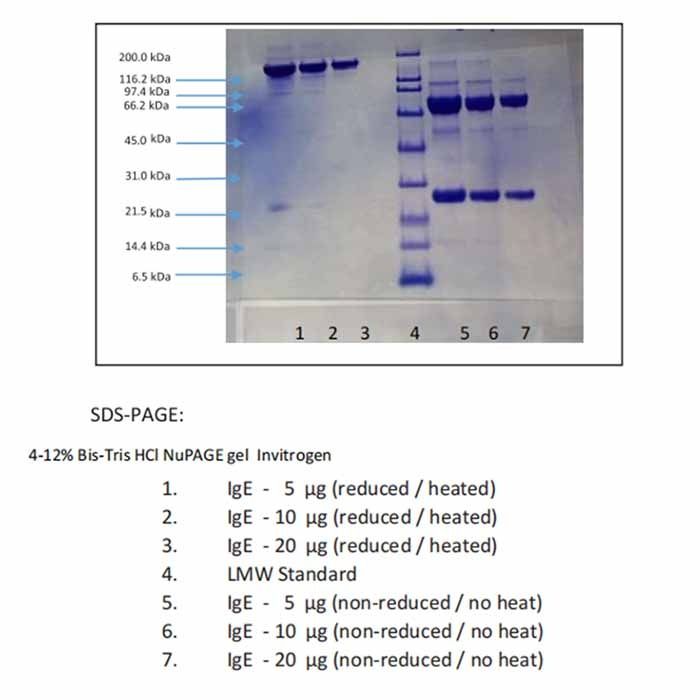
GRADE & PURITY Native ? Native grade — protein/biomolecule in its natural (non-recombinant, non-denatured) form. Use when native structure and activity are required. ≥95%(SDS-PAGE) Protein concentration (see COA)
Accession #
P01854,P0DOY2,P0DOY3
★
Size
USA
Allemagne (EU)*
Price
Qty
25μg
np001078-25μg
Fabrication sur commande aux États-Unis · 2–4 semaines ·
—
379,90$US
100μg
np001078-100μg
Fabrication sur commande aux États-Unis · 2–4 semaines ·
—
919,90$US
Enter a quantity for the sizes you want to add.
🧪

Why this grade

Native, ≥95%(SDS-PAGE), Protein concentration (see COA) Native for sensitive chromatographic and analytical workflows requiring minimal baseline interference.

🌡

Storage & shipping

Store at -80°C,Avoid repeated freezing and thawing Ships Dry ice packs + Cold packs Check lot-specific COA for exact specifications.

📋

Quality documents

SDS, COA, datasheet, and spec sheet available for download. Lot-specific COA accessible via lot number lookup.

📚

Literature proof

Cited in 0 peer-reviewed publications across chromatography, organic synthesis, and cross-coupling reactions.

Vue d’ensemble

Immunoglobulin E is the least abundant plasma immunoglobulin. IgE is involved in severe allergic reactions; it also provides protection against parasitic infections by promoting cytotoxic granule release.

Role of protein in biology

Serum immunoglobulin E (IgE) is the least abundant antibody class in human plasma, circulating at concentrations below 0.6 µg/mL in healthy individuals. This monomeric glycoprotein features a unique Fc region with seven N-linked glycosylation sites, including a conserved oligomannose glycan at Asn394 critical for structural stability and binding to the high-affinity receptor FcεRI. IgE mediates type I hypersensitivity reactions by binding FcεRI on mast cells and basophils, triggering degranulation and release of histamine, leukotrienes, and cytokines upon allergen exposure. Beyond allergies, IgE plays a protective role against parasitic infections like helminths by activating eosinophils and basophils to release cytotoxic granules.

Common research uses

Elevated serum IgE (>300 IU/mL) is a hallmark in allergic conditions such as asthma, atopic dermatitis, and allergic bronchopulmonary aspergillosis (ABPA). Hyperimmunoglobulinemia E syndromes (HIES), caused by STAT3 mutations, present with recurrent infections, eczema, and IgE levels exceeding 2,000 IU/mL. IgE multiple myeloma, a rare plasma cell malignancy, produces monoclonal IgE with normal structure but lambda light chain predominance, often complicating renal function. Parasitic infections and viral diseases like HIV also drive polyclonal IgE elevation. Clinically, total IgE quantification aids in diagnosing ABPA and monitoring omalizumab therapy, an anti-IgE monoclonal antibody that reduces free IgE levels by forming inert complexes. Despite its short serum half-life (2–3 days), cell-bound IgE persists for weeks on immune cells, necessitating combined plasma and cell-bound IgE measurements for accurate allergy diagnosis. Myeloma-derived IgE remains invaluable for structural studies due to its intact glycosylation and receptor-binding properties. Emerging therapies targeting IgE-FcεRI interactions and glycosylation pathways aim to modulate allergic responses while preserving protective functions.

Common uses include IVD Assay standards, calibrators and controls, therapeutics research, immune system research.

Specifications

Product Name
Immunoglobulin E (IgE), Human Myeloma Plasma, Lambda
Grade
Native
Spécifications et pureté
Native, ≥95%(SDS-PAGE), Protein concentration (see COA)
Poids moléculaire prévu
190kDa
Type de molécule
Protein
Stockage et expédition
Forme
Frozen in 15 mM potassium phosphate, pH 7.4, with 150 mM NaCl and 0.05% NaN3.
Concentration
Protein concentration (see COA)
Conditions de stockage de stockage
Store at -80°C,Avoid repeated freezing and thawing
Expédié en
Dry ice packs + Cold packs
Stabilité et stockage
Store at -80℃ long term (>1 year). Upon receipt, it is recommended to aliquot. Avoid freeze/thaw cycle.

Documentation

📋 Safety Data Sheet (SDS)

Comprehensive hazard, handling, storage, and regulatory compliance document.

Download SDS →

✅ Certificate of Analysis (COA)

Lot-specific quality data. Enter your lot number to retrieve the exact COA.

Look up COA →

📊 Datasheet

Quick-reference summary of product specifications and applications.

View datasheet →

🔬 Specification Sheet

Full quality attributes and acceptance criteria for this grade.

View spec sheet →

Advanced Data

Certificats (CoA, COO, BSE/TSE et tableau d'analyse)
C of A & Other Certificates(BSE/TSE, COO):
Analytical Chart:
FAQ et articles
Calculateurs de solution
Avis

Avis des clients

Foire aux questions

What is the purity of this product, and how is it determined?
This product is supplied at ≥95% purity, determined by SDS-PAGE. Lot-specific values are stated on the Certificate of Analysis.
How should this product be stored?
Store at ?80 °C. Ultra-low temperature storage is required to maintain the specified shelf life.
How is this product shipped?
This product ships frozen with dry ice and cold packs. Unpack on arrival and transfer it to the storage condition stated above; handle dry ice with insulated gloves in a ventilated area.
What documentation is provided?
Available product documentation, including Certificates of Analysis (COA), Safety Data Sheets (SDS), and specification sheets, is shown in the product document area. Document availability and access follow the current site policy.

Shall we send you a message when we have discounts available?

Remind me later

Thank you! Please check your email inbox to confirm.

Oops! Notifications are disabled.