
ASK1
Browse by type, application, or key specifications such as purity, grade, packaging, and handling requirements.
4 produits
Produits populaires
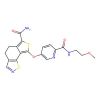
- CDK8/19-IN-1CAS: 1818427-07-4 PubChem CID: 126511854◐ .Sur commande · 8–12 semaines Article #: C1424122Voir le produitTarifs et tailles des emballages
Identificateurs techniques
- Nom IUPAC
- 8-[6-(2-methoxyethylcarbamoyl)pyridin-3-yl]oxy-4,5-dihydrothieno[3,4-g][1,2]benzothiazole-6-carboxamide
- SMILES
- COCCNC(=O)C1=NC=C(C=C1)OC2=C3C(=C(S2)C(=O)N)CCC4=C3SN=C4
- InChIKey
- NENJFZKQHYXRDQ-UHFFFAOYSA-N
- InChI
- 1S/C19H18N4O4S2/c1-26-7-6-21-18(25)13-5-3-11(9-22-13)27-19-14-12(16(28-19)17(20)24)4-2-10-8-23-29-15(10)14/h3,5,8-9H,2,4,6-7H2,1H3,(H2,20,24)(H,21,25)
- GDC-3280CAS: 1590403-33-0 Formule: C18H14F3N5O2 Poids moléculaire: 389.33◐ .Sur commande · 8–12 semaines Article #: G1424121Voir le produitTarifs et tailles des emballages
Identificateurs techniques
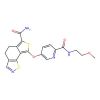
- CDK8/19-IN-1CAS: 1818427-07-4 PubChem CID: 126511854Moligand™ ? Moligand™ — Aladdin's line of ligands and bioactive small molecules. Use for receptor, pathway, and binding studies needing defined small-molecule tools. 10 mM in DMSO◐ .Sur commande · 8–12 semaines Article #: C1494492Voir le produitTarifs et tailles des emballages
Identificateurs techniques
- GDC-3280CAS: 1590403-33-0 Formule: C18H14F3N5O2 Poids moléculaire: 389.33Moligand™ ? Moligand™ — Aladdin's line of ligands and bioactive small molecules. Use for receptor, pathway, and binding studies needing defined small-molecule tools. 10 mM in DMSO◐ .Sur commande · 8–12 semaines Article #: G1498426Voir le produitTarifs et tailles des emballages
Identificateurs techniques
Expédition rapide Expédition le jour même sur les articles en stock
Detalles técnicos Informations sur la qualité et les spécifications sur chaque page du produit
Options de taille d'emballage Tailles d'emballage multiples avec accès aux prix à partir de la liste
R&D Utilisation uniquement Produits fournis pour la recherche et le développement
Foire aux questions
How is the ASK1 listing put together?
It draws on reported ASK1 annotations within Apoptosis and lists each compound with its structure, identifiers, and the activity published for it. Always check the underlying assay before comparing potency values across entries.
How do I choose an ASK1 modulator for my assay?
Start from the assay format and readout — biochemical, cell-based, or in vivo — then compare the ASK1 entries on potency, selectivity over related family members, and solubility in your vehicle. Where several chemotypes are available, a reference compound plus a structurally unrelated backup is the usual way to control for off-target effects.
Which specifications matter most for ASK1 compounds?
Purity and identity confirmation come first, then solubility in DMSO or your chosen vehicle, recommended storage temperature, and stability in solution. For ASK1 work in particular, freshly prepared stocks avoid most of the reproducibility problems seen with stored plates. All products are supplied for professional research and development use only, and are not for use in humans, animals, diagnostics, or therapy.
What if the ASK1 compound I need is not listed?
Search by CAS number or SMILES first, since analogs of ASK1 compounds are often catalogued under a related target. Custom synthesis and bulk enquiries go to [email protected]. We supply verified businesses, research institutions, universities, and government agencies.