Determine the necessary mass, volume, or concentration for preparing a solution.
| Activity Type | Relation | Activity value | Units | Action Type | Journal | PubMed Id | doi | Assay Aladdin ID |
|---|

average Mw ~100,000, 35 wt. % in H2O pour les flux de travail chromatographiques et analytiques sensibles nécessitant une interférence de ligne de base minimale.
Room temperature Expédition . Consultez le COA spécifique au lot pour les spécifications exactes.
SDS, COA, fiche technique et fiche de spécifications disponibles au téléchargement. COA spécifique au lot accessible via la recherche par numéro de lot.
Cité dans 718 publications à comité de lecture couvrant la chromatographie, la synthèse organique et les réactions de couplage croisé.
Poly (acrylic acid) (PAA) is hygroscopic, brittle and colorless in nature with Tg at nearly 106℃. At temperatures above 200, up to 250℃, it loses water and becomes an insoluble crosslinked polymer anhydride. Solubility of dried PAA in water increases with rise in temperature. Concentrated solutions of PAA in water are thixotropic in nature.
Application:
PAA is used in the preparation of nano-hydroxyapatite polyacrylic acid (Hap/PAAc) biocomposites.†Other probable applications of PAA are: to study solute diffusion in Polyvinyl alcohol/PAA copolymer hydrogels†, synthesizing poly(N-isopropylacrylamide)-block-PAA copolymer which responds to both temperature and pH stimuli†, in preparing block copolymer of oligo (methyl methacrylate)/PAA for micellar delivery of hydrophobic drugs†, and as a thickening agent for adhesives.
Document complet couvrant les dangers, la manipulation, le stockage et la conformité réglementaire.
<<<<<<< HEAD Télécharger la SDS → ======= Télécharger la SDS → >>>>>>> release248-p3Données qualité spécifiques au lot. Saisissez votre numéro de lot pour récupérer le COA exact.
Rechercher le COA →Résumé de référence rapide des spécifications et applications du produit.
Voir la fiche technique →Attributs de qualité complets et critères d'acceptation pour cette qualité.
Voir la fiche de spécifications →Taxonomy Tree
| Kingdom | Organic compounds |
|---|---|
| Superclass | Organic acids and derivatives |
| Classe | Carboxylic acids and derivatives |
| Subclass | Acrylic acids and derivatives |
| Intermediate Tree Nodes | Not available |
| Direct Parent | Acrylic acids |
| Alternative Parents | Monocarboxylic acids and derivatives Carboxylic acids Organic oxides Hydrocarbon derivatives Carbonyl compounds |
| Molecular Framework | Aliphatic acyclic compounds |
| Substituents | Acrylic acid - Monocarboxylic acid or derivatives - Carboxylic acid - Organic oxygen compound - Organic oxide - Hydrocarbon derivative - Organooxygen compound - Carbonyl group - Aliphatic acyclic compound |
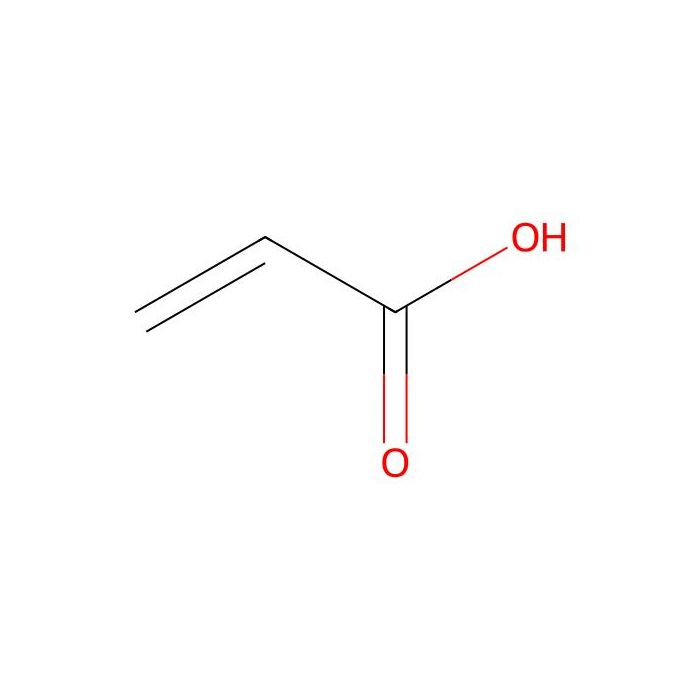
| Description | This compound belongs to the class of organic compounds known as acrylic acids. These are organic compounds containing acrylic acid CH2=CHCO2H. |
| External Descriptors | Unsaturated fatty acids |
| Activity Type | Relation | Activity value | Units | Action Type | Journal | PubMed Id | doi | Assay Aladdin ID |
|---|
| Activity Type | Relation | Activity value | Units | Action Type | Journal | PubMed Id | doi | Assay Aladdin ID |
|---|
| Activity Type | Relation | Activity value | Units | Action Type | Journal | PubMed Id | doi | Assay Aladdin ID |
|---|
| Activity Type | Relation | Activity value | Units | Action Type | Journal | PubMed Id | doi | Assay Aladdin ID |
|---|
| Activity Type | Relation | Activity value | Units | Action Type | Journal | PubMed Id | doi | Assay Aladdin ID |
|---|
Find and download the COA for your product by matching the lot number on the packaging.
| Lot Number | Certificate Type | Date | Article |
|---|---|---|---|
 B2525475 | Certificate of Analysis | Feb 17, 2025 | P434402 |
| H2420385 | Certificate of Analysis | Aug 07, 2024 | P434402 |
| H2420386 | Certificate of Analysis | Aug 07, 2024 | P434402 |
| E2413480 | Certificate of Analysis | Apr 09, 2024 | P434402 |
| F2325609 | Certificate of Analysis | Jun 02, 2023 | P434402 |
| Point d'ébullition (°C) | 116℃ |
|---|---|
| Poids moléculaire | 72.060 g/mol |
| XLogP3 | 0.300 |
| Hydrogen Bond Donor Count | 1 |
| Hydrogen Bond Acceptor Count | 2 |
| Rotatable Bond Count | 1 |
| Exact Mass | 72.0211 Da |
| Monoisotopic Mass | 72.0211 Da |
| Topological Polar Surface Area | 37.300 Ų |
| Heavy Atom Count | 5 |
| Formal Charge | 0 |
| Complexity | 55.900 |
| Isotope Atom Count | 0 |
| Defined Atom Stereocenter Count | 0 |
| Undefined Atom Stereocenter Count | 0 |
| Defined Bond Stereocenter Count | 0 |
| Undefined Bond Stereocenter Count | 0 |
| The total count of all stereochemical bonds | 0 |
| Covalently-Bonded Unit Count | 1 |