GRADE & PURITYRecombinant?Recombinant — produced via recombinant expression for defined sequence and consistency. Use for reproducible, animal-free proteins of known origin.ExactAb™?ExactAb™ — Aladdin's antibody line emphasizing precision and validated quality. Use for reliable, specificity-validated antibody applications.Validated?Validated grade — performance confirmed in defined applications before release. Use when you want documented assurance the reagent works as stated.0.6 mg/mL
ExactAb™, Validated, Recombinant, 0.6 mg/mL ExactAb™,Recombinant,Validated for sensitive chromatographic and analytical workflows requiring minimal baseline interference.
🌡
Storage & shipping
Store at -20°C,Avoid repeated freezing and thawing Ships Ice chest + Ice pads Check lot-specific COA for exact specifications.
📋
Quality documents
SDS, COA, datasheet, and spec sheet available for download. Lot-specific COA accessible via lot number lookup.
📚
Literature proof
Cited in 0 peer-reviewed publications across chromatography, organic synthesis, and cross-coupling reactions.
Vue d’ensemble
Rabbit anti Human DAZAP1 Antibody, Recombinant, could be used for WB and so on. Application: WB: 1/500-1/1000 Protein Function RNA-binding protein, which may be required during spermatogenesis.
Specifications
Product Name
Recombinant DAZAP1 Antibody - Primary antibody, specific to DAZAP1, Rabbit IgG
Synonymes
Deleted in azoospermia-associated protein 1 | DAZ associated protein 1 | DAZ-associated protein 1 | Dazap1 | DAZP1_HUMAN | Deleted in azoospermia associated protein 1 | Deleted in azoospermia-associated protein 1 | DAZ associated protein 1 antibody | DAZ-
Spécifications et pureté
ExactAb™, Validated, Recombinant, 0.6 mg/mL
Espèce hôte
Rabbit
Spécificité
DAZAP1
Immunogène
Recombinant protein of human DAZAP1 (AA 294-398)
Contrôle positif
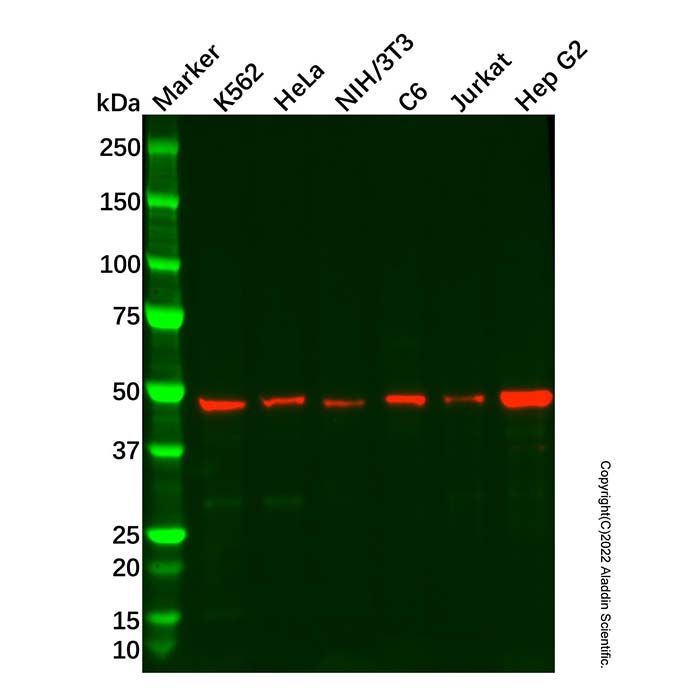
WB: K562, HeLa, Jurkat, Hep G2, NIH/3T3 and C6 cell lysates.
Conjugation
Unconjugated
Grade
ExactAb™, Recombinant, Validated
Isotype
Rabbit IgG
SDS-PAGE
150 kDa
Méthode de purification
Antigen affinity purified
Concentration
0.6 mg/mL
Product Line
Produits biologiques
Stockage et expédition
Forme
Liquid
Conditions de stockage de stockage
Store at -20°C,Avoid repeated freezing and thawing
Expédié en
Ice chest + Ice pads
Stabilité et stockage
Store at 4°C short term (1-2 weeks). Store at -20°C long term (24 months). Upon receipt, it is recommended to aliquot. Avoid freeze/thaw cycle.
Images
Recombinant DAZAP1 Antibody (Ab099191) - Western Blot All lanes: Recombinant DAZAP1 Antibody (Ab099191) at 1/1000 dilution Samples: Lysates at 20 µg per lane Secondary: Goat Anti-Rabbit IgG H&L (HRP) (Ab170144) at 1/20000 dilution
Predicted band size: 43 kDa Observed band size: 46 kDa Exposure time: 22.1 s
Application
Application
Dilution info
WB
1/500-1/1000
Documentation
📋 Safety Data Sheet (SDS)
Comprehensive hazard, handling, storage, and regulatory compliance document.
Determine the necessary mass, volume, or concentration for preparing a solution.
Dilution Calculator
Determine the dilution needed to prepare a stock solution.
Reconstitution Calculator
Avis
Avis des clients
Application Protocols
Manufacturer-validated applications, tested dilutions, sample preparation guidance, and positive control recommendations are Not specified for this item; refer to CoA/Spec Sheet.
General protocol frameworks (literature/general; adjust to your system)
Western blot: Prepare lysates with RIPA + inhibitors; 20–40 µg total protein per lane. Transfer to PVDF, block 5% BSA, incubate primary anti-DAZAP1 at an empirically determined dilution, then HRP-conjugated secondary; detect via ECL.
Immunofluorescence/ICC: Fix cells in 4% PFA, permeabilize with 0.1–0.3% Triton X-100, block 1–3% BSA, incubate with primary antibody, then fluorophore-conjugated secondary; mount with antifade.
IP/RIP: Combine clarified lysate with antibody, rotate at 4°C, capture with Protein A/G beads, wash with increasing stringency, elute for WB/MS; for RIP/CLIP, maintain RNase-free conditions.
These steps are general templates. Optimize antibody dilutions, incubation times, and retrieval/permeabilization conditions based on the data sheet when available.
Biological Roles
Target overview (literature/general; not item-specific claims)
DAZAP1 (DAZ-associated protein 1) is an RNA-binding protein containing two RNA-recognition motifs (RRMs) and a C-terminal proline-rich region. It interacts with DAZ family proteins and diverse RNA substrates.
Cellular functions (literature)
RNA metabolism: Implicated in regulation of pre-mRNA splicing and mRNA stability/translation through binding to U-rich elements and coordination with splicing factors.
Germ cell biology: Originally identified via interaction with DAZ proteins involved in gametogenesis; DAZAP1 localization and expression support roles in testicular tissue, though it is also expressed in somatic cells.
Nucleus–cytoplasm dynamics: Reported to shuttle between nucleus and cytoplasm, with context-dependent localization that can modulate RNA processing and transport.
Protein–protein interactions: Engages SR proteins and other RNA processing factors; proline-rich region may mediate additional interactions.
Research utility of anti-DAZAP1 antibodies (general)
Mapping expression patterns across tissues and developmental stages via WB/IF.
Co-immunoprecipitation to define protein interaction networks and, in RIP/CLIP workflows, to identify bound RNA motifs and targets.
Note: The above roles reflect published literature on DAZAP1 and do not constitute functional validation for this specific antibody lot. For epitope, species reactivity, and validated applications: Not specified for this item; refer to CoA/Spec Sheet.
Buffer Applications
Not typically applicable. This product is an antibody reagent used within buffer systems rather than a buffering agent itself. For successful use, select a compatible assay buffer (e.g., PBS or TBS at pH ~7.2–7.5; literature) and follow blocking/detergent practices appropriate to your application (WB, IF, IP). Item-specific buffer composition and recommended diluent are Not specified for this item; refer to CoA/Spec Sheet.
Green Alternatives
Antibodies are aqueous bioreagents; conventional green chemistry solvent substitutions are not directly applicable. Nevertheless, sustainability considerations can still be applied.
General greener-practice suggestions (literature/general)
Minimize cold-chain footprint: Consolidate shipments and coordinate delivery to reduce dry-ice/ice-pack waste. This item ships with ice pads; promptly store at -20°C to avoid reshipments.
Right-size packaging: Order concentrations/formats that match experimental throughput to reduce expired waste.
Reuse/Recycle: Recycle HDPE/PP vials and secondary packaging where facilities exist. Use reusable cold packs where permitted.
Process efficiency: Optimize antibody dilutions and blocking conditions to reduce repeat runs and reagent consumption.
Trade-offs
Adding stabilizers (e.g., glycerol, BSA) can improve shelf-life and reduce waste but may introduce animal-derived components or affect downstream MS analyses. Balance stability with downstream compatibility.
Item-specific greener alternatives are Not applicable; this is the DAZAP1-targeting recombinant antibody itself.
Pharmaceutical Uses
Not applicable for therapeutic or clinical use. This product is designated: For research use only (per Product Data). It is not an API, excipient, or diagnostic. Do not use in human or veterinary applications.
General context (for researchers in bioprocess labs)
While recombinant antibodies can serve as reference reagents or analytical tools in development environments, any GMP specifications, pharmacopeial monographs, viral safety validation, or residual host-cell impurity limits for this item are Not specified and should not be assumed.
If an application requires clinical-grade materials, source appropriate GMP-grade reagents and follow institutional QA/QC procedures.
Physical Properties
Item-specific physicochemical specifications (concentration, buffer composition, excipients, pH, endotoxin level) are Not specified for this item; refer to CoA/Spec Sheet.
Literature/general values for antibodies (for context only; not item specifications)
Approximate molecular mass (IgG): ~150 kDa (literature).
Isoelectric point (IgG): typically pI ~6–9 depending on isotype and sequence (literature).
Solubility: Highly soluble in aqueous buffers (PBS, TBS) with stabilizers; precipitates at extreme pH or high ionic strength (general guidance).
Thermal behavior: Unfolding transitions often observed between ~60–75°C by DSC, sequence- and buffer-dependent (literature).
UV characteristics: Peak A280 with approximate extinction coefficient dependent on sequence; concentration typically determined by A280 using sequence-derived ε (literature). For this item’s ε and concentration: Not specified; refer to CoA/Spec Sheet.
Form: Liquid or lyophilized presentation varies by lot; specific appearance Not specified.
Practical notes
Avoid foaming and vigorous vortexing to limit aggregation.
If lyophilized, reconstitution solvent, volume, and target concentration must follow the CoA. Do not assume standard values.
What these designations typically imply (general definitions; consult CoA for lot-specific metrics)
Recombinant antibody: Produced from defined expression constructs in a controlled host system (e.g., CHO/HEK), enabling sequence consistency, batch-to-batch reproducibility, and reduced background versus animal-derived polyclonals.
ExactAb™: Brand/platform indicating engineered, sequence-defined antibodies with consistent performance characteristics. Specific platform metrics (e.g., sequence identity, Fc format, glycan profile) are Not specified for this item; refer to CoA/Spec Sheet.
Validated: Indicates the antibody has undergone application-specific testing by the manufacturer. Exact validated applications, sample types, and performance criteria are Not specified for this item; refer to CoA/Spec Sheet for the validated use-cases and expected band sizes/epitope coverage.
Additional quality considerations (general)
Purity profile: SDS-PAGE typically shows heavy/light chains under reducing conditions; HPLC/SEC assesses aggregation. Item-specific purity percentages are Not specified.
Endotoxin and bioburden: Important for cell-based assays; thresholds for this item are Not specified.
Documentation: Request CoA/Spec Sheet for isotype, clonality (mono vs poly), host species, concentration, buffer composition, preservative/stabilizer, and validation images.
Reaction and Applications
This product is an antibody reagent; it is not used as a reactant or catalyst in chemical synthesis. Instead, its applications are immunochemical.
General research applications for anti-DAZAP1 antibodies (literature/general; item-specific validation Not specified)
Western blot (WB): Detection of endogenous DAZAP1 in cell/tissue lysates; expected bands near the DAZAP1 molecular mass (literature) depending on isoform and species. Optimization of load, transfer, and blocking is essential.
Immunoprecipitation (IP)/RIP: Enrichment of DAZAP1 and associated RNA/protein complexes for downstream analysis (e.g., mass spectrometry, RT-qPCR). Use RNase-free conditions for RNA-centric workflows.
Immunofluorescence (IF)/Immunocytochemistry (ICC): Subcellular localization studies. Fixation and antigen retrieval conditions must be optimized (PFA vs methanol; permeabilization with Triton X-100 or saponin).
Chromatin or RNA crosslinking approaches (CLIP/CLIP-Seq variants): Antibody can facilitate capture of RNA-binding protein targets under UV crosslinking paradigms; stringent validation is required.
Note: The Manufacturer Applications field for this listing is not provided. Specific tested applications, dilutions, and species reactivity are Not specified for this item; refer to CoA/Spec Sheet.
Reaction Conditions
Not applicable in the context of chemical reactions. For immunoassay conditions, see Application Protocols. Since item-specific tested applications and dilutions are Not specified for this item, only general guidance can be offered.
General assay-condition considerations (literature/general)
Western blot: Typical primary antibody incubations at 4°C overnight or 1–2 h at room temperature in TBST + 5% BSA or milk; optimize dilution empirically.
IF/ICC: Commonly 1–2 h at room temperature or overnight at 4°C in PBS + 1–3% BSA with 0.1–0.3% Triton X-100 when permeabilization is needed.
IP/RIP: Incubate clarified lysate with antibody 1–4 h at 4°C, then capture with Protein A/G beads; stringency adjusted via salt/detergent.
These are literature-based norms; specific recommendations for this product are Not specified; refer to CoA/Spec Sheet.
Safety and Handling
Regulatory/SDS status
GHS classification, signal word, hazard statements, and pictograms: Not specified for this item; consult the product SDS for authoritative information.
General laboratory safety for protein antibodies (good practice; not a substitute for SDS)
PPE: Lab coat, gloves (nitrile), and safety glasses. Avoid inhalation of aerosols or contact with skin/eyes.
Handling: Work on ice or at 2–8°C when preparing aliquots to minimize thermal stress. Use low-protein-binding tips and tubes to reduce loss and aggregation.
Incompatibilities: Avoid strong oxidizers, extreme pH (<5 or >9 unless validated), and repeated freeze–thaw cycles which can denature proteins.
Biological origin considerations: Recombinant production reduces variability; nevertheless, treat as potentially biohazardous lab material. Decontaminate surfaces with appropriate detergents or 10% bleach followed by water.
First aid (general): In case of contact, rinse with water for 15 minutes; if inhaled, move to fresh air. Seek medical attention if irritation persists. Spill response: Absorb with inert material, clean with aqueous detergent; dispose according to institutional guidelines.
Storage and shipping (item-specific)
Storage: Store at -20°C, Avoid repeated freezing and thawing (per Product Data).
Shipping: Shipped in ice chest + ice pads (per Product Data). Upon receipt, promptly transfer to specified storage.
Solvent Selection
Not typically applicable. This product is an aqueous protein reagent (antibody), not a small-molecule solute used for organic synthesis. Use the supplied buffer or recommended reconstitution buffer (commonly PBS or TBS, pH ~7.2–7.5; literature) unless the CoA specifies otherwise.
General guidance (literature/general)
Compatible media: Physiological buffers (PBS, TBS) with optional stabilizers (e.g., 0.1% BSA, 10–50% glycerol) to enhance freeze–thaw stability; verify compatibility with your assay.
Avoid: Strong organic solvents (acetonitrile, methanol, DMSO) for stock preparation; these may denature antibodies. Small percentages of solvent may be tolerated in downstream workflows, but validate empirically.
Filtration: If sterility is required and buffer permits, use 0.22 µm low-protein-binding filters; avoid shear and multiple passes.
Storage and Reconstitution
Item-specific storage and shipping
Storage Conditions: Store at -20°C, Avoid repeated freezing and thawing (per Product Data).
Shipped In: Ice chest + Ice pads (per Product Data). On receipt, verify integrity and place immediately at -20°C.
General best practices (literature/general)
Aliquoting: Upon first thaw, aliquot into single-use volumes to prevent freeze–thaw cycles. Use low-protein-binding tubes and tips.
Short-term handling: Keep on ice during setup; return promptly to -20°C after use. If the CoA indicates glycerol-containing buffer, storage at -20°C in working aliquots can remain partially liquid and is acceptable; verify formulation.
Lyophilized formats: If provided lyophilized (Not specified for this item), reconstitute with sterile, antibody-grade water or buffer as directed on the CoA to the recommended concentration. Allow gentle dissolution; avoid vigorous mixing.
Long-term stability: Do not deviate from the specified -20°C storage. Stability claims, protected-from-light requirements, and preservative content are Not specified; refer to CoA/Spec Sheet.
Freeze–thaw guidance: Absolutely minimize cycles; each cycle can promote aggregation and activity loss. Document aliquot usage to maintain consistency.
For exact buffer composition, pH, protein concentration, and recommended diluents: Not specified for this item; refer to CoA/Spec Sheet.
Structure and Identity
Item-specific identifiers for small molecules (Molecular Formula, MW, SMILES, InChIKey) are not applicable to antibody biologics. For lot-specific sequence, isotype, and concentration details: Not specified for this item; refer to CoA/Spec Sheet.
Literature/general description of target and reagent
Target: DAZAP1 (DAZ-associated protein 1), a ubiquitously expressed RNA-binding protein associated with the DAZ family; contains two N‑terminal RNA-recognition motifs (RRMs) and a C‑terminal proline-rich region.
Antibody type: Recombinant antibody (ExactAb™), protein biologic typically supplied in an aqueous buffer. IgG isotype and clonality (mono/polyclonal) are Not specified for this item; refer to CoA/Spec Sheet.
Expected antibody architecture (literature, generic): IgG ~150 kDa heterotetramer with two heavy and two light chains stabilized by disulfide bonds; Fc domain mediates effector functions; Fab domains confer antigen specificity.
Antigen structural features (literature): DAZAP1 RRMs bind U-rich RNA elements; nuclear and cytoplasmic localization reported depending on cell context.
2D/functional depiction in words (general)
The antibody presents two antigen-binding fragments (Fabs) recognizing epitopes within DAZAP1; the constant regions comprise CH1–CH3 (heavy chain) and CL (light chain). No small-molecule structural parameters apply.
Synthetic Utility
Not applicable. As a recombinant antibody, this product is not used as a synthetic building block or reagent in organic synthesis. For relevant information, see Reaction & Applications (immunochemical workflows) and Application Protocols once available from the CoA/Spec Sheet.
Target Specificity
Item-specific details are Not specified for this item; refer to CoA/Spec Sheet.
Information typically provided for antibodies (for your expectation-setting)
Antigen: DAZAP1 (DAZ-associated protein 1) — epitope region, peptide vs full-length immunogen.
Species reactivity: Validated across specific species (e.g., human/mouse/rat); cross-reactivity pattern.
Clonality and isotype: Monoclonal/polyclonal; IgG subclass and light chain type.
Host/expression system: Species or recombinant production host.
Validation images: WB band size, IF localization patterns, IP enrichment.
Absent explicit data in this listing, please consult the CoA/Spec Sheet for this SKU (Ab099191) for definitive target-specificity information.
Foire aux questions
What does ExactAb? mean?
ExactAb? indicates the product has been validated for use in rigorous antibody validation workflows. Validation may include positive/negative control samples, signal-to-noise testing, and protocol-specific QC. Lot-specific test data is published on the Certificate of Analysis where available.
What does Recombinant mean?
Recombinant is a defined analytical purity tier suitable for workflows requiring a specific validated property. It specifies a minimum assay percentage, controlled limits on common impurities (water, heavy metals, residue on ignition), and lot-to-lot consistency. Recombinant is one of several purity tiers — choose based on the sensitivity and regulatory requirements of your method.
How should this product be stored?
Store at ?20 °C. Avoid repeated freeze–thaw cycles. Aliquot into single-use volumes before freezing.
How is this product shipped?
This product ships in an insulated container with ice pads. Unpack on arrival and transfer it to the storage condition stated above.
What documentation is provided?
Available product documentation, including Certificates of Analysis (COA), Safety Data Sheets (SDS), and specification sheets, is shown in the product document area. Document availability and access follow the current site policy.
Which species reactivity has this antibody been validated against?
Validated reactivity is listed on the PDP and on each lot's datasheet. We validate against the most commonly tested species for the target (Recombinant DAZAP1 Antibody); cross-reactivity in untested species may exist but is not guaranteed. Contact technical support for specific species inquiries.
Need help choosing the grade?
Our grade selection guide covers purity, stabilizer status, and application suitability for all variants in our catalog.
Nous utilisons des cookies pour garantir le bon fonctionnement du site et, lorsque cela est autorisé, pour améliorer votre expérience. Vous pouvez gérer vos préférences à tout moment dans les Paramètres. Pour en savoir plus, consultez notre Politique relative aux cookies.
Souhaitez-vous que nous vous envoyions un message lorsque des réductions seront disponibles?
Me rappeler plus tard
Merci ! Veuillez vérifier votre boîte de réception e-mail pour confirmer.
Products are supplied to verified businesses, institutions, and qualified professionals for research and development use only. Not for use in humans, animals, diagnosis, or therapy.

 ZJ24F0505894