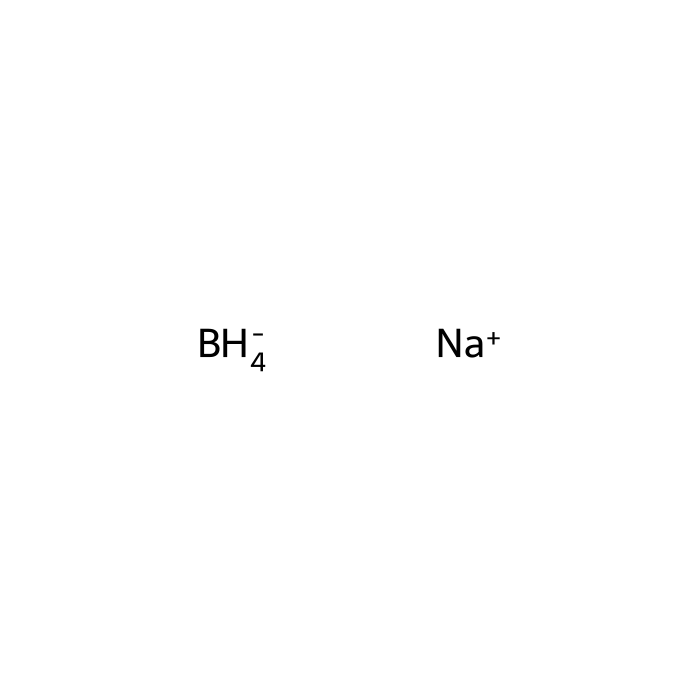
Sodium borohydride solution - ~12 wt. % in 14 M NaOH , CAS No.16940-66-2

CAS: 16940-66-2 Cat. No.: S432203 Formule: NaBH4 Poids moléculaire: 37.83 Numéro CE: 241-004-4 PubChem CID: 4311764
DISPONIBLE À COMMANDE
QUALITÉ & PURETÉ ~12 wt. % in 14 M NaOH
Synonyms
BORATE(1-), TETRAHYDRO-, SODIUM (1:1) | EINECS 241-004-4 | sodium;boranuide | O0577 | COLORSTRIP 2000 | sodium boro hydride | sodium boranuide | SODIUM TETRAHYDRIDOBORATE | 87L0B9CPPA | sodium borohydri- de | sodium borohydrid | EC 241-004-4 | NaBH | natr
Storage
Room temperature
Shipped In
FedEx DG Service
★
Taille
USA
Allemagne (EU)*
Prix
Qté
25ml
S432203-25ml
3 En stock
—
19,90$US
Enter a quantity for the sizes you want to add.
🧪
Pourquoi cette qualité

~12 wt. % in 14 M NaOH pour les flux de travail chromatographiques et analytiques sensibles nécessitant une interférence de ligne de base minimale.

🌡

Stockage & expédition

Room temperature Expédition FedEx DG Service. Consultez le COA spécifique au lot pour les spécifications exactes.

📋

Documents qualité

SDS, COA, fiche technique et fiche de spécifications disponibles au téléchargement. COA spécifique au lot accessible via la recherche par numéro de lot.

📚

Preuve documentaire

Cité dans 3036 publications à comité de lecture couvrant la chromatographie, la synthèse organique et les réactions de couplage croisé.

Vue d’ensemble

Alkaline sodium borohydride solution can be used as an efficient reagent for the generation of hydrogen via hydrolysis in the presence of various catalysts such as γ-Al 2 O 3 supported cobalt catalysts, carbon supported cobalt catalysts, graphene oxide particles supported with cobalt nanoparticles and Ni 45 Au 45 Co 10 trimetallic nanoparticles.

Spécifications

Synonymes
BORATE(1-), TETRAHYDRO-, SODIUM (1:1) | EINECS 241-004-4 | sodium;boranuide | O0577 | COLORSTRIP 2000 | sodium boro hydride | sodium boranuide | SODIUM TETRAHYDRIDOBORATE | 87L0B9CPPA | sodium borohydri- de | sodium borohydrid | EC 241-004-4 | NaBH | natr
Spécifications et pureté
~12 wt. % in 14 M NaOH
Informations juridiques
Ascensus
Conditions de stockage de stockage
Room temperature
Expédié en
FedEx DG Service
Noms et identifiants
Pubchem Sid
Sourires canoniques
[BH4-].[Na+]
IUPAC Name
sodium;boranuide
InChIKey
YOQDYZUWIQVZSF-UHFFFAOYSA-N
INCHI
1S/BH4.Na/h1H4;/q-1;+1
Isomères SMILES
[BH4-].[Na+]
WGK Allemagne
2
RTECS
ED3325000
PubChem CID
4311764
Numéro ONU
1426
Groupe d'emballage
I
Poids moléculaire
37.83

Documentation

📋 Fiche de données de sécurité (FDS)

Document complet couvrant les dangers, la manipulation, le stockage et la conformité réglementaire.

<<<<<<< HEAD Télécharger la SDS → ======= Télécharger la SDS → >>>>>>> release248-p3

✅ Certificat d'analyse (COA)

Données qualité spécifiques au lot. Saisissez votre numéro de lot pour récupérer le COA exact.

Rechercher le COA →

📊 Fiche technique

Résumé de référence rapide des spécifications et applications du produit.

Voir la fiche technique →

🔬 Fiche de spécifications

Attributs de qualité complets et critères d'acceptation pour cette qualité.

Voir la fiche de spécifications →

Données avancées

Taxonomic Classification

Taxonomy Tree

KingdomInorganic compounds
SuperclassMixed metal/non-metal compounds
ClasseMiscellaneous mixed metal/non-metals
SubclassNot available
Intermediate Tree Nodes Not available
Direct ParentMiscellaneous mixed metal/non-metals
Alternative Parents Metalloid salts  Inorganic sodium salts  
Molecular FrameworkNot available
Substituents Inorganic sodium salt - Inorganic salt - Miscellaneous mixed metal/non-metal - Inorganic metalloid salt
DescriptionThis compound belongs to the class of inorganic compounds known as miscellaneous mixed metal/non-metals. These are inorganic compounds containing non-metal as well as metal atoms but not belonging to afore mentioned classes.
External Descriptors inorganic sodium salt - metal tetrahydridoborate
Structure 3D
Modèle de structure chimique interactif


Certificats (CoA, COO, BSE/TSE et tableau d'analyse)
C of A & Other Certificates(BSE/TSE, COO):
Analytical Chart:

Find and download the COA for your product by matching the lot number on the packaging.

17 results found

Lot NumberCertificate TypeDateArticle
J2613162J2613162Certificate of AnalysisNov 03, 2026 S432203
G2630345G2630345Certificate of AnalysisAug 17, 2026 S432203
F2616324F2616324Certificate of AnalysisJun 24, 2026 S432203
F2616329F2616329Certificate of AnalysisJun 24, 2026 S432203
C2617004C2617004Certificate of AnalysisMar 25, 2026 S432203
C2617003C2617003Certificate of AnalysisMar 25, 2026 S432203
K2506778K2506778Certificate of AnalysisNov 20, 2025 S432203
G2517539G2517539Certificate of AnalysisJul 18, 2025 S432203
G2517549G2517549Certificate of AnalysisJul 18, 2025 S432203
C2527005C2527005Certificate of AnalysisApr 01, 2025 S432203
B2506001B2506001Certificate of AnalysisMar 13, 2025 S432203
L2412806L2412806Certificate of AnalysisDec 13, 2024 S432203
J2414722J2414722Certificate of AnalysisOct 18, 2024 S432203
G2405080G2405080Certificate of AnalysisJul 09, 2024 S432203
E2408425E2408425Certificate of AnalysisJun 03, 2024 S432203
A2411875A2411875Certificate of AnalysisJan 17, 2024 S432203
A2412001A2412001Certificate of AnalysisJan 17, 2024 S432203
Propriétés chimiques et physiques
Point d'ébullition (°C)130°C
Point de fusion (°C)-20--10°C
Poids moléculaire37.840 g/mol
XLogP3
Hydrogen Bond Donor Count0
Hydrogen Bond Acceptor Count1
Rotatable Bond Count0
Exact Mass38.0304 Da
Monoisotopic Mass38.0304 Da
Topological Polar Surface Area0.000 Ų
Heavy Atom Count2
Formal Charge0
Complexity2.000
Isotope Atom Count0
Defined Atom Stereocenter Count0
Undefined Atom Stereocenter Count0
Defined Bond Stereocenter Count0
Undefined Bond Stereocenter Count0
The total count of all stereochemical bonds0
Covalently-Bonded Unit Count2
FAQ et articles
DIBAL-H, Diisobutylaluminium hydride
Lithium triethylborohydride, LiTEBH, Superhydride
Professional Guide to Streptavidin-Modified Proteins
Common Reagents for Reducing Protein Disulfide Bonds
Nanowires: Properties, Preparation Routes, and Process Selection (Comprehensive Analysis of Top-Down and Bottom-Up Approaches with Recommended Aladdin Reagents)
How to Choose a Hydrogen Evolution (HER) Catalyst: Kinetic Barriers in Water Electrolysis, AWE/PEM/AEM Pathways, and a Materials-Family Roadmap (with a Product Map)
Installing a Redox Switch on Biomolecules: Principles, Conjugation Essentials, and an Application Guide for ATTO MB2 NHS ester
Selection of Common Research Salts: A Task Map for Alkali Metal Salts & Alkaline Earth Metal Salts (with Product Tables 1–6)
Why Metal Nanocatalysts Can “Save Energy Yet Lose Performance Easily”: Durability Logic from Active Sites to Support/Interface Engineering (Including Selection Guide and Product Tables A–D)
2-Methylpyridine–Borane (2-Picoline·BH₃) Reductive Amination Guide: Process Drivers for Replacing NaBH₃CN, the Practical Operating Window, and Scale-Up/Quench Close-Out Essentials (Including Product Tables 1–3)
Flavones: Structural Features, Physicochemical Properties, and Key Points for Research and Applications
Glutaraldehyde-mediated Microbial Inactivation: Chemical Mechanisms, Determinants, and Key Validation Considerations
Reconsidering N-Acyl Amino Protecting Groups: Deprotection Differences, Strategic Roles, and Experimental Selection of Ac, Bz, and Tfa
Phthaloyl: Its Role in Primary Amine Protection and Practical Considerations for Experimental Selection
Research Value of Polyelectrolyte Multilayers: Layer-by-Layer Design of Interfacial Composition, Mass Transport, and Function
Experimental Selection Logic for Pentafluorophenyl-Based Systems: Practical Judgment from Active Esters and Pre-Activated Monomers to Downstream Transformations
Reaction Selection in Small-Molecule Synthesis: From Transformation-Type Assessment to Experimental Route Screening
Application Differences Among Glutaraldehyde, Paraformaldehyde, and Formalin in Tissue and Cell Sample Fixation
Practical Guide to TSA Tyramide Signal Amplification: How to Select Reagents, Optimize the Workflow, and Reduce Background When Detection Signals Are Weak for Low-Abundance Targets
From Diverse Ketones to Three-Dimensional Spirocyclic Building Blocks: Reaction Design of [1.1.1]Propellane-Involved Ketone Ring Expansion
Sulfonyl Hydrazide-Mediated Introduction of Small C(sp³) Fragments: Nickel-Catalyzed Cross-Coupling, Medicinal Chemistry Applications, and Reagent Selection
Thietanes: Promising Small-Ring Building Blocks with Tunable Physicochemical Properties through Sulfur Oxidation-State Control
Skin Mechanism of Action of Pro-Xylane: From C-Xyloside Priming and CS/DS Chain Remodeling to the Dermal–Epidermal Junction
Design Logic of Fluorinated 3,3-Disubstituted Oxetane Building Blocks: Structural Construction and Modulation of Amine Basicity, Lipophilicity, and Metabolic Stability
Build the Three-Membered Ring First, or Form the Carbon–Nitrogen Bond First?—Retrosynthetic Strategies, Route Selection, and Stereochemical Control in Cyclopropylamine Synthesis
Route Selection for Thiol Synthesis: C–S Bond Construction, Sulfur Source Forms, and Thiol Release
ACT-1014-6470 Kilogram-Scale Synthesis: N7-Selective Reductive Amination of an Unprotected Pyrazole, Subsequent N2 Alkylation, and Intramolecular Urea Formation
MTAD-Mediated Oxidative Dearomatization of Pyridines: Transient para-Cycloaddition, Alkene Oxidation, and Heteroatom Functionalization
Citations of This Product
Calculateurs de solution
Avis

Avis des clients

Souhaitez-vous que nous vous envoyions un message lorsque des réductions seront disponibles?

Me rappeler plus tard

Merci ! Veuillez vérifier votre boîte de réception e-mail pour confirmer.

Oups ! Les notifications sont désactivées.