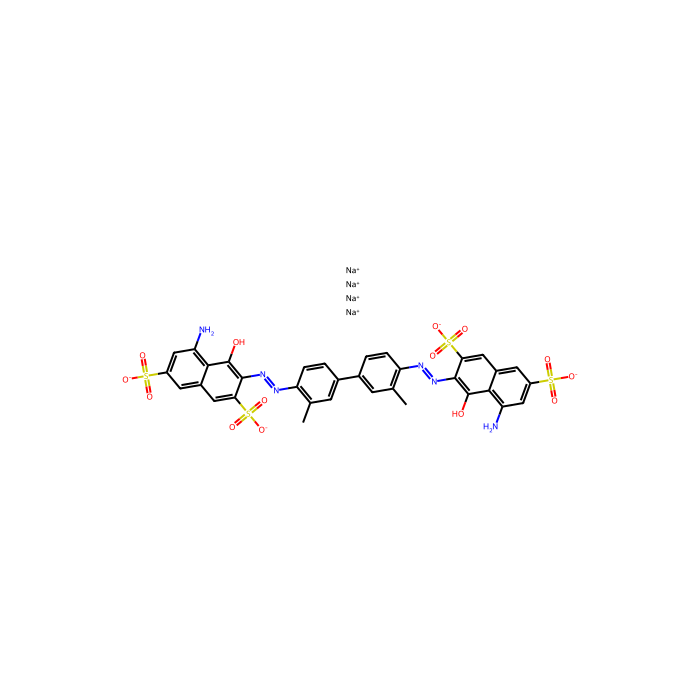
Bleu trypan - ≥60% , CAS No.72-57-1

CAS: 72-57-1 Cat. No.: T108743 Formule: C34H24N6Na4O14S4 Poids moléculaire: 960.81 Beilstein Registry Number: 4360496 Numéro CE: 200-786-7
DISPONIBLE À COMMANDE
GRADE & PURITY ≥60%
Synonyms
Centraline Blue 3B | Bleue diretto 3B | Modr Prima 14 [Czech] | Sodium ditolyl-diazobis-8-amino-1-naphthol-3,6-disulfonate | Benzanil Blue R | Congoblau 3B | Dianilblau H3G | TRYPAN BLUE [MART.] | Diaminblau 3B | NCGC00167554-01 | TRYPAN BLUE [VANDF] | Bl
Storage
Desiccated,Room temperature
Shipped In
Normal
★
Size
USA
Allemagne (EU)*
Price
Qty
5g
T108743-5g
2 En stock
—
12,90$US
25g
T108743-25g
2 En stock
—
32,90$US
100g
T108743-100g
1 En stock
—
99,90$US
Enter a quantity for the sizes you want to add.
🧪
Why this grade

≥60% for sensitive chromatographic and analytical workflows requiring minimal baseline interference.

🌡

Storage & shipping

Desiccated,Room temperature Ships Normal Check lot-specific COA for exact specifications.

📋

Quality documents

SDS, COA, datasheet, and spec sheet available for download. Lot-specific COA accessible via lot number lookup.

📚

Literature proof

Cited in 53 peer-reviewed publications across chromatography, organic synthesis, and cross-coupling reactions.

Vue d’ensemble

Le bleu Trypan est un colorant acide bleu tétrasulfoné, hydrophile et azoïque, largement utilisé pour évaluer la viabilité des cellules. Méthode facile pour déterminer la viabilité des cellules, le bleu Trypan colore en bleu les cellules mortes dont les membranes sont perméables, alors que le colorant est exclu par la plupart des cellules vivantes et leurs membranes intactes, ce qui permet de déterminer visuellement les cellules vivantes par rapport aux cellules mortes. Bien que le bleu Trypan soit principalement utilisé pour évaluer la viabilité des cellules cultivées, d'autres applications de ce colorant ont été rapportées. Dans des tranches d'organes abdominaux de rats, le bleu Trypan a été utilisé pour déterminer la viabilité des cellules ainsi que la viabilité des amas de cellules d'îlots de Langerhans à partir d'échantillons de pancréas de caprins.
Un colorant de viabilité pour quantifier les cellules vivantes par rapport aux cellules mortes

Specifications

Synonymes
Centraline Blue 3B | Bleue diretto 3B | Modr Prima 14 [Czech] | Sodium ditolyl-diazobis-8-amino-1-naphthol-3,6-disulfonate | Benzanil Blue R | Congoblau 3B | Dianilblau H3G | TRYPAN BLUE [MART.] | Diaminblau 3B | NCGC00167554-01 | TRYPAN BLUE [VANDF] | Bl
Spécifications et pureté
≥60%
Conditions de stockage de stockage
Desiccated,Room temperature
Expédié en
Normal
Pureté
≥60%
Noms et identifiants
Pubchem Sid
Sourires canoniques
CC1=C(C=CC(=C1)C2=CC(=C(C=C2)N=NC3=C(C4=C(C=C(C=C4C=C3S(=O)(=O)[O-])S(=O)(=O)[O-])N)O)C)N=NC5=C(C6=C(C=C(C=C6C=C5S(=O)(=O)[O-])S(=O)(=O)[O-])N)O.[Na+].[Na+].[Na+].[Na+]
IUPAC Name
tetrasodium;5-amino-3-[[4-[4-[(8-amino-1-hydroxy-3,6-disulfonatonaphthalen-2-yl)diazenyl]-3-methylphenyl]-2-methylphenyl]diazenyl]-4-hydroxynaphthalene-2,7-disulfonate
InChIKey
GLNADSQYFUSGOU-UHFFFAOYSA-J
INCHI
1S/C34H28N6O14S4.4Na/c1-15-7-17(3-5-25(15)37-39-31-27(57(49,50)51)11-19-9-21(55(43,44)45)13-23(35)29(19)33(31)41)18-4-6-26(16(2)8-18)38-40-32-28(58(52,53)54)12-20-10-22(56(46,47)48)14-24(36)30(20)34(32)42;;;;/h3-14,41-42H,35-36H2,1-2H3,(H,43,44,45)(H,46,47,48)(H,49,50,51)(H,52,53,54);;;;/q;4*+1/p-4
Isomères SMILES
CC1=C(C=CC(=C1)C2=CC(=C(C=C2)N=NC3=C(C4=C(C=C(C=C4C=C3S(=O)(=O)[O-])S(=O)(=O)[O-])N)O)C)N=NC5=C(C6=C(C=C(C=C6C=C5S(=O)(=O)[O-])S(=O)(=O)[O-])N)O.[Na+].[Na+].[Na+].[Na+]
WGK Allemagne
3
RTECS
QJ6475000
Poids moléculaire
960.81
Beilstein
4360496

Documentation

📋 Safety Data Sheet (SDS)

Comprehensive hazard, handling, storage, and regulatory compliance document.

Download SDS →

✅ Certificate of Analysis (COA)

Lot-specific quality data. Enter your lot number to retrieve the exact COA.

Look up COA →

📊 Datasheet

Quick-reference summary of product specifications and applications.

View datasheet →

🔬 Specification Sheet

Full quality attributes and acceptance criteria for this grade.

View spec sheet →

Advanced Data

Taxonomic Classification

Taxonomy Tree

KingdomOrganic compounds
SuperclassBenzenoids
ClasseBenzene and substituted derivatives
SubclassBiphenyls and derivatives
Intermediate Tree Nodes Benzidines
Direct Parent3,3'-disubstituted benzidines
Alternative Parents 2-naphthalene sulfonic acids and derivatives  2-naphthalene sulfonates  1-sulfo,2-unsubstituted aromatic compounds  Toluenes  Phenoxides  Sulfonyls  Organosulfonic acids  Azo compounds  Propargyl-type 1,3-dipolar organic compounds  Primary amines  Organooxygen compounds  Organic sodium salts  Organic oxides  Hydrocarbon derivatives  Organic cations  
Molecular FrameworkAromatic homopolycyclic compounds
Substituents 3,3'-disubstituted benzidine - 2-naphthalene sulfonate - Naphthalene sulfonic acid or derivatives - 2-naphthalene sulfonic acid or derivatives - Naphthalene sulfonate - Naphthalene - Arylsulfonic acid or derivatives - 1-sulfo,2-unsubstituted aromatic compound - Phenoxide - Toluene - Organic sulfonic acid or derivatives - Organosulfonic acid or derivatives - Organosulfonic acid - Sulfonyl - Azo compound - Organic alkali metal salt - Organic 1,3-dipolar compound - Propargyl-type 1,3-dipolar organic compound - Organic salt - Organic sodium salt - Amine - Primary amine - Hydrocarbon derivative - Organosulfur compound - Organooxygen compound - Organonitrogen compound - Organic oxide - Organic oxygen compound - Organic nitrogen compound - Organic cation - Aromatic homopolycyclic compound
DescriptionThis compound belongs to the class of organic compounds known as 3,3'-disubstituted benzidines. These are organic compounds containing a benzidine skeleton, which is substituted only at the 3- and 3'-positions.
External Descriptors Not available
Structure 3D
Modèle de structure chimique interactif


Certificats (CoA, COO, BSE/TSE et tableau d'analyse)
C of A & Other Certificates(BSE/TSE, COO):
Analytical Chart:

Find and download the COA for your product by matching the lot number on the packaging.

14 results found

Lot NumberCertificate TypeDateArticle
E2625614Certificate of AnalysisJun 03, 2026 T108743
E2224059Certificate of AnalysisMar 11, 2026 T108743
E2224099Certificate of AnalysisMar 11, 2026 T108743
A2621642Certificate of AnalysisJan 23, 2026 T108743
G2003051Certificate of AnalysisApr 07, 2024 T108743
H2323035Certificate of AnalysisAug 29, 2023 T108743
B2302724Certificate of AnalysisFeb 19, 2023 T108743
B2302726Certificate of AnalysisFeb 19, 2023 T108743
B2302727Certificate of AnalysisFeb 19, 2023 T108743
B2302725Certificate of AnalysisFeb 10, 2023 T108743
B2302728Certificate of AnalysisFeb 10, 2023 T108743
B2302729Certificate of AnalysisFeb 10, 2023 T108743
K1808014Certificate of AnalysisSep 13, 2022 T108743
E2224080Certificate of AnalysisMay 28, 2022 T108743
Propriétés chimiques et physiques
SolubilitéSoluble in water (10 mg/ml at 25 °C), ethanol (0.6 mg/ml), and EGME (20 mg/ml).
Point de fusion (°C)>300°C
Poids moléculaire960.800 g/mol
XLogP3
Hydrogen Bond Donor Count4
Hydrogen Bond Acceptor Count20
Rotatable Bond Count5
Exact Mass959.982 Da
Monoisotopic Mass959.982 Da
Topological Polar Surface Area404.000 Ų
Heavy Atom Count62
Formal Charge0
Complexity1790.000
Isotope Atom Count0
Defined Atom Stereocenter Count0
Undefined Atom Stereocenter Count0
Defined Bond Stereocenter Count0
Undefined Bond Stereocenter Count0
The total count of all stereochemical bonds0
Covalently-Bonded Unit Count5
FAQ et articles
Surfactant-Free Nuclear Protein Extraction Protocol
Methods for Counting Cells Using a Hemocytometer
In Vitro Cytotoxicity Testing Guide
Red Blood Cell Lysis Buffer — Technical Description & Operating Guide
CRISPR Gene-Editing Therapies
EdU Staining: Basic Principle and Experimental Workflow
Frequently Asked Questions about Cell Culture
What methods are used to measure cell proliferation?
Quick Reference Guide to “Blue” Reagents in Biological Experiments: Use Cases, Critical Control Points, and Selection Guidance
Tissue Dissociation for Single-Cell Preparation: Sample Handling and Quality Control Strategies
Comparison of Common Mammalian Cell Antibiotic Selection Systems: Puromycin, G418, Hygromycin B, and Blasticidin
Construction and Evaluation Strategy of a Gentamicin-Induced Cell Injury Model
Summary of Cell Staining Methods
Citations of This Product
Calculateurs de solution
Avis

Avis des clients

Shall we send you a message when we have discounts available?

Remind me later

Thank you! Please check your email inbox to confirm.

Oops! Notifications are disabled.