QUALITÉ & PURETÉCarrier Free?Carrier-free — supplied without added carrier protein/stabilizer. Use when carriers (e.g. BSA) would interfere with conjugation or sensitive assays.ExactAb™?ExactAb™ — Aladdin's antibody line emphasizing precision and validated quality. Use for reliable, specificity-validated antibody applications.Validated?Validated grade — performance confirmed in defined applications before release. Use when you want documented assurance the reagent works as stated.High Performance?High-performance grade with optimized purity and performance characteristics. Use for sensitive analyses where ordinary grades fall short.0.5 mg/mL
ExactAb™, Validated, Carrier Free, High performance, 0.5 mg/mL Carrier Free,ExactAb™,High Performance,Validated pour les flux de travail chromatographiques et analytiques sensibles nécessitant une interférence de ligne de base minimale.
🌡
Stockage & expédition
Store at -20°C,Avoid repeated freezing and thawing Expédition Ice chest + Ice pads. Consultez le COA spécifique au lot pour les spécifications exactes.
📋
Documents qualité
SDS, COA, fiche technique et fiche de spécifications disponibles au téléchargement. COA spécifique au lot accessible via la recherche par numéro de lot.
📚
Preuve documentaire
Cité dans 0 publications à comité de lecture couvrant la chromatographie, la synthèse organique et les réactions de couplage croisé.
Vue d’ensemble
Mouse anti Human VAMP8/EDB Antibody, Monoclonal (1414CT354.12.23.93), could be used for WB, IHC and so on. Application · WB: 1/1000-1/2000 · IHC: 1/100-1/500 Protein Function Involved in the targeting and/or fusion of transport vesicles to their target membrane. Involved for dense-granule secretion in platelets. Plays a role in regulated enzyme secretion in pancreatic acinar cells. Involved in the abscission of the midbody during cell division, which leads to completely separate daughter cells. Involved in the homotypic fusion of early and late endosomes.
Spécifications
Product Name
VAMP8/EDB Mouse mAb - Primary antibody, specific to VAMP8, Mouse IgG1
ExactAb™, Validated, Carrier Free, High performance, 0.5 mg/mL
Espèce hôte
Mouse
Spécificité
VAMP8
Immunogène
A KLH conjugated synthetic peptide from the N-terminal region of human VAMP8 (AA 2-24).
Contrôle positif
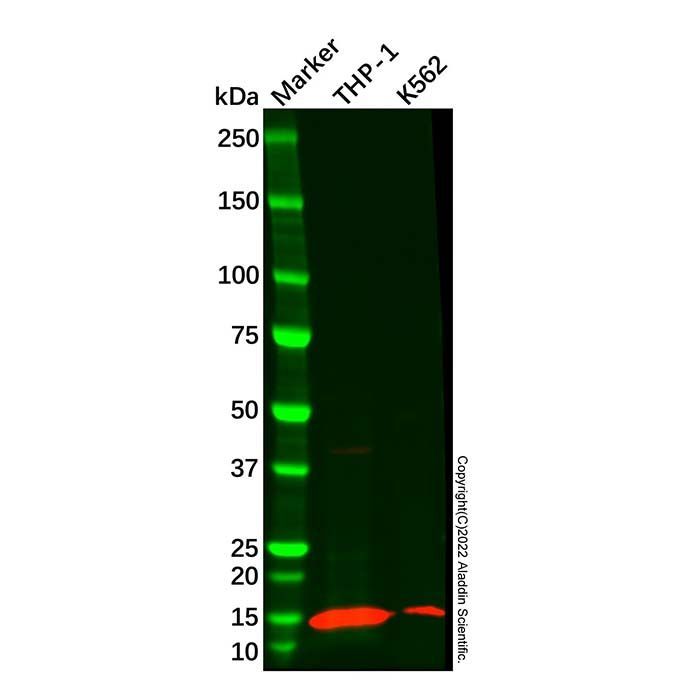
WB: THP-1 and K562 cell lysates. IHC: Human brain tissue.
Conjugation
Unconjugated
Grade
Carrier Free, ExactAb™, High Performance, Validated
Isotype
Mouse IgG1
Type de chaîne lumineuse
kappa
SDS-PAGE
150 kDa
Méthode de purification
Protein G purified
Concentration
0.5 mg/mL
Product Line
Produits biologiques
Stockage et expédition
Forme
Liquid
Conditions de stockage de stockage
Store at -20°C,Avoid repeated freezing and thawing
Expédié en
Ice chest + Ice pads
Stabilité et stockage
Store at 4℃ short term (1-2 weeks). Store at -20℃ long term (24 months). Upon receipt, it is recommended to aliquot. Avoid freeze/thaw cycle.
Images
VAMP8/EDB Mouse mAb (Ab133867) - Western Blot All lanes: VAMP8/EDB Mouse mAb (Ab133867) at 1/1000 dilution Samples: Lysates at 20 µg per lane Secondary: Goat Anti-Mouse IgG H&L (HRP) (Ab179001) at 1/20000 dilution
Predicted band size: 11 kDa Observed band size: 15 kDa Exposure time: 26.4 s
VAMP8/EDB Mouse mAb (Ab133867) - IHC Immunohistochemical analysis of paraffin-embedded H. brain section using VAMP8/EDB Mouse mAb (Ab133867) (N-term). VAMP8/EDB Mouse mAb (Ab133867) was diluted at 1/25 dilution. A undiluted biotinylated goat polyvalent antibody was used as the secondary, followed by DAB staining.
Application
Application
Dilution info
IHC
1/100-1/500
WB
1/1000 - 1/2000
Documentation
📋 Fiche de données de sécurité (FDS)
Document complet couvrant les dangers, la manipulation, le stockage et la conformité réglementaire.
Determine the necessary mass, volume, or concentration for preparing a solution.
Dilution Calculator
Determine the dilution needed to prepare a stock solution.
Reconstitution Calculator
Avis
Avis des clients
Application Protocols
Item-specific tested applications and recommended conditions: Not specified for this item; refer to CoA/Spec Sheet.
General guidance (informational; not product-specific instructions)
Western blot (WB): Validate lysis conditions for membrane proteins; include reducing agents (e.g., DTT/BME) and appropriate membrane permeabilization. Optimize antibody dilution, incubation time (typically overnight at 4°C for primary), and blocking buffer.
Immunofluorescence/ICC: Use proper fixation (paraformaldehyde or methanol) and permeabilization (e.g., saponin/Triton X‑100) compatible with vesicular targets like VAMP8; include controls for specificity.
IHC: Antigen retrieval conditions (pH and heat) can markedly affect detection; perform retrieval screens. Include isotype and no‑primary controls.
Flow cytometry: For intracellular targets, fix/perm and titrate antibody carefully; verify that epitope is preserved.
IP/Co-IP: Employ gentle detergents (e.g., 0.1–1% NP‑40/Triton) to preserve protein–protein interactions; validate capture efficiency and load appropriate positive controls.
Always consult the product-specific datasheet for validated applications, suggested dilutions, and positive control recommendations when available.
Biological Roles
Focus on the antigen (literature context; not product specifications):
VAMP8 overview
Vesicle-associated membrane protein 8 (VAMP8, also called endobrevin) is a member of the R-SNARE family involved in membrane fusion events in the endocytic and secretory pathways (literature).
VAMP8 participates in endosome–lysosome fusion, regulated exocytosis (e.g., degranulation in immune cells), and autophagosome–lysosome fusion, assembling into trans-SNARE complexes with cognate Q-SNAREs to mediate bilayer merger (literature).
Reported roles include platelet granule release, pancreatic enzyme secretion, and neutrophil/basolymphocyte degranulation, with context-dependent regulation by phosphorylation and accessory factors (literature).
“EDB” designation
The product name includes “EDB”; the specific epitope/domain represented by “EDB” is not defined in the provided Product Data. Verify the antigen domain mapping and immunogen details in the datasheet for precise biological interpretation.
Experimental implications (general)
Antibodies to VAMP8 are commonly used to interrogate vesicle trafficking, lysosomal fusion competence, and regulated secretion pathways. Subcellular localization is typically vesicular/membranous; permeabilization conditions impact detection in IF/ICC.
All biological roles above are general literature context about VAMP8 and are not claims of performance or specificity for this specific antibody lot. Always confirm specificity and reactivity empirically.
Buffer Applications
This section is primarily relevant to small-molecule buffers. For a monoclonal antibody, buffer selection is application-driven rather than buffering per se.
Not typically applicable as a buffering agent.
Practical notes (general for antibodies)
Use isotonic, near‑neutral buffers (PBS, TBS) for handling and storage. For conjugation, avoid primary amines (no Tris/glycine) and remove azide if peroxidase labeling is planned.
If performing IP/ChIP, low pH glycine (pH ~2.5–3.0) is often used for elution followed by immediate neutralization; verify compatibility with your downstream assay.
Item-specific buffer composition and pH are not specified for this product; consult the CoA/Spec Sheet.
Green Alternatives
While “green alternatives” usually compares organic solvents or reagents, for antibodies the sustainability focus centers on formulation and workflow design.
Considerations (general)
Carrier-free formulations can reduce use of stabilizing additives (e.g., BSA), easing downstream purification and minimizing animal-derived components in workflows.
Recombinant or sequence-defined monoclonals (if applicable under ExactAb™) can reduce animal use and improve lot-to-lot reproducibility, lowering waste from re-optimization.
Use room-temperature-stable formats when available to reduce cold-chain energy demand; for this specific item, storage at −20°C is specified.
Practice improvements
Adopt miniaturized assay volumes (microplates, microfluidics) to cut reagent consumption.
Employ reusable, validated secondary capture systems (e.g., Protein A/G resins) where compatible to extend reagent life.
Optimize blocking/wash steps to reduce buffer volumes without compromising data quality.
Tradeoffs
Preservative-free/carrier-free materials may be more sensitive to handling and microbial contamination, requiring careful aseptic technique and aliquoting (more plastics), which can offset some gains; balance based on assay criticality.
Note: No product-specific green certification or alternative format is specified for this item.
Pharmaceutical Uses
This product is supplied strictly for research use only (from Product Data) and is not intended for diagnostic or therapeutic applications.
Non-clinical, laboratory roles (general)
Analytical reagent in discovery workflows: target validation, pathway studies, and QC assays.
Potential use as a capture/detection reagent in immunoassays, if so validated by the user.
Formulary/excipient status
No pharmacopeial status or excipient role is indicated for this item. Any GMP or clinical-grade suitability is not specified—this is a research reagent.
Always refer to the CoA and institutional policies if contemplating regulated uses; this listing provides no claims of diagnostic performance or clinical suitability.
Concentration, formulation, excipients/preservatives, pH: Not specified for this item; refer to CoA/Spec Sheet.
Molecular weight: Not specified for this item; refer to CoA/Spec Sheet.
General/literature properties for IgG-class antibodies (context; not product specifications)
Typical molecular mass: ~150 kDa for full-length IgG; fragments (Fab/F(ab’)2) are smaller (literature).
Solubility: Readily soluble in aqueous buffers (e.g., PBS, TBS) with modest ionic strength; stability often improved by neutral pH and low surfactant levels (literature).
Isoelectric point (pI): IgGs vary widely (~6–9) depending on isotype and sequence (literature).
Thermal stability: Many monoclonals unfold above ~60–70°C; functional stability is strongly buffer- and formulation-dependent (literature).
Light sensitivity: Proteins can be sensitive to prolonged UV exposure; minimize light for conjugates (general practice).
Physical state: Provided either in solution or lyophilized; this item’s state is not specified.
Not applicable/Not defined for proteins (context)
Boiling point, melting point, vapor pressure, logP: Not applicable for macromolecular biologics; not used as specifications.
Note: Use the item’s CoA/Spec Sheet for the exact formulation, concentration, and any stabilizers; do not infer properties or excipients beyond what is documented for this specific lot.
Carrier Free: Provided without added carrier proteins; specific excipients are not listed here. For this item, exact formulation is not specified—refer to CoA/Spec Sheet.
ExactAb™: Vendor quality/technology designation indicating a precisely defined monoclonal format; consult the manufacturer’s note for platform details.
Validated, High Performance: Indicates internal validation and performance screening; application-specific validation data are not provided in this listing.
Practical implications (general guidance)
Carrier-free antibodies are preferred for direct conjugation (enzymes, fluorophores, oligos) and for functional assays where carriers (e.g., BSA, gelatin, glycerol) may interfere. Because the precise formulation is not specified for this item, verify buffer composition and residual stabilizers in the CoA prior to conjugation.
“Validated”/“High Performance” generally implies lot-controlled consistency and robust signal-to-noise under recommended conditions; however, end-user optimization is still required.
If the product is recombinant or clonally defined under the ExactAb™ label, this typically enhances lot-to-lot reproducibility and epitope fidelity compared to polyclonal reagents (general note; confirm in CoA/Spec Sheet for this item).
What to check on arrival
Certificate of Analysis for: concentration, purity, endotoxin (if relevant), buffer/excipient list, isotype/clone, and tested applications.
If conjugation is planned, confirm absence of carrier proteins and amine-containing buffers that complicate NHS chemistry.
Reaction and Applications
This section typically addresses small-molecule reaction chemistry (e.g., cross-couplings, condensations). As a monoclonal antibody, this product is not a reagent for organic synthesis.
Not applicable
No named organic reactions, catalysts, or solvent systems apply to this biological reagent.
Where to look instead
See “Target Specificity” for antigen information and “Application Protocols” for assay-oriented usage guidance once available from the datasheet.
Reaction Conditions
Not applicable to this product. Conventional reaction parameters (temperature, catalysts, stoichiometry) for small-molecule transformations do not pertain to an antibody reagent.
For experimental conditions relevant to immunoassays (e.g., incubation times, temperatures, blocking/wash conditions), consult the product datasheet once available or follow your lab’s validated SOPs for the intended application.
Safety and Handling
Hazard information (from Product Data)
Signal word: Not specified for this item; refer to SDS.
H-statements / GHS classification / pictograms: Not specified for this item; refer to SDS.
General laboratory safety for antibodies (informational; defer to SDS)
PPE: Use lab coat, gloves (nitrile), and safety glasses. Avoid aerosol generation and practice aseptic handling to prevent contamination.
Incompatibilities: Avoid strong oxidizers and extremes of pH that denature proteins. Proteolytic enzymes and repeated freeze–thaw cycles can degrade antibody integrity.
Biological safety: Product is for research use only. Although antibodies are generally considered low hazard, handle as a biological material; disinfect spills with appropriate protein-compatible disinfectants and follow institutional biosafety procedures.
First aid (general): If skin or eye contact occurs, rinse with water. If inhaled as aerosol or ingested, seek medical attention per institutional guidelines. Always consult the SDS for authoritative measures.
Special risks
Preservatives such as sodium azide or thimerosal can pose additional hazards if present; their presence/absence is not specified for this item—consult the CoA/SDS.
Avoid repeated freeze–thaw (explicit in Product Data) to prevent aggregation and loss of activity.
Always consult and follow the product-specific SDS and institutional EHS policies for handling, storage, and disposal.
Solvent Selection
This product is an aqueous protein reagent rather than a small-molecule solute; conventional organic solvent selection is not typically applicable.
Practical buffer considerations (general guidance for antibodies)
Working buffers: PBS or TBS at pH ~7.2–7.6 are commonly used. Low detergent (e.g., 0.01% Tween-20) can reduce nonspecific binding in assays; avoid detergents for conjugation workflows.
Conjugation: Use amine-free buffers (e.g., PBS without Tris/glycine) for NHS ester chemistry; remove azide before peroxidase conjugation.
Low-protein binding plastics and filtered buffers (0.22 μm) help maintain activity and reduce adsorption.
Miscibility/solubility
Antibodies are water-soluble proteins; avoid high percentages of organic solvents that can denature proteins. For elution in IP/ChIP, transient exposure to low pH glycine or high-salt buffers may be used with prompt neutralization (general practice).
Not specified for this item
Exact formulation and any excipients are not specified; consult the CoA/Spec Sheet to choose compatible buffers for your downstream application.
Storage and Reconstitution
Item-specific storage and shipping (from Product Data)
Storage: Store at −20°C.
Handling: Avoid repeated freezing and thawing.
Shipping: Ice chest + ice pads.
Not specified for this item; refer to CoA/Spec Sheet
Physical state (solution vs lyophilized), concentration, buffer/excipients, and pH
Reconstitution solvent/volume if lyophilized
Presence of preservatives (e.g., sodium azide) or carrier proteins
General best practices (informational)
Upon receipt, briefly centrifuge to collect contents. If solution, aliquot into single-use volumes to minimize freeze–thaw cycles; store at the recommended temperature. If lyophilized, reconstitute with sterile, antibody‑compatible buffer (e.g., PBS) under aseptic conditions, then aliquot.
Thaw on ice; mix gently—avoid vigorous vortexing to minimize aggregation. Use low‑protein‑binding tubes and sterile filtration (0.22 μm) only if necessary and compatible with concentration.
For long-term storage, maintain at −20°C or below as specified; avoid frost-free freezers. Protect from microbial contamination. Do not store working dilutions for extended periods unless supplemented with appropriate stabilizers per your SOPs.
For lot-specific instructions (including any recommended storage at 4°C for short-term use), consult the CoA/Spec Sheet.
Structure and Identity
Brief description: VAMP8/EDB Mouse mAb (SKU: Ab133867) is a mouse monoclonal antibody intended for research applications.
Item-specific facts (from Product Data)
Product type: Mouse monoclonal antibody (mAb)
Target designation in name: VAMP8/EDB
Grade/Purity: Carrier Free; ExactAb™; Validated; High Performance
CAS, CID, InChIKey, SMILES: Not specified for this item; refer to CoA/Spec Sheet.
Structural identity and format
Antibody class/isotype, light chain type, clone ID, and sequence: Not specified for this item; refer to CoA/Spec Sheet.
Antibodies are large glycoproteins built from two heavy and two light chains forming a Y‑shaped quaternary structure with variable (VH/VL) and constant (CH/CL) domains connected by disulfide bonds (general knowledge).
Antigen-recognition site: Complementarity determining regions (CDRs) in the variable domains (general knowledge).
Molecular formula and molecular weight
Empirical molecular formula: Not applicable for complex biologics; not specified for this item.
Molecular weight: Not specified for this item; refer to CoA/Spec Sheet. Typical murine IgG full-length antibodies are ~150 kDa (literature, approximate).
2D/functional description in words
A bivalent immunoglobulin with two antigen-binding Fabs and one Fc domain capable of Fc receptor/complement interactions depending on isotype (general knowledge). The specific epitope noted as “EDB” in the name is not further defined in the Product Data; consult the datasheet for precise epitope and domain mapping.
Synthetic Utility
Not applicable. As a monoclonal antibody reagent, this product is not used as a building block or reagent in classical organic synthesis or polymer chemistry.
For practical usage, refer to “Application Protocols” and “Target Specificity.”
Target Specificity
Item-specific (from Product Data)
Antigen/Target designation: VAMP8/EDB (as named in the product title). The precise epitope and domain mapping are not provided here.
Host: Mouse monoclonal antibody.
Not specified for this item; refer to CoA/Spec Sheet
Clone ID and isotype/subclass
Immunogen details (sequence/peptide, species of origin)
Species reactivity and cross-reactivity
Validated applications (WB, IHC, IF, FC, IP, etc.) and expected band size(s)
Affinity/avidity, KD, or blocking/neutralization capability
Notes
Because epitope and species reactivity are not provided, users should verify applicability to their samples via small-scale pilot experiments and appropriate positive/negative controls.
Foire aux questions
What does ExactAb? mean?
ExactAb? indicates the product has been validated for use in rigorous antibody validation workflows. Validation may include positive/negative control samples, signal-to-noise testing, and protocol-specific QC. Lot-specific test data is published on the Certificate of Analysis where available.
What does Carrier Free mean?
Carrier Free indicates that the material has been processed and tested for specialty industrial processing. Specifications focus on the impurities that affect performance in that application — for example, metal content for electronics, particle size for batteries, refractive index for optics, or moisture content for moisture-sensitive processes.
How should this product be stored?
Store at ?20 °C. Avoid repeated freeze–thaw cycles. Aliquot into single-use volumes before freezing.
How is this product shipped?
This product ships in an insulated container with ice pads. Unpack on arrival and transfer it to the storage condition stated above.
What documentation is provided?
Available product documentation, including Certificates of Analysis (COA), Safety Data Sheets (SDS), and specification sheets, is shown in the product document area. Document availability and access follow the current site policy.
Which species reactivity has this antibody been validated against?
Validated reactivity is listed on the PDP and on each lot's datasheet. We validate against the most commonly tested species for the target (VAMP8/EDB Mouse mAb); cross-reactivity in untested species may exist but is not guaranteed. Contact technical support for specific species inquiries.
Besoin d'aide pour choisir la qualité ?
Notre guide de sélection des qualités couvre la pureté, le statut du stabilisant et l'adéquation à l'application pour toutes les variantes de notre catalogue.
Nous utilisons des cookies pour garantir le bon fonctionnement du site et, lorsque cela est autorisé, pour améliorer votre expérience. Vous pouvez gérer vos préférences à tout moment dans les Paramètres. Pour en savoir plus, consultez notre Politique relative aux cookies.
Souhaitez-vous que nous vous envoyions un message lorsque des réductions seront disponibles?
Me rappeler plus tard
Merci ! Veuillez vérifier votre boîte de réception e-mail pour confirmer.
Products are supplied to verified businesses, institutions, and qualified professionals for research and development use only. Not for use in humans, animals, diagnosis, or therapy.

 ZJ24F0403968