Determine the necessary mass, volume, or concentration for preparing a solution.
≥97%, <50nmTEM ベースライン干渉を最小限に抑える必要がある、感度の高いクロマトグラフィーおよび分析ワークフロー向け。
Room temperature,Desiccated Normal に出荷。正確な仕様については、ロット固有の COA をご確認ください。
SDS、COA、データシート、仕様書をダウンロードできます。ロット固有の COA はロット番号検索で入手可能です。
クロマトグラフィー、有機合成、クロスカップリング反応に関する 462 件の査読済み論文で引用されています。
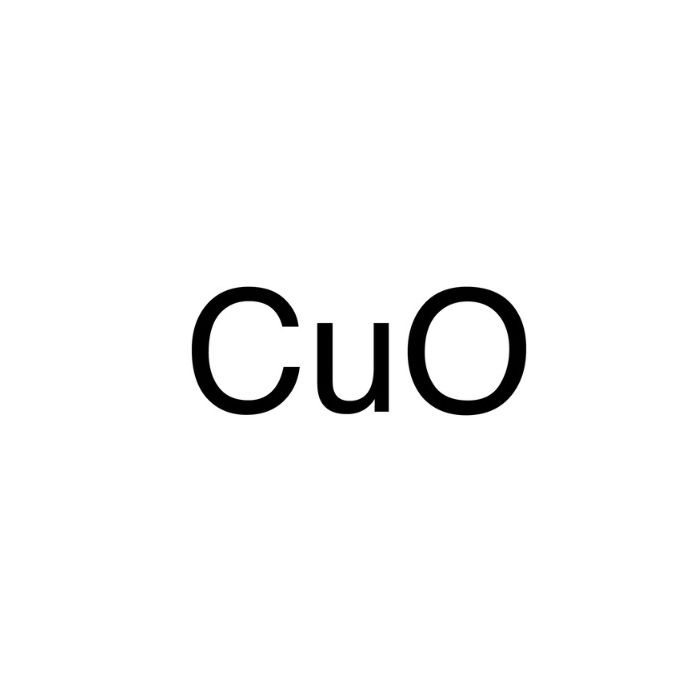
Copper oxides (Cu 2 O, CuO) are p-type semiconductor materials with small band gap energy. High physical and chemical stability of metal oxide nanoparticles renders them extremely useful in catalytic applications.The structures of the compounds are monoclinic. Nanoscaled copper oxide compounds can be prepared by thermal plasma technology. A study reports its antimicrobial properties.
Application
Toxicity of copper oxide nanoparticles was reported. Cu 2 O has been used in coating Cu nanoparticles (Cu 2 O NPs). Copper oxide nanoparticles has been reported to be used as an anode material for lithium ion cells and as gas sensors on account of it high surface reactivity. Hollow Cu 2 O NPs has been used in the preparation of nucleosides and as a catalyst in azide-alkyne cycloadditions by other groups. CuO NPs may be used as a catalyst for CSe, CTe, and CS bond formation and synthesis of 2-aminobenzothiazole. Molecular responses of mouse macrophages to CuO and Cu 2 O NPs were studied.
危険性、取扱い、保管、および規制遵守を網羅した包括的な文書。
<<<<<<< HEAD SDS をダウンロード → ======= SDS をダウンロード → >>>>>>> release248-p3Taxonomy Tree
| Kingdom | Inorganic compounds |
|---|---|
| Superclass | Mixed metal/non-metal compounds |
| 分類 | Transition metal organides |
| Subclass | Transition metal oxides |
| Intermediate Tree Nodes | Not available |
| Direct Parent | Transition metal oxides |
| Alternative Parents | Inorganic salts Inorganic oxides |
| Molecular Framework | Not available |
| Substituents | Transition metal oxide - Inorganic oxide - Inorganic salt |
| 説明 | This compound belongs to the class of inorganic compounds known as transition metal oxides. These are inorganic compounds containing an oxygen atom of an oxidation state of -2, in which the heaviest atom bonded to the oxygen is a transition metal. |
| External Descriptors | Not available |
Find and download the COA for your product by matching the lot number on the packaging.
| Lot Number | Certificate Type | 日付 | 商品 |
|---|---|---|---|
| Certificate of Analysis | Oct 30, 2025 | C431871 | |
| Certificate of Analysis | Oct 30, 2025 | C431871 | |
| Certificate of Analysis | Oct 30, 2025 | C431871 | |
| Certificate of Analysis | Apr 18, 2024 | C431871 | |
| Certificate of Analysis | Apr 18, 2024 | C431871 | |
| Certificate of Analysis | Apr 18, 2024 | C431871 | |
| Certificate of Analysis | Apr 18, 2024 | C431871 |
| 分子量 | 79.550 g/mol |
|---|---|
| XLogP3 | |
| Hydrogen Bond Donor Count | 0 |
| Hydrogen Bond Acceptor Count | 1 |
| Rotatable Bond Count | 0 |
| Exact Mass | 78.9245 Da |
| Monoisotopic Mass | 78.9245 Da |
| Topological Polar Surface Area | 17.100 Ų |
| Heavy Atom Count | 2 |
| Formal Charge | 0 |
| Complexity | 2.000 |
| Isotope Atom Count | 0 |
| Defined Atom Stereocenter Count | 0 |
| Undefined Atom Stereocenter Count | 0 |
| Defined Bond Stereocenter Count | 0 |
| Undefined Bond Stereocenter Count | 0 |
| The total count of all stereochemical bonds | 0 |
| Covalently-Bonded Unit Count | 1 |