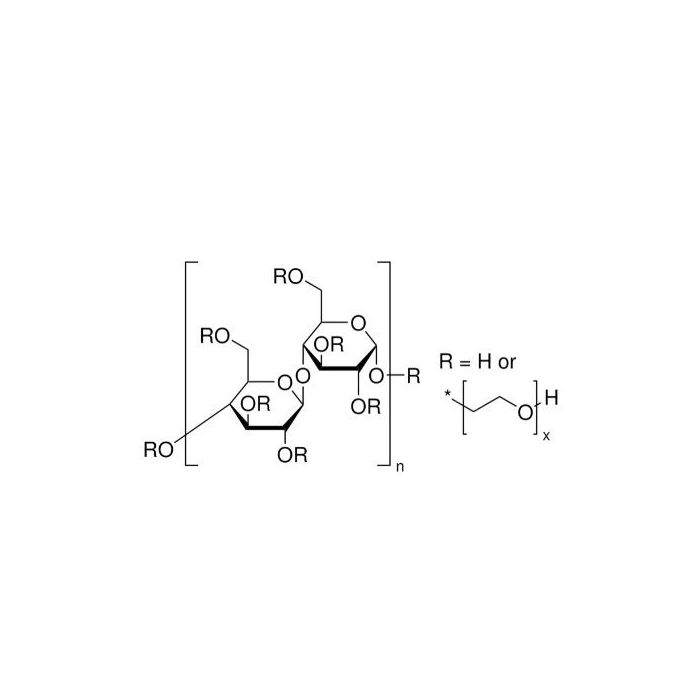
Hydroxyethyl Cellulose(HEC) - 100~200mpa.s,25℃ , CAS No.9004-62-0

CAS: 9004-62-0 Cat. No.: H104786 EC番号: 618-387-5
注文可能
グレード&純度 100~200mpa.s,25℃
Synonyms
HEC | H11622 | Hydroxyethyl-cellulose | 2-Hydroxyethyl cellulose | DTXSID60873934 | 2-O-(2-Hydroxyethyl)-4-O-methylhexopyranosyl-(1->4)-[4-O-methylhexopyranosyl-(1->6)]hexopyranosyl-(1->5)-2,6-anhydro-1-deoxyheptitol | FT-0627136 | SCHEMBL23306563 | 5-[6-
Storage
Room temperature,Desiccated
Shipped In
Normal
★
サイズ
USA
ドイツ (EU)*
価格
個数
50g
H104786-50g
2 在庫あり
—

$26.90

$31.90
保存 $5.00 (15.67%)
100g
H104786-100g
1 在庫あり
—

$47.90

$55.90
保存 $8.00 (14.31%)
500g
H104786-500g
2 在庫あり
—

$159.90

$185.90
保存 $26.00 (13.99%)
Enter a quantity for the sizes you want to add.
🧪
このグレードを選ぶ理由

100~200mpa.s,25℃ ベースライン干渉を最小限に抑える必要がある、感度の高いクロマトグラフィーおよび分析ワークフロー向け。

🌡

保管・配送

Room temperature,Desiccated Normal に出荷。正確な仕様については、ロット固有の COA をご確認ください。

📋

品質書類

SDS、COA、データシート、仕様書をダウンロードできます。ロット固有の COA はロット番号検索で入手可能です。

📚

文献的裏付け

クロマトグラフィー、有機合成、クロスカップリング反応に関する 214 件の査読済み論文で引用されています。

概要

Hydroxyethyl cellulose is a gelling and thickening agent derived from cellulose and is widely used in cosmetics, cleaning solutions and other household products. It is used with hydrophobic drugs in capsule formulations, to improve the drugs dissolution in the gastrointestinal fluids. This process is known as hydrophilization.
Hydroxyethylcellulose is used as a gelling and thickening agent in the development of biostructures for the delivery of hydrophobic drugs. Hydroxyethylcellulose is used in the development of polymer networks and block copolymers useful in separation technology such as capillary electrophoresis and in biofilms and coatings. It is also used for encapsulation of cells in chitosan/glycerophosphate/hydroxyethyl cellulose (chitosan-GP/HEC) gels.

仕様

同義語
HEC | H11622 | Hydroxyethyl-cellulose | 2-Hydroxyethyl cellulose | DTXSID60873934 | 2-O-(2-Hydroxyethyl)-4-O-methylhexopyranosyl-(1->4)-[4-O-methylhexopyranosyl-(1->6)]hexopyranosyl-(1->5)-2,6-anhydro-1-deoxyheptitol | FT-0627136 | SCHEMBL23306563 | 5-[6-
仕様と純度
100~200mpa.s,25℃
保管条件
Room temperature,Desiccated
入荷
Normal
名前と識別子
パブケム・シド
カノニカル・スマイル
CC1C(C(C(C(O1)CO)OC2C(C(C(C(O2)COC3C(C(C(C(O3)CO)OC)O)O)OC4C(C(C(C(O4)CO)OC)O)OCCO)O)O)O)O
IUPAC Name
5-[6-[[3,4-dihydroxy-6-(hydroxymethyl)-5-methoxyoxan-2-yl]oxymethyl]-3,4-dihydroxy-5-[4-hydroxy-3-(2-hydroxyethoxy)-6-(hydroxymethyl)-5-methoxyoxan-2-yl]oxyoxan-2-yl]oxy-6-(hydroxymethyl)-2-methyloxane-3,4-diol
InChIKey
CWSZBVAUYPTXTG-UHFFFAOYSA-N
INCHI
1S/C29H52O21/c1-10-15(34)16(35)24(13(8-33)45-10)49-28-20(39)18(37)25(50-29-26(43-5-4-30)21(40)23(42-3)12(7-32)47-29)14(48-28)9-44-27-19(38)17(36)22(41-2)11(6-31)46-27/h10-40H,4-9H2,1-3H3
異性体SMILES
CC1C(C(C(C(O1)CO)OC2C(C(C(C(O2)COC3C(C(C(C(O3)CO)OC)O)O)OC4C(C(C(C(O4)CO)OC)O)OCCO)O)O)O)O
WGKドイツ
1
RTECS
FJ5958000
Reaxy-Rn
24866087
Reaxys-RN_link_address
https://www.reaxys.com/reaxys/secured/hopinto.do?context=S&query=IDE.XRN=24866087&ln=

ドキュメント

📋 安全データシート(SDS)

危険性、取扱い、保管、および規制遵守を網羅した包括的な文書。

<<<<<<< HEAD SDS をダウンロード → ======= SDS をダウンロード → >>>>>>> release248-p3

✅ 分析証明書(COA)

ロット固有の品質データ。ロット番号を入力して、正確な COA を取得してください。

COA を検索 →

📊 データシート

製品仕様と用途のクイックリファレンス概要。

データシートを見る →

🔬 仕様書

このグレードの完全な品質特性と合格基準。

仕様書を見る →

詳細データ

Taxonomic Classification

Taxonomy Tree

KingdomOrganic compounds
SuperclassOrganic oxygen compounds
分類Organooxygen compounds
SubclassCarbohydrates and carbohydrate conjugates
Intermediate Tree Nodes Not available
Direct ParentOligosaccharides
Alternative Parents O-glycosyl compounds  Oxanes  Secondary alcohols  Oxacyclic compounds  Dialkyl ethers  Acetals  Primary alcohols  Hydrocarbon derivatives  
Molecular FrameworkAliphatic heteromonocyclic compounds
Substituents Oligosaccharide - O-glycosyl compound - Glycosyl compound - Oxane - Secondary alcohol - Oxacycle - Organoheterocyclic compound - Ether - Dialkyl ether - Acetal - Hydrocarbon derivative - Primary alcohol - Alcohol - Aliphatic heteromonocyclic compound
説明This compound belongs to the class of organic compounds known as oligosaccharides. These are carbohydrates made up of 3 to 10 monosaccharide units linked to each other through glycosidic bonds.
External Descriptors Not available
3 D構造
インタラクティブ化学構造モデル


証明書(CoA、COO、BSE/TSEと分析図)
C of A & Other Certificates(BSE/TSE, COO):
Analytical Chart:

Find and download the COA for your product by matching the lot number on the packaging.

23 results found

Lot NumberCertificate Type日付商品
I2222031I2222031Certificate of AnalysisJul 03, 2026 H104786
I2222029I2222029Certificate of AnalysisJul 03, 2026 H104786
G2120186G2120186Certificate of AnalysisMay 09, 2025 H104786
B2419257B2419257Certificate of AnalysisJan 31, 2024 H104786
B2419268B2419268Certificate of AnalysisJan 31, 2024 H104786
C2428294C2428294Certificate of AnalysisJan 31, 2024 H104786
C2428296C2428296Certificate of AnalysisJan 31, 2024 H104786
C2428297C2428297Certificate of AnalysisJan 31, 2024 H104786
G2606104G2606104Certificate of AnalysisJan 31, 2024 H104786
H2323013H2323013Certificate of AnalysisAug 31, 2023 H104786
H2322415H2322415Certificate of AnalysisAug 31, 2023 H104786
H2322414H2322414Certificate of AnalysisAug 31, 2023 H104786
I2222163I2222163Certificate of AnalysisJul 11, 2022 H104786
I2222028I2222028Certificate of AnalysisJul 11, 2022 H104786
G2207248G2207248Certificate of AnalysisJun 17, 2022 H104786
K2526070K2526070Certificate of AnalysisJun 17, 2022 H104786
G2207270G2207270Certificate of AnalysisJun 17, 2022 H104786
G2207267G2207267Certificate of AnalysisJun 17, 2022 H104786
G2207163G2207163Certificate of AnalysisJun 17, 2022 H104786
G2207162G2207162Certificate of AnalysisJun 17, 2022 H104786
D2222134D2222134Certificate of AnalysisApr 26, 2022 H104786
A2226099A2226099Certificate of AnalysisJan 24, 2022 H104786
A2226100A2226100Certificate of AnalysisJan 24, 2022 H104786
化学的性質と物理的性質
感度Moisture sensitive
融点(°C)288-290°C
分子量736.700 g/mol
XLogP3-7.700
Hydrogen Bond Donor Count11
Hydrogen Bond Acceptor Count21
Rotatable Bond Count15
Exact Mass736.3 Da
Monoisotopic Mass736.3 Da
Topological Polar Surface Area315.000 Ų
Heavy Atom Count50
Formal Charge0
Complexity999.000
Isotope Atom Count0
Defined Atom Stereocenter Count0
Undefined Atom Stereocenter Count20
Defined Bond Stereocenter Count0
Undefined Bond Stereocenter Count0
The total count of all stereochemical bonds0
Covalently-Bonded Unit Count1
よくある質問と記事
Microcrystalline Cellulose (MCC): A Comprehensive Primer and Selection Guide—Structural Features, Key Performance Metrics, and Application Scenarios
Understanding Hydrophilic Polymers in Aqueous Systems: Hydration Mechanisms, Structural Knobs, and Task-Oriented Selection Guide (Including Tables 1–3)
Applications and Selection of Acrylic Resins in Coatings: Analysis of Architectural, Industrial, and Supporting Materials
Natural Resins in Coating Formulations: Functional Positioning, Structure–Property Relationships, and Selection Validation
Waterborne Resin Technology Explained: Waterborne Forms, Performance Balance, and a Technology Map
Waterborne Resin Application Guide: Formulation Synergy, Troubleshooting, and Technology Development Trends
Why LABSA (Sulfonic Acid) Is Commonly Used in Household Cleaning Formulations: Neutralization Mechanism, Detergency Action, and Formulation Application Points
From Structure to Performance: Conditioning, Film-Forming, Thickening, and Chelating Applications of Functional Ingredients in Personal Care and Home Care
From Structure to Rheology: How Carbomer Forms Gel Structures and Enables Thickening, Suspension, and Auxiliary Emulsion Stabilization
What Is the Difference Between Triethanolamine and Diethanolamine: Understanding Their Formulation Functions, Application Differences, and Selection Logic from a Molecular-Structure Perspective
Thickening, Suspension, Auxiliary Stabilization, and Agglomeration Mechanisms of Xanthan Gum in Personal Care Formulations: From Molecular Structure to Processing Applications
AES (Fatty Alcohol Polyoxyethylene Ether Sulfate) in Personal and Home-Care Cleansing Formulations: An Analysis of Structure, Performance, and Low-Temperature Flowability
Understanding CAPB from Its Structure: How Cocamidopropyl Betaine Improves Foam, Enhances Mildness, and Supports Thickening
From Structure to Rheology: Thickening, Stabilization, and Selection Logic of Cellulose Ethers for Personal Care Applications
How to Select Thickeners for Strongly Acidic Cleaning Systems: Comparison of Thickening Mechanisms and Application Considerations for Fatty Amine Ethoxylates
Analysis of the Production Process of Hydroxypropyl Methylcellulose (HPMC) for Putty: Understanding Differences in Substitution Structure and Gelation Temperature from High-Ratio and Low-Ratio Formulations
Why Are Daily Chemical Products Prone to Viscosity Thinning in Summer? Core Mechanisms, Troubleshooting Methods, and Solutions
Types, Mechanisms of Action, Key Quality Indicators, and Selection and Application of Common Cellulose Ethers in Wall Putty
Influencing Factors and Control Strategies for Blistering in Neutral Wall Putty: An Experimental Analysis Based on HPMC Dosage, Viscosity, and Ground Calcium Carbonate Fineness
How to Select Binding/Gel Materials for Neutral Wall Putty? A Comparison of Pregelatinized Starch, PVA, and Redispersible Polymer Powder Based on Four Application Trials
Causes and Mechanism Analysis of Delamination During Sanding of Water-Resistant Putty
What Are the Differences Between Polyvinyl Alcohol 1788, 2488, and 2699? Understanding Workability, Bonding Strength, and Relative Water Resistance from the Perspective of Degree of Polymerization and Degree of Hydrolysis
Common Problems and Formulation Adjustment Strategies for Neutral Putty Under High Summer Temperatures
Differences and Application Selection of Cassava- and Corn-Based Pregelatinized Starch in Neutral Putty Formulations
The Role, Selection, Cracking Risk Analysis, and Dosage Control of Bentonite in Neutral Putty
Dispersants, Anti-Redeposition Agents, and Scale-Control Materials in Household Cleaning Formulations: Mechanisms of Action, Selection Logic, and Representative Products
Experimental Applications of Carboxymethyl Cellulose (CMC) Solution in Enzyme Assays, Suspension Systems, and Functional Materials
Niacinamide Brightening Mechanisms and Formulation Design: Melanosome Transfer, pH Regulation, and Combination Strategies
Citations of This Product
ソリューション計算機
レビュー

顧客レビュー

Shall we send you a message when we have discounts available?

Remind me later

Thank you! Please check your email inbox to confirm.

Oops! Notifications are disabled.