Kaolin - Packing grade, whiteness ≥ 85% , CAS No.1332-58-7

CAS: 1332-58-7 Cat. No.: K1373699 分子式: Al2Si2O5(OH)4 · 2 H2O 分子量: 294.19 EC番号: 310-194-1
注文可能
グレード&純度 Packing grade, whiteness ≥ 85%
Storage
Desiccated,Room temperature
Shipped In
Normal
★
サイズ
USA
ドイツ (EU)*
価格
個数
100g
K1373699-100g
3 在庫あり
—

$11.90

$13.90
保存 $2.00 (14.39%)
500g
K1373699-500g
受注生産 · 8~12週間

$45.90

$53.90
保存 $8.00 (14.84%)
Enter a quantity for the sizes you want to add.
🧪
このグレードを選ぶ理由

Packing grade, whiteness ≥ 85% ベースライン干渉を最小限に抑える必要がある、感度の高いクロマトグラフィーおよび分析ワークフロー向け。

🌡

保管・配送

Desiccated,Room temperature Normal に出荷。正確な仕様については、ロット固有の COA をご確認ください。

📋

品質書類

SDS、COA、データシート、仕様書をダウンロードできます。ロット固有の COA はロット番号検索で入手可能です。

📚

文献的裏付け

クロマトグラフィー、有機合成、クロスカップリング反応に関する 166 件の査読済み論文で引用されています。

概要

A hydrated aluminum silicate.

Kaolin (Bolus alba) is a clay dominated by minerals of the kaolinite family. Kaolin increased the sensitivity of this method for monitoring hemophilia therapy.

仕様

仕様と純度
Packing grade, whiteness ≥ 85%
保管条件
Desiccated,Room temperature
入荷
Normal
名前と識別子
カノニカル・スマイル
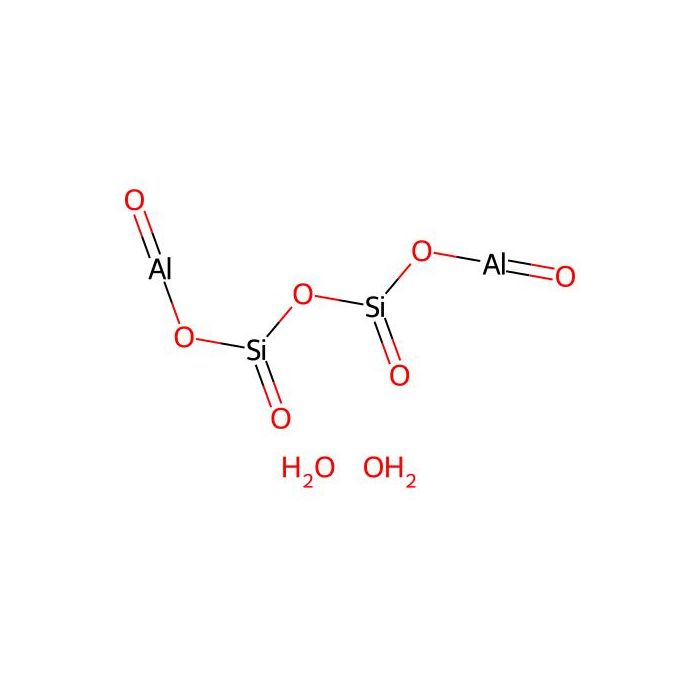
O.O.O=[Al]O[Si](=O)O[Si](=O)O[Al]=O
IUPAC Name
oxo-oxoalumanyloxy-[oxo(oxoalumanyloxy)silyl]oxysilane;dihydrate
InChIKey
NLYAJNPCOHFWQQ-UHFFFAOYSA-N
INCHI
1S/2Al.O5Si2.2H2O.2O/c;;1-6(2)5-7(3)4;;;;/h;;;2*1H2;;/q2*+1;-2;;;;
異性体SMILES
O.O.O=[Al]O[Si](=O)O[Si](=O)O[Al]=O
RTECS
GF1670500
分子量
294.19
Reaxy-Rn
36272658
Reaxys-RN_link_address
https://www.reaxys.com/reaxys/secured/hopinto.do?context=S&query=IDE.XRN=36272658&ln=

ドキュメント

📋 安全データシート(SDS)

危険性、取扱い、保管、および規制遵守を網羅した包括的な文書。

<<<<<<< HEAD SDS をダウンロード → ======= SDS をダウンロード → >>>>>>> release248-p3

✅ 分析証明書(COA)

ロット固有の品質データ。ロット番号を入力して、正確な COA を取得してください。

COA を検索 →

📊 データシート

製品仕様と用途のクイックリファレンス概要。

データシートを見る →

🔬 仕様書

このグレードの完全な品質特性と合格基準。

仕様書を見る →

詳細データ

Taxonomic Classification

Taxonomy Tree

KingdomInorganic compounds
SuperclassMixed metal/non-metal compounds
分類Miscellaneous mixed metal/non-metals
SubclassMiscellaneous metallic oxoanionic compounds
Intermediate Tree Nodes Not available
Direct ParentMiscellaneous silicates
Alternative Parents Miscellaneous aluminates  Metalloid salts  Inorganic oxides  
Molecular FrameworkNot available
Substituents Silicate - Aluminate - Inorganic oxide - Inorganic metalloid salt
説明This compound belongs to the class of inorganic compounds known as miscellaneous silicates. These are inorganic compounds in which the largest metallic oxoanion is silicate, to which either no atom or a non metal atom is bonded.
External Descriptors Not available
3 D構造
インタラクティブ化学構造モデル


証明書(CoA、COO、BSE/TSEと分析図)
C of A & Other Certificates(BSE/TSE, COO):
Analytical Chart:

Find and download the COA for your product by matching the lot number on the packaging.

10 results found

Lot NumberCertificate Type日付商品
J2514444J2514444Certificate of AnalysisOct 29, 2025 K1373699
J2527744J2527744Certificate of AnalysisOct 29, 2025 K1373699
J2527745J2527745Certificate of AnalysisOct 29, 2025 K1373699
J2514531J2514531Certificate of AnalysisOct 24, 2025 K1373699
H2528322H2528322Certificate of AnalysisSep 01, 2025 K1373699
H2528175H2528175Certificate of AnalysisAug 30, 2025 K1373699
H2528323H2528323Certificate of AnalysisAug 30, 2025 K1373699
H2528324H2528324Certificate of AnalysisAug 30, 2025 K1373699
H2617176H2617176Certificate of AnalysisAug 30, 2025 K1373699
J2619033J2619033Certificate of AnalysisAug 30, 2025 K1373699
化学的性質と物理的性質
分子量258.160 g/mol
XLogP3
Hydrogen Bond Donor Count2
Hydrogen Bond Acceptor Count9
Rotatable Bond Count4
Exact Mass257.902 Da
Monoisotopic Mass257.902 Da
Topological Polar Surface Area98.000 Ų
Heavy Atom Count13
Formal Charge0
Complexity167.000
Isotope Atom Count0
Defined Atom Stereocenter Count0
Undefined Atom Stereocenter Count0
Defined Bond Stereocenter Count0
Undefined Bond Stereocenter Count0
The total count of all stereochemical bonds0
Covalently-Bonded Unit Count3
よくある質問と記事
Applications of Nanoclay in Materials and Formulations: Dispersion Mechanisms, Performance Enhancement, and Product Selection
Mercapto Silane Coupling Agents: Structural Features, Classification, Applications, and Selection
Titanate Coupling Agents: Structural Features, Classification, Typical Applications, and Differences from Silane Coupling Agents
How Matting Agents in Coatings Build Low-Gloss Coating Surfaces: Mechanisms, Formulation Trade-Offs, and Product Selection
Silicone Resin Coating Formulation Design: From Application Conditions to Matching Resins, Pigments and Fillers, Curing, and Substrates
Vinyl Acetate-Acrylic Emulsion (Vinyl Acrylic Emulsion): A Cost-Performance Balance Solution for Architectural Coatings
PVAc, VAE, and Vinyl Acetate-Based Emulsions: Film-Forming Logic and Performance Boundaries in Architectural Coatings
Application Positioning, Scenario Selection, and Key Use Considerations for Chlorinated Rubber Resin in Coatings
Formulation Design of Chlorinated Rubber Coatings: Component Synergy and Performance Control
What Is Silica Sol: Mechanism of Action, Application Scenarios, and Selection Criteria for Nanosilica Dispersions
Waterborne Resin Application Guide: Formulation Synergy, Troubleshooting, and Technology Development Trends
Resin Polarity in Coating Formulations: From Molecular Structure to Dissolution, Compatibility, Interfacial Interactions, and Formulation Design
Why Do Daily Chemical Products Become Opaque? Formation Mechanisms of Milky Turbidity, Pearlescence, and Coverage, and How to Select the Right Ingredients
Color-Development Mechanisms, Formulation Forms, and Selection/Application Logic of Colorants in Personal Care Products
Analysis of the Production Process of Hydroxypropyl Methylcellulose (HPMC) for Putty: Understanding Differences in Substitution Structure and Gelation Temperature from High-Ratio and Low-Ratio Formulations
Types, Mechanisms of Action, Key Quality Indicators, and Selection and Application of Common Cellulose Ethers in Wall Putty
Influencing Factors and Control Strategies for Blistering in Neutral Wall Putty: An Experimental Analysis Based on HPMC Dosage, Viscosity, and Ground Calcium Carbonate Fineness
How to Select Binding/Gel Materials for Neutral Wall Putty? A Comparison of Pregelatinized Starch, PVA, and Redispersible Polymer Powder Based on Four Application Trials
Causes and Mechanism Analysis of Delamination During Sanding of Water-Resistant Putty
What Are the Differences Between Polyvinyl Alcohol 1788, 2488, and 2699? Understanding Workability, Bonding Strength, and Relative Water Resistance from the Perspective of Degree of Polymerization and Degree of Hydrolysis
Common Problems and Formulation Adjustment Strategies for Neutral Putty Under High Summer Temperatures
Differences and Application Selection of Cassava- and Corn-Based Pregelatinized Starch in Neutral Putty Formulations
The Role, Selection, Cracking Risk Analysis, and Dosage Control of Bentonite in Neutral Putty
Mechanism of Action of Porous Silica in Oil-Control Loose Powder: Pore Structure, Capillary Imbibition, and Surface Modification
Citations of This Product
ソリューション計算機
レビュー

顧客レビュー

Shall we send you a message when we have discounts available?

Remind me later

Thank you! Please check your email inbox to confirm.

Oops! Notifications are disabled.