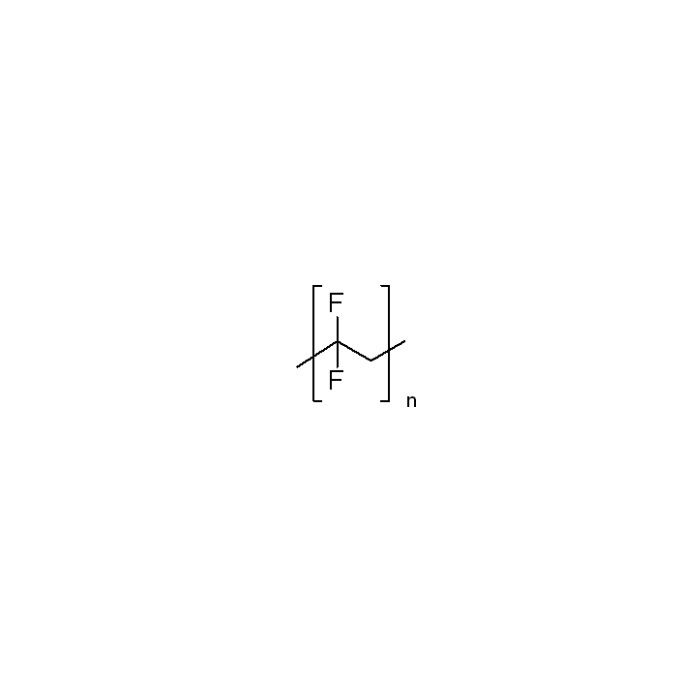
ポリフッ化ビニリデン - 粉末、低粘度射出、押出成形 , CAS No.24937-79-9

CAS: 24937-79-9 Cat. No.: P302012 分子式: (CH2CF2)n EC番号: 607-458-6
注文可能
グレード&純度 Powder, low viscosity injection, extrusion forming
Synonyms
1,1-DIFLUOROETHENE [HSDB]|FC 1132a|Kynar 460|PVF2|VF 2|Vidar|KF 1000|fluorovinylidene|K 160|Dalvor|Ftoroplast 2|Kynar 202|Foraflon 50|VINYLIDENE DIFLUORIDE [INCI]|1,1-Difluoroethylene or Refrigerant gas R 1132a|Halocarbon 1132A|Difluoro 1.1 ethene|Kynar|1,1-Difluoroethylene|Kynar 200|R 1132A|Vinylidene fluoride|1,1-Difluoroethylene or Refrigerant gas R 1132a [UN1959] [Flammable gas]|KF 1100|Difluoro 1.1. ethylene|Fluorolon 2|Dulite|VINYLIDENE FLUORIDE (IARC)|Kynar 901|Ftorlon 2|Kynar 51|Genetron 1132a|Ethene, 1,1-difluoro-|Kynar 300|Vinylidene difluoride|HFC 1132A|Kynar 500|Kynar 821|Ethylene, 1,1-difluoro-|F 2|Difluoro-1,1-ethylene|REFRIGERANT GAS R-1132A|VINYLIDENE FLUORIDE [IARC]|VW 12|REFRIGERANT GAS R 1132A|Kynar 301|Kynar 450|VDF|1,1-DIFLUOROETHENE|1,1-Difluoro-ethene
Storage
Room temperature
Shipped In
ノーマル
★
サイズ
USA
ドイツ (EU)*
価格
個数
100g
P302012-100g
7 在庫あり
—

$58.90

$68.90
保存 $10.00 (14.51%)
500g
P302012-500g
1 在庫あり
1 在庫あり
$239.90
Enter a quantity for the sizes you want to add.

概要

ポリフッ化ビニリデン(PVDF)は、ピエゾ、焦電、強誘電特性を示す半結晶性の非中心対称ポリマーである。PVDFは線状ポリマーであり、分子鎖の方向に垂直な永久電気双極子を示す。これらの双極子は、炭素に対する水素とフッ素の原子間の電気陰性度の差に起因する。加工条件によって、PVDFはいくつかの異なる結晶相(α,β,γ,δ)を示す。PVDFのβ相は、最も優れた強誘電特性と圧電特性を示す相である。

ポリフッ化ビニリデン(PVDF)はナノポーラス電極に使用される。カーボンナノチューブを埋め込んだPVDFの極細繊維からなる複合材料の合成に使用される。PVDFは、センサー、アクチュエーター、エネルギー貯蔵、血圧計、圧力センサー、ナノジェネレーター、リチウムイオン電池などに使用できる。さらに、PVDF-ナノクレイナノコンポジットやPVDFアクリルゴム/クレイナノコンポジットハイブリッドのマトリックスとしての応用も考えられる。

仕様

同義語
1,1-DIFLUOROETHENE [HSDB] | FC 1132a | Kynar 460 | PVF2 | VF 2 | Vidar | KF 1000 | fluorovinylidene | K 160 | Dalvor | Ftoroplast 2 | Kynar 202 | Foraflon 50 | VINYLIDENE DIFLUORIDE [INCI] | 1,1-Difluoroethylene or Refrigerant gas R 1132a | Halocarbon 1132A | Difluoro 1.1 ethene | Kynar | 1,1-Difluoroethylene | Kynar 200 | R 1132A | Vinyl もっと見る
仕様と純度
粉末、低粘度射出、押出成形
保管条件
Room temperature
入荷
ノーマル
名前と識別子
パブケム・シド
パブケム・シド・ウル
https://pubchem.ncbi.nlm.nih.gov/substance/508816159
SMILES
FC(F)=C
IUPAC Name
1,1-difluoroethene
InChIKey
BQCIDUSAKPWEOX-UHFFFAOYSA-N
InChI
1S/C2H2F2/c1-2(3)4/h1H2
異性体SMILES
C=C(F)F

詳細データ

Taxonomic Classification

Taxonomy Tree

KingdomOrganic compounds
SuperclassOrganic oxygen compounds
分類Organooxygen compounds
SubclassKetene acetals
Intermediate Tree Nodes Not available
Direct ParentKetene acetals
Alternative Parents Vinyl fluorides  Fluoroalkenes  Organofluorides  Hydrofluorocarbons  Hydrocarbon derivatives  
Molecular FrameworkAliphatic acyclic compounds
Substituents Ketene acetal or derivatives - Fluoroalkene - Haloalkene - Vinyl halide - Vinyl fluoride - Hydrofluorocarbon - Hydrocarbon derivative - Organofluoride - Organohalogen compound - Aliphatic acyclic compound
説明This compound belongs to the class of organic compounds known as ketene acetals. These are organic compounds comprising the ketene acetal functional group, with the general structure XC(Y)=C(R3)R4 (R1,R2=H, alkyl, aryl; X,Y=any hetero atom).
External Descriptors acetal
3 D構造
インタラクティブ化学構造モデル


作用メカニズム
証明書(CoA、COO、BSE/TSEと分析図)
C of A & Other Certificates(BSE/TSE, COO):
Analytical Chart:

Find and download the COA for your product by matching the lot number on the packaging.

21 results found

Lot NumberCertificate Type日付商品
K2612880K2612880Certificate of AnalysisNov 04, 2026 P302012
K2612879K2612879Certificate of AnalysisNov 04, 2026 P302012
K2612865K2612865Certificate of AnalysisNov 04, 2026 P302012
K2513017K2513017Certificate of AnalysisMay 21, 2025 P302012
J2612049J2612049Certificate of AnalysisMay 21, 2025 P302012
F2504516F2504516Certificate of AnalysisMay 21, 2025 P302012
F2504523F2504523Certificate of AnalysisMay 21, 2025 P302012
F2504527F2504527Certificate of AnalysisMay 21, 2025 P302012
G2601126G2601126Certificate of AnalysisAug 05, 2024 P302012
H2421432H2421432Certificate of AnalysisAug 05, 2024 P302012
H2421431H2421431Certificate of AnalysisAug 05, 2024 P302012
H2421430H2421430Certificate of AnalysisAug 05, 2024 P302012
H2421429H2421429Certificate of AnalysisAug 05, 2024 P302012
D23261259D23261259Certificate of AnalysisFeb 17, 2023 P302012
I2305249I2305249Certificate of AnalysisFeb 17, 2023 P302012
B2324823B2324823Certificate of AnalysisFeb 17, 2023 P302012
B2324722B2324722Certificate of AnalysisFeb 17, 2023 P302012
B2324686B2324686Certificate of AnalysisFeb 17, 2023 P302012
B2324619B2324619Certificate of AnalysisFeb 17, 2023 P302012
A2522104A2522104Certificate of AnalysisJul 26, 2022 P302012
A2522105A2522105Certificate of AnalysisJul 26, 2022 P302012
化学的性質と物理的性質
融点(°C)155-165°C
分子量64.03
XLogP31.300
Hydrogen Bond Donor Count0
Hydrogen Bond Acceptor Count2
Rotatable Bond Count0
Exact Mass64.0125 Da
Monoisotopic Mass64.0125 Da
Topological Polar Surface Area0.000 Ų
Heavy Atom Count4
Formal Charge0
Complexity27.000
Isotope Atom Count0
Defined Atom Stereocenter Count0
Undefined Atom Stereocenter Count0
Defined Bond Stereocenter Count0
Undefined Bond Stereocenter Count0
The total count of all stereochemical bonds0
Covalently-Bonded Unit Count1
よくある質問と記事
How to Choose a Hydrogen Evolution (HER) Catalyst: Kinetic Barriers in Water Electrolysis, AWE/PEM/AEM Pathways, and a Materials-Family Roadmap (with a Product Map)
Panorama Guide to Lithium-Ion Battery Electrode Materials: Working Principles, Materials Map, and Selection Navigation (incl. Tables 1–4)
A Panorama Guide to Synthetic Resins: Definitions & Polymerization Mechanisms, Classification Frameworks, Common Resins and Applications, Packaging Codes, and a Selection Roadmap (Tables 1–3)
Optical & Optoelectronic Materials Selection Guide:Positioning materials, key metrics, and validation paths along “Generation → Guiding → Control → Readout” (with product navigation and Tables 1–4)
uide to Hydrophobic Polymers and Hydrophobic Surfaces: Wetting Models, Evaluation Metrics, and Task-Oriented Material Selection (including Tables 1–3)
Research Value of Polyelectrolyte Multilayers: Layer-by-Layer Design of Interfacial Composition, Mass Transport, and Function
Why Fluorocarbon Resins Are Weatherable: Structural Stability, Low Surface Energy, and Coating Film Appearance Retention
PVDF, FEVE and Functional Fluororesins: System Differences and Application Selection in Fluorocarbon Coatings
Fluorocarbon Resin Coating Formulation Design: Resin Selection, Supporting Systems, and Key Application Control Points
When Should You Choose Silicone Resin? Selection Comparison with Epoxy, Acrylic, Polyurethane, Fluororesin, and Other Coating Resins
Applicability Boundaries, Failure Risks, and Alternative System Selection for Chlorinated Rubber Resin in Coatings
Citations of This Product
ソリューション計算機
レビュー

顧客レビュー

Shall we send you a message when we have discounts available?

Remind me later

Thank you! Please check your email inbox to confirm.

Oops! Notifications are disabled.