
Determine the necessary mass, volume, or concentration for preparing a solution.
このグレードを選ぶ理由
UltraBio™, ≥99.5%(F) UltraBio™ ベースライン干渉を最小限に抑える必要がある、感度の高いクロマトグラフィーおよび分析ワークフロー向け。
保管・配送
Room temperature FedEx DG Service に出荷。正確な仕様については、ロット固有の COA をご確認ください。
品質書類
SDS、COA、データシート、仕様書をダウンロードできます。ロット固有の COA はロット番号検索で入手可能です。
文献的裏付け
クロマトグラフィー、有機合成、クロスカップリング反応に関する 181 件の査読済み論文で引用されています。
概要
Potassium fluoride may be used in thermodynamic analysis of DNA-ligand binding and studies on the structural stability of proteins and peptides.
A versatile fluoride ion source used in a study of ion-specific swelling and de-swelling of ampholytic polymer gels, in the room temperature oxidation of noble metals in HF, and in the measurement of electronic polarizabilities of ions in polymers of alkali halides.
仕様
仕様と純度
UltraBio™, ≥99.5%(F)
保管条件
Room temperature
入荷
FedEx DG Service
等級
UltraBio™
純度
≥99.5%(F)
名前と識別子
PH
7.0-8.5 (25 °C, 1 M in H 2 O)
カノニカル・スマイル
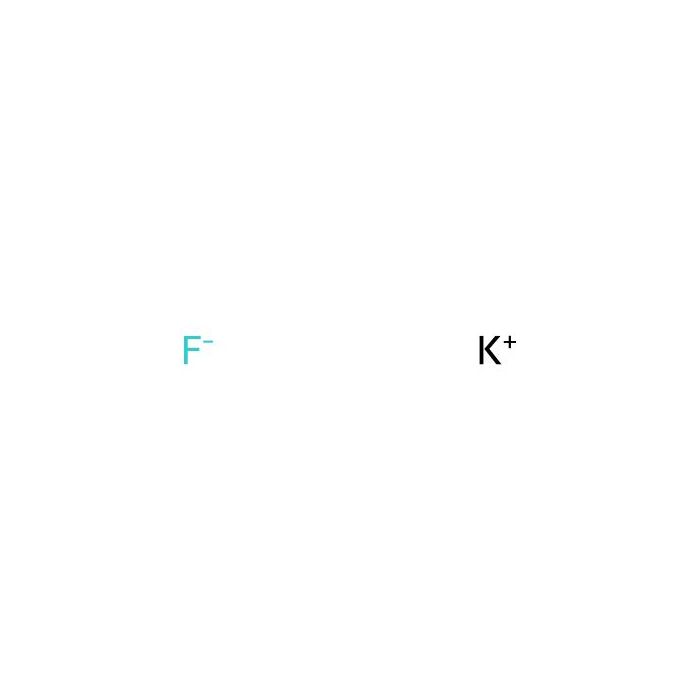
[F-].[K+]
IUPAC Name
potassium;fluoride
InChIKey
NROKBHXJSPEDAR-UHFFFAOYSA-M
INCHI
1S/FH.K/h1H;/q;+1/p-1
異性体SMILES
[F-].[K+]
WGKドイツ
1
UN番号
1812
包装グループ
III
分子量
58.1
Beilstein
3902818
ドキュメント
📋 安全データシート(SDS)
危険性、取扱い、保管、および規制遵守を網羅した包括的な文書。
<<<<<<< HEAD SDS をダウンロード → ======= SDS をダウンロード → >>>>>>> release248-p3詳細データ
Taxonomic Classification
Taxonomy Tree
- Kingdom Inorganic compounds
- Superclass Mixed metal/non-metal compounds
- 分類 Alkali metal salts
- Subclass Alkali metal fluorides
- 分類 Alkali metal salts
- Superclass Mixed metal/non-metal compounds
| Kingdom | Inorganic compounds |
|---|---|
| Superclass | Mixed metal/non-metal compounds |
| 分類 | Alkali metal salts |
| Subclass | Alkali metal fluorides |
| Intermediate Tree Nodes | Not available |
| Direct Parent | Alkali metal fluorides |
| Alternative Parents | Inorganic salts |
| Molecular Framework | Not available |
| Substituents | Alkali metal fluoride - Inorganic salt |
| 説明 | This compound belongs to the class of inorganic compounds known as alkali metal fluorides. These are inorganic compounds in which the largest halogen atom is fluorine, and the heaviest metal atom is an alkali metal. |
| External Descriptors | fluoride salt - potassium salt |
3 D構造
インタラクティブ化学構造モデル
証明書(CoA、COO、BSE/TSEと分析図)
C of A & Other Certificates(BSE/TSE, COO):
Analytical Chart:
化学的性質と物理的性質
| 溶解度 | H 2 O: 1 M at 20 °C, clear, colorless |
|---|---|
| 沸点(°C) | 1505°C |
| 融点(°C) | 858°C |
| 分子量 | 58.096 g/mol |
| XLogP3 | |
| Hydrogen Bond Donor Count | 0 |
| Hydrogen Bond Acceptor Count | 1 |
| Rotatable Bond Count | 0 |
| Exact Mass | 57.9621 Da |
| Monoisotopic Mass | 57.9621 Da |
| Topological Polar Surface Area | 0.000 Ų |
| Heavy Atom Count | 2 |
| Formal Charge | 0 |
| Complexity | 2.000 |
| Isotope Atom Count | 0 |
| Defined Atom Stereocenter Count | 0 |
| Undefined Atom Stereocenter Count | 0 |
| Defined Bond Stereocenter Count | 0 |
| Undefined Bond Stereocenter Count | 0 |
| The total count of all stereochemical bonds | 0 |
| Covalently-Bonded Unit Count | 2 |
よくある質問と記事
UltraBio™: Defining Excellence in Molecular Biology Applications
Categories: Reagent Specifications, Grading and Purity
Citations of This Product
ソリューション計算機
レビュー
顧客レビュー
グレードの選択でお困りですか?
当社のグレード選定ガイドでは、カタログ内のすべてのバリエーションについて、純度、安定剤の状態、用途への適合性を網羅しています。
UltraBio™ グレードガイドを見る →Remind me later
Products are supplied to verified businesses, institutions, and qualified professionals for research and development use only. Not for use in humans, animals, diagnosis, or therapy.
Copyright © 2023–present Aladdin Scientific Corporation. All rights reserved.