This compound belongs to the class of organic compounds known as organobromides. These are compounds containing a chemical bond between a carbon atom and a bromine atom.
External Descriptors
Not available
1. Djoumbou Feunang Y, Eisner R, Knox C, Chepelev L, Hastings J, Owen G, Fahy E, Steinbeck C, Subramanian S, Bolton E, Greiner R, and Wishart DS. ClassyFire: Automated Chemical Classification With A Comprehensive, Computable Taxonomy. Journal of Cheminformatics, 2016, 8:61.
Determine the necessary mass, volume, or concentration for preparing a solution.
Dilution Calculator
Determine the dilution needed to prepare a stock solution.
Reconstitution Calculator
Revisões
Avaliações dos Clientes
Application Protocols
No vendor-tested bioassay protocols are provided for this small-molecule reagent.
General synthetic workflow examples (literature-style, not item-specific claims):
Preparation of a docosyl ether:
Dry phenol (1.0 eq), K2CO3 (2.0 eq), 1-bromodocosane (1.2 eq) in dry acetonitrile; heat 80 °C 12 h; work up with water and extract with hexanes; purify by column (hexanes/EtOAc).
Formation of docosyl thioether:
Thiol (1.0 eq), K2CO3 (1.2 eq), TBAB (5 mol%), toluene/H2O (3:1), 60 °C 6 h; separate organic phase, wash, concentrate.
Synthesis of docosyl azide:
1-Bromodocosane (1.0 eq), NaN3 (1.5 eq) in DMF; 90 °C 8 h; quench with water, extract with ether; use azide with caution.
These are illustrative and should be optimized for scale, purity, and EHS. Always consult primary literature and perform small-scale trials.
Biological Roles
This product is a synthetic chemical reagent, not a biological standard. No biological activity or clinical role is claimed for this item.
General biochemical context (literature):
The docosyl (C22) chain length corresponds to behenyl moieties found in certain natural lipids and waxes. Incorporation of long saturated chains increases hydrophobicity, decreases permeability, and elevates melting points of lipid assemblies and materials.
Docosylated derivatives (e.g., quaternary ammonium salts, esters, ethers) can display surfactant behavior, form micelles or bilayers, and modulate interfacial properties. These effects are physical-chemical and system-dependent.
In biochemical probe design, a C22 tail is sometimes used to anchor molecules into hydrophobic phases (membranes, polymer matrices) or to tune partitioning (e.g., lipophilicity for phase extraction), without implying any biological target interaction.
Research-use only disclaimer (per Product Data): For research use only.
Buffer Applications
Not typically applicable. 1-Bromodocosane is an extremely hydrophobic alkylating reagent and is not used to prepare aqueous buffer systems or to control pH. For work involving this compound, focus on organic reaction media and phase-transfer systems as discussed under Solvent Selection and Reaction & Applications.
Green Alternatives
Context: 1-Bromodocosane is an electrophilic alkylating reagent. While the substrate itself is not easily replaced when a C22 tail is required, greener choices can be made in solvent and leaving-group selection.
Greener choices (literature/general):
Solvent substitution:
Replace chlorinated solvents with toluene, 2-MeTHF, cyclopentyl methyl ether (CPME), or acetonitrile when compatible with kinetics and solubility.
Use aqueous biphasic systems with phase-transfer catalysts (PTC) to minimize dipolar aprotic solvents (DMF/DMSO) for O-/S-alkylations.
Leaving group alternatives:
Use docosyl tosylate/mesylate or docosyl carbonate (e.g., p-nitrophenyl carbonate) prepared from docosanol; avoids handling alkyl bromides and may offer better selectivity in certain systems.
Enzymatic or catalyzed esterification of docosanol to incorporate C22 chains into molecules without halogenated intermediates.
Trade-offs:
Bromides typically give higher SN2 rates than tosylates in some systems; tosylates/mesylates might require stronger base or higher temperature.
2-MeTHF/CPME improve EHS and process safety but can alter rates/solubility; validate on small scale.
Comparison snapshot (general):
1-bromodocosane: strong electrophile; halide waste; often faster.
Docosyl tosylate: non-halogenated byproducts; sometimes slower; easier waste handling.
Solvent switch to 2-MeTHF/CPME: greener profile; similar performance to THF/toluene in many alkylations.
Pharmaceutical Uses
No pharmacopeial or excipient designation is provided for this item; refer to CoA/Spec Sheet for any regulatory notes.
General formulation context (literature, non-clinical):
Docosyl (behenyl) groups are commonly present in cosmetic and formulation excipients (e.g., behenyl alcohol, behenate esters) to modulate viscosity, melting profile, and hydrophobicity. 1-Bromodocosane itself is not used as an excipient; rather, it is a synthetic intermediate to access docosylated materials.
In pre-formulation chemistry, it can be used to prepare C22-alkylated surfactants, lipids, or polymer side chains for evaluating solubilization and release behavior in model systems. Any such work remains research-stage and must not be interpreted as clinical use.
Regulatory note: This product is for research use only and not for human or veterinary therapeutic applications.
Physical Properties
Item-specific specifications (this lot):
Appearance: Not specified for this item; refer to CoA/Spec Sheet.
Grade/Purity: Not specified for this item; refer to CoA/Spec Sheet.
Literature/general properties (for context; not item-specific specifications):
Physical state: waxy, hydrophobic solid or high-melting semisolid at ambient temperature for very long-chain alkyl bromides; may soften near warm room temperature depending on exact crystalline form.
Solubility: insoluble in water; soluble in nonpolar and moderately polar organic solvents (hexanes, heptane, toluene, chloroform, dichloromethane). Better SN2 reactivity typically observed in polar aprotic media (DMF, DMSO, acetonitrile).
Density: long-chain bromides are typically denser than water; exact value for this item is not specified.
Volatility: very low; negligible vapor pressure at room temperature relative to shorter-chain analogs.
Partitioning: highly lipophilic; expected high logP due to C22 chain (exact logP not specified).
Notes for handling in the lab (general):
Melting behavior can show polymorphism and supercooling; gentle warming (30–50 °C) may be needed to fully liquefy for accurate dispensing.
Solutions are stable in dry, oxygen-free hydrocarbons and chlorinated solvents; avoid prolonged heating in strongly nucleophilic or basic media if not intended to react.
Quality and Grades
Product-specific quality details:
Grade/Purity: Not specified for this item; refer to CoA/Spec Sheet for assay, impurity profile, and residual solvent data.
Stabilizers/Inhibitors: Not specified for this item; refer to CoA/Spec Sheet.
Guidance on typical expectations and implications (general):
For alkylating reagents like 1-bromodocosane, purity impacts reaction selectivity and downstream purification. Trace alcohol (docosanol) or olefin (docosene) impurities can affect yields in SN2 and cross-coupling transformations.
Low-halide content in solvent and absence of peroxide-forming impurities (from solvents) are relevant for sensitive reactions (e.g., when forming Grignard reagents).
If a "high-purity" or "95–98%" grade is required for materials science (e.g., SAMs or surfactant synthesis), consult the CoA for GC purity, water content (Karl Fischer), and halide assay. If UV-trace applications are intended, an HPLC/UV grade reduces baseline drift; however, no such designation is provided here.
Batch-specific CoA should provide: GC/MS chromatogram; identity confirmation (NMR/IR); and residual solvents. Always verify before process-scale use.
Reaction and Applications
1-Bromodocosane is a versatile long-chain electrophile. As a primary alkyl bromide, it undergoes clean bimolecular substitution with a wide range of nucleophiles and serves as a handle to introduce a docosyl (C22) tail into molecules and materials.
Common transformations (literature/general):
Williamson ether synthesis: alcohol/phenol → docosyl ether using base (NaH, K2CO3) in DMF/acetone/MeCN.
Thioether formation: thiols/thiolates → docosyl thioethers; useful for SAM precursors after thiol functionalization.
Azide displacement: NaN3 → docosyl azide; downstream Staudinger reduction or CuAAC (after conversion to alkyne-bearing partners).
Cyanation: NaCN/KCN → docosanenitrile; can be reduced to primary amine.
Grignard formation: Mg/ether → docosylmagnesium bromide for C–C bond formation (addition to carbonyls, transmetallation for cross-coupling).
Metal-catalyzed cross-coupling: Ni/Fe catalysis enables C(sp3)–C bond formation from primary alkyl bromides with organozincs/boronates under optimized conditions.
Applications:
Materials: hydrophobic surface modification; preparation of amphiphiles, phase-change materials, and SAMs via downstream chemistry.
Polymer/colloid chemistry: introduction of C22 tails to improve compatibilization, viscosity, and barrier properties.
Practical tips:
Use dry conditions; residual docosanol reduces alkylation efficiency—pre-dry or distill solvents, confirm substrate purity by GC.
Long chains can crystallize; gentle heating and vigorous stirring improve mass transfer.
For sterically hindered nucleophiles, elevate temperature (60–100 °C) or employ PTC.
Reaction Conditions
Typical conditions (literature guidance; not item-specific):
O-alkylation (phenols/alcohols):
Base: K2CO3 or Cs2CO3 (phenols); NaH or t-BuOK (alcohols).
Solvent: DMF, acetone, MeCN, or toluene (with PTC).
Temperature/time: 50–90 °C, 2–24 h depending on nucleophile strength and solubility.
S-alkylation (thiols):
Base: Na2CO3/K2CO3 or Et3N.
Solvent: MeCN, DMF, or biphasic toluene/water with PTC (e.g., TBAB).
Temperature/time: rt–70 °C, typically fast due to high nucleophilicity of RS−.
N-alkylation (amines):
Base: Et3N, DIPEA, or Na2CO3; control over mono- vs. di-alkylation by stoichiometry.
Solvent: MeCN, DMF, or neat (melt) at mild heat for waxy amines.
Temperature/time: rt–80 °C, 2–18 h.
Azide substitution:
Reagents: NaN3 (1.2–2.0 eq).
Solvent: DMF or DMSO; 60–100 °C, 4–16 h.
Cyanation:
Reagents: NaCN/KCN (caution—highly toxic).
Solvent: DMSO/DMF; 60–100 °C.
Grignard formation:
Reagents: Mg turnings; initiators: I2 or 1,2-dibromoethane.
Solvent: anhydrous Et2O or THF; reflux to initiate then control at 0–25 °C depending on subsequent addition.
Notes:
Long-chain substrates may require elevated temperature to overcome mass-transfer limitations.
Monitor by TLC may be challenging; GC or 1H NMR (disappearance of –CH2Br ~3.4–3.5 ppm) is more reliable.
Expected yields are often high (70–95%) for clean SN2 on unhindered nucleophiles under optimized conditions; verify in your system.
Safety and Handling
Item-specific hazard information:
GHS classification, signal word, pictograms, H-statements: Not specified for this item; refer to SDS.
General safety guidance for long-chain primary alkyl bromides (literature/commonsense lab practice):
Hazards: irritant to skin/eyes; may cause respiratory irritation if aerosolized. Alkyl bromides are alkylating agents—avoid contact and inhalation. Long-chain members have low volatility but should still be handled in a fume hood.
PPE: lab coat, safety glasses or splash goggles, and appropriate chemical-resistant gloves (e.g., nitrile). Avoid skin contact; wash thoroughly after handling.
Storage: per Product Data, store at 2–8 °C. Keep container tightly closed under inert atmosphere if possible. Protect from moisture and strong light/heat.
Incompatibilities: strong bases and strong nucleophiles (will react via substitution); strong oxidizers; powdered metals (if unintended Grignard formation is a concern).
First aid (overview; defer to SDS):
Skin: remove contaminated clothing, wash with soap and water.
Eyes: rinse cautiously with water for several minutes; remove contact lenses if present and easy.
Inhalation: move to fresh air; seek medical attention if symptoms persist.
Ingestion: rinse mouth; do not induce vomiting; seek medical attention.
Fire: combustible organic; use CO2, dry chemical, or foam. Although volatility is low, treat as a combustible solid/liquid depending on temperature.
Special risks: No significant peroxide formation risk (unlike ethers). Thermal decomposition can release HBr and brominated organics.
Solvent Selection
Solubility and polarity considerations (general literature):
Nature: highly hydrophobic C22 chain with a primary bromide. Excellent solubility in nonpolar hydrocarbons (hexanes, heptane) and aromatic solvents (toluene). Good solubility in chlorinated solvents (CH2Cl2, CHCl3). Limited to moderate solubility in polar aprotics (MeCN, DMF, DMSO) but those are preferred for SN2 kinetics.
Water: effectively insoluble; emulsions may persist due to surfactant-like behavior of long chains.
Choosing solvents by application:
SN2 alkylations (e.g., O-, N-, S-alkylation): polar aprotic solvents enhance nucleophilicity and rates. Typical choices: acetonitrile, DMF, DMSO. For less reactive nucleophiles (phenoxides, thiolates), DMF/DMSO often outperform toluene.
Grignard formation: diethyl ether or THF are standard; rigorously anhydrous conditions required. Toluene can be used as cosolvent for higher temperatures after initiation.
Phase-transfer catalysis: biphasic toluene/hexane with aqueous base and a quaternary ammonium PTC can enable alkylations of phenols/thiols.
Hexane (ε ~1.9): dissolves substrate; poor for SN2 without PTC.
Toluene (ε ~2.4): higher bp for heated reactions; compatible with PTC.
CH2Cl2 (ε ~8.9): good solubility; moderate SN2 rates; easy workup.
MeCN (ε ~37): strong SN2 performance; easy removal; consider solubility limits for very long chains.
Always match solvent to nucleophile/base, temperature, and desired kinetics.
Storage and Reconstitution
Storage (from Product Data):
Store at 2–8 °C.
Shipped on wet ice.
Additional handling guidance (general):
Keep container tightly closed. For long-term storage, consider inert gas blanket (N2/Ar) to minimize slow hydrolysis/oxidation.
Avoid exposure to strong light and heat. Store away from bases, nucleophiles, and oxidizers.
If the material solidifies, gently warm (30–50 °C) to liquefy before weighing or syringe transfer. Do not overheat.
Reconstitution:
This item is supplied neat (no reconstitution buffer required). To prepare stock solutions, dissolve in a suitable dry organic solvent (e.g., hexanes, toluene, CH2Cl2, or acetonitrile) at the desired concentration. Use anhydrous solvents for moisture-sensitive applications.
For repeated use, dispense into small aliquots to minimize headspace and freeze–thaw-like cycles of warming/cooling that may introduce condensation upon opening.
Shelf life:
Not specified for this item; refer to CoA/Spec Sheet. Inspect periodically for discoloration or formation of docosanol (can be assessed by GC/NMR) if stored for extended periods.
Structure and Identity
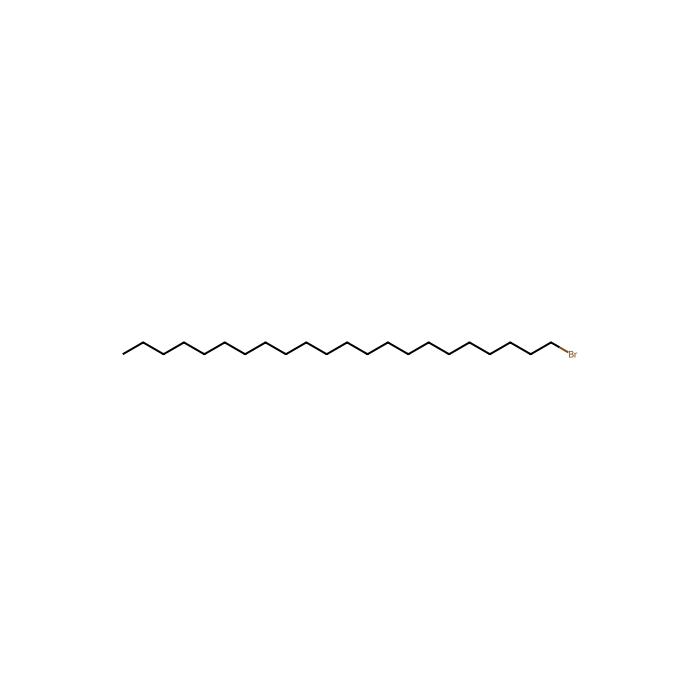
Straight-chain primary alkyl bromide bearing a C22 saturated hydrocarbon chain (behenyl/docosyl) with bromine at C-1.
Item-specific identifiers (from Product Data)
SKU: B152631
Product name: 1-Bromodocosane
CAS: 6938-66-5
InChIKey: Not specified for this item; refer to CoA/Spec Sheet. (Product Data lists "309893", which is not a standard InChIKey format.)
SMILES: Not specified for this item; refer to CoA/Spec Sheet.
Literature identity (general chemistry reference; not item-specific specs)
2D structure (verbal): a linear chain of 22 sp3 carbons (no branching, no unsaturation); terminal carbon bears bromine (–CH2–Br), distal terminus is a methyl group (–CH3).
→ Docosyl thiols/ethers/amines via nucleophilic substitution (O/N/S).
→ Organometallics: docosylmagnesium bromide; further → organozinc for Negishi couplings.
Retrosynthetic value: acts as a masked docosyl cation equivalent, enabling installation of a C22 tail late in synthesis without requiring activation of an alcohol at that stage.
Use cases:
Tailoring amphiphilicity of small molecules and polymers by late-stage C22 grafting.
Building SAM precursors after introducing a terminal thiol post-substitution.
Generating hydrophobic spacers in ligands, resins, and dendrimers.
Best practices:
Ensure dry, oxygen-free conditions for organometallic routes; initiate Grignard with iodine or 1,2-dibromoethane.
For weak nucleophiles, add catalytic KI (Finkelstein acceleration) or employ PTC and heat.
Confirm completion by GC; long-chain substrates can partition into solids—vigorous stirring improves kinetics.
Target Specificity
Not applicable. This product is a small-molecule chemical reagent and is not an antibody, probe, or biologic. No target, epitope, isotype, or species reactivity information applies.
Usamos cookies para garantir o funcionamento adequado do site e, quando permitido, para melhorar a sua experiência. Você pode gerenciar suas preferências a qualquer momento nas Configurações. Saiba mais em nossa Política de Cookies.
Deseja que lhe enviemos uma mensagem quando tivermos descontos disponíveis?
Lembrar-me mais tarde
Obrigado! Por favor, verifique a sua caixa de entrada de e-mail para confirmar.
Products are supplied to verified businesses, institutions, and qualified professionals for research and development use only. Not for use in humans, animals, diagnosis, or therapy.

 I2609331