Determine the necessary mass, volume, or concentration for preparing a solution.
Taxonomy Tree
| Kingdom | Organic compounds |
|---|---|
| Superclass | Organoheterocyclic compounds |
| Classe | Pyridines and derivatives |
| Subclass | Halopyridines |
| Intermediate Tree Nodes | Not available |
| Direct Parent | Polyhalopyridines |
| Alternative Parents | 2-halopyridines Aryl fluorides Heteroaromatic compounds Azacyclic compounds Organopnictogen compounds Organonitrogen compounds Organofluorides Hydrocarbon derivatives |
| Molecular Framework | Aromatic heteromonocyclic compounds |
| Substituents | Polyhalopyridine - 2-halopyridine - Aryl halide - Aryl fluoride - Heteroaromatic compound - Azacycle - Organic nitrogen compound - Organopnictogen compound - Hydrocarbon derivative - Organonitrogen compound - Organofluoride - Organohalogen compound - Aromatic heteromonocyclic compound |
| Descrição | This compound belongs to the class of organic compounds known as polyhalopyridines. These are organic compounds containing a pyridine ring substituted at two or more positions by a halogen atom. |
| External Descriptors | Not available |
| Sensibilidade | Air Sensitive |
|---|---|
| Índice de refração | 1.444 |
| Ponto de inflamação (°F) | 75.2 °F |
| Ponto de inflamação (°C) | 24 °C |
| Ponto de ebulição (°C) | 115°C |
| Ponto de fusão (°C) | -33°C |
| Peso molecular | 115.08 |
| XLogP3 | 1.400 |
| Hydrogen Bond Donor Count | 0 |
| Hydrogen Bond Acceptor Count | 3 |
| Rotatable Bond Count | 0 |
| Exact Mass | 115.023 Da |
| Monoisotopic Mass | 115.023 Da |
| Topological Polar Surface Area | 12.900 Ų |
| Heavy Atom Count | 8 |
| Formal Charge | 0 |
| Complexity | 76.800 |
| Isotope Atom Count | 0 |
| Defined Atom Stereocenter Count | 0 |
| Undefined Atom Stereocenter Count | 0 |
| Defined Bond Stereocenter Count | 0 |
| Undefined Bond Stereocenter Count | 0 |
| The total count of all stereochemical bonds | 0 |
| Covalently-Bonded Unit Count | 1 |
H226:Flammable liquid and vapor
H315:Causes skin irritation
H319:Causes serious eye irritation
H335:May cause respiratory irritation
P210:Keep away from heat, hot surface, sparks, open flames and other ignition sources. - No smoking.
P233:Keep container tightly closed.
P240:Ground/bond container and receiving equipment.
P241:Use explosion-proof [electrical/ventilating/lighting/.../] equipment.
P242:Use only non-sparking tools.
P243:Take precautionary measures against static discharge.
P261:Avoid breathing dust/fume/gas/mist/vapors/spray.
P264:Wash hands [and …] thoroughly after handling.
P271:Use only outdoors or in a well-ventilated area.
P280:Wear protective gloves/protective clothing/eye protection/face protection.
P321:Specific treatment (see ... on this label).
P302+P352:IF ON SKIN: wash with plenty of water.
P303+P361+P353:IF ON SKIN (or hair): Take off Immediately all contaminated clothing. Rinse SKIN with water [or shower].
P304+P340:IF INHALED: Remove person to fresh air and keep comfortable for breathing.
P305+P351+P338:IF IN EYES: Rinse cautiously with water for several minutes. Remove contact lenses if present and easy to do - continue rinsing.
P362+P364:Take off contaminated clothing and wash it before reuse.
P370+P378:In case of fire: Use ... to extinguish.
P405:Store locked up.
P403+P233:Store in a well-ventilated place. Keep container tightly closed.
P403+P235:Store in a well-ventilated place. Keep cool.
P501:Dispose of contents/container to an approved waste disposal plant.
P264+P265:Wash hands [and …] thoroughly after handling. Do not touch eyes.
P337+P317:If eye irritation persists: Get medical help.
P332+P317:If skin irritation occurs: Get medical help.
P319:Get medical help if you feel unwell.
Not applicable. No tested bioassay or immunoassay protocols (WB, IHC, IF, FC, etc.) are relevant to this small-molecule building block. For synthetic applications, see the Reaction Conditions and Synthetic Utility sections for general laboratory guidance.
This compound is a synthetic fluorinated heteroaromatic used as a chemical building block. It is not a natural metabolite, cofactor, or biopolymer component.
General context (literature)
Biotransformation expectations
Use guidance
Not typically applicable. 2,5-Difluoropyridine is a neutral organic building block and is not used as a buffering agent or buffer component.
As a building block, 2,5-difluoropyridine itself is not readily replaced. Green chemistry opportunities lie in solvent/base choice and step economy.
Greener solvent choices for common steps (literature)
Energy and process intensification
Waste and hazard reduction
Comparative snapshot (general)
Always confirm that greener substitutions maintain selectivity (especially for 2- vs 5-position reactions) before scale-up.
No therapeutic or clinical claims are made for this product. In pharmaceutical R&D and manufacturing, 2,5-difluoropyridine may serve as:
Formulation/excipient status: Not applicable; this is not an excipient and has no pharmacopoeial monograph noted here.
Process considerations (general)
All uses are confined to laboratory research unless separately qualified through appropriate development and regulatory pathways.
Note: No item-specific specifications were provided. Values below are general literature references only and should not be construed as product specifications.
Always verify operational parameters (bp, density, refractive index) with your lot-specific CoA/SDS before scale-up.
Item-specific grade/purity: Not specified for this item; refer to CoA/Spec Sheet.
Discussion of grades (general guidance)
Stabilizers/inhibitors
Lot-specific documentation
Practical note
2,5-Difluoropyridine is an electron-deficient heteroaromatic valued as a handle for regioselective substitution and metalation.
Nucleophilic aromatic substitution (SNAr) (literature)
Directed metalation/functionalization (literature)
Cross-coupling via pre-activation (literature)
Electrophilic/nucleophilic patterns (general)
Applications
General literature guidance only; verify on your substrate set before scale-up.
SNAr (amine installation at C2)
SNAr (alkoxy/thiolate)
Directed metalation/borylation at C4
5-Position substitution
Workup/purification
Item-specific hazard fields (signal word, H-statements, GHS class, pictograms) are not provided in the Product Data for this SKU. Always consult the SDS for authoritative safety information.
GHS/Regulatory
General hazards of fluorinated pyridines (literature/good laboratory practice)
PPE recommendations (good practice)
Handling and storage
First aid overview (general)
Spill/fire response (general)
This product is a small-molecule building block rather than a working solvent. The following guidance concerns solvents commonly used to dissolve and react 2,5-difluoropyridine.
Polarity/miscibility (literature, general)
Choosing a solvent by transformation
Practical tips
Comparison snapshot (general)
Item-specific storage (from Product Data)
General handling recommendations
Stability considerations (general)
Reconstitution/dispensing
Freeze–thaw guidance
Always consult the CoA and SDS for lot-specific stability and handling details before critical or regulated work.
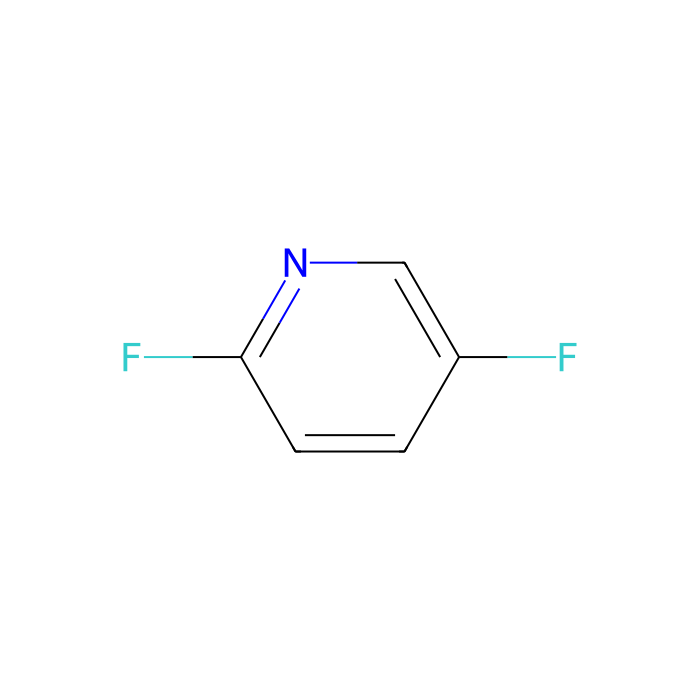
Brief description: 2,5-Difluoropyridine is a fluorinated aza-aromatic building block featuring two C–F substituents on a pyridine ring.
Item-specific (Product Data)
Literature/computed identifiers (general reference; not item-specific specs)
Structural features (general chemistry description)
Stereochemistry
Electronic character (general)
Key reactivity arises from the electron-withdrawing N and two F substituents, creating a strongly activated aryl fluoride at C2 and a less activated site at C5.
Functional group behavior (literature)
Typical transformations
Retrosynthetic value
Practical notes
Not applicable. This product is a small-molecule chemical building block, not a biological macromolecule or affinity reagent. No antigen/epitope, species reactivity, clone, or isotype information applies. Product Data provides no target-binding details.