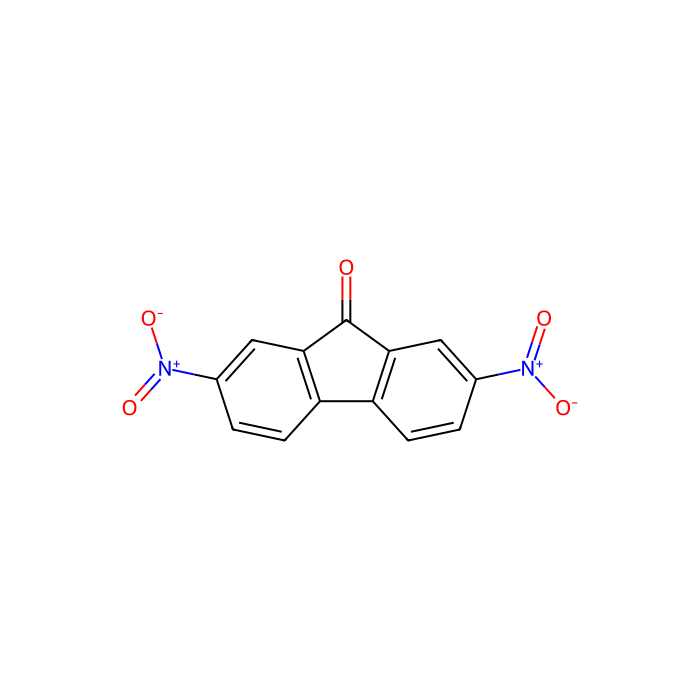
2,7-Dinitro-9-fluorenone forms 1:1 Π-complex with tetrathiafulvalene. 2,7-Dinitro-9-fluorenone was used to develop sensor for determination of submicromolar concentrations of selected genotoxic nitro compounds using mercury meniscus modified silver solid amalgam electrode coupled with direct current voltammetry or differential pulse voltammetry. It was used to study mechanism of generation of spontaneous and mutation-induced deletion revertants of hisG428 in Salmonella tester strain TA102 .
This compound belongs to the class of organic compounds known as fluorenes. These are compounds containing a fluorene moiety, which consists of two benzene rings connected through either a cyclopentane, cyclopentene, or cyclopenta-1,3-diene.
External Descriptors
Not available
1. Djoumbou Feunang Y, Eisner R, Knox C, Chepelev L, Hastings J, Owen G, Fahy E, Steinbeck C, Subramanian S, Bolton E, Greiner R, and Wishart DS. ClassyFire: Automated Chemical Classification With A Comprehensive, Computable Taxonomy. Journal of Cheminformatics, 2016, 8:61.
Determine the necessary mass, volume, or concentration for preparing a solution.
Dilution Calculator
Determine the dilution needed to prepare a stock solution.
Reconstitution Calculator
Revisões
Avaliações dos Clientes
Application Protocols
No assay-specific protocols are provided for this item. For synthetic or materials applications, consider the following general workflows:
Preparation of 2,7-diamino-9-fluorenone: Catalytic hydrogenation (H2/Pd-C) in EtOH, filtration, and crystallization.
Thin-film preparation for materials testing: Dissolve in chlorobenzene or toluene (with gentle heating), filter (0.2 µm PTFE), spin-cast on cleaned substrates; anneal as required. Optimize concentration and spin speed empirically.
These are literature-style suggestions only; adjust to your lab setup and consult primary references.
Biological Roles
This compound is a synthetic nitroaromatic ketone used primarily in materials and synthetic organic chemistry. It is not a naturally occurring metabolite and has no established physiological role.
General considerations (literature/biochemistry context):
Nitroaromatic compounds can undergo enzymatic or chemical reduction in biological systems to nitroso/hydroxylamine/amine species, but such processes are context-dependent and not typically exploited for this molecule in biological workflows.
The rigid, conjugated scaffold and electron-deficient character make it more relevant to photophysical studies than to biochemistry.
For laboratory use only. No clinical or therapeutic applications are implied.
Buffer Applications
Not typically applicable. 2,7-Dinitro-9-fluorenone is a neutral, poorly water-soluble aromatic solid and is not used to prepare aqueous buffer systems. For aqueous work, consider focusing on extraction/partition steps or using water-miscible cosolvents (e.g., DMSO) to deliver the compound into test systems if required.
Replace chlorinated solvents with greener aprotics where feasible: 2-methyltetrahydrofuran (2-MeTHF), cyclopentyl methyl ether (CPME), dimethyl carbonate (DMC), propylene carbonate (PC), or anisole/toluene. Solubility must be verified experimentally due to the compound’s rigid aromatic core and high melting point.
Reductive chemistry alternatives:
Prefer catalytic hydrogenation (H2, Pd/C or Raney Ni in EtOH/EtOAc) over stoichiometric metal/acid reductions (SnCl2, Fe/HCl), reducing inorganic waste.
Employ transfer hydrogenation (e.g., HCOONH4/Pd-C; cyclohexene/Pd) to avoid high-pressure hydrogen.
Workup/waste minimization:
Use solid-supported catalysts and scavengers to streamline purification.
Opt for crystallization from greener solvents (EtOAc/EtOH) rather than chromatographic separations when possible.
Compact comparison (illustrative; not specifications):
| Task | Conventional | Greener alternative | Trade-offs |
|---|---|---|---|
| Dissolution/film casting | CH2Cl2/CHCl3 | 2-MeTHF, anisole | May require warming; slower evaporation |
| Nitro reduction | SnCl2/HCl | H2/Pd-C in EtOH | Catalyst handling; need H2 source |
| Oxime formation | Pyridine/CHCl3 | EtOH or AcOH(aq) | Rate may be slower; water content control needed |
Evaluate performance against your target metrics (yield, purity, device performance) before full adoption.
Pharmaceutical Uses
No excipient or pharmacopeial role is indicated for this item. As a highly conjugated nitroaromatic, it is used in research settings (e.g., as an electron-acceptor building block or synthetic intermediate) rather than in pharmaceutical formulations. Any use should be limited to laboratory-scale R&D. For research use only (per Product Data).
Physical Properties
Item-specific values: Not specified for this item; refer to CoA/Spec Sheet.
Literature/general expectations (for reference only; not product specifications):
Physical state/appearance: Typically a yellow to orange crystalline solid for nitro-substituted fluorenones
Melting point: Commonly high for polycyclic nitro aromatics; exact value not confirmed for this compound in this listing
Solubility: Sparingly soluble in nonpolar hydrocarbons; better solubility in chlorinated solvents (CH2Cl2, CHCl3), aromatic solvents (toluene), and polar aprotics (THF, DMF, DMSO), especially on warming
Acid/base: Neutral (no ionizable groups in water); nitro and carbonyl groups confer strong electron-withdrawing character
UV–Vis: Expected strong π–π* absorption in near-UV/visible due to extended conjugation and nitro substitution (useful as an electron acceptor chromophore)
Stability: Thermally robust aromatic scaffold; nitro groups are stable under neutral conditions but can be reduced; carbonyl participates in typical aryl ketone chemistry
Note: Do not treat these literature notes as specifications. For method development, determine exact solubility and thermal behavior under your lab conditions.
Quality and Grades
Item-specific grade/purity: Not specified for this item; refer to CoA/Spec Sheet.
Guidance for interpreting grades (general):
Analytical/Reagent grade: Typically indicates high chemical purity suitable for general synthesis and analysis; trace impurities controlled to typical reagent standards.
HPLC/Optical grade (if offered for analogous products): Emphasizes low UV background/fluorescence and particulate levels for spectroscopic or chromatographic applications.
Electronic/Materials grade: Focuses on metal/ionic and particulate contamination relevant to device fabrication; may include specific drying and filtration history.
Stabilizers/inhibitors: None indicated in Product Data. If stabilizers are present in a particular lot, they will be listed on the CoA/SDS; absence/presence can influence photochemical behavior and background in photo/electrochemical experiments.
Practical recommendation:
Verify assay, residual solvents, and any trace metal profile on the CoA when using 2,7-dinitro-9-fluorenone as an electron acceptor in materials chemistry, where device performance can be sensitive to ppm-level contaminants.
For synthetic use, ensure clarity on water content and ash if these are critical to your application—request a specification sheet if not available online.
Reaction and Applications
Electron-acceptor in materials chemistry (literature):
The 2,7-dinitro substitution markedly lowers the LUMO of the fluorenone core, making it useful as an electron acceptor or n-type component in small-molecule/polymer blends, OFETs, and photoconductive materials. It can participate in charge-transfer (CT) complexes with electron donors.
Synthetic transformations centered on this scaffold (literature):
Nitro-to-amino reductions: Converting 2,7-dinitro-9-fluorenone to 2,7-diamino-9-fluorenone (DAF) using catalytic hydrogenation (H2/Pd-C), Fe/AcOH, SnCl2/HCl, or Zn/NH4Cl. The diamine is a versatile intermediate for dyes, polyimides, and donor–acceptor chromophores.
Carbonyl derivatization: Formation of oximes/hydrazones (NH2OH, hydrazines) and subsequent transformations (e.g., Beckmann rearrangement conditions on oximes) to access ring-substituted amides or nitrogen-bridged frameworks.
Nucleophilic additions to the 9-ketone: Addition of organometallics (RMgX, RLi) can be moderated by the electron-withdrawing nitro groups; reactions often benefit from low temperatures and controlled stoichiometry.
Cross-coupling after functional group interconversion: While the parent bears nitro groups, installing halides or pseudohalides at other positions permits Pd-catalyzed couplings to build extended conjugation.
Photoredox/photochemistry (literature):
Fluorenone derivatives serve as triplet photosensitizers and electron-relay catalysts; additional nitro groups increase electron affinity, enabling photoinduced electron transfer (PET) with donors under UV/visible irradiation.
Practical tips:
Degas solvents for reductive or photochemical work to control oxygen levels.
Monitor reductions by TLC/LC–MS; the color change (yellow to less intensely colored amines) can aid tracking.
Reaction Conditions
Literature-style general guidance (verify and optimize for your substrate, scale, and equipment):
H2/Pd-C (5–10 wt%): EtOH or EtOH/THF, rt to 50 °C, 1–8 h under 1–3 bar H2. Monitor by TLC/LC–MS. Work up by filtration over celite and crystallization. Typical reports for similar substrates show good to excellent yields when over-reduction of the carbonyl is controlled.
Fe/AcOH or Fe/NH4Cl(aq): 60–90 °C, 2–6 h; filter hot to remove iron salts, basify, and isolate diamine. Generates significant inorganic waste.
SnCl2·2H2O/HCl: Reflux in EtOH or EtOAc/EtOH with HCl; efficient but generates tin waste.
Oxime formation from the 9-ketone:
Hydroxylamine hydrochloride (1.2–1.5 equiv), pyridine or EtOH with base (NaOAc), 50–80 °C, 2–6 h; isolate oxime by crystallization.
Carbonyl reduction to alcohol:
NaBH4 in MeOH/THF at 0–25 °C, 0.5–2 h; quench with NH4Cl(aq). Nitro groups are generally tolerated but monitor for any side reactions.
Photochemistry/electron transfer:
As an acceptor/photosensitizer with amine donors under 350–420 nm irradiation in MeCN or toluene; degas (Ar/N2) to manage oxygen quenching. Reaction times: 1–24 h depending on light intensity and concentration.
Note: These conditions are general for nitro-substituted fluorenones and related scaffolds and are provided for planning purposes only.
Safety and Handling
Item-specific GHS (from Product Data):
Signal Word: Not specified for this item; refer to SDS.
H-Statements: Not specified for this item; refer to SDS.
GHS Classification/Pictograms: Not specified for this item; refer to SDS.
General safety considerations for nitroaromatic ketones (literature/typical guidance):
Hazards: May cause skin/eye/respiratory irritation; nitro aromatics can exhibit methemoglobin-forming potential upon significant exposure and are often harmful if swallowed or inhaled. Avoid dust formation.
Oxidizing/reactivity: While nitro groups are strongly electron-withdrawing, the substance is not typically a strong oxidizer; however, avoid mixing with strong reducing agents (e.g., hydrides, metals in acid) except in controlled reductions. Avoid strong bases/nucleophiles at elevated temperature which can promote side reactions.
Incompatibilities: Strong reducing agents, strong bases under forcing conditions, energetic dehydrating agents, and nitrating media.
PPE: Laboratory coat, safety glasses or goggles, appropriate chemical-resistant gloves (e.g., nitrile), and use in a fume hood to control dust/vapors.
First aid (overview; defer to SDS): Move to fresh air if inhaled; rinse skin/eyes with water for at least 15 minutes upon contact; seek medical attention if symptoms persist; if ingested, rinse mouth and seek medical advice—do not induce vomiting unless directed by medical personnel.
Fire: Combustible organic solid; use dry chemical, CO2, or foam. Thermal decomposition may release NOx—firefighters should wear SCBA.
Always consult the product’s SDS for authoritative hazard classifications and response measures.
Solvent Selection
Polarity/miscibility profile (general):
The molecule is moderately polarizable but overall nonionic; best solubility in chlorinated solvents (CH2Cl2, CHCl3), aromatic hydrocarbons (toluene), and polar aprotic solvents (THF, DMF, DMSO). Limited solubility in aliphatic hydrocarbons.
Spectroscopy and thin-film casting: CHCl3 or chlorobenzene often provide good dissolution and film-forming behavior for donor–acceptor blends.
Preparative reactions (reductions/condensations): Ethanol/tetrahydrofuran mixtures for catalytic hydrogenations; DMF/DMSO for SNAr on suitably activated partners; acetic acid or EtOH for Bechmann/oxime formation.
Chromatography: Elute with toluene/EtOAc or hexanes/EtOAc gradients; strong yellow color assists fraction tracking. Add 0.5–2% Et3N only if basicity is required (rare for this neutral acceptor).
Comparison guidance:
Versus 9-fluorenone: The dinitro compound is less soluble in nonpolar media but dissolves better in more polar aprotics due to increased dipolarity.
Versus nitrobenzenes: Larger π-system enhances solubility in aromatics; higher melting point often demands warm solvent to achieve saturation.
Storage and Reconstitution
Item-specific (from Product Data):
Storage conditions: Room temperature
Shipped in: Normal
General handling:
Keep container tightly closed, in a dry, well-ventilated area. Protect from prolonged light exposure to avoid unintended photochemical changes typical of fluorenone chromophores.
Minimize exposure to strong bases/reductants during storage. Avoid moisture ingress to maintain material integrity and flowability.
Reconstitution/dissolution (general guidance):
Suitable solvents: CH2Cl2, CHCl3, toluene, THF, DMF, DMSO. Warm gently (30–50 °C) with stirring to accelerate dissolution; avoid overheating.
For analytical solutions: Filter through 0.2 µm PTFE prior to use to remove particulates.
Stock solutions in aprotic solvents can be stored at 2–8 °C, protected from light; allow to reach room temperature before opening to prevent moisture condensation.
Always refer to the CoA/SDS for lot-specific guidance and observe the “For research use only” restriction.
Structure and Identity
A highly electron-deficient polycyclic aromatic ketone bearing two ring nitro groups on the fluorenone scaffold.
Item-specific (from Product Data):
CAS: 31551-45-8
InChIKey: 118914 (as listed; consult CoA/SDS for canonical InChIKey)
Storage: Room temperature
Shipped: Normal
Literature/derived identifiers (for reference; not item specifications):
Common name: 2,7-Dinitro-9-fluorenone; 2,7-dinitrofluoren-9-one
Expected molecular formula (literature): C13H6N2O5
Core: Fluorenone (tricyclic system: two benzene rings fused to a five-membered bridgehead containing a carbonyl at C-9)
Substitution: Nitro groups at the 2- and 7-positions (para to the bridgehead carbonyl on each outer ring), strongly withdrawing and deactivating toward further electrophilic substitution
Functional groups: Aryl ketone (conjugated), two aryl nitro groups; no stereocenters
2D description: Three fused rings with a central C=O at the bridgehead; one nitro on each of the two outer rings in positions opposite the ring fusion lines
Synthetic Utility
Functional group handles:
Two aryl nitro groups (2,7-positions): amenable to stepwise or concurrent reduction to anilines, enabling subsequent acylation, sulfonylation, diazotization, or coupling to form azo dyes/push–pull systems.
Aryl ketone at C-9: supports imine/oxime/hydrazone formation, nucleophilic additions, and standard carbonyl reductions (NaBH4 gives secondary alcohol; Wolff–Kishner/Clemmensen for deoxygenation in suitable substrates).
Retrosynthetic value (literature):
Serves as a convergent acceptor core in donor–acceptor materials. The 2,7-positions are strategically orthogonal for symmetric functionalization after nitro reduction.
Provides a platform for building polyimide or poly(arylene) architectures via diamine derivatives (post-reduction) and subsequent condensation with dianhydrides/diacyl chlorides.
Named/typical transformations:
Reduction: H2/Pd-C; Fe/AcOH; SnCl2/HCl to 2,7-diamino-9-fluorenone.
Oxime formation/Beckmann-type chemistry from the 9-ketone oxime under acidic dehydrating conditions (substrate- and condition-dependent).
Organometallic addition at C-9 (RMgX/RLi) giving tertiary carbinols upon subsequent functionalization when nitro groups are protected or conditions are moderated.
Practical tips:
Sequence planning: Reduce nitro groups after sensitive carbonyl manipulations if catalysts/conditions would otherwise poison or over-reduce.
Purification: Crystallization often effective due to rigid core; hot filtration from EtOAc/toluene can remove colored metal residues after reductions.
Target Specificity
Not applicable. This product is a small-molecule chemical, not a biological targeting reagent (no antigen/epitope, clone, isotype, or species specificity).
Perguntas frequentes
How should this product be stored?
Store at room temperature.
How is this product shipped?
This product ships under standard ambient conditions. No temperature-controlled packaging is required.
What is the purity of this product?
This product is supplied at ≥97% purity (chemical assay). Lot-specific values are stated on the Certificate of Analysis.
What are the CAS number, molecular formula and molecular weight?
The CAS Number is 31551-45-8, the molecular formula is C13H6N2O5, and the molecular weight is 270.2 g/mol. InChIKey HDVGAFBXTXDYIB-UHFFFAOYSA-N.
What documentation is provided?
Available product documentation, including Certificates of Analysis (COA), Safety Data Sheets (SDS), and specification sheets, is shown in the product document area. Document availability and access follow the current site policy.
Usamos cookies para garantir o funcionamento adequado do site e, quando permitido, para melhorar a sua experiência. Você pode gerenciar suas preferências a qualquer momento nas Configurações. Saiba mais em nossa Política de Cookies.
Deseja que lhe enviemos uma mensagem quando tivermos descontos disponíveis?
Lembrar-me mais tarde
Obrigado! Por favor, verifique a sua caixa de entrada de e-mail para confirmar.
Products are supplied to verified businesses, institutions, and qualified professionals for research and development use only. Not for use in humans, animals, diagnosis, or therapy.

 J2628152