GRAU & PUREZACP?Chemically Pure grade — moderate purity above technical grade but below analytical. Use for general lab reactions where ultra-low impurities aren't critical.≥98%
This compound belongs to the class of organic compounds known as medium-chain fatty acids. These are fatty acids with an aliphatic tail that contains between 4 and 12 carbon atoms.
External Descriptors
Branched fatty acids
1. Djoumbou Feunang Y, Eisner R, Knox C, Chepelev L, Hastings J, Owen G, Fahy E, Steinbeck C, Subramanian S, Bolton E, Greiner R, and Wishart DS. ClassyFire: Automated Chemical Classification With A Comprehensive, Computable Taxonomy. Journal of Cheminformatics, 2016, 8:61.
Determine the necessary mass, volume, or concentration for preparing a solution.
Dilution Calculator
Determine the dilution needed to prepare a stock solution.
Reconstitution Calculator
Revisões
Avaliações dos Clientes
Application Protocols
Not applicable as a validated bioassay reagent.
Notes
No tested applications (e.g., WB, IHC, IF, FC) or recommended dilutions are relevant to this small‑molecule reagent. Protocols will be highly use‑case‑specific (see Reaction & Applications and Reaction Conditions for synthetic protocols).
For users preparing metal 2‑ethylhexanoates or performing esterifications/amidations, follow the general guidance provided and adapt stoichiometry, solvent, and temperature to your substrates and scale.
Biological Roles
Applicability
2‑Ethylhexanoic acid is not an endogenous metabolite in humans; it is a synthetic/industrial branched fatty acid analogue.
Literature notes (for context only; not medical/clinical claims)
As a branched carboxylic acid with pKa ~4.8–4.9, it exists largely as the carboxylate at physiological pH but is seldom encountered biologically due to poor aqueous solubility.
In environmental and microbial contexts, β‑oxidation of branched acids is slower than for straight‑chain analogs, affecting persistence and metabolic fate.
It can arise as a downstream oxidation product of 2‑ethylhexanol (a common plasticizer alcohol) in environmental/biotransformation studies.
Relevance to lab work
Biological assays rarely use 2‑ethylhexanoic acid directly; however, its metal salts (e.g., zinc, manganese, cobalt “octoates”) are sometimes studied as homogeneous catalysts or model compounds in bioinspired oxidation chemistry. Any such use should be restricted to basic research under appropriate controls.
Caveats
Potential for irritation and specific hazard classifications reported in the literature warrant careful handling; avoid exposure in cell culture or biological systems unless explicitly designed and justified for mechanistic research.
Conclusion
Primary significance is chemical, not biological: it serves as a hydrophobic, coordinating carboxylate for materials and catalysis research rather than a buffer or biochemical reagent.
Buffer Applications
Not typically applicable.
Rationale
Although 2‑ethylhexanoic acid has a carboxylic acid pKa near 4.8–4.9 (literature), its poor water solubility and hydrophobic character make it unsuitable as an aqueous buffer component.
Practical guidance
For buffering near pH 4–5, consider water‑soluble systems such as acetate, citrate, or phthalate buffers. If a hydrophobic acid component is needed in a biphasic or micellar system, validate partitioning and effective pKa under your specific conditions.
Recommendation
Use this product primarily for synthetic chemistry or materials applications. See Reaction & Applications and Synthetic Utility sections for relevant use cases.
Green Alternatives
Context
2‑Ethylhexanoic acid (2‑EHA) is effective for making oil‑soluble metal salts and hydrophobic esters. Green chemistry considerations revolve around sourcing (petro vs. bio‑based 2‑ethylhexanol routes), toxicity classifications, volatility, and persistence.
Greener choices and trade‑offs (literature-based)
Carboxylate choice for metal salts:
Alternative acids: Neodecanoic acid (neo‑C10) or versatic acids can provide similar solubility with potentially different toxicity profiles; however, they are often more branched and less biodegradable.
Shorter acids (acetic, propionic): Better biodegradability and lower bioaccumulation but yield metal salts with poorer solubility in nonpolar media.
Catalysis alternatives:
For lactide polymerization, catalysts such as Zn(2‑ethylhexanoate) or Ca‑based systems may present lower toxicity concerns than Sn(Oct)2, though activity/selectivity can differ.
Solvent/process choices:
Use high‑boiling bio‑derived solvents (e.g., 2‑MeTHF, CPME, pinacolone) or solvent‑free melt conditions for esterifications to reduce VOCs.
Employ solid acid catalysts (ion‑exchange resins, zeolites) to minimize corrosive mineral acids and enable catalyst recycling.
Comparison snapshot (general)
2‑EHA vs. acetic acid: 2‑EHA enables oil‑soluble metal salts and hydrophobic esters at the cost of lower biodegradability and higher logP; acetic acid is greener but less fit‑for‑purpose in nonpolar systems.
2‑EHA vs. neodecanoic acid: Similar performance in salt solubility; neodecanoate often offers higher thermal stability but may be more persistent.
Practical tips
Optimize atom economy via direct esterification or transesterification rather than acid chloride routes.
Implement solvent recycling and energy‑efficient water removal (azeotropy, pervaporation) to reduce process footprint.
Pharmaceutical Uses
Scope of discussion
No therapeutic or clinical uses are claimed. The following notes address formulation/manufacturing contexts only (literature‑based, not item‑specific specifications).
Relevance
2‑Ethylhexanoic acid itself is not commonly used as a pharmaceutical excipient due to hydrophobicity and odor. However, derivatives and metal salts play roles upstream in materials and catalyst preparation.
Examples (literature)
Catalyst precursor: Tin(II) 2‑ethylhexanoate is a widely used catalyst for ring‑opening polymerization of lactide/ε‑caprolactone during synthesis of biomedical polymers (e.g., PLA, PCL). Any residual catalyst must meet stringent impurity limits; choice of carboxylate affects solubility and processability.
Probing hydrophobic ion pairing: 2‑Ethylhexanoate counterions can be employed to enhance solubility of basic drugs in nonaqueous media or to form lipophilic salts for crystallization studies, though pharmacopeial status is limited.
Regulatory/quality considerations
Pharmacopeial monographs for 2‑ethylhexanoic acid are not commonly referenced. If intended for regulated manufacturing support, qualify via in‑house specifications (identity, assay, residual solvents, trace metals) and ensure supplier change control.
Conclusion
Consider 2‑EHA as a process reagent or ligand/counterion precursor rather than a final excipient. Verify all uses against internal quality systems and regulatory requirements.
Physical Properties
Item-specific specs
Appearance: Not specified for this item; refer to CoA/Spec Sheet.
Literature/typical values (for reference only; not item-specific specs)
Molecular formula: C8H16O2
Molecular weight: ~144.21 g/mol (literature)
Physical state: Oily liquid at ambient temperature (literature)
Vapor pressure: low; on the order of ~0.03 mmHg at 25 °C (literature)
Water solubility: low (poorly soluble; on the order of a few g/L or less at RT; literature). Miscible with many organics (alcohols, ethers, hydrocarbons, ketones, esters).
The branched structure reduces lattice packing and lowers the melting point relative to straight‑chain octanoic acid.
The relatively low acidity (vs. mineral acids) combined with hydrophobicity affords metal carboxylates that are highly soluble in nonpolar solvents, a key reason for its prevalence in coatings driers and homogeneous catalysis precursors.
Always consult the product’s CoA/SDS for authoritative specifications relevant to your batch.
Quality and Grades
Item-specific quality information
Grade/Purity: CP (Chemical Pure) — supplied for research use only.
What CP grade typically implies (general guidance)
CP grade generally indicates material suitable for routine laboratory and preparative work where stringent analytical specifications (e.g., HPLC/UV cutoff, trace metal profiles, water content) are not mandated. It is commonly adequate for synthesis of intermediates, salt formation, and general materials R&D.
Implications for use
Chromatographic or spectroscopic applications sensitive to UV background, peroxides, or trace metals should verify suitability by running blanks/controls or consider a higher grade (e.g., GC, HPLC, or trace‑metal‑specified grades) when available.
If you are preparing metal 2‑ethylhexanoates for catalysis (e.g., Sn, Co, Mn, Zn), trace water and halides can influence salt formation and solubility. For moisture‑sensitive preparations, pre‑drying and/or Karl Fischer verification may be prudent.
Item-specific non-specified parameters
Water content, peroxide content, UV cutoff, trace metal limits: Not specified for this item; refer to CoA/Spec Sheet.
Stabilizers/additives
No stabilizer information provided for this item. If your process is sensitive to inhibitors or antioxidants, confirm absence/presence via CoA.
Documentation
For batch‑level acceptance, request CoA including assay, GC profile, and, if relevant, residual solvents/impurities.
Reaction and Applications
Typical application domains (literature; expand as needed)
Metal carboxylate precursor (“octoate” formation): Reacts with metal oxides, hydroxides, or alkoxides to form oil‑soluble metal 2‑ethylhexanoates (e.g., Sn(Oct)2, Co(Oct)2/3, Mn(Oct)3, Zn(Oct)2). These are widely used as homogeneous catalysts (e.g., tin(II) 2‑ethylhexanoate in ring‑opening polymerization of lactones/L‑lactide) and as driers in coatings (Co/Mn/Zr systems).
Esterification: Fischer esterification with alcohols to give 2‑ethylhexanoate esters (e.g., isobornyl 2‑ethylhexanoate, 2‑ethylhexyl 2‑ethylhexanoate) employed as plasticizers, lubricants, and specialty solvents.
Amide formation: Coupling with amines using carbodiimides (DCC, EDCI) or mixed anhydrides to afford 2‑ethylhexanamides—useful as hydrophobic auxiliaries or ligands.
Acid chloride/anhydride synthesis: Conversion with SOCl2 or (COCl)2 enables acylation chemistry under milder conditions. The resulting acyl chloride can participate in Friedel–Crafts acylations (though aliphatic acylations are less common) or efficient amidations/esterifications.
Salt metathesis: Neutralization with organic bases (e.g., tertiary amines) yields lipophilic ammonium 2‑ethylhexanoates for phase‑transfer or ionic‑liquid‑like behavior.
Practical guidance
Water removal accelerates esterification; apply Dean–Stark (in toluene/xylene) or molecular sieves. Catalyze with p‑TsOH or a mineral acid; solid acid resins can simplify workup.
For metal salt formation, control stoichiometry (acid number) and temperature (60–140 °C typical) to drive dehydration and achieve targeted oxidation states. Inert atmosphere may be required for air‑sensitive metals (e.g., Sn(II)).
Monitor reactions by acid value, GC, or IR (disappearance of ν(O–H) ~2500–3300 cm−1 and shift of ν(C=O)).
Reaction Conditions
General, literature-based guidance (not item-specific specifications)
Temperature/time: Reflux (110–140 °C) for 3–12 h depending on alcohol sterics.
Workup: Neutralize residual acid with Na2CO3, wash, dry, distill or concentrate. Typical isolated yields: 70–95%.
Amidation via acid chloride
Reagents: SOCl2 (1.2–1.5 eq) or (COCl)2 (1.1–1.3 eq), catalytic DMF. Solvent: DCM or toluene.
Conditions: 0–25 °C for chlorination; then add amine (1.1–1.5 eq) and base (Et3N, 2.0 eq) at 0–25 °C.
Yields: Often 75–95% for unhindered amines.
Direct coupling (carbodiimide)
Reagents: DCC or EDCI (1.1–1.3 eq), additive HOBt or Oxyma (0.1–0.2 eq), catalyst DMAP (0.05–0.1 eq).
Solvent: DCM, DMF, or THF. Temp: 0–25 °C, 2–16 h.
Notes: Remove dicyclohexylurea by filtration. Yields: 60–90%.
Metal 2‑ethylhexanoate formation
Substrates: Metal oxide/hydroxide/alkoxide; 2‑EHA as reagent and part‑solvent.
Conditions: 80–150 °C under inert atmosphere (for air‑sensitive metals). Remove water/alcohol by azeotropy (xylene, toluene) or vacuum.
Stoichiometry: 2 mol acid per mol divalent metal (e.g., Zn, Co, Sn(II)).
Monitoring: Acid number drop; IR shift to asymmetric/symmetric νCOO− (~1540/1400 cm−1). Yields typically high (near quantitative by titration).
Acylation (Schotten–Baumann‑type)
For acid chloride route: Biphasic DCM/aqueous base (NaHCO3/Na2CO3), 0–10 °C to control exotherm; then stir to completion.
Always tailor conditions to substrate sterics/electronics and consult primary literature for sensitive systems.
Safety and Handling
Item-specific hazard data
Signal word, H‑statements, GHS classification, pictograms: Not specified for this item; refer to SDS.
General safety information (literature; not a substitute for SDS)
2‑Ethylhexanoic acid is an irritant to skin, eyes, and mucous membranes. As an organic acid, it can cause burns with prolonged contact. Some regulatory sources classify it with reproductive toxicity concerns; verify current classification in your jurisdiction.
PPE: Wear chemical‑resistant gloves (e.g., nitrile), lab coat, and splash goggles. Use in a fume hood to avoid inhalation of vapors/aerosols.
Storage: Room temperature per Product Data. Keep container tightly closed in a well‑ventilated area. Store away from bases, strong oxidizers, strong reducing agents, and reactive metals if preparing metal salts in situ.
Incompatibilities: Strong bases (exothermic neutralization), acid chlorides/anhydrides (acylation hazards), strong oxidizers (combustion risk). Avoid contact with nitrides/cyanides where acidification may release toxic gases.
Spill/cleanup: Contain with inert absorbent; neutralize cautiously with sodium bicarbonate solution; collect for disposal in accordance with local regulations.
First aid (overview): Skin/eye contact—flush with water for at least 15 minutes; remove contaminated clothing. Inhalation—move to fresh air. Ingestion—rinse mouth; do not induce vomiting; seek medical attention.
Disposal
Treat as organic acid waste. Neutralize if appropriate, then dispose via licensed chemical waste contractor following local regulations.
Always defer to the current SDS for definitive hazard classifications and response measures.
Solvent Selection
Relevance
2‑Ethylhexanoic acid is typically a reagent/ligand rather than a primary solvent. However, its solvating behavior and miscibility influence reaction media and salt formation.
Polarity and miscibility (literature)
Polarity: Low to moderate (branched C8 chain with a polar headgroup); behaves as an amphiphile.
Miscibility: Poorly soluble in water; miscible with many organic solvents (alcohols, ethers, esters, ketones, aromatics, and many hydrocarbons). Forms homogeneous phases with nonpolar media when converted to metal carboxylates.
Dielectric behavior: As a protic, weak acid, it can hydrogen bond; however, bulk behavior is dominated by hydrophobic interactions.
When to choose it in a medium
As a co‑solvent/reagent for in situ formation of oil‑soluble metal carboxylates (e.g., Sn(II), Co(II/III), Mn(III), Zn(II)) that must remain in nonpolar matrices (alkyds, hydrocarbon solvents).
To modulate acidity and solubility without introducing strongly coordinating anions (compared with sulfonates).
Alternatives and comparisons
Acetic acid: Higher acidity and water miscibility; less suitable for generating highly oil‑soluble metal salts.
Neodecanoic acid or 2‑ethylhexanoic acid analogs: Provide even higher hydrophobicity; useful when maximal nonpolar solubility is required, but may be more viscous.
Benzoic acid: Aromatic, different coordination/solubility profile; often gives less hydrocarbon solubility for metal salts.
Practical tips
If used as a reaction medium, consider drying (molecular sieves or azeotrope) for moisture‑sensitive steps. Verify acid number to maintain reproducibility in catalytic or salt‑forming processes.
Storage and Reconstitution
Item-specific instructions (from Product Data)
Storage conditions: Room temperature.
Shipping: Normal conditions.
General guidance
Keep tightly closed in original container to minimize moisture ingress and contamination. Although hydrophobic, free acids can absorb small amounts of water over time, affecting acid number and reactivity.
If long-term storage is anticipated, protect from excessive heat and direct sunlight. An inert headspace (nitrogen) is optional but beneficial if repeated heating or metal salt formation is planned.
No reconstitution is required; the product is supplied ready to use. If solidification occurs at low ambient temperatures (near its literature melting point around −6 to −7 °C), gently warm to room temperature and homogenize before use.
Stability and specification notes
Appearance, assay, water content, and impurity profile: Not specified for this item; refer to CoA/Spec Sheet for batch-specific data.
Preparation for sensitive uses
For moisture‑sensitive reactions (e.g., forming metal carboxylates from alkoxides), consider drying over 3 Å molecular sieves or by azeotropic removal of traces of water with toluene/xylene prior to use.
Structure and Identity
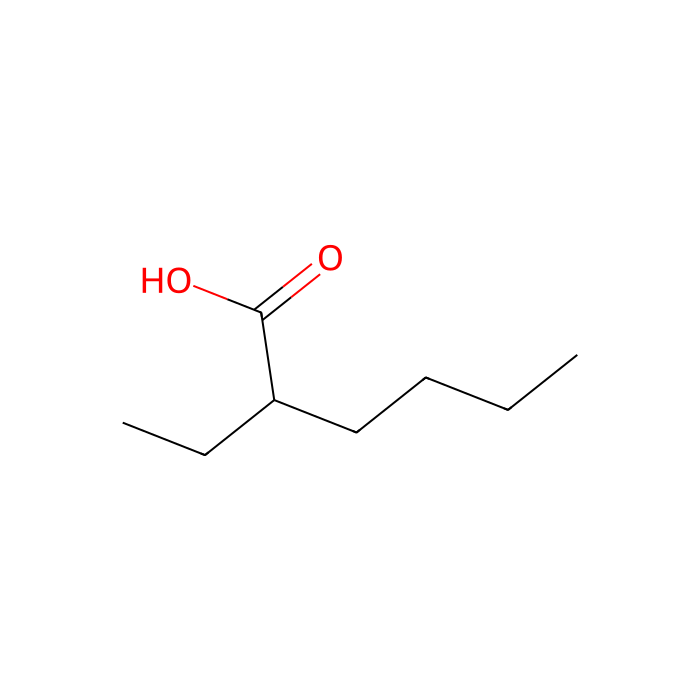
Brief description: 2‑Ethylhexanoic acid is a branched, medium‑chain carboxylic acid (C8) commonly used to generate oil‑soluble metal carboxylates (so‑called “octoates”) and as an acylating/ligating reagent in synthesis.
Item-specific facts (from Product Data)
SKU: E103542
Product name: 2‑Ethylhexanoic acid
CAS: 149‑57‑5
PubChem CID: 8697
InChIKey (as provided): 253313
Grade/Purity: CP (Chemical Pure)
Storage: Room temperature; shipped under normal conditions
Computed/literature identity data (for reference; not item-specific specs)
Molecular formula (literature): C8H16O2
Molecular weight (literature): 144.21 g/mol
Preferred IUPAC name (literature): 2‑ethylhexanoic acid
Carbon skeleton: Branched C8 chain with an ethyl substituent at C2 relative to the carboxyl carbon (i.e., CH3–CH(C2H5)–(CH2)3–CO2H).
Stereochemistry: No stereogenic centers in the free acid; achiral.
2D depiction in words: A carboxyl group attached to C1 of a six‑carbon chain, with an ethyl branch at C2 (from the carboxyl end). This branching increases hydrophobicity versus straight‑chain octanoic acid and enhances solubility of its metal salts in nonpolar media.
Note: Where literature identifiers differ from Product Data, defer to the Product Data for cataloging purposes; use literature entries for cheminformatics only.
Synthetic Utility
Functional profile
Carboxylic acid (weak, hydrophobic) capable of forming acyl derivatives and coordinating as a carboxylate ligand. The branched C8 tail imparts nonpolar solubility to its derivatives.
Key transformations (literature)
Esterification/transesterification: Access to a family of hydrophobic esters used as plasticizers and solvent modifiers. Acid catalysis (p‑TsOH, H2SO4) or solid acids; water removal critical.
Amidation: Via carbodiimide coupling (DCC/EDCI + HOBt/DMAP) or via acid chloride; affords bulky, lipophilic amides that can modulate membrane affinity or act as auxiliaries.
Acid chloride formation: SOCl2, (COCl)2, or Ghosez’s reagent to generate 2‑ethylhexanoyl chloride—useful for acylations where steric bulk reduces over‑acylation.
Anhydride/mixed anhydride routes: Enable mild peptide‑like couplings to sensitive nucleophiles.
Metal salt synthesis: Neutralization/dehydration with metal oxides/hydroxides/alkoxides to give oil‑soluble carboxylates (“octoates”) central to catalysis and coatings.
Strategic uses in synthesis
Hydrophobic tagging: Installing the 2‑ethylhexanoyl group increases lipophilicity (cLogP upshift), aiding phase separation or extraction of products.
Ligand exchange: Carboxylate metathesis on pre‑formed metal complexes to tune solubility and reactivity in nonpolar solvents.
Practical considerations
Control acid number and water content for reproducibility. Use Dean–Stark or azeotropic drying during esterifications. Monitor by IR (νC=O ~1710–1730 cm−1 for esters vs. ~1700–1710 cm−1 for acids) and by GC.
The branched chain can hinder acylation at crowded sites—leverage this for selective mono‑acylations.
Target Specificity
Not applicable.
Explanation
This product is a small‑molecule carboxylic acid, not a biological targeting reagent (e.g., antibody, peptide, inhibitor with defined biomolecular target affinity). No antigen/epitope, clone, isotype, or species reactivity applies.
Perguntas frequentes
What is the purity of this product?
This product is supplied at ≥98% purity (chemical assay). Lot-specific values are stated on the Certificate of Analysis.
What does CP mean?
CP is a defined analytical purity tier suitable for general analytical and reagent applications. It specifies a minimum assay percentage, controlled limits on common impurities (water, heavy metals, residue on ignition), and lot-to-lot consistency. CP is one of several purity tiers — choose based on the sensitivity and regulatory requirements of your method.
How should this product be stored?
Store at room temperature.
How is this product shipped?
This product ships under standard ambient conditions. No temperature-controlled packaging is required.
What are the CAS number, molecular formula and molecular weight?
The CAS Number is 149-57-5, the molecular formula is C8H16O2, and the molecular weight is 144.21 g/mol. InChIKey OBETXYAYXDNJHR-UHFFFAOYSA-N.
What documentation is provided?
Available product documentation, including Certificates of Analysis (COA), Safety Data Sheets (SDS), and specification sheets, is shown in the product document area. Document availability and access follow the current site policy.
Usamos cookies para garantir o funcionamento adequado do site e, quando permitido, para melhorar a sua experiência. Você pode gerenciar suas preferências a qualquer momento nas Configurações. Saiba mais em nossa Política de Cookies.
Deseja que lhe enviemos uma mensagem quando tivermos descontos disponíveis?
Lembrar-me mais tarde
Obrigado! Por favor, verifique a sua caixa de entrada de e-mail para confirmar.
Products are supplied to verified businesses, institutions, and qualified professionals for research and development use only. Not for use in humans, animals, diagnosis, or therapy.

 K2605699