Determine the necessary mass, volume, or concentration for preparing a solution.
Taxonomy Tree
| Kingdom | Organic compounds |
|---|---|
| Superclass | Organic oxygen compounds |
| Classe | Organooxygen compounds |
| Subclass | Not available |
| Intermediate Tree Nodes | Not available |
| Direct Parent | Organooxygen compounds |
| Alternative Parents | Hydrocarbon derivatives |
| Molecular Framework | Aliphatic acyclic compounds |
| Substituents | Hydrocarbon derivative - Organooxygen compound - Aliphatic acyclic compound |
| Descrição | This compound belongs to the class of organic compounds known as organooxygen compounds. These are organic compounds containing a bond between a carbon atom and an oxygen atom. |
| External Descriptors | Not available |
Find and download the COA for your product by matching the lot number on the packaging.
| Lot Number | Certificate Type | Data | Item |
|---|---|---|---|
| Certificate of Analysis | Oct 21, 2025 | E156272 | |
| Certificate of Analysis | Oct 14, 2025 | E156272 | |
| Certificate of Analysis | Oct 14, 2025 | E156272 | |
| Certificate of Analysis | Apr 17, 2023 | E156272 |
| Índice de refração | 1.42 |
|---|---|
| Ponto de inflamação (°F) | 57°C(lit.) |
| Ponto de inflamação (°C) | 57°C(lit.) |
| Ponto de ebulição (°C) | 177 °C |
| Peso molecular | 156.26 |
| XLogP3 | 4.400 |
| Hydrogen Bond Donor Count | 0 |
| Hydrogen Bond Acceptor Count | 1 |
| Rotatable Bond Count | 7 |
| Exact Mass | 156.151 Da |
| Monoisotopic Mass | 156.151 Da |
| Topological Polar Surface Area | 9.200 Ų |
| Heavy Atom Count | 11 |
| Formal Charge | 0 |
| Complexity | 88.900 |
| Isotope Atom Count | 0 |
| Defined Atom Stereocenter Count | 0 |
| Undefined Atom Stereocenter Count | 1 |
| Defined Bond Stereocenter Count | 0 |
| Undefined Bond Stereocenter Count | 0 |
| The total count of all stereochemical bonds | 0 |
| Covalently-Bonded Unit Count | 1 |
H226:Flammable liquid and vapor
H302:Harmful if swallowed
H315:Causes skin irritation
H319:Causes serious eye irritation
H373:May causes damage to organs through prolonged or repeated exposure
H411:Toxic to aquatic life with long lasting effects
P210:Keep away from heat, hot surface, sparks, open flames and other ignition sources. - No smoking.
P233:Keep container tightly closed.
P240:Ground/bond container and receiving equipment.
P241:Use explosion-proof [electrical/ventilating/lighting/.../] equipment.
P242:Use only non-sparking tools.
P243:Take precautionary measures against static discharge.
P260:Do not breathe dust/fume/gas/mist/vapors/spray.
P264:Wash hands [and …] thoroughly after handling.
P270:Do not eat, drink or smoke when using this product.
P273:Avoid release to the environment.
P280:Wear protective gloves/protective clothing/eye protection/face protection.
P321:Specific treatment (see ... on this label).
P330:Rinse mouth.
P391:Collect spillage.
P302+P352:IF ON SKIN: wash with plenty of water.
P303+P361+P353:IF ON SKIN (or hair): Take off Immediately all contaminated clothing. Rinse SKIN with water [or shower].
P305+P351+P338:IF IN EYES: Rinse cautiously with water for several minutes. Remove contact lenses if present and easy to do - continue rinsing.
P362+P364:Take off contaminated clothing and wash it before reuse.
P370+P378:In case of fire: Use ... to extinguish.
P403+P235:Store in a well-ventilated place. Keep cool.
P501:Dispose of contents/container to an approved waste disposal plant.
P264+P265:Wash hands [and …] thoroughly after handling. Do not touch eyes.
P301+P317:IF SWALLOWED: Get medical help.
P337+P317:If eye irritation persists: Get medical help.
P332+P317:If skin irritation occurs: Get medical help.
P319:Get medical help if you feel unwell.
Not applicable in the context of immunoassays or molecular biology kits. There are no WB/IHC/IF/FC protocols for this chemical.
For materials applications (general guidance, not product‑specific):
Consult the primary literature and your EHS protocols for scale‑up and curing parameters. These examples are provided for research planning only.
Item-specific biological data are not provided. As a synthetic vinyl ether monomer, 2‑ethylhexyl vinyl ether does not have a known intrinsic biological role.
General biochemical context (literature/knowledge):
Use in bio‑oriented research (non-clinical):
Compliance reminder: For research use only. No medical, diagnostic, or therapeutic applications are intended or supported for this product.
This compound is a hydrophobic, reactive vinyl ether monomer and is not used to prepare aqueous buffers or to control pH. It is practically insoluble in water and can undergo acid‑catalyzed reactions that are incompatible with buffer formulation.
Practical guidance:
Context: 2‑Ethylhexyl vinyl ether is primarily a reactive monomer. When an inert ether solvent is needed, greener, more stable alternatives are often preferable. If a hydrophobic reactive diluent is required, consider life‑cycle and safety tradeoffs.
Greener inert ether solvents (when you do NOT need a reactive vinyl ether):
Tradeoffs vs EOVE:
Greener reactive diluents (if reactivity is required):
Selection guidance: If your process goal is solvation or viscosity reduction without incorporation into the polymer, choose 2‑MeTHF/CPME. If reactive dilution is fundamental, assess renewable allyl/acrylate alternatives and implement inhibitor and containment controls to mitigate EHS impacts.
No item-specific pharmacopeial status or excipient grade is provided for this product. Not specified for this item; refer to CoA/Spec Sheet.
General context (non-clinical, formulation science):
Compliance note: This product is offered for research use only and is not intended for drug, diagnostic, or clinical applications.
Item-specific properties were not supplied. The following are general literature values for 2‑ethylhexyl vinyl ether (for method development and planning only; not product specifications):
Important: None of the above values constitute specifications for SKU E156272. Not specified for this item; refer to CoA/Spec Sheet for any lot-specific values (e.g., inhibitor content, purity, refractive index, density). Always verify properties experimentally under your conditions due to sensitivity of vinyl ethers to acid traces and polymerization.
Guidance on grades for this class of material (general information):
Considerations for method development:
2‑Ethylhexyl vinyl ether (EOVE) is an electron‑rich enol ether valued as a hydrophobic monomer and a versatile synthon.
Practical tips:
General literature guidance for vinyl ethers (adapt for your system; not product specifications):
Cationic polymerization:
Thiol–ene additions:
Acid‑catalyzed hydrolysis/unmasking:
Halofunctionalization:
Expected yields: Highly system‑dependent. Clean thiol–ene and controlled cationic polymerizations often reach high conversions (>90%) under optimized conditions (literature).
Always run small‑scale trials to tune initiator load, temperature profile, and inhibitor content for your specific apparatus and heat removal.
General safety characteristics of vinyl ethers (literature/experience-based):
Always consult the product’s SDS and institutional protocols for authoritative guidance.
This compound is most commonly used as a reactive monomer rather than as a routine solvent. However, understanding its solvation profile is valuable when formulating or copolymerizing.
Comparison (general):
Reconstitution: Not applicable—this product is supplied as a liquid. If purification is required, distill under reduced pressure over basic alumina under inert atmosphere, collecting middle cut; immediately use or re‑stabilize. Always consult the CoA/SDS for lot‑specific guidance (e.g., inhibitor identity and recommended storage duration).
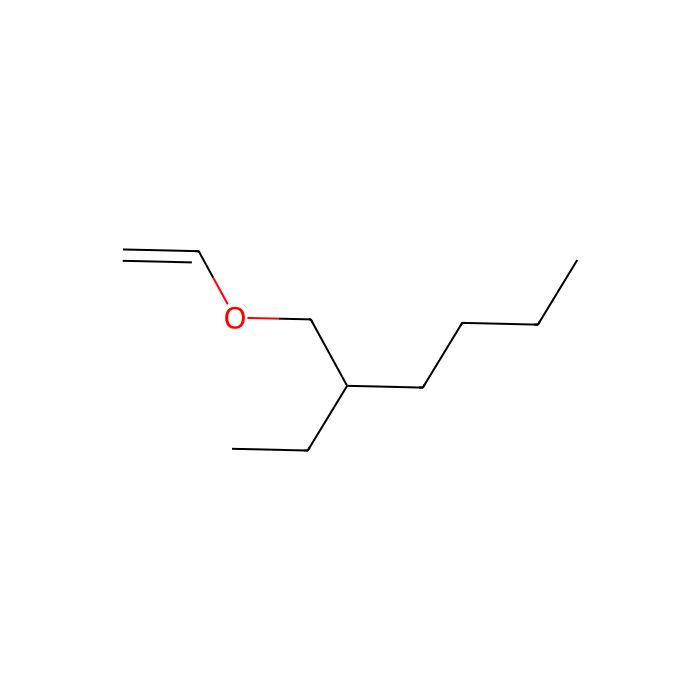
A hydrophobic vinyl ether monomer featuring a branched C8 alkoxy substituent on a terminal vinyl group; commonly used in cationic polymerization and hydrophobic coatings.
Item-specific (Product Data):
Literature/Computed identifiers (general reference; not item-specific):
Structural features (general chemistry):
2‑Ethylhexyl vinyl ether (EOVE) is a representative enol ether with distinctive nucleophilic alkene character due to α‑oxygen donation.
Key transformations (literature/general):
Practical notes:
Not applicable. This product is a small‑molecule vinyl ether monomer and is not an antibody, protein, or targeted biological reagent. No antigen/epitope specificity, clone, or isotype information is relevant.