This compound belongs to the class of organic compounds known as styrenes. These are organic compounds containing an ethenylbenzene moiety.
External Descriptors
Not available
1. Djoumbou Feunang Y, Eisner R, Knox C, Chepelev L, Hastings J, Owen G, Fahy E, Steinbeck C, Subramanian S, Bolton E, Greiner R, and Wishart DS. ClassyFire: Automated Chemical Classification With A Comprehensive, Computable Taxonomy. Journal of Cheminformatics, 2016, 8:61.
P305+P351+P338:IF IN EYES: Rinse cautiously with water for several minutes. Remove contact lenses if present and easy to do - continue rinsing.
Calculadoras de soluções
Molarity Calculator
Determine the necessary mass, volume, or concentration for preparing a solution.
Dilution Calculator
Determine the dilution needed to prepare a stock solution.
Reconstitution Calculator
Revisões
Avaliações dos Clientes
Application Protocols
No bioassay or immunoassay protocols apply to this small-molecule reagent.
For synthetic applications, follow standard organic chemistry procedures cited under Reaction Conditions and Synthetic Utility.
For analytical use (e.g., LC–MS/GC–MS), prepare samples in suitable solvents (e.g., MeOH, ACN, DMSO) at validated concentrations; consider forming anilinium salts for aqueous injections.
If performing extractions, exploit acid/base partitioning of the amine to streamline purification and recovery.
Biological Roles
This product is intended for research and synthetic chemistry use; no biological or clinical activity is claimed.
General context (literature):
Aromatic amines like 2-vinylaniline can be protonated to form anilinium salts; in biochemical environments, basicity and hydrophobicity govern partitioning and interactions with biomolecules.
The vinyl group provides a handle for conjugation chemistries (e.g., thiol–ene, radical additions) in materials or probe development; however, 2-vinylaniline itself is not a standard biochemical reagent.
In metabolically competent systems, aromatic amines may undergo oxidative metabolism (N-oxidation, ring hydroxylation) and conjugation; such information is general to anilines and not specific to this item.
For laboratory bio-related method development (analytical):
Sample preparation often requires acidified aqueous phases to solubilize/protonate the amine for LC–MS; ion-pairing is rarely necessary with modern columns.
Derivatization of the amine (e.g., with dansyl chloride) can enhance detectability, but such steps should be validated for your matrix.
No biological roles or pathways are specified for this item; consult the primary literature for application-specific insight.
Buffer Applications
2-Vinylaniline is not a buffering agent and is not typically used to prepare biological buffers.
If aqueous handling is required, temporary conversion to an anilinium salt (e.g., with dilute HCl) can improve water solubility for extraction or analytical sample prep.
For biochemical experiments, avoid using this compound as a buffer component; instead, employ standard systems (e.g., phosphate, HEPES, Tris) and use 2-vinylaniline only as a substrate or test article dissolved in a suitable co-solvent (e.g., DMSO, MeOH) at low percentages.
Green Alternatives
Although 2-vinylaniline is a substrate rather than a solvent, greener choices can be made in processes that employ it.
Solvent substitution (literature-guided):
Replace toluene/THF/DCM, where feasible, with 2-MeTHF, CPME, EtOAc, or propylene carbonate depending on the transformation.
For Pd-catalyzed annulations or couplings, 2-MeTHF or bio-based cycloalkyl ethers often match performance while improving safety and sustainability.
Base and reagent choices:
Use carbonate bases (K2CO3, Cs2CO3) or NaOtBu in minimal excess; avoid stoichiometric transition metals.
Employ oxygen (air) as terminal oxidant in oxidative Heck annulations where literature precedents permit, limiting peroxide or hypervalent iodine waste.
Energy and workup:
Flow chemistry or microwave protocols can reduce reaction times/energy use.
Choose greener extraction solvents (EtOAc over DCM) and minimize silica by adopting crystallization or acid/base extractive purifications when possible.
Comparison snapshot (general guidance):
Toluene vs 2-MeTHF: Similar boiling range; 2-MeTHF offers better renewability and often improved phase separations, but can form peroxides; manage with routine testing.
DCM vs EtOAc: EtOAc is less toxic and biodegradable; may require slightly longer reaction times or different catalyst ligands to maintain rates.
DMF/DMAc vs Cyrene or NBP: Dipolar aprotics can sometimes be replaced by bio-derived alternatives, though solubility and catalyst compatibility must be validated experimentally.
Note: Verify process performance and impurity profiles under substituted conditions; catalytic systems are sensitive to solvent and amine coordination.
Pharmaceutical Uses
No pharmacopeial status or excipient role is specified for this item.
General formulation/manufacturing context (literature):
2-Vinylaniline is primarily a synthetic intermediate/building block. It can serve as a precursor to indole/indoline scaffolds common in discovery chemistry.
If used in pre-formulation research, typical activities include salt screening (to modulate solubility) and derivatization (acylation, sulfonylation) to tune physicochemical properties.
For analytical controls, validated LC–UV or LC–MS methods for aromatic amines are commonly used; sample preparation often leverages acid–base extraction.
No medical or clinical claims are made. This product is for research use only.
Physical Properties
Note: No item-specific specifications are provided in the Product Data. Values below reflect literature/general expectations for 2-vinylaniline and should not be used as this item’s CoA.
Physical state/appearance (item-specific): Not specified for this item; refer to CoA/Spec Sheet.
Molecular formula (literature): C8H9N
Molecular weight (literature): ~119.17 g/mol
Boiling point (literature): Reported for o-vinylaniline in the elevated range typical of substituted anilines; consult primary literature or SDS for specific values.
Melting point (literature): Typically liquid at room temperature; precise MP not broadly reported; consult primary references.
Density (literature): Expected near that of substituted anilines (~0.99–1.05 g/mL); exact value should be confirmed from primary data.
Solubility (general):
Water: Low (aromatic amines are sparingly soluble in neutral water; more soluble under acidic conditions via protonation).
Organic solvents: Miscible/soluble in common organics (e.g., ethers, esters, aromatics, chlorinated solvents, alcohols) — verify for your application.
pKa (conjugate acid, literature): Aromatic anilinium cations typically pKaH ~4.5–5.5; actual value depends on substitution and medium.
LogP (literature, qualitative): Moderately hydrophobic due to aromatic ring and vinyl substituent; expect low-to-moderate logP.
Refractive index: Not specified for this item; refer to CoA/Spec Sheet.
Quality and Grades
Grade/Purity: Not specified for this item; refer to CoA/Spec Sheet.
Appearance: Not specified for this item; refer to CoA/Spec Sheet.
Context and guidance (general):
Research grade 2-vinylaniline is commonly supplied with organic-volatile and non-volatile impurity limits appropriate for synthesis. In the absence of a specified grade, consult the CoA for assay, GC purity, and residual solvent/trace metal information.
UV/Chromatography considerations: If you plan to use UV detection, be aware the aromatic ring and aniline chromophore absorb in the UV; for trace analysis, low-UV-absorbing solvents and clean baseline standards are advisable.
Stabilizers/inhibitors: Vinyl aromatics are sometimes stabilized with radical inhibitors (e.g., MEHQ/BHT) to suppress polymerization; presence/absence is item-specific. For this item, stabilizer content is Not specified; refer to CoA/Spec Sheet.
Batch-to-batch reproducibility: For metal-catalyzed couplings (e.g., Buchwald–Hartwig, Heck), trace impurities (sulfur, peroxides, residual acids/bases) can influence outcomes. Filtering through basic alumina or brief vacuum stripping can help if side reactions are observed, but confirm acceptability for your QC needs.
Reaction and Applications
2-Vinylaniline is a versatile bifunctional building block combining an aniline (nucleophilic, directing) and a terminal vinyl (olefinic) handle. This enables orthogonal transformations and annulations.
Key application families (literature):
Intramolecular annulation to indolines/indoles:
Pd-catalyzed oxidative Heck cyclization and related annulations convert o-aminostyrenes to 2,3-dihydroindoles and indoles under aerobic or peroxide co-oxidants.
Iodocyclization or electrophile-induced cyclization (I2, NIS, Br2) affords haloindolines/indoles amenable to further cross-coupling.
Hydrofunctionalization of the vinyl group:
Hydroboration–oxidation (e.g., BH3·THF or pinacol borane with catalysts) yields β-amino alcohol precursors after oxidation.
Hydroamination (Au, Pt, lanthanide catalysts) provides indolines or amine-adducts; intramolecular modes are possible via N–H activation.
Acylation, sulfonylation, and carbamoylation to tune electronics and directivity for subsequent cyclizations or C–H activation.
Buchwald–Hartwig N-arylation to build diarylamines while preserving or transforming the vinyl group.
Electrophilic aromatic substitution and directed metalation:
Ortho/para-directing effects of –NH2 can be exploited (after appropriate protection) for further ring functionalization.
Cross-coupling on halo-derivatives:
If pre-halogenated, Suzuki–Miyaura, Heck, and Sonogashira couplings enable elaboration; the native vinyl group allows sequential logic (e.g., first N-protection, then olefin elaboration, then deprotection and cyclization).
Practical notes:
Consider temporary protection (e.g., acyl/carbamate) to suppress amine coordination during Pd-catalysis on the vinyl function.
Oxygen/light can promote undesired polymerization of the vinyl unit; conduct sensitive steps under inert atmosphere and subdued light.
Reaction Conditions
Representative literature conditions for transformations involving 2-vinylaniline (guidance only; optimize for your system):
Oxidative Heck-type annulation to indolines/indoles:
Catalyst: Pd(OAc)2 (1–5 mol%) with phosphine or NHC ligand as needed.
Oxidant: O2 (air), Cu(OAc)2, or benzoquinone; base K2CO3 or Cs2CO3.
Solvent: Toluene, 1,4-dioxane, DMAc, or 2-MeTHF; 60–120°C.
Notes: N-acyl protection can improve selectivity; intramolecular C–N bond formation delivers 5-membered rings.
Reagents: I2 or NIS (1.1–1.5 equiv), base (NaHCO3) or acid promoter, 0–25°C in DCM or MeCN.
Outcome: Haloindolines/indoles suitable for cross-coupling (Suzuki/Negishi).
Hydroboration–oxidation of the vinyl group:
Reagents: BH3·THF or HBPin with Ir/Rh catalysts; 0–25°C to reflux depending on system.
Solvent: THF or 2-MeTHF; oxidation with H2O2/NaOH affords the corresponding alcohol after subsequent transformations.
Buchwald–Hartwig N-arylation (on the aniline):
Catalyst: Pd2(dba)3 or Pd(OAc)2 (1–3 mol%) with BrettPhos/SPhos/XPhos.
Base: NaOtBu/K3PO4; Solvent: Toluene, dioxane, or CPME; 60–110°C.
Tip: Protect the amine if competing intramolecular reactions are possible.
Protection strategies:
Acylation: Ac2O, Et3N, DCM, 0–25°C; or Boc protection (Boc2O, DMAP, base) in MeCN/THF.
Workup/purification:
Acid–base extraction to remove amine by converting to its salt, then basify to recover the free base.
Chromatography on silica with 0.1–1% Et3N in eluent to improve band shape.
Expected yields and rates vary with substrate and catalyst; consult primary literature for the closest analogues.
Safety and Handling
Hazard classification details are not provided in the Product Data. Always review the product’s SDS before use.
GHS classification, signal word, pictograms, H-statements: Not specified for this item; refer to SDS.
General hazards (aromatic amine, literature):
May be harmful if inhaled, swallowed, or absorbed through skin; may cause skin and eye irritation.
Aromatic amines can cause methemoglobinemia upon significant exposure; handle to minimize exposure (literature, general precaution).
Vinyl aromatics may undergo autoxidation/polymerization; minimize exposure to heat, air, and light.
Recommended PPE: Chemical-resistant gloves (e.g., nitrile), lab coat, safety glasses/goggles; handle in a fume hood.
Handling practices:
Avoid breathing vapors; prevent skin/eye contact.
Use inert atmosphere for moisture/oxygen-sensitive transformations.
For amine vapors/odors, ensure adequate ventilation.
Incompatibilities (general): Strong oxidizers, acylating agents, acid chlorides/anhydrides (vigorous reactions), isocyanates; strong acids/bases may form salts or drive side reactions.
First aid overview (general guidance; defer to SDS):
Inhalation: Move to fresh air; seek medical attention if symptoms persist.
Skin contact: Wash with soap and water; remove contaminated clothing.
Eye contact: Rinse cautiously with water for several minutes; seek medical advice if irritation continues.
Ingestion: Rinse mouth; seek medical attention.
Fire safety: Use CO2, dry chemical, or foam; aromatic amines can burn and may produce toxic fumes (NOx) on combustion.
Waste: Dispose according to local regulations for organic amine-containing wastes.
Solvent Selection
2-Vinylaniline is a moderately hydrophobic, basic aromatic amine with a terminal vinyl group. It dissolves well in common organic solvents; protonation under acidic conditions increases aqueous solubility.
Polarity/miscibility (general):
Good solubility in ethers (THF, MTBE), esters (EtOAc), aromatics (toluene), chlorinated solvents (DCM, DCE), and polar aprotics (MeCN, DMF, DMAc, DMSO).
Limited solubility in neutral water; forms water-soluble salts in dilute mineral acids.
Solvent choice by application:
Pd-catalyzed couplings (Heck/Buchwald–Hartwig): Toluene, dioxane, or DMAc/DMF are typical; 2-MeTHF or CPME are greener alternatives to THF/toluene in many cases.
Electrophilic acylation/ sulfonylation of the amine: Use DCM/CH2Cl2 or MeCN at 0–25°C with base; for greener options, EtOAc or 2-MeTHF often suffice.
Hydroboration/oxidation or hydrofunctionalization of the vinyl group: THF, 2-MeTHF, or alcohol solvents depending on reagent system.
Salt formation/purification: Partitioning between organic solvent and dilute HCl/H2SO4 for amine extraction is effective.
Practical tips:
Avoid strongly protic media during metal-catalyzed couplings unless designed for such conditions; amine protonation can deactivate catalysts.
For chromatographic purification, start with hexanes/EtOAc or toluene/EtOAc gradients; amine-modified silica or addition of 0.1–1% Et3N can improve band shape.
Dielectric constants and Hansen parameters: Select based on the transformation; aromatic and ether solvents often balance solubility and reactivity for this substrate.
Storage and Reconstitution
Storage conditions (item-specific, Product Data): Store at 2–8°C.
Shipping (item-specific, Product Data): Shipped on wet ice.
Container: Store in a tightly closed, chemically compatible container (amber glass recommended) under inert headspace if possible to limit oxidation/polymerization of the vinyl functionality.
Light/air sensitivity (general for vinyl aromatics): Limit exposure to air and light to reduce risk of autoxidation/polymerization; keep desiccated if feasible.
Stabilizers: Presence of inhibitors is Not specified for this item; refer to CoA/Spec Sheet. If your application is inhibitor-sensitive, pre-test and, if necessary, purify (e.g., short plug of basic alumina) immediately before use.
Reconstitution/handling:
If supplied as a neat liquid/solid, use directly. For solution preparation, dissolve in a dry, oxygen-free solvent appropriate to your application (e.g., anhydrous toluene, THF, EtOAc, DCM, MeCN).
For aqueous work, prepare the anilinium salt by adding dilute mineral acid, then adjust pH as needed.
Freeze–thaw: Not typically required; if refrigerated solutions are prepared, minimize freeze–thaw cycles and use septum-sealed vials under inert gas for sensitive transformations.
Stability: For long-term storage, periodic GC/HPLC check is advisable to monitor for polymerization or oxidative byproducts. Always defer to the product’s CoA/SDS for definitive guidance.
Structure and Identity
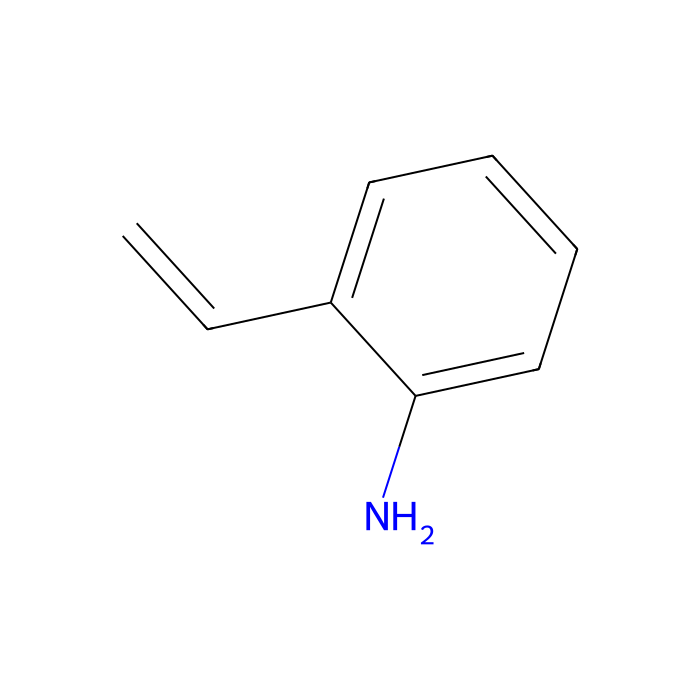
2-Vinylaniline (o-vinylaniline) is an ortho-disubstituted aniline featuring an aniline core and a pendant vinyl (ethenyl) group at the ortho position.
Item identifiers (Product Data):
SKU: V303619
CAS: 3867-18-3
Category: Small molecules and compound library (research use only)
Molecular formula (literature): C8H9N
Molecular weight (literature): ~119.17 g/mol
InChIKey: Not specified for this item; refer to CoA/Spec Sheet.
SMILES: Not specified for this item; refer to CoA/Spec Sheet.
2D structural features (descriptive):
A benzene ring bearing two adjacent substituents: an amino group (–NH2) and a vinyl group (–CH=CH2) in the ortho relationship.
Conjugation extends across the aromatic ring and into the vinyl substituent, enabling electrophilic/nucleophilic aromatic and vinyl reactivity.
The amine is primary and aromatic (anilinium conjugate acid forms under acidic conditions). No stereocenters are present; the vinyl group is terminal and planar.
Synonym context (general): o-Vinylaniline; 2-ethenylaniline; 2-aminostyrene (usage varies in literature).
Synthetic Utility
Functional groups and reactivity (literature):
Aromatic primary amine (–NH2): Nucleophilic at nitrogen; can coordinate to metals, direct ortho C–H activation, and be derivatized (acyl/sulfonyl/carbamate protection) to modulate reactivity.
Terminal vinyl group (–CH=CH2): Participates in radical additions, hydrofunctionalizations (hydroboration/oxidation, hydroamination, hydrosilylation), and electrophilic additions; can be engaged in cyclizations with the adjacent aniline.
Key synthetic strategies:
Indoline/indole synthesis: Intramolecular oxidative Heck-type or electrophile-induced cyclization from o-aminostyrenes to form bicyclic nitrogen heterocycles; halocyclization followed by dehydrohalogenation or cross-coupling broadens scope.
N-Protection and cross-coupling: Temporary N-acylation (e.g., with Boc2O or acid chlorides) suppresses catalyst poisoning; subsequent Pd-catalyzed transformations on the vinyl or aryl positions proceed with improved selectivity.
Sequential functionalization: (1) N-derivatize; (2) elaborate vinyl (e.g., hydroboration then Suzuki coupling after oxidation/derivatization); (3) deprotect and cyclize to fix substitution around the indoline/indole ring.
Directed ortho metalation (DoM): With appropriate protecting groups, the aniline can direct lithiation enabling installation of electrophiles before or after vinyl transformation.
Late-stage diversification: The vinyl handle allows mild conjugations (thiol–ene, photoredox hydroalkylation) under conditions compatible with sensitive motifs.
Practical tips:
Control amine basicity by protection or in situ protonation to balance catalyst compatibility vs desired reactivity.
Exclude oxygen/light during transformations prone to polymerization or radical pathways; consider inhibitor removal or addition as appropriate for the step.
Target Specificity
This product is a small molecule building block, not a biological macromolecule or affinity reagent. No target specificity, antigen, epitope, clone, or species reactivity applies.
Target/antigen: Not applicable.
Isotype/clone: Not applicable.
Tested reactivity: Not applicable.
Perguntas frequentes
What is the purity of this product?
This product is supplied at ≥95% purity (chemical assay). Lot-specific values are stated on the Certificate of Analysis.
How should this product be stored?
Store at 2–8 °C. Refrigerated storage is required to maintain the specified shelf life.
How is this product shipped?
This product ships chilled on wet ice. Unpack on arrival and transfer it to the storage condition stated above.
What are the CAS number, molecular formula and molecular weight?
The CAS Number is 3867-18-3, the molecular formula is C8H9N, and the molecular weight is 119.16 g/mol. InChIKey KURPPWHPIYBYBS-UHFFFAOYSA-N.
What documentation is provided?
Available product documentation, including Certificates of Analysis (COA), Safety Data Sheets (SDS), and specification sheets, is shown in the product document area. Document availability and access follow the current site policy.
Usamos cookies para garantir o funcionamento adequado do site e, quando permitido, para melhorar a sua experiência. Você pode gerenciar suas preferências a qualquer momento nas Configurações. Saiba mais em nossa Política de Cookies.
Deseja que lhe enviemos uma mensagem quando tivermos descontos disponíveis?
Lembrar-me mais tarde
Obrigado! Por favor, verifique a sua caixa de entrada de e-mail para confirmar.
Products are supplied to verified businesses, institutions, and qualified professionals for research and development use only. Not for use in humans, animals, diagnosis, or therapy.

 F2328659