
Determine the necessary mass, volume, or concentration for preparing a solution.
| Activity Type | Relation | Activity value | Units | Action Type | Journal | PubMed Id | doi | Assay Aladdin ID |
|---|
Anhydrous Grade, ≥99%, stabilized with 200 ppm MEHQ Anhydrous Grade para fluxos de trabalho cromatográficos e analíticos sensíveis que exigem interferência mínima da linha de base.
Protected from light,Room temperature,Argon charged,Desiccated Envio FedEx DG Service. Consulte o COA específico do lote para obter as especificações exatas.
SDS, COA, ficha técnica e folha de especificações disponíveis para download. COA específico do lote acessível por meio de pesquisa por número de lote.
Citado em 1545 publicações revisadas por pares nas áreas de cromatografia, síntese orgânica e reações de acoplamento cruzado.
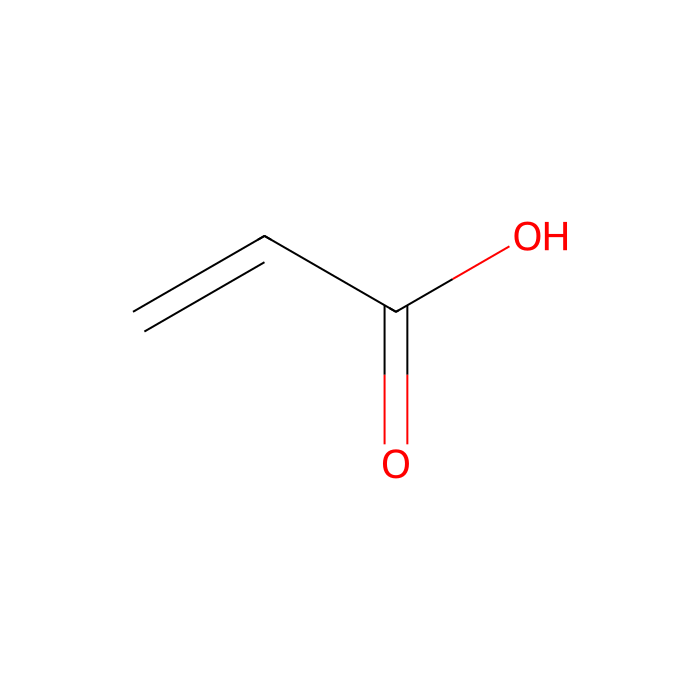
Acrylic acid is an unsaturated carboxylic acid that is commonly used as a versatile building block in the chemical industry because of its reactive double bond between the carbon and oxygen atoms. It is used to prepare various acrylic acid-based polymers, which are used for various applications such as adhesives, paints & coatings, medical devices, organic semiconductors,thin-film transistors, hydrogels and lithium-ion batteries. Additionally, acrylic acid also serves as one of the polyelectrolytes in the self-assembled polymeric film used for hydrogen generation.
Application
Acrylic acid can be primarily used as a monomer to produce various acrylic polymers, including polyacrylic acid, polymethyl methacrylate (PMMA), acrylonitrile butadiene styrene (ABS), and many others. These polymers exhibit a wide range of properties, such as transparency, scratch-resistant, flexibility, and resistance to water and chemicals, which make them valuable materials in various applications. Acrylic acid is also used as a key component in the synthesis of superabsorbent polymers(SAPs). These polymers possess a unique ability to quickly absorb and retain large quantities of water. Due to their excellent properties, SAPs have been widely used in many fields, such as drug-delivery systems, chemical industry, and personal care, etc.
Acrylic acid can also be used as:
A key component in the preparation of copolymer binder, which helps to optimize the performance of lithium-ion batteries.
A surface modifier for the carbon nanotubes with poly(acrylic acid) in order to improve adhesion and dispersion of the nanotubes in the oxide semiconductor matrix for thin-film transistor applications.
A reactive monomer for the surface modification of polydimethylsiloxane (PDMS)through a simultaneous polymerization process with ethylene glycol dimethacrylate. Modified PDMS potentially applied in new applications fields such as microfluidics or biomedical devices.
A precursor for the synthesis of cashew gum/acrylic acid nanoparticles via the copolymerization process. The use of acrylic acid in the synthesis is to introduce hydrophilic functional groups into the cashew gum backbone, thereby improving its solubility in water and increasing its compatibility with other hydrophilic materials.
AAc is used in preparing monodispersed poly (N-isopropylacryamide) (PNIPAM)/AAc microgels.[8] AAc has been plasma-deposited on surfaces for cell culture applications.Surface modification of poly(ethylene terephthalate) (PET) films via UV-induced graft copolymerization with AAc has been reported.AAc is used primarily as an intermediate in the production of acrylates.
Documento abrangente sobre perigos, manuseamento, armazenamento e conformidade regulamentar.
<<<<<<< HEAD Baixar SDS → ======= Baixar SDS → >>>>>>> release248-p3Dados de qualidade específicos do lote. Introduza o número de lote para obter o COA exato.
Consultar COA →Resumo de referência rápida das especificações e aplicações do produto.
Ver ficha técnica →Atributos de qualidade completos e critérios de aceitação para este grau.
Ver folha de especificações →Taxonomy Tree
| Kingdom | Organic compounds |
|---|---|
| Superclass | Organic acids and derivatives |
| Classe | Carboxylic acids and derivatives |
| Subclass | Acrylic acids and derivatives |
| Intermediate Tree Nodes | Not available |
| Direct Parent | Acrylic acids |
| Alternative Parents | Monocarboxylic acids and derivatives Carboxylic acids Organic oxides Hydrocarbon derivatives Carbonyl compounds |
| Molecular Framework | Aliphatic acyclic compounds |
| Substituents | Acrylic acid - Monocarboxylic acid or derivatives - Carboxylic acid - Organic oxygen compound - Organic oxide - Hydrocarbon derivative - Organooxygen compound - Carbonyl group - Aliphatic acyclic compound |
| Descrição | This compound belongs to the class of organic compounds known as acrylic acids. These are organic compounds containing acrylic acid CH2=CHCO2H. |
| External Descriptors | Unsaturated fatty acids |
| Activity Type | Relation | Activity value | Units | Action Type | Journal | PubMed Id | doi | Assay Aladdin ID |
|---|
| Activity Type | Relation | Activity value | Units | Action Type | Journal | PubMed Id | doi | Assay Aladdin ID |
|---|
| Activity Type | Relation | Activity value | Units | Action Type | Journal | PubMed Id | doi | Assay Aladdin ID |
|---|
| Activity Type | Relation | Activity value | Units | Action Type | Journal | PubMed Id | doi | Assay Aladdin ID |
|---|
| Activity Type | Relation | Activity value | Units | Action Type | Journal | PubMed Id | doi | Assay Aladdin ID |
|---|
Find and download the COA for your product by matching the lot number on the packaging.
| Lot Number | Certificate Type | Data | Item |
|---|---|---|---|
 A2615024 | Certificate of Analysis | Oct 09, 2026 | A397753 |
| F2609175 | Certificate of Analysis | Jun 23, 2026 | A397753 |
| F2609184 | Certificate of Analysis | Jun 23, 2026 | A397753 |
| F2609185 | Certificate of Analysis | Jun 22, 2026 | A397753 |
| C2605194 | Certificate of Analysis | Mar 16, 2026 | A397753 |
| D2518096 | Certificate of Analysis | Jan 21, 2026 | A397753 |
| B2604044 | Certificate of Analysis | Jun 10, 2025 | A397753 |
| F2524157 | Certificate of Analysis | Jun 10, 2025 | A397753 |
| F2524156 | Certificate of Analysis | Jun 10, 2025 | A397753 |
| F2524118 | Certificate of Analysis | Jun 10, 2025 | A397753 |
| F2524112 | Certificate of Analysis | Jun 10, 2025 | A397753 |
| C2513187 | Certificate of Analysis | Mar 20, 2025 | A397753 |
| H2309582 | Certificate of Analysis | Jun 11, 2024 | A397753 |
| L2411301 | Certificate of Analysis | Apr 02, 2024 | A397753 |
| J2429198 | Certificate of Analysis | Apr 02, 2024 | A397753 |
| I2411032 | Certificate of Analysis | Apr 02, 2024 | A397753 |
| D2411145 | Certificate of Analysis | Apr 02, 2024 | A397753 |
| D2411144 | Certificate of Analysis | Apr 02, 2024 | A397753 |
| D2411143 | Certificate of Analysis | Apr 02, 2024 | A397753 |
| D2411142 | Certificate of Analysis | Apr 02, 2024 | A397753 |
| D2411141 | Certificate of Analysis | Apr 02, 2024 | A397753 |
| F2419071 | Certificate of Analysis | Jun 14, 2023 | A397753 |
| F2314408 | Certificate of Analysis | Jun 14, 2023 | A397753 |
| H2309576 | Certificate of Analysis | Jun 14, 2023 | A397753 |
| C2310632 | Certificate of Analysis | Mar 17, 2023 | A397753 |
| A2212048 | Certificate of Analysis | Oct 21, 2022 | A397753 |
| I2212477 | Certificate of Analysis | Sep 01, 2022 | A397753 |
| I2212478 | Certificate of Analysis | Sep 01, 2022 | A397753 |
| I2212479 | Certificate of Analysis | Sep 01, 2022 | A397753 |
| I2212480 | Certificate of Analysis | Sep 01, 2022 | A397753 |
| A2417123 | Certificate of Analysis | Sep 01, 2022 | A397753 |
| E2227114 | Certificate of Analysis | Jun 01, 2022 | A397753 |
| Solubilidade | Soluble in water, chloroform, ethanol, methanol, and DMF. |
|---|---|
| Sensibilidade | Hygroscopic,Light & Air sensitive. |
| Índice de refração | 1.4192-1.4212 |
| Ponto de inflamação (°F) | 119.3 °F - closed cup |
| Ponto de inflamação (°C) | 48.5 °C - closed cup |
| Ponto de ebulição (°C) | 139°C |
| Ponto de fusão (°C) | 13°C |
| Peso molecular | 72.060 g/mol |
| XLogP3 | 0.300 |
| Hydrogen Bond Donor Count | 1 |
| Hydrogen Bond Acceptor Count | 2 |
| Rotatable Bond Count | 1 |
| Exact Mass | 72.0211 Da |
| Monoisotopic Mass | 72.0211 Da |
| Topological Polar Surface Area | 37.300 Ų |
| Heavy Atom Count | 5 |
| Formal Charge | 0 |
| Complexity | 55.900 |
| Isotope Atom Count | 0 |
| Defined Atom Stereocenter Count | 0 |
| Undefined Atom Stereocenter Count | 0 |
| Defined Bond Stereocenter Count | 0 |
| Undefined Bond Stereocenter Count | 0 |
| The total count of all stereochemical bonds | 0 |
| Covalently-Bonded Unit Count | 1 |
O nosso guia de seleção de graus abrange pureza, estado do estabilizador e adequação à aplicação para todas as variantes do nosso catálogo.
Ver o guia de graus Anhydrous Grade →