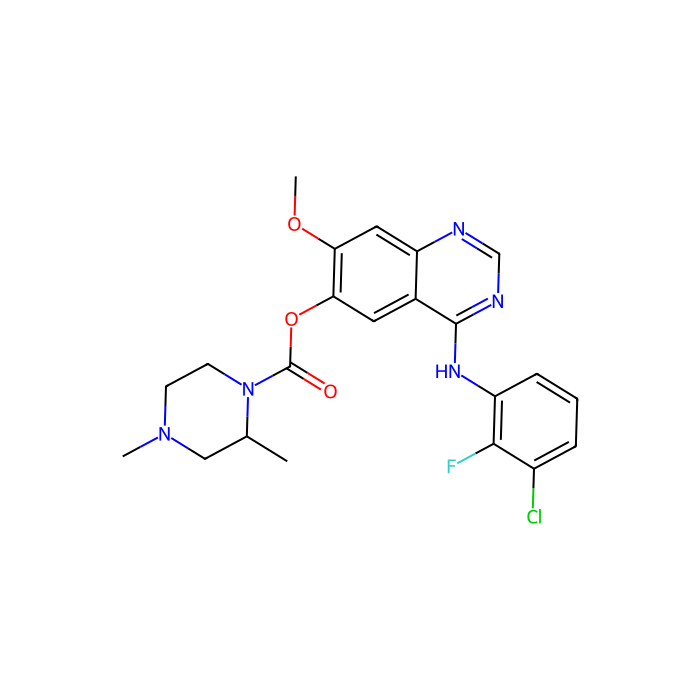
AZD3759 - Moligand™, ≥99% , Epidermal growth factor receptor erbB1 inhibitor, CAS No.1626387-80-1, Epidermal growth factor receptor erbB1 inhibitor

CAS: 1626387-80-1 Cat. No.: A413895 Fórmula: C22H23ClFN5O3 Peso molecular: 459.9
Disponível para encomenda
GRAU & PUREZA Moligand™ ? Moligand™ — Aladdin's line of ligands and bioactive small molecules. Use for receptor, pathway, and binding studies needing defined small-molecule tools. ≥99%
Synonyms
(R)-4-(3-chloro-2-fluorophenylamino)-7-methoxyquinazolin-6-yl 2,4-dimethylpiperazine-1-carboxylate|zorifertinib|(9S,10R)-3,4,5,14,15,16-hexamethoxy-9,10-dimethyltricyclo[10.4.0.0^{2,7}]hexadeca-1(16),2,4,6,12,14-hexaene|4-((3-Chloro-2-fluorophenyl)amino)-7-methoxyquinazolin-6-yl (2R)-2,4-dimethylpiperazine-1-carboxylate|(+/-)-N-[2-[[Hydroxy-3-(4-hydroxy)propyl]amino]ethyl-4-morpholinecarboxamide hemifumarate salt|4-[(3-CHLORO-2-FLUOROPHENYL)AMINO]-7-METHOXYQUINAZOLIN-6-YL (2R)-2,4-DIMETHYLPIPERAZINE-1-CARBOXYLATE|ZORIFERTINIB [WHO-DD]|OMEPRAZOLE IMPURITY C [EP IMPURITY]|1-PIPERAZINECARBOXYLIC ACID, 2,4-DIMETHYL-, 4-((3-CHLORO-2-FLUOROPHENYL)AMINO)-7-METHOXY-6-QUINAZOLINYL ESTER, (2R)-|(R)-4-((3-chloro-2-fluorophenyl)amino)-7-methoxyquinazolin-6-yl 2,4-dimethylpiperazine-1-carboxylate|(2R)-2,4-dimethyl-1-piperazinecarboxylic acid, 4-[(3-chloro-2-fluorophenyl)amino]-7-methoxy-6-quinazolinyl ester|AZD3759|AZD-3759|[4-(3-chloro-2-fluoroanilino)-7-methoxyquinazolin-6-yl] (2R)-2,4-dimethylpiperazine-1-carboxylate|AZD 3759|ZORIFERTINIB [INN]
Storage
Store at -20°C
Shipped In
Ice chest + Ice pads
★
Tamanho
USA
Alemanha (EU)*
Preço
Qtd
25mg
A413895-25mg
8 Em stock
—

9,90US$

14,90US$
Gravar 5,00 US$ (33.56%)
100mg
A413895-100mg
Em stock ≥10
—

27,90US$

41,90US$
Gravar 14,00 US$ (33.41%)
500mg
A413895-500mg
3 Em stock
—

104,90US$

157,90US$
Gravar 53,00 US$ (33.57%)
1g
A413895-1g
3 Em stock
—

112,90US$

169,90US$
Gravar 57,00 US$ (33.55%)
5g
A413895-5g
2 Em stock
—

394,90US$

592,90US$
Gravar 198,00 US$ (33.40%)
Enter a quantity for the sizes you want to add.

Visão geral

Information

AZD3759 is a potent, oral active, CNS-penetrantEGFRinhibitor withIC50of 0.3 nM, 0.2 nM, and 0.2 nM for EGFR (WT), EGFR (L858R), and EGFR (exon 19Del), respectively. Phase 1.


Targets

EGFR (L858R) (Cell-free assay); EGFR (exon 19Del) (Cell-free assay); EGFR (WT) (Cell-free assay) 0.2 nM; 0.2 nM; 0.3 nM


In vitro

In H3255 (L858R) cells, AZD3759 inhibits EGFR phosphorylation with IC50 of 7.2 nM. AZD3759 demonstrates inhibitory effects on both the pEGFR pathway and cell proliferation of EGFR mutation-derived cells PC-9 and H3255 with IC50 of 7.7 nM and 7 nM, respectively, showing mo activity on cell proliferation of H838 cells.


In vivo

AZD3759 shows good oral bioavailability in dogs, and penetrates extensively into monkey brain. In a brain metastasis PC-9 (Exon19Del) model, AZD3759 (15 mg/kg) causes significant dose-dependent antitumor efficacy.


Cell Research(from reference)

Cell lines:PC-9 (exon 19Del), H3255 (L858R) and H838 (wt) cells 

Concentrations:~30 mM 

Incubation Time:72 h 

Especificações

Sinónimos
(R)-4-(3-chloro-2-fluorophenylamino)-7-methoxyquinazolin-6-yl 2,4-dimethylpiperazine-1-carboxylate | zorifertinib | (9S,10R)-3,4,5,14,15,16-hexamethoxy-9,10-dimethyltricyclo[10.4.0.0^{2,7}]hexadeca-1(16),2,4,6,12,14-hexaene | 4-((3-Chloro-2-fluorophenyl)amino)-7-methoxyquinazolin-6-yl (2R)-2,4-dimethylpiperazine-1-carboxylate | (+/-)-N-[2 Show more
Especificações e pureza
Moligand™, ≥99%
Mecanismos bioquímicos e fisiológicos
AZD3759 is a potent, oral active, CNS-penetrant EGFR inhibitor with IC50 of 0.3 nM, 0.2 nM, and 0.2 nM for EGFR (WT), EGFR (L858R), and EGFR (exon 19Del), respectively. Phase 1.
Condições de armazenamento de armazenamento
Store at -20°C
Enviado em
Ice chest + Ice pads
Este produto requer transporte de cadeia fria. Serviços terrestres e outros serviços econômicos não estão disponíveis.
Grau
Moligand™
Tipo de ação
INHIBITOR
Mecanismo de ação
Epidermal growth factor receptor erbB1 inhibitor
Pureza
≥99%
Propriedades do produto
ALogP
4.635
hba_count
5
Contagem HBD
1
Ligação rotativa
5
Nomes e identificadores
Pubchem Sid
Pubchem Sid Url
https://pubchem.ncbi.nlm.nih.gov/substance/488202379
SMILES
CC1CN(CCN1C(=O)OC2=C(C=C3C(=C2)C(=NC=N3)NC4=C(C(=CC=C4)Cl)F)OC)C
IUPAC Name
[4-(3-chloro-2-fluoroanilino)-7-methoxyquinazolin-6-yl] (2R)-2,4-dimethylpiperazine-1-carboxylate
InChIKey
MXDSJQHFFDGFDK-CYBMUJFWSA-N
InChI
1S/C22H23ClFN5O3/c1-13-11-28(2)7-8-29(13)22(30)32-19-9-14-17(10-18(19)31-3)25-12-26-21(14)27-16-6-4-5-15(23)20(16)24/h4-6,9-10,12-13H,7-8,11H2,1-3H3,(H,25,26,27)/t13-/m1/s1
SMILES isoméricas
C[C@@H]1CN(CCN1C(=O)OC2=C(C=C3C(=C2)C(=NC=N3)NC4=C(C(=CC=C4)Cl)F)OC)C
Peso molecular
459.9
Reaxys
27160017
Reaxys-RN_link_address
https://www.reaxys.com/reaxys/secured/hopinto.do?context=S&query=IDE.XRN=27160017&ln=

Dados avançados

Taxonomic Classification

Taxonomy Tree

KingdomOrganic compounds
SuperclassOrganoheterocyclic compounds
ClasseDiazanaphthalenes
SubclassBenzodiazines
Intermediate Tree Nodes Quinazolines
Direct ParentQuinazolinamines
Alternative Parents Piperazine carboxylic acids  Aniline and substituted anilines  Anisoles  Alkyl aryl ethers  Aminopyrimidines and derivatives  N-methylpiperazines  Chlorobenzenes  Fluorobenzenes  Aryl chlorides  Aryl fluorides  Imidolactams  Carbamate esters  Heteroaromatic compounds  Trialkylamines  Azacyclic compounds  Carbonyl compounds  Organofluorides  Organic oxides  Organochlorides  Hydrocarbon derivatives  
Molecular FrameworkAromatic heteropolycyclic compounds
Substituents Quinazolinamine - Piperazine-1-carboxylic acid - Anisole - Aniline or substituted anilines - Phenol ether - Alkyl aryl ether - Aminopyrimidine - Fluorobenzene - Halobenzene - Chlorobenzene - N-alkylpiperazine - N-methylpiperazine - Aryl chloride - 1,4-diazinane - Monocyclic benzene moiety - Aryl halide - Aryl fluoride - Imidolactam - Pyrimidine - Piperazine - Benzenoid - Heteroaromatic compound - Carbamic acid ester - Tertiary amine - Tertiary aliphatic amine - Ether - Azacycle - Organic nitrogen compound - Organohalogen compound - Organochloride - Carbonyl group - Organofluoride - Organonitrogen compound - Organooxygen compound - Hydrocarbon derivative - Organic oxide - Organic oxygen compound - Amine - Aromatic heteropolycyclic compound
DescriçãoThis compound belongs to the class of organic compounds known as quinazolinamines. These are heterocyclic aromatic compounds containing a quianazoline moiety substituted by one or more amine groups.
External Descriptors Not available
Estrutura 3D
Modelo de Estrutura Química Interativa


Alvos associados (humanos)
EGFR Tclin Epidermal growth factor receptor (4 Activities)
Activity TypeActivity Value -log(M)Mechanism of ActionActivity ReferencePublications (PubMed IDs)
KCNH2 Tclin Potassium voltage-gated channel subfamily H member 2 (0 Activities)
Activity TypeActivity Value -log(M)Mechanism of ActionActivity ReferencePublications (PubMed IDs)
EGFR Tclin Epidermal growth factor receptor erbB1 (33727 Activities)
Activity TypeRelationActivity valueUnitsAction TypeJournalPubMed IddoiAssay Aladdin ID
DRD2 Tclin Dopamine D2 receptor (23596 Activities)
Activity TypeRelationActivity valueUnitsAction TypeJournalPubMed IddoiAssay Aladdin ID
LCK Tclin Tyrosine-protein kinase LCK (9212 Activities)
Activity TypeRelationActivity valueUnitsAction TypeJournalPubMed IddoiAssay Aladdin ID
CYP2C8 Tchem Cytochrome P450 2C8 (1492 Activities)
Activity TypeRelationActivity valueUnitsAction TypeJournalPubMed IddoiAssay Aladdin ID
SRC Tclin Tyrosine-protein kinase SRC (10310 Activities)
Activity TypeRelationActivity valueUnitsAction TypeJournalPubMed IddoiAssay Aladdin ID
FLT1 Tclin Vascular endothelial growth factor receptor 1 (6262 Activities)
Activity TypeRelationActivity valueUnitsAction TypeJournalPubMed IddoiAssay Aladdin ID
KDR Tclin Vascular endothelial growth factor receptor 2 (20924 Activities)
Activity TypeRelationActivity valueUnitsAction TypeJournalPubMed IddoiAssay Aladdin ID
CYP2D6 Tclin Cytochrome P450 2D6 (33882 Activities)
Activity TypeRelationActivity valueUnitsAction TypeJournalPubMed IddoiAssay Aladdin ID
FYN Tclin Tyrosine-protein kinase FYN (5308 Activities)
Activity TypeRelationActivity valueUnitsAction TypeJournalPubMed IddoiAssay Aladdin ID
LYN Tclin Tyrosine-protein kinase Lyn (4251 Activities)
Activity TypeRelationActivity valueUnitsAction TypeJournalPubMed IddoiAssay Aladdin ID
CYP1A2 Tchem Cytochrome P450 1A2 (26471 Activities)
Activity TypeRelationActivity valueUnitsAction TypeJournalPubMed IddoiAssay Aladdin ID
CYP3A5 Tclin Cytochrome P450 3A5 (525 Activities)
Activity TypeRelationActivity valueUnitsAction TypeJournalPubMed IddoiAssay Aladdin ID
CYP2C9 Tchem Cytochrome P450 2C9 (32119 Activities)
Activity TypeRelationActivity valueUnitsAction TypeJournalPubMed IddoiAssay Aladdin ID
CYP2C19 Tchem Cytochrome P450 2C19 (29246 Activities)
Activity TypeRelationActivity valueUnitsAction TypeJournalPubMed IddoiAssay Aladdin ID
CYP3A4 Tclin Cytochrome P450 3A4 (53859 Activities)
Activity TypeRelationActivity valueUnitsAction TypeJournalPubMed IddoiAssay Aladdin ID
YES1 Tclin Tyrosine-protein kinase YES (2781 Activities)
Activity TypeRelationActivity valueUnitsAction TypeJournalPubMed IddoiAssay Aladdin ID
CYP2B6 Tchem Cytochrome P450 2B6 (1338 Activities)
Activity TypeRelationActivity valueUnitsAction TypeJournalPubMed IddoiAssay Aladdin ID
NCI-H1975 (4994 Activities)
Activity TypeRelationActivity valueUnitsAction TypeJournalPubMed IddoiAssay Aladdin ID
A549 (127892 Activities)
Activity TypeRelationActivity valueUnitsAction TypeJournalPubMed IddoiAssay Aladdin ID
A-431 (6446 Activities)
Activity TypeRelationActivity valueUnitsAction TypeJournalPubMed IddoiAssay Aladdin ID
PC-9 (1037 Activities)
Activity TypeRelationActivity valueUnitsAction TypeJournalPubMed IddoiAssay Aladdin ID
EPHB4 Tchem Ephrin type-B receptor 4 (3198 Activities)
Activity TypeRelationActivity valueUnitsAction TypeJournalPubMed IddoiAssay Aladdin ID
NCI-H838 (81 Activities)
Activity TypeRelationActivity valueUnitsAction TypeJournalPubMed IddoiAssay Aladdin ID
ERBB2 Tclin Epidermal growth factor receptor (487 Activities)
Activity TypeRelationActivity valueUnitsAction TypeJournalPubMed IddoiAssay Aladdin ID
BEAS-2B (690 Activities)
Activity TypeRelationActivity valueUnitsAction TypeJournalPubMed IddoiAssay Aladdin ID
HCC827 (1172 Activities)
Activity TypeRelationActivity valueUnitsAction TypeJournalPubMed IddoiAssay Aladdin ID
NCI-H3255 (70 Activities)
Activity TypeRelationActivity valueUnitsAction TypeJournalPubMed IddoiAssay Aladdin ID
Alvos associados (não humanos)
Hdac6 Histone deacetylase 6 (222 Activities)
Activity TypeRelationActivity valueUnitsAction TypeJournalPubMed IddoiAssay Aladdin ID
Canis familiaris (36305 Activities)
Activity TypeRelationActivity valueUnitsAction TypeJournalPubMed IddoiAssay Aladdin ID
Mus musculus (284745 Activities)
Activity TypeRelationActivity valueUnitsAction TypeJournalPubMed IddoiAssay Aladdin ID
Rattus norvegicus (775804 Activities)
Activity TypeRelationActivity valueUnitsAction TypeJournalPubMed IddoiAssay Aladdin ID
rep Replicase polyprotein 1ab (378 Activities)
Activity TypeRelationActivity valueUnitsAction TypeJournalPubMed IddoiAssay Aladdin ID
Brain (1 Activities)
Activity TypeRelationActivity valueUnitsAction TypeJournalPubMed IddoiAssay Aladdin ID
Blood (6 Activities)
Activity TypeRelationActivity valueUnitsAction TypeJournalPubMed IddoiAssay Aladdin ID
Plasma (328 Activities)
Activity TypeRelationActivity valueUnitsAction TypeJournalPubMed IddoiAssay Aladdin ID
Cerebrospinal fluid (288 Activities)
Activity TypeRelationActivity valueUnitsAction TypeJournalPubMed IddoiAssay Aladdin ID
Mecanismos de ação
Certificados(CoA,COO,BSE/TSE e Mapa de Análise)
C of A & Other Certificates(BSE/TSE, COO):
Analytical Chart:

Find and download the COA for your product by matching the lot number on the packaging.

13 results found

Lot NumberCertificate TypeDataItem
F2224252F2224252Certificate of AnalysisJan 19, 2026 A413895
F2224253F2224253Certificate of AnalysisJan 19, 2026 A413895
E23251124E23251124Certificate of AnalysisMar 04, 2025 A413895
E23251125E23251125Certificate of AnalysisMar 04, 2025 A413895
E23251130E23251130Certificate of AnalysisMar 04, 2025 A413895
E23251145E23251145Certificate of AnalysisMar 04, 2025 A413895
E23251156E23251156Certificate of AnalysisMar 04, 2025 A413895
E23251172E23251172Certificate of AnalysisMar 04, 2025 A413895
E23251179E23251179Certificate of AnalysisMar 04, 2025 A413895
E23251175E23251175Certificate of AnalysisMay 06, 2023 A413895
E23251186E23251186Certificate of AnalysisMay 06, 2023 A413895
F2224254F2224254Certificate of AnalysisMay 31, 2022 A413895
F2224255F2224255Certificate of AnalysisMay 31, 2022 A413895
Propriedades químicas e físicas
SolubilidadeSolubility (25°C) In vitro DMSO: 92 mg/mL (200.04 mM); Ethanol: 44 mg/mL warmed with 50ºC Water: bath (95.67 mM); Water: Insoluble;
DMSO (mg/mL) Solubilidade máxima91
DMSO (mM) Solubilidade máxima197.869102
Água (mg/mL) Solubilidade máxima<1
Peso molecular459.9
XLogP34.100
Hydrogen Bond Donor Count1
Hydrogen Bond Acceptor Count8
Rotatable Bond Count5
Exact Mass459.147 Da
Monoisotopic Mass459.147 Da
Topological Polar Surface Area79.800 Ų
Heavy Atom Count32
Formal Charge0
Complexity649.000
Isotope Atom Count0
Defined Atom Stereocenter Count1
Undefined Atom Stereocenter Count0
Defined Bond Stereocenter Count0
Undefined Bond Stereocenter Count0
The total count of all stereochemical bonds0
Covalently-Bonded Unit Count1
Segurança e perigos (GHS)
Pictograma(s)
Sinal
Warning
Declarações de perigo

H302:Harmful if swallowed

H315:Causes skin irritation

H319:Causes serious eye irritation

H335:May cause respiratory irritation

Declarações de precaução

P261:Avoid breathing dust/fume/gas/mist/vapors/spray.

P305+P351+P338:IF IN EYES: Rinse cautiously with water for several minutes. Remove contact lenses if present and easy to do - continue rinsing.

Reaxys
27160017
Reaxys-RN_link_address
https://www.reaxys.com/reaxys/secured/hopinto.do?context=S&query=IDE.XRN=27160017&ln=
Calculadoras de soluções
Revisões

Avaliações dos Clientes

Application Protocols

No tested application protocols are provided in the product data for this item.

  • Validated applications, recommended concentrations/dilutions, and positive controls: Not specified for this item; refer to CoA/Spec Sheet.

General recommendations (non-item-specific):

  • Prepare single-use aliquots of DMSO stock to avoid freeze–thaw cycles.
  • Include vehicle-only controls in all assays. Confirm absence of compound precipitation after dilution by visual inspection and, if needed, light scattering or filtration (0.2 µm).
  • Verify compound integrity during the assay by spot-check LC–MS/UPLC at start and end points.

Please consult your internal SOPs and the lot-specific documentation for any validated procedures.

Biological Roles

Item-specific biological characterization is not provided in the product data.

General/literature context:

  • AZD3759 is described in the open literature as a small-molecule ligand designed for protein kinase engagement. Public sources often position it as a selective ATP-site binder for receptor tyrosine kinases. Users should consult primary references for definitive target profiling, potency, and selectivity panels.

Practical research uses (non-clinical):

  • Chemical probe for target engagement assays (e.g., thermal shift, cellular target occupancy) in biochemical and cell-based systems.
  • Benchmark control in screening funnels to calibrate assay sensitivity and dynamic range.
  • Analytical standard for exposure assessments and exploratory ADME method development in laboratory settings.

Caveats:

  • Do not infer therapeutic efficacy or safety from research-grade material. Biological outcomes can be highly context-dependent (cell line, expression, media, vehicle concentration).
  • Confirm off-target liabilities and aggregation/fluorescence interference through orthogonal assays and counterscreens.

For rigorous use, pair this compound with lot-specific analytical data (purity/identity), confirm solubility under assay conditions, and document vehicle effects. Always adhere to the “Research Use Only” notice and avoid any clinical or diagnostic application.

Buffer Applications

This product is not a buffering agent and is not typically used to set or control pH.

Practical guidance for assay buffers (general):

  • Prepare compound stocks in DMSO, then dilute into assay buffers such as HEPES, PBS, or Tris at the lowest feasible DMSO percentage (often ≤0.5–1% v/v). Validate vehicle tolerance for your biological system.
  • Include detergents (e.g., 0.01–0.05% Tween-20) only if required to mitigate nonspecific binding or aggregation and after verifying no impact on the assay signal.
  • Maintain constant ionic strength and pH across samples and controls to avoid confounding target engagement data. Filter buffers (0.22 µm) to remove particulates.

If buffer-related specifications (pH stability range, salt compatibility) are critical for your workflow, determine them empirically for your lot or consult relevant literature; item-specific data are not provided here.

Green Alternatives

Because AZD3759 is a research ligand rather than a bulk solvent or reagent, “green alternatives” are best considered in terms of formulation and handling practices.

Greener choices (general considerations):

  • Stock solvent optimization: Use the minimum effective DMSO percentage in assays. Where feasible, evaluate bio-friendly co-solvents (glycerol, PEG-400) or aqueous solubilization aids that are validated and compatible with your assay.
  • Minimize waste: Prepare aliquots at use-ready concentrations to reduce repeated thawing and disposal of expired solutions. Consolidate dilutions to avoid leftover high-DMSO mixtures.
  • Avoid halogenated wash solvents: For vial and equipment cleaning, substitute MeOH/EtOH/IPA or aqueous detergents in place of chlorinated solvents when compatible.
  • Energy footprint: Store only as cold as required (here: −20°C per item data) and avoid unnecessary shipments by coordinating orders.

Illustrative comparison (formulation focus):

  • DMSO vs ethanol: DMSO offers broader solubility but has higher environmental persistence and worker-exposure concerns; ethanol is greener but may not solubilize complex heteroaromatics sufficiently.
  • DMF/NMP vs aqueous systems: DMF/NMP have higher EHS burdens; where possible, transition to buffered aqueous vehicles after a minimal DMSO seed.

Always validate alternative solvents for chemical stability and assay performance before scale-up.

Pharmaceutical Uses

No clinical or therapeutic claims are made for this product. It is supplied strictly for research use only.

Relevant non-clinical, pharmaceutical R&D contexts:

  • Reference standard for analytical method development and validation (e.g., LC–MS/MS quantitation) in discovery or preformulation laboratories.
  • Tool compound for in vitro permeability/efflux assessments, plasma protein binding experiments, and stability studies under controlled lab conditions.
  • Control article in formulation screening (solubilization strategies, co-solvents, enabling excipients) without any implication of suitability for human use.

Regulatory/quality notes:

  • Pharmacopeial monograph: Not specified for this item; refer to CoA/Spec Sheet and applicable databases.
  • Residual solvents, elemental impurities, and release criteria: Not specified for this item; consult the lot-specific CoA.

Use constraints:

  • For research use only; not for human or veterinary use, not for diagnostic procedures, and not for ex vivo or in vivo applications in humans. Ensure internal governance and EHS approvals are in place before use.
Physical Properties

Item-specific physicochemical constants have not been provided in the product data.

  • Molecular weight: Not specified for this item; refer to CoA/Spec Sheet.
  • Molecular formula: Not specified for this item; refer to CoA/Spec Sheet.
  • Appearance: Not specified for this item; refer to CoA/Spec Sheet.
  • Melting point (literature/general): Not specified here; consult primary literature or CoA for the exact solid-state transition(s) of the supplied form (free base vs. salt, solvate, or polymorph).
  • Boiling point: Generally not applicable for high-MW, solid research ligands; item-specific data not provided.
  • Density/refractive index: Not applicable/Not specified for this item; refer to CoA/Spec Sheet.
  • Aqueous solubility: Not specified for this item; refer to CoA/Spec Sheet.
  • LogP/logD, pKa(s) (literature/computed): Not provided here. Values may vary with protonation state and counterions; confirm with experimentally determined data for your lot.

Practical notes (general guidance, not item-specific specifications):

  • Many heteroaromatic research ligands are prepared as DMSO stock solutions (e.g., 10–50 mM) and subsequently diluted into aqueous assay buffers containing low percentages of DMSO. Actual solubility and stability must be verified empirically for your batch/assay conditions.
  • Hygroscopicity and polymorphism, if relevant, should be assessed from the CoA and by pre-use characterization (DSC/TGA, PXRD, or Karl Fischer for moisture if needed).
Quality and Grades
  • Grade/Purity: Moligand™ (as provided). This denotes a research-use small-molecule ligand product intended for discovery chemistry, screening, and assay development. It emphasizes identity and performance suitable for laboratory research.

What Moligand™ generally implies (contextual explanation; not item-specific specs):

  • Focus on small-molecule ligands/probes commonly used for biochemical, cellular, or biophysical assays.
  • Typically accompanied by identity confirmation (e.g., NMR/MS/HRMS) and purity determination (e.g., HPLC/UPLC); exact tests, thresholds, and acceptance criteria are lot-specific.

Critical notes for this specific listing:

  • Numerical purity, residual solvents, counterion content, water/peroxide levels, metal traces, and UV cutoff are Not specified for this item; refer to CoA/Spec Sheet.
  • If your application is sensitive (e.g., quantitative bioassays, crystallography), request and verify the full analytical package for the delivered lot (chromatographic purity trace, spectroscopic data, and salt/form information).

Quality assurance in practice (recommendations):

  • Upon receipt, record the lot and immediately archive the CoA/SDS.
  • For reproducibility across campaigns, reserve a primary reference vial for characterization and prepare working aliquots to minimize variability from freeze–thaw or ambient exposure.
  • If low-UV or trace-metal specifications are required (e.g., analytical or catalysis contexts), contact technical support for a specification-controlled batch.
Reaction and Applications

This product is supplied as a research-use small-molecule ligand (not primarily as a synthetic reagent). Consequently, its core value is in discovery and analytical contexts rather than as a building block.

Research applications (general, non-clinical):

  • Reference chemical control for biochemical target engagement studies and orthogonal assay validation.
  • Tool compound for screening cascades, hit confirmation, and establishing structure–response relationships when used alongside analogs.
  • Analytical reference standard for LC–MS method development, retention-time locking, and quantitation in ADME-like lab studies.
  • Probe candidate for biophysical characterization (e.g., thermal shift, SPR, NMR binding) when solubility and stability permit.

Practical considerations:

  • Prepare concentrated DMSO stocks (e.g., 10–50 mM as allowed by solubility) and verify by analytical HPLC/UPLC.
  • Assess stability under assay conditions (temperature, pH, light) and track potential degradation or aggregation.
  • Include vehicle controls and, where relevant, orthogonal readouts to de-risk assay interference (e.g., fluorescence quenching/inner-filter effects).

Note: If you intend to derivatize or immobilize the molecule for chemoproteomics or affinity enrichment, consult structural disclosures and ensure functional handles are compatible with your coupling chemistry. Item-specific reactivity is not provided here.

Reaction Conditions

Conventional synthetic reaction conditions are not directly applicable because this product is supplied as a final small-molecule ligand, not a reagent. Nonetheless, users frequently need handling conditions for biophysical/biochemical experimentation.

General assay handling conditions (non-item-specific):

  • Stock preparation: Dissolve in anhydrous DMSO to a convenient concentration (e.g., 10–50 mM as permitted by solubility). Warm gently to room temperature and vortex/sonicate briefly to aid dissolution; avoid prolonged heating.
  • Working solutions: Dilute stocks into assay buffer immediately before use to minimize precipitation and degradation. Maintain consistent vehicle percentage across samples and controls.
  • Temperature: Many assays are performed at ambient to 37°C; verify chemical stability over the assay timeframe under your specific pH and buffer composition.
  • Light/oxidation: Protect solutions from light; consider inert atmosphere for long incubations if the compound is air-sensitive (status not specified here).
  • Analytical confirmation: Use LC–MS or UPLC-UV to confirm concentration and integrity after dilution, especially for long incubations.

Item-specific parameters such as pKa-dependent solubility, exact stability windows, and incompatibilities are not provided; determine empirically for your use case.

Safety and Handling

Hazard classification details have not been supplied for this item in the product data.

  • GHS classification: Not specified for this item; refer to SDS.
  • Signal word / H-statements / Pictograms: Not specified for this item; refer to SDS.

General laboratory safety guidance (defer to SDS for authoritative instructions):

  • Handle in a chemical fume hood while wearing appropriate PPE: lab coat, safety glasses, and suitable chemical-resistant gloves.
  • Avoid inhalation of dust or aerosols. Prevent skin and eye contact. Do not ingest. Wash thoroughly after handling.
  • Storage incompatibilities: Keep separate from strong oxidizers, strong acids/bases, and reactive reducing agents unless compatibility is confirmed.
  • Spills: For small dry spills, avoid dust generation; sweep up with minimal disturbance and dispose of per institutional hazardous waste procedures. For solutions, absorb with inert material and clean area with appropriate solvent while maintaining ventilation.
  • First aid (overview; follow SDS): If on skin/eyes, rinse with water for several minutes; remove contaminated clothing. If inhaled, move to fresh air. If swallowed, rinse mouth; seek medical advice in all cases of exposure.
  • Thermal/photolysis considerations: Many research ligands are light- and/or heat-sensitive. Protect from light, avoid prolonged elevated temperatures, and minimize freeze–thaw.

Always consult the lot-specific SDS delivered with the product for definitive hazard, toxicological, and disposal guidance.

Solvent Selection

Item-specific solubility data are not provided. The following is general guidance for small-molecule heteroaromatic ligands used in discovery assays.

  • Primary stock solvent (typical): DMSO due to broad solubilizing power and compatibility with biochemical/cell-based assays at low final percentages (commonly ≤0.5–1% v/v). Verify your assay tolerance.
  • Alternative solvents: DMF, NMP, ethanol, or methanol can be considered for formulation or intermediate dilutions. For purely synthetic manipulations or stability studies, anhydrous acetonitrile or acetone may also be useful.
  • Aqueous media: Direct water solubility varies with ionization state and salt form. Use co-solvent strategies (DMSO → buffer dilution) and surfactants or cyclodextrins only if validated for the assay.
  • pH modulation: If an ionizable functionality is present (amine/azole/acid), mild acid or base can modulate solubility; ensure chemical stability is maintained and avoid conditions that induce hydrolysis or oxidation.

Selection tips (general):

  • For biophysics (SPR/ITC/DSF): Favor high-purity DMSO stocks, verify absence of particulates by 0.2 µm filtration, and match vehicle in samples/controls.
  • For LC–MS quantification: Choose solvents compatible with the mobile phase. Minimize nonvolatile buffers.
  • For long incubations in aqueous buffers: Confirm stability by LC or UV profiling at assay-relevant temperature and time.

Always confirm solvent choice with small-scale tests and the lot-specific CoA.

Storage and Reconstitution
  • Storage conditions (item-specific): Store at −20°C (per product data). Protect from light and moisture.
  • Shipping: Ice chest + Ice pads (per product data).

Reconstitution and handling (general guidance; not item-specific specifications):

  • Allow the container to equilibrate to room temperature in a desiccator before opening to minimize moisture condensation.
  • Prepare a concentrated stock solution in high-quality, anhydrous DMSO. Typical working stocks for small-molecule ligands are 10–50 mM, limited by solubility. Filter through 0.2 µm PTFE if particulates are present.
  • Aliquot stocks into amber vials or microtubes to avoid repeated freeze–thaw events and light exposure. Store aliquots at −20°C or below.
  • For short-term use, refrigerated storage (2–8°C) of working dilutions may be acceptable if stability is verified; otherwise prepare fresh before use.
  • Avoid multiple freeze–thaw cycles; thaw on ice or at room temperature, mix gently, and promptly return unused aliquots to storage.

Item-specific attributes such as exact solubility, solution stability, and form (free base vs. salt) are Not specified for this item; refer to the lot CoA/Spec Sheet and confirm empirically under your assay conditions.

Structure and Identity
  • Product name: AZD3759 (SKU: A413895)
  • CAS: 1626387-80-1
  • PubChem CID: 78209992
  • InChIKey: 230869 (as provided in product data)
  • Molecular formula: Not specified for this item; refer to CoA/Spec Sheet.
  • Molecular weight: Not specified for this item; refer to CoA/Spec Sheet.
  • SMILES: Not specified for this item; refer to CoA/Spec Sheet.

Structural features (general/literature context):

  • AZD3759 is widely described in the literature as a small-molecule kinase-targeted chemical probe candidate; detailed functional groups and ring systems vary by disclosed structure and are not item-specified here. Consult the CoA/SDS or primary literature for the definitive structural diagram.

2D structure description:

  • A precise 2D structural description is not item-specified. For accurate depiction and atom-level identity (including any heteroaromatic ring systems, alkynes, amines, or other features), please refer to the product CoA or peer-reviewed structural disclosures. This listing intentionally avoids asserting a structural diagram without the manufacturer’s specification.

Notes:

  • When preparing regulatory or publication materials, cite the CAS and your lot-specific CoA/SDS for definitive identifiers. If structural identifiers (SMILES/InChI) are required for cheminformatics, extract them from the lot CoA or trusted databases and verify against the supplied CAS.
Synthetic Utility

This listing is for a finished research ligand rather than a synthetic building block. As such, it is not commonly employed as a reagent or intermediate in standard organic transformations.

How it may still support synthetic/medchem workflows (general):

  • SAR benchmarking: Use as a comparator compound to contextualize activity changes from designed analogs.
  • Analytical control: Serve as a retention-time and response-factor standard during purification and quantitation of structural analogs.
  • Derivatization (if structure allows): With appropriate knowledge of the exact structure and functional handles, it may be possible to append linkers or reporter groups for affinity capture or imaging; this requires consultation of primary structural data and compatibility with chosen coupling chemistry.

Notably, without item-specific functional group disclosure (e.g., free amines, phenols, alkynes), we cannot recommend reaction classes or named transformations. If you intend to modify the molecule, obtain definitive structural identifiers (SMILES/InChI) and confirm reactivity through small-scale scouting and analytical verification.

Target Specificity

Target specificity data are not provided in the product listing and should not be inferred from the product name alone.

  • Verified molecular target(s): Not specified for this item; refer to CoA/Spec Sheet and primary literature.
  • Selectivity panel results, binding constants (Kd, Ki, IC50), and off-target profiles: Not specified for this item; consult peer-reviewed sources and validate under your laboratory conditions.

For rigorous research, determine target engagement in your system using orthogonal assays (e.g., biochemical enzyme assays, cellular target-occupancy measurements, CETSA/thermal shift) and include appropriate positive/negative controls.

Deseja que lhe enviemos uma mensagem quando tivermos descontos disponíveis?

Lembrar-me mais tarde

Obrigado! Por favor, verifique a sua caixa de entrada de e-mail para confirmar.

Ops! As notificações estão desativadas.