
Determine the necessary mass, volume, or concentration for preparing a solution.
🌎 Enviar para: United States
340,000+ produtos de pesquisa · Triple ISO certified · COA & SDS Disponível para todos os produtos · Envio no mesmo dia em itens em estoque
Visão geral
Reactant for:
- Preparation of building blocks for synthesis of fluoroallylic compounds
- Synthesis of alcohols via hydrolysis of alkyl silyl ethers at neutral pH in buffered mixed organic-aqueous solutions
- Nucleophilic fluorination of alkynyliodonium salts to form fluorovinylic compounds
- Nucleophilic aromatic substitution (SNAr) reactions
Used in the successful synthesis of a single-crystal Dion-Jacobson phase, CsLaTa2O7, that has applications in photocatalysis and superconductivity.
Especificações
Especificações e pureza
UltraBio™, ≥99%(F)
Condições de armazenamento de armazenamento
Room temperature
Enviado em
FedEx DG Service
Grau
UltraBio™
Pureza
≥99%(F)
Nomes e identificadores
PH
6.5-7.5 (25 °C, 3 M in H 2 O)
Sorrisos canónicos
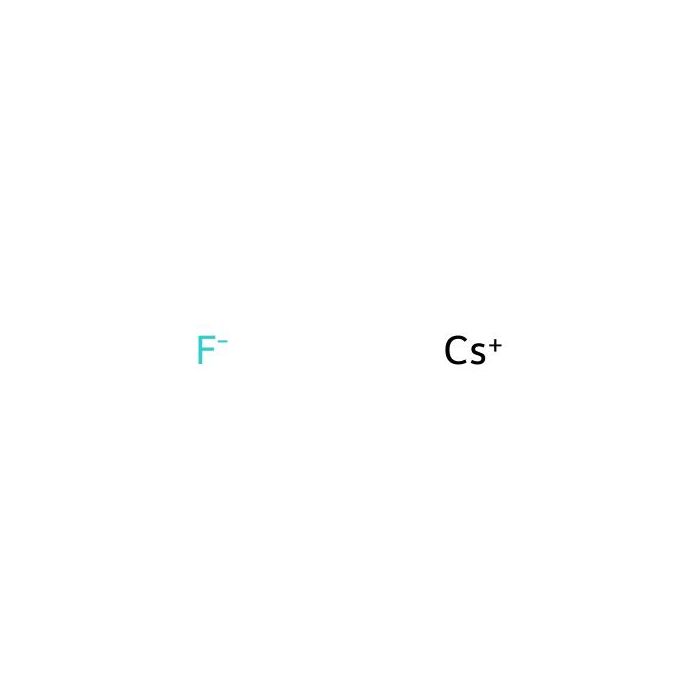
[F-].[Cs+]
IUPAC Name
cesium;fluoride
InChIKey
XJHCXCQVJFPJIK-UHFFFAOYSA-M
INCHI
1S/Cs.FH/h;1H/q+1;/p-1
SMILES isoméricas
[F-].[Cs+]
WGK Alemanha
3
RTECS
FK9650000
Número UN
3288
Grupo de embalagem
III
Peso molecular
151.9
Reaxy-Rn
6184400
Dados avançados
Taxonomic Classification
Taxonomy Tree
- Kingdom Inorganic compounds
- Superclass Mixed metal/non-metal compounds
- Classe Alkali metal salts
- Subclass Alkali metal fluorides
- Classe Alkali metal salts
- Superclass Mixed metal/non-metal compounds
| Kingdom | Inorganic compounds |
|---|---|
| Superclass | Mixed metal/non-metal compounds |
| Classe | Alkali metal salts |
| Subclass | Alkali metal fluorides |
| Intermediate Tree Nodes | Not available |
| Direct Parent | Alkali metal fluorides |
| Alternative Parents | Inorganic salts |
| Molecular Framework | Not available |
| Substituents | Alkali metal fluoride - Inorganic salt |
| Descrição | This compound belongs to the class of inorganic compounds known as alkali metal fluorides. These are inorganic compounds in which the largest halogen atom is fluorine, and the heaviest metal atom is an alkali metal. |
| External Descriptors | Not available |
Estrutura 3D
Modelo de Estrutura Química Interativa
Certificados(CoA,COO,BSE/TSE e Mapa de Análise)
C of A & Other Certificates(BSE/TSE, COO):
Analytical Chart:
Propriedades químicas e físicas
| Solubilidade | H 2 O: 3 M at 20 °C, clear, colorless |
|---|---|
| Ponto de ebulição (°C) | 1251°C |
| Ponto de fusão (°C) | 682 °C |
| Peso molecular | 151.903 g/mol |
| XLogP3 | |
| Hydrogen Bond Donor Count | 0 |
| Hydrogen Bond Acceptor Count | 1 |
| Rotatable Bond Count | 0 |
| Exact Mass | 151.904 Da |
| Monoisotopic Mass | 151.904 Da |
| Topological Polar Surface Area | 0.000 Ų |
| Heavy Atom Count | 2 |
| Formal Charge | 0 |
| Complexity | 2.000 |
| Isotope Atom Count | 0 |
| Defined Atom Stereocenter Count | 0 |
| Undefined Atom Stereocenter Count | 0 |
| Defined Bond Stereocenter Count | 0 |
| Undefined Bond Stereocenter Count | 0 |
| The total count of all stereochemical bonds | 0 |
| Covalently-Bonded Unit Count | 2 |
FAQs e artigos
UltraBio™: Defining Excellence in Molecular Biology Applications
Categories: Reagent Specifications, Grading and Purity
Citations of This Product
Calculadoras de soluções
Revisões
Avaliações dos Clientes
Precisa de ajuda para escolher o grau?
O nosso guia de seleção de graus abrange pureza, estado do estabilizador e adequação à aplicação para todas as variantes do nosso catálogo.
Ver o guia de graus UltraBio™ →Lembrar-me mais tarde
Products are supplied to verified businesses, institutions, and qualified professionals for research and development use only. Not for use in humans, animals, diagnosis, or therapy.
Copyright © 2023–present Aladdin Scientific Corporation. All rights reserved.