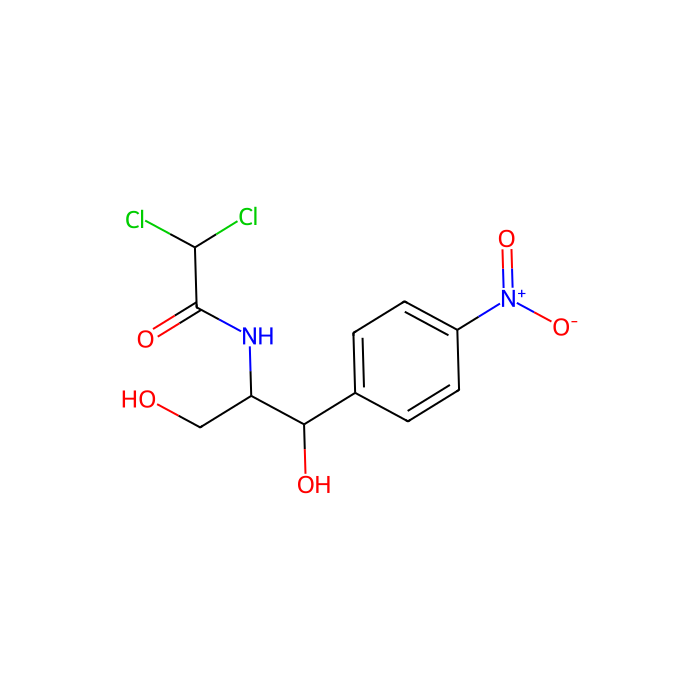
Determine the necessary mass, volume, or concentration for preparing a solution.
| Activity Type | Activity Value -log(M) | Mechanism of Action | Activity Reference | Publications (PubMed IDs) |
|---|

Moligand™, 10mM in DMSO Moligand™ for sensitive chromatographic and analytical workflows requiring minimal baseline interference.
Store at -80°C Ships Dry ice packs + Cold packs Check lot-specific COA for exact specifications.
SDS, COA, datasheet, and spec sheet available for download. Lot-specific COA accessible via lot number lookup.
Cited in 328 peer-reviewed publications across chromatography, organic synthesis, and cross-coupling reactions.
Information
Chloramphenicol Chloramphenicol (Chloromycetin) is a bacteriostatic by inhibiting protein synthesis.
In vitro
Chloramphenicol results in a constitutive increase in the level of cspA transcript and constitutive production of CS7.4. Chloramphenicol down-regulates the mitochondrial DNA-encoded Cox I protein, but not nuclear-encoded proteins. Chloramphenicol increases cellular levels of the p21(waf1/cip1) protein and p21(waf1/cip1) mRNA through a p53-independent pathway. Chloramphenicol, at concentrations greater than 0.1 g/L (0.3 mM), inhibits the denitrifying enzyme activity (DEA) of slurries of humisol and sandy loam soils by disrupting the activity of existing nitrate reductase enzymes. Chloramphenicol, at concentrations from 5 mM to 2 mM initiates apoptosis in dividing cells from a monkey kidney-derived cell line and in haematopoietic progenitor cells from human neonatal cord blood. Chloramphenicol suppresses growth of progenitor cells.
In vivo
Chloramphenicol results in increased t1/2(beta) (by 209%), and decreased ClB (by 45%), and prolonged recovery indices (by 768 to 946%) in greyhounds. Chloramphenicol suppresses increases in the body weight and liver weight of experimental animals and at the same time induced a remarkable increase in lipid peroxidation in the liver during the formation of megamitochondria. Chloramphenicol-induced formation of megamitochondria is not simply ascribed to the suppression of the dividing process of mitochondria due to lowered protein synthesis in mitochondria but is intimately related to oxidative stress.
Cell Data
cell lines:MCF-7 cells
Concentrations:
Incubation Time:
Powder Purity:≥99%
Comprehensive hazard, handling, storage, and regulatory compliance document.
Download SDS →Lot-specific quality data. Enter your lot number to retrieve the exact COA.
Look up COA →Full quality attributes and acceptance criteria for this grade.
View spec sheet →| Activity Type | Activity Value -log(M) | Mechanism of Action | Activity Reference | Publications (PubMed IDs) |
|---|
| Activity Type | Activity Value -log(M) | Mechanism of Action | Activity Reference | Publications (PubMed IDs) |
|---|
| Solubilidade | Solubility (25°C) In vitro DMSO: 5 mg/mL warmed with 50ºC Water: bath (6.68 mM); Water: Insoluble; Ethanol: Insoluble; |
|---|---|
| Rotação específica [α] | 20 ° (C=5, EtOH) |
| Ponto de inflamação (°F) | 57.2°F closed cup |
| Ponto de inflamação (°C) | 14.0°C closed cup |
| Ponto de fusão (°C) | 149-153°C |
Our grade selection guide covers purity, stabilizer status, and application suitability for all variants in our catalog.
View Moligand™ grade guide →