This compound belongs to the class of organic compounds known as p-phthalate esters. These are ester derivatives of p-phthalic acids, which are based on a benzene 1,4-dicarboxylic acid skeleton.
External Descriptors
Not available
1. Djoumbou Feunang Y, Eisner R, Knox C, Chepelev L, Hastings J, Owen G, Fahy E, Steinbeck C, Subramanian S, Bolton E, Greiner R, and Wishart DS. ClassyFire: Automated Chemical Classification With A Comprehensive, Computable Taxonomy. Journal of Cheminformatics, 2016, 8:61.
Determine the necessary mass, volume, or concentration for preparing a solution.
Dilution Calculator
Determine the dilution needed to prepare a stock solution.
Reconstitution Calculator
Revisões
Avaliações dos Clientes
Application Protocols
No application protocols are specified for this item. As a general small-molecule building block, protocol details depend on the intended synthetic transformation (e.g., O-alkylation, hydrolysis, transesterification). See the Reaction Conditions and Synthetic Utility sections for literature-level procedural guidance and adapt to your laboratory’s standards.
Biological Roles
This product is a synthetic aromatic diester and is not a known endogenous metabolite. No established biological role is associated with diethyl 2,5-dihydroxyterephthalate. The following points reflect general, literature-level context only and are not item-specific:
Phenolic functionality: Aromatic phenols can participate in hydrogen bonding and radical-scavenging chemistry in vitro; however, specific antioxidant capacity depends strongly on substitution and medium.
Biodegradation considerations: Aromatic diesters may undergo hydrolysis to the corresponding diacids and alcohols under environmental/enzymatic conditions, but rates vary widely with structure and matrix.
Bioconjugation precursor: After hydrolysis to the diacid, carboxylates can be used in standard coupling chemistry to attach to biomolecule scaffolds (e.g., amide formation) for research probes; this is a synthetic use, not a biological function.
No claims are made for physiological activity or clinical relevance. For all biological experiments, this material is intended strictly for research use in controlled laboratory settings.
Buffer Applications
This compound is not a buffering reagent and is not typically used to prepare biological or analytical buffer systems. If dissolution is required for assays:
Prepare stock solutions in DMSO or DMF and dilute into assay media as compatible (literature/general practice).
Adjust pH using dedicated buffer systems (e.g., phosphate, HEPES, acetate) rather than relying on this compound’s weak phenolic acidity.
Refer to Buffer/biochemical reagents sections for suitable buffering agents.
Green Alternatives
As a solid organic building block, the principal “green” considerations relate to solvent and reagent choices in its transformations rather than to the compound itself. Literature/general guidance:
Greener solvent swaps for common steps:
O-alkylation of phenols: Prefer dimethyl carbonate (DMC) as alkylating agent/solvent (safer than MeI/benzyl halides) with base; propylene carbonate or 2-MeTHF can substitute for DMF/DMSO in some cases.
Hydrolysis/transesterification: Use catalytic organic bases (e.g., DBU) in ethanol or water/ethanol mixtures instead of strong mineral bases in aprotic media.
Crystallization and processing: Ethyl acetate and isopropanol offer greener profiles vs chlorinated solvents; 2-MeTHF can replace THF for workups.
Greenness comparison (literature/general):
DMF vs Cyrene/PC:
Pros (Cyrene/propylene carbonate): biodegradable/safer; good polarity.
Cons: Higher viscosity; sometimes lower solubility; may require heating.
DCM vs EtOAc:
Pros (EtOAc): lower toxicity, biodegradable, favorable E-factor in workups.
Cons: Higher boiling point; may reduce extraction efficiency for very nonpolar impurities.
Process-intensification tips:
Employ solvent recycling and antisolvent crystallizations (EtOAc/hexane or IPA/water) to minimize waste.
Consider enzyme-catalyzed transesterification in green media (e.g., Novozym 435 in 2-MeTHF or solvent-free) for selective ester exchange.
Note: Select alternatives must be validated for yield/selectivity and compatibility with downstream steps.
Pharmaceutical Uses
There are no pharmacopeial monographs or standard excipient roles known for diethyl 2,5-dihydroxyterephthalate. Any use would be as a synthetic intermediate in R&D. General, non-clinical context:
Intermediate: Potential precursor to polyarylates, polycarbonates, or pro-moieties after hydrolysis/functionalization in medicinal chemistry campaigns.
Material component (R&D): The corresponding diacid is used as a linker in coordination polymers/MOFs; the diethyl ester can serve as a process-friendly, storable intermediate prior to hydrolysis.
No therapeutic or clinical claims are made. For manufacturing or GMP contexts, suitability, residuals, and impurity profiles must be established independently.
Physical Properties
Item-specific physical property specifications are not provided for this SKU. The following values are general/literature guidance for the compound and should not be construed as specifications.
Appearance: Not specified for this item; refer to CoA/Spec Sheet.
Melting point: Not specified for this item; refer to CoA/Spec Sheet. (Aromatic terephthalate diesters with ring hydroxyls are typically crystalline solids; literature mp values can vary depending on solvate/tautomerism.)
Boiling point: Not applicable (decomposes before boiling at ambient pressure; literature trend for aromatic diesters).
Density: Not specified for this item; refer to CoA/Spec Sheet.
Refractive index: Not applicable to solids; Not specified for this item; refer to CoA/Spec Sheet.
LogP/logD: Expected moderate hydrophobicity with H-bonding capacity (literature expectation for aromatic diesters with phenols), but item-specific value is Not specified for this item; refer to CoA/Spec Sheet.
Solubility (qualitative, literature/general):
Organic solvents: Typically soluble in polar aprotics (DMSO, DMF, DMAc), moderately soluble in ethyl acetate, acetone, acetonitrile; limited in nonpolar hydrocarbons.
Alcohols: Often soluble in methanol/ethanol upon warming due to phenolic H-bonding.
Water: Poorly soluble due to diester functionality and aromatic core.
Always consult the item’s CoA/SDS for definitive properties relevant to your lot and application.
Quality and Grades
Grade/purity: Not specified for this item; refer to CoA/Spec Sheet.
What grade means (general guidance):
For building-block solids like aromatic diesters, common designations include “purified,” “98%,” or “research grade.” Higher assay grades reduce unknown impurities that could affect polymerization, metal coordination, or selective functionalization (e.g., O-alkylation vs C-acylation of phenols).
Chromatographic-grade statements (e.g., HPLC grade) generally apply to solvents, not to solid reagents; for solids, look for assay and impurity profiling on the CoA.
Stabilizers: None indicated for this item; if present in other lots, stabilizers would be listed on the CoA.
What to check on receipt:
Assay, residual solvents, identity (NMR/IR), water content (Karl Fischer) if moisture sensitivity is critical for your reaction.
Metal content is usually not specified for organic building blocks; if using in catalysis-sensitive syntheses (e.g., MOF nucleation), request trace analysis if needed.
Conclusion: Use the CoA/Spec Sheet for lot-specific acceptance criteria. This listing provides no additional item-specific quality designations beyond research use.
Reaction and Applications
Literature/general applications for dihydroxy-substituted terephthalate diesters:
Functional monomer/precursor:
Polyarylate formation: Phenolic OH groups can be condensed with diacid chlorides (e.g., tere-/isophthaloyl chloride) to form high-Tg polyarylates; the para-diester framework tunes rigidity and solubility.
Carbonate formation: Reaction with phosgene equivalents (e.g., triphosgene) or dialkyl carbonates affords aryl carbonates, enabling poly(carbonate) or oligocarbonate synthesis.
Protecting-group strategies:
Orthogonal protection via etherification (benzyl, allyl, silyl) of phenols, leaving the ethyl esters intact; subsequent selective deprotection allows stepwise elaboration.
Hydrolysis of the ethyl esters (basic or acidic) to the diacid provides 2,5-dihydroxyterephthalic acid, a valuable linker for MOFs and H-bonded frameworks.
Deprotonation with K2CO3 or Cs2CO3 in DMF/acetone, then alkyl halides (e.g., MeI, benzyl bromide) to install aryl ethers; para-diester groups modulate phenolic acidity and directing effects.
Electrophilic aromatic functionalization:
The resorcinol pattern (2,5-dihydroxylation) directs EAS (e.g., halogenation, nitration) to positions activated by phenols; ester groups are deactivating and meta-directing, enabling regioselective access to elaborated scaffolds.
Transesterification/cross-esterification:
Exchange of ethyl for bulkier or functional alcohols (e.g., PEG, neopentyl) using acid/base catalysts provides tailored diesters for materials applications.
Materials/coordination chemistry:
After hydrolysis, the diacid serves as a linker to generate metal–organic frameworks; the ester form is often used as a soluble, storable precursor and for post-synthetic modification.
Practical tips:
For clean O-alkylations, rigorously dry solvents and use carbonate bases; control temperature (20–50 C) to minimize C-alkylation.
For hydrolysis, begin with mild basic methanol/water to assess mono- vs di-saponification selectivity.
Reaction Conditions
Typical, literature-level conditions for transformations of diethyl 2,5-dihydroxyterephthalate (guidance only; optimize per substrate and scale):
O-alkylation (Williamson ether synthesis):
Base: K2CO3 or Cs2CO3 (2.0–3.0 equiv)
Solvent: DMF or acetone; 20–60 C, 2–16 h
Electrophile: Alkyl halide or tosylate (1.2–2.0 equiv)
Tips: Dry solvent; add halide slowly to minimize dialkylation vs monoalkylation if desired.
Ester hydrolysis (saponification):
Base: NaOH or KOH (2.2–4.0 equiv)
Solvent: MeOH/H2O (4:1 to 1:1) or THF/H2O; 0–25 C for mono-saponification, reflux for di-saponification
Workup: Acidify to pH ~2 to precipitate diacid; isolate by filtration.
Acidic hydrolysis:
Reflux in aqueous mineral acid (e.g., 6 M HCl) or organic acids (e.g., TFA in aqueous media) as appropriate; monitor for phenolic side reactions.
Transesterification:
Catalysts: p-TsOH (1–5 mol%) or sodium alkoxide (0.1–1.0 equiv)
Alcohol partner: 5–20 equiv
Temperature: 60–120 C (depending on alcohol bp)
Continuous removal of EtOH (Dean–Stark or reduced pressure) improves conversion.
GHS/CLP classification: Not specified for this item; refer to SDS.
Signal word / H-statements / pictograms: Not specified for this item; refer to SDS.
General hazards (literature/general for aromatic diesters with phenolic groups): Low volatility; dust may cause mechanical irritation to eyes/respiratory tract. Phenolic OH can contribute to mild skin/eye irritation. Combustible organic solid.
PPE recommendations (good laboratory practice):
Safety glasses or chemical splash goggles
Lab coat; appropriate gloves (e.g., nitrile)
Handle powders in a fume hood to minimize dust inhalation
Storage conditions: Room temperature (per Product Data). Keep container tightly closed in a dry, well-ventilated place; protect from strong bases and strong oxidizers.
Fire safety: Use CO2, dry chemical, or foam for small fires. Dust control to reduce explosion risk typical of organic powders.
First aid (summary; defer to SDS):
Eye/skin contact: Rinse with water for several minutes; remove contaminated clothing; seek medical attention if irritation persists.
Inhalation: Move to fresh air; seek medical advice if symptoms occur.
Ingestion: Rinse mouth; do not induce vomiting; seek medical attention.
Always consult the SDS for authoritative hazard and response information before use.
Solvent Selection
This compound is a moderately polar, hydrogen-bond-donating aromatic diester. It behaves as follows (literature/general behavior):
Polarity class: Moderately polar aromatic; multiple carbonyls and phenolic OH groups enable dipolar and H-bond interactions.
Miscibility/solubility (qualitative):
Good: DMSO, DMF, DMAc, NMP
Moderate: Ethyl acetate, acetone, acetonitrile, methanol/ethanol (often improved by warming)
Limited: Toluene, chlorinated solvents (CH2Cl2/CHCl3) may dissolve upon warming/sonication
Poor: Aliphatic hydrocarbons (hexanes/heptane)
Selection tips by use case:
Nucleophilic O-alkylation (Williamson): polar aprotic solvents (DMF, DMSO) with K2CO3/Cs2CO3 enhance deprotonation of the phenolic OH.
Selective hydrolysis/transesterification: alcoholic solvents (MeOH/EtOH) with base or acid catalysts enable controlled ester cleavage or exchange.
Metal–organic framework (MOF) assembly screening: high-boiling polar aprotics (DMF/DMAc) commonly used; include modulator acids if required.
Small comparison (literature):
DMF vs DMSO: DMF often affords cleaner workups for O-alkylation; DMSO offers higher solubility but can complicate isolation.
EtOAc vs MeCN: EtOAc gives better solubility for aromatic diesters and is greener; MeCN offers lower viscosity and faster crystallizations.
For sensitive transformations, determine solubility experimentally at working concentrations and temperatures.
Storage and Reconstitution
Storage conditions: Room temperature (per Product Data). Store in a tightly closed container, protected from moisture and strong bases/oxidants. For long-term storage, a desiccator is recommended.
Shipping: Ambient/normal (per Product Data).
Reconstitution/dissolution (general guidance):
Prepare stock solutions in DMSO or DMF (e.g., 10–100 mg/mL) for reaction setup or assay seeding. Warm gently (30–40 C) and sonicate if needed.
For workups or crystallizations, ethyl acetate, acetone, or alcohols (MeOH/EtOH/IPA) are common choices.
Freeze–thaw: Not applicable to solids; if solutions are prepared, store aliquots to minimize repeated warming cycles. DMSO/DMF solutions can be kept at 2–8 C or −20 C depending on stability requirements; validate prior to extended storage.
Stability notes: Phenolic/ester functionalities are generally stable under neutral, dry conditions. Avoid prolonged exposure to strong base (risk of transesterification/saponification) and strong oxidants.
Always refer to the item’s CoA/SDS for lot-specific handling and stability information.
Structure and Identity
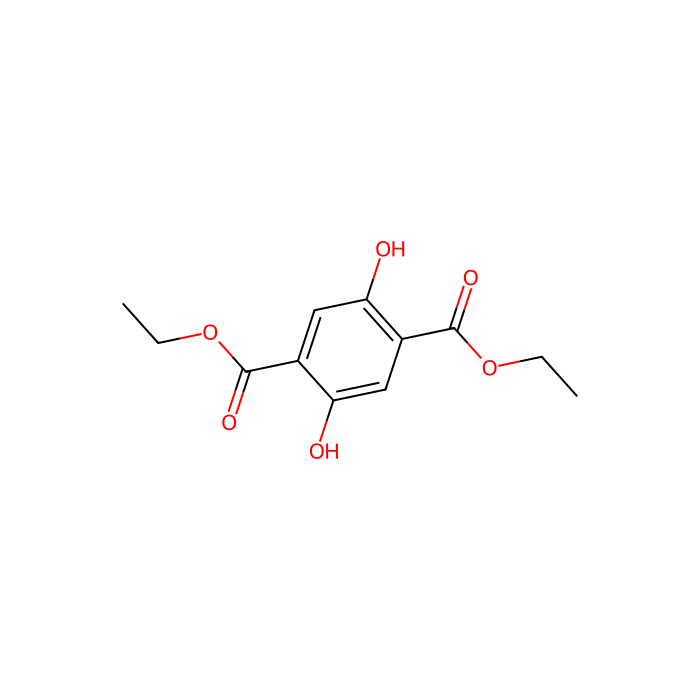
Diethyl 2,5-dihydroxyterephthalate is an aromatic diester bearing two phenolic hydroxyl groups on the benzene ring para to one another across two diethyl terephthalate substituents.
Two para-related diethyl ester groups (–C(=O)OEt) at the 1- and 4-positions (terephthalate framework)
Two phenolic hydroxyls at the 2- and 5-positions (resorcinol pattern within a terephthalate scaffold)
No stereogenic centers; planar conjugated system with electron-withdrawing ester carbonyls and electron-donating phenols
Notes on identity sources:
All identifiers not explicitly provided under Product Data are listed as literature/representative values and are not item-specific specifications.
Synthetic Utility
Key reactive elements and their synthetic leverage (literature/general):
Phenolic OH groups (2,5-positions):
O-alkylation/acylation to generate ethers/esters; enables protecting-group strategies and tuning of electronic properties.
Oxidation to quinone-like systems (with caution) for redox-active materials.
Diethyl terephthalate moieties:
Hydrolysis to diacids (mono- or di-saponification) for subsequent amide coupling or salt formation.
Transesterification with specialized alcohols (e.g., benzyl, neopentyl, PEGylated alcohols) to adjust solubility and reactivity.
Aromatic core:
Electrophilic substitution guided by the phenolic activation (with meta-directing influence of ester groups) to access regioselective halogenation/nitration patterns.
Metalation strategies (e.g., directed ortho-metalation adjacent to phenols after protection) to introduce new substituents.
Strategic value in retrosynthesis:
Serves as a bifunctional platform combining a diol (phenolic) and a diester within the same rigid aromatic scaffold, enabling orthogonal diversification.
The ester form provides improved handling and organic solubility vs the corresponding diacid, facilitating multi-step sequences before final hydrolysis.
Not applicable. This product is a small-molecule building block and does not possess biological target specificity such as an antibody, enzyme inhibitor profile, or receptor binding selectivity as part of this catalog entry.
We use cookies to ensure the website functions properly and, where permitted, to improve your experience. You can manage your preferences at any time in Settings. Learn more in our Cookie Policy.
Shall we send you a message when we have discounts available?
Remind me later
Thank you! Please check your email inbox to confirm.
Products are supplied to verified businesses, institutions, and qualified professionals for research and development use only. Not for use in humans, animals, diagnosis, or therapy.

 I2611034