This compound belongs to the class of organic compounds known as dialkyl alkylphosphonates. These are compounds containing a phosphonic acid that is diesterified with alkyl groups, and the phosphorus atom is also directly attached to an alkyl group.
External Descriptors
Not available
1. Djoumbou Feunang Y, Eisner R, Knox C, Chepelev L, Hastings J, Owen G, Fahy E, Steinbeck C, Subramanian S, Bolton E, Greiner R, and Wishart DS. ClassyFire: Automated Chemical Classification With A Comprehensive, Computable Taxonomy. Journal of Cheminformatics, 2016, 8:61.
Determine the necessary mass, volume, or concentration for preparing a solution.
Dilution Calculator
Determine the dilution needed to prepare a stock solution.
Reconstitution Calculator
Revisões
Avaliações dos Clientes
Application Protocols
No antibody/assay protocols apply to this small-molecule reagent. For synthetic applications, see the Reaction Conditions tab for representative procedure outlines (base-mediated α-functionalization, hydroboration–oxidation, epoxidation, metathesis, and dealkylation). Always adapt to your substrate and verify by 31P/1H/13C NMR, GC/LC-MS.
Biological Roles
Item-specific biological data: Not specified for this item; refer to CoA/Spec Sheet.
General/literature context:
Phosphonates (C–P containing P(V) compounds) are recognized as phosphate bioisosteres that resist hydrolysis by phosphatases due to the robust C–P bond. As such, alkylphosphonates are frequently used as stable mimics in biochemical probe development and materials that interact with metal oxides or biominerals.
The allyl substituent is a synthetic handle rather than a biological motif; its primary value is enabling subsequent diversification to access functionalized phosphonates/phosphonic acids for binding studies (e.g., surface anchoring to TiO2/ZrO2, mineralization studies) or as reference standards in analytical workflows.
Hydrolysis/deprotection (e.g., to the phosphonic acid) can dramatically increase hydrophilicity and metal-binding capacity, relevant for designing ligands, chelators, or immobilization tags in bioconjugation workflows.
Note: No medical or clinical use is claimed or implied. Any biological testing must be designed and validated by the end user; consult SDS and institutional biosafety guidelines.
Buffer Applications
This product is not a buffering reagent and is not typically used to prepare pH buffer systems. If your work involves aqueous systems, consider standard buffers (e.g., phosphate, HEPES, Tris) and introduce phosphonate-containing compounds only as substrates or ligands as needed.
For research involving the corresponding phosphonic acid (obtained by dealkylation), buffering capacity remains limited compared with dedicated buffers; instead, such acids are used for coordination/surface binding rather than pH control.
Green Alternatives
Because the reagent itself (diethyl allylphosphonate) is the desired functionality carrier, “alternatives” usually concern solvent and process choices rather than replacement of the substrate.
Greener process choices (literature/general):
Solvent swaps
Replace THF with 2-MeTHF or CPME for base-mediated steps (comparable solvating power, lower peroxide tendency, higher boiling point, often bio-based for 2-MeTHF).
Prefer EtOAc or MeCN over chlorinated solvents for oxidations and extractions when compatible with the chemistry.
Oxidants/reductants
Use catalytic oxidations (e.g., H2O2/UHP with catalysts) instead of stoichiometric peracids for epoxidations where feasible.
Employ boranes generated in situ from safer precursors (9-BBN, catecholborane) and practice boron recovery.
Energy efficiency
Conduct reactions at ambient temperature with more active catalysts (e.g., metathesis with second-generation Ru catalysts at lower loadings) to reduce energy input.
Trade-offs (general):
2-MeTHF and CPME hold water more than THF; ensure adequate drying for strong-base chemistry.
Avoiding DCM can lengthen reaction times or alter selectivity in some oxidations; pilot trials are advised.
Comparison table (general guidance):
THF: petroleum-derived, peroxide-prone, excellent base chemistry solvent.
2-MeTHF: bio-based option, less peroxide-prone, good for organometallics, higher bp aids heat transfer.
DCM: high volatility/ease of removal but chlorinated; EtOAc/MeCN often greener substitutes when compatible.
Pharmaceutical Uses
Item-specific pharmacopeial status/grade: Not specified for this item; refer to CoA/Spec Sheet.
General/formulation context (non-clinical):
Phosphonate esters and their acids are widely explored as functional excipients or intermediates in discovery and process chemistry due to their hydrolytic stability and metal-binding properties.
Diethyl allylphosphonate itself is primarily a synthetic intermediate. It can be transformed into phosphonic acids or β/γ-functionalized phosphonate esters that serve as: ligating motifs for API crystallization studies, surface modifiers for device materials, or intermediates toward bioisosteric structures in lead optimization.
Deprotection of the ethyl esters (e.g., TMSBr) provides the corresponding acid, which exhibits high polarity and may act as a counterion or surface-active component in formulation research, though dedicated toxicological evaluation is required for any such use.
No therapeutic or clinical claims are made. Use is restricted to research and development under appropriate regulatory oversight.
Physical Properties
Item-specific specifications: Not specified for this item; refer to CoA/Spec Sheet.
Representative literature/computed values (for reference only; not item-specific specs):
Molecular weight: 178.17 g/mol (from formula C7H15O3P)
Physical state: typically a colorless to pale liquid (literature)
Boiling point: approximately 95–105 °C at ~0.7–5 mmHg (literature reports vary); at 1 atm typically distilled under reduced pressure to avoid thermal decomposition.
Density: ~1.05–1.10 g/mL at 20–25 °C (literature range for dialkyl alkylphosphonates)
Refractive index (nD 20): ~1.414–1.420 (literature)
Solubility: miscible with common organic solvents (Et2O, THF, DCM, toluene, MeCN). Limited solubility in water; hydrolysis is slow under neutral conditions but accelerated by strong acid/base (general behavior of phosphonate esters).
Estimated pKa (C–H α to P=O): ~22–24 in DMSO (literature, typical for dialkyl alkylphosphonates). This underpins deprotonation with strong bases (e.g., NaH, LDA) in synthesis.
Notes:
Values above are literature/general references to guide method development; consult the product’s CoA/SDS for actual lot-specific data and handling limits.
Quality and Grades
Grade/Purity: Not specified for this item; refer to CoA/Spec Sheet.
Appearance: Not specified for this item; refer to CoA/Spec Sheet.
Context and guidance (general):
Typical research grades for organophosphorus reagents include Technical, Laboratory/AR, and ≥95–99% purity assay. Higher purities reduce background in catalysis and improve reproducibility in anion-generation steps (e.g., NaH/LDA deprotonations).
If designated “anhydrous” or accompanied by a stabilizer, this would be noted on the label/CoA. Phosphonate esters are less moisture-sensitive than acid chlorides, but trace water can influence strong-base chemistry and E1cb-type condensations.
For spectroscopy/chromatography applications (e.g., monitoring by 31P NMR, GC), lots with low nonvolatile residue and narrow distillation cuts are preferred; HPLC-grade solvents for dilution minimize UV background.
Verification: Review the lot-specific CoA for assay method (e.g., 31P NMR integration, GC area %), residual solvents, and water content (Karl Fischer) if reported. When critical, pre-dry over molecular sieves and confirm purity by 1H/13C/31P NMR prior to use.
Reaction and Applications
Use-profile (general/literature): Diethyl allylphosphonate is a versatile building block combining an allyl olefin with a phosphonate ester. It is leveraged to introduce the phosphonate motif into 3-carbon frameworks and as a platform for further α-to-P or alkene functionalization.
Key transformations:
Allyl-olefin chemistry
Hydroboration–oxidation of the C=C to give 3-hydroxypropyl phosphonate esters (useful handles for further derivatization or as masked phosphonic acids after deprotection).
Epoxidation (mCPBA, peracids) to allylic epoxides, enabling subsequent ring-opening to 1,3-difunctionalized phosphonates.
Olefin metathesis (ROMP, CM) to access diversified alkenyl phosphonates.
Phosphonate-centered chemistry
α-Deprotonation (pKa ~22–24, literature) with NaH or LDA generates carbanions that can participate in C–C bond formation (e.g., additions to carbonyls, E1cb-type condensations) delivering substituted alkenyl/allylic phosphonates after elimination.
Halogenation/trapping at the α-position to P (NBS, electrophiles) followed by substitution to elaborate the scaffold.
As a precursor to phosphonic acids
Cleavage of ethyl esters (e.g., TMSBr) affords the corresponding allylphosphonic acid—useful in materials, chelation, and as a phosphate bioisostere in discovery chemistry.
Radical and photochemical additions across the double bond can install functionality while retaining the P(V) center for downstream HWE or cross-coupling strategies.
Applications include synthesis of β/γ-functionalized phosphonates for Horner–Wadsworth–Emmons reagents, ligands, and surface-binding motifs. Always validate new transformations on small scale and monitor by 31P NMR to track P-species.
Reaction Conditions
General, literature-based guidance (optimize for your system; not item-specific specs):
α-Deprotonation/electrophile trapping
Base: NaH (60% in mineral oil) or LDA (1.0–1.5 equiv)
Solvent: anhydrous THF, 2-MeTHF, or DME
Temperature: 0 to −78 °C for deprotonation; then 0–25 °C for electrophile addition
Notes: strictly anhydrous conditions; slow addition of electrophile improves selectivity. Monitor by 31P and 1H NMR.
Hydroboration–oxidation of the allyl C=C
Reagents: 9-BBN (1.1 equiv) or BH3·THF, then H2O2/NaOH
Solvent: THF or 2-MeTHF
Temperature: 0–25 °C (hydroboration), then 0–25 °C (oxidation)
Typical outcome: anti-Markovnikov alcohol (primary) with high regioselectivity.
Epoxidation
Reagents: mCPBA (1.1–1.5 equiv) with NaHCO3 buffer
Solvent: DCM or MeCN
Temperature: 0 °C to rt; 1–6 h
Workup: aqueous Na2SO3 to quench peracids; avoid strong base during workup to limit ester cleavage.
Tips: remove ethylene under slight vacuum or N2 sweep to drive equilibrium.
Dealkylation to phosphonic acid
Reagent: TMSBr (3–6 equiv)
Solvent: DCM or MeCN (dry)
Temperature: 0–25 °C, then methanolysis to liberate the acid
Caution: moisture-sensitive; exclude water until quench.
Expected yields vary with substrate and conditions; consult primary literature and run small-scale trials before scale-up.
Safety and Handling
Item-specific hazard coding (GHS, H-statements, pictograms): Not specified for this item; refer to SDS.
General safety considerations for diethyl allylphosphonate (literature/typical for alkylphosphonates):
Likely classification: Combustible liquid; may cause skin/eye irritation. Avoid inhalation of vapors/aerosols. Handle in a fume hood.
PPE: lab coat, chemical-resistant gloves (e.g., nitrile), safety goggles. Use splash protection when charging or transferring larger quantities.
Incompatibilities: Strong oxidizers. Hydrolyzes under strong acids or bases to phosphonic acid derivatives and ethanol; avoid prolonged exposure to moisture, especially at elevated temperature or extreme pH.
Stability: Generally stable under ambient conditions. The allyl double bond can undergo radical reactions; avoid peroxides/initiators unless intended.
First aid (overview; defer to SDS):
Inhalation: move to fresh air; seek medical attention if symptoms persist.
Skin/eye contact: rinse with water for several minutes; remove contaminated clothing; obtain medical advice if irritation continues.
Ingestion: rinse mouth; do not induce vomiting; seek medical attention.
Spill/cleanup: Absorb with inert material (vermiculite, sand), collect for disposal. Prevent entry into drains.
Firefighting: Use CO2, dry chemical, or foam. Combustion may produce phosphorus oxides; firefighters should wear SCBA.
Always consult the product SDS for authoritative, item-specific hazard and response information.
Solvent Selection
Diethyl allylphosphonate is a moderately polar, high-boiling organic liquid. Solvent choice depends on whether you exploit the allyl C=C or the phosphonate α-CH acidity.
Polarity/miscibility (general):
Miscible with ethers (THF, MTBE), chlorinated solvents (DCM, CHCl3), aromatics (toluene), esters (EtOAc), and polar aprotics (DMF, DMSO, MeCN). Limited water solubility.
Choosing solvents by transformation:
Strong-base deprotonation (NaH, LDA): anhydrous THF, 2-MeTHF, or DME at 0 to −78 °C for controlled enolate-like chemistry.
Electrophilic additions to the C=C (e.g., hydroboration, epoxidation): THF or toluene for hydroboration; DCM or MeCN for peracid epoxidations.
Radical processes or AIBN-initiated additions: toluene, xylene, or chlorobenzene provide higher-temperature windows.
Metal-catalyzed additions/couplings: toluene, dioxane, or MeCN depending on the catalyst system.
Practical tips:
Minimize water when performing base-promoted reactions; pre-dry with 3 Å molecular sieves and use rigorously anhydrous solvents.
For distillation or solvent swap, reduced pressure helps keep bath temperatures low to protect the phosphonate ester.
Small comparison (general):
THF vs 2-MeTHF: similar polarity; 2-MeTHF is greener and less peroxide-prone; both solvate NaH/LDA well.
DCM vs EtOAc: DCM offers faster epoxidations/peracid solubility; EtOAc is greener but less compatible with very strong bases.
Storage and Reconstitution
Storage (per Product Data): Store at room temperature. Protect from moisture and strong acids/bases to prevent hydrolysis of the phosphonate ester. Keep container tightly closed in a dry, well-ventilated place.
Shipping (per Product Data): Shipped at ambient conditions (Normal).
Handling tips (general):
For moisture-sensitive reactions, pre-dry by brief storage over 3 Å molecular sieves or by co-evaporation with dry toluene under reduced pressure. Verify no degradation by 31P NMR before use.
If distillation is needed, use reduced pressure to limit thermal exposure; collect middle cuts.
Reconstitution: Not applicable; supplied neat. If preparing standard solutions, use anhydrous solvents (THF, toluene, MeCN), store under inert gas, and segregate from strong acids/bases.
Shelf life: Not specified for this item; refer to CoA/Spec Sheet. Periodically inspect for changes in color, odor, or 31P NMR profile as indicators of degradation.
Research Use Only: For research use only (per Product Data).
Preferred IUPAC name (literature): Diethyl (prop-2-en-1-yl)phosphonate
Molecular formula (literature): C7H15O3P
Molecular weight (literature): 178.17 g/mol
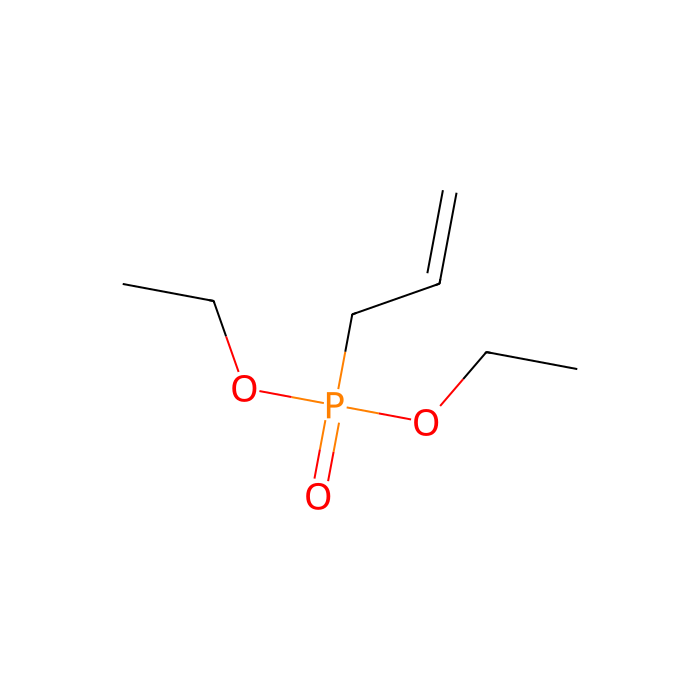
SMILES (literature): C=CCP(=O)(OCC)OCC
InChIKey: Not specified for this item; refer to CoA/Spec Sheet.
Structural features (general description):
Contains a tetracoordinated phosphorus(V) center as a phosphonate ester: P(=O)(OEt)2.
One P–C bond to an allyl group (prop-2-en-1-yl, –CH2–CH=CH2), providing an electron-rich terminal alkene amenable to diverse functionalization (hydroboration, epoxidation, metathesis, radical additions).
The phosphonate group is a strong π-acceptor/σ-withdrawing substituent; the methylene directly bonded to P bears relatively acidic C–H bonds (α to P=O).
2D depiction in words: an allyl chain (CH2–CH=CH2) attached via its CH2 to a phosphoryl center bearing a P=O and two ethoxy groups (O–CH2–CH3).
Synthetic Utility
Strategic reactivity (literature/general):
Dual handle design: an electron-rich allyl C=C for classical alkene chemistry and a phosphonate moiety enabling α-deprotonation and downstream Horner–Wadsworth–Emmons-type transformations after suitable elaboration.
Alpha chemistry to P=O:
Strong bases (NaH, LDA, LiHMDS) form the α-carbanion at the P–CH2 position. Trapping with electrophiles (alkyl halides, carbonyls) generates substituted allyl/alkenyl phosphonates. Subsequent elimination can deliver conjugated alkenes bearing the phosphonate.
Epoxidation → epoxides; regioselective ring openings yield 1,3-difunctional arrays.
Dihydroxylation or halofunctionalization generate versatile vicinal difunctional intermediates.
Metathesis (CM with styrenes/olefins) diversifies the alkenyl chain while retaining P(V).
Deprotection/derivatization:
TMSBr-mediated dealkylation affords the phosphonic acid; subsequent salt formation (Na+, K+, NH4+) tunes solubility for separations or surface binding.
Downstream applications:
Access to β-ketophosphonates or alkenyl phosphonates that serve as HWE reagents for stereoselective alkene synthesis.
Installation of phosphonate anchors onto polymers/nanoparticles via post-functionalization of the allyl group.
Analytical note: 31P NMR (ca. +20 to +35 ppm typical for dialkyl alkylphosphonates; literature) is highly diagnostic; coupling to the α-CH2 (2JPH) confirms integrity and substitution patterns.
Target Specificity
Not applicable. This product is a small-molecule organophosphorus reagent, not a biological targeting agent (e.g., antibody, enzyme, ligand with defined biological target). No antigen/epitope, clone, isotype, or species reactivity is relevant.
Usamos cookies para garantir o funcionamento adequado do site e, quando permitido, para melhorar a sua experiência. Você pode gerenciar suas preferências a qualquer momento nas Configurações. Saiba mais em nossa Política de Cookies.
Deseja que lhe enviemos uma mensagem quando tivermos descontos disponíveis?
Lembrar-me mais tarde
Obrigado! Por favor, verifique a sua caixa de entrada de e-mail para confirmar.
Products are supplied to verified businesses, institutions, and qualified professionals for research and development use only. Not for use in humans, animals, diagnosis, or therapy.

 G2320286