GRADE & PURITYMoligand™?Moligand™ — Aladdin's line of ligands and bioactive small molecules. Use for receptor, pathway, and binding studies needing defined small-molecule tools.≥96%
This compound belongs to the class of organic compounds known as alpha amino acids. These are amino acids in which the amino group is attached to the carbon atom immediately adjacent to the carboxylate group (alpha carbon).
External Descriptors
Dicarboxylic acids
1. Djoumbou Feunang Y, Eisner R, Knox C, Chepelev L, Hastings J, Owen G, Fahy E, Steinbeck C, Subramanian S, Bolton E, Greiner R, and Wishart DS. ClassyFire: Automated Chemical Classification With A Comprehensive, Computable Taxonomy. Journal of Cheminformatics, 2016, 8:61.
Determine the necessary mass, volume, or concentration for preparing a solution.
Dilution Calculator
Determine the dilution needed to prepare a stock solution.
Reconstitution Calculator
Revisões
Avaliações dos Clientes
Application Protocols
No item-specific tested applications or protocols are provided in the Product Data. The following general procedures are offered as literature-informed starting points; adjust to your system.
Preparation of aqueous stock (research use):
Weigh the desired amount of DL-α-aminoadipic acid into a clean vessel.
Add ~80% of the final volume of water. While stirring, adjust pH to 7.5–8.5 with 1 M NaOH to aid dissolution (target 100–500 mM depending on solubility).
Bring to volume with water. Optional: sterile-filter (0.22 µm) for cell-free assays. Store at 2–8 °C for short term; prepare fresh as needed.
Coupling to a primary amine (solution-phase model):
Protect the α-amine (e.g., Boc) and one carboxyl as needed for selectivity.
Dissolve the protected acid (1.0 equiv) and amine partner (1.1 equiv) in dry DMF (0.05–0.2 M).
Add HATU (1.1 equiv) and DIPEA (2.5 equiv) at 0 °C; stir 2–4 h at RT.
Quench with water, extract or precipitate, and purify by chromatography. Remove protecting groups under standard conditions (e.g., TFA for Boc, H2/Pd for benzyl esters).
Ion-exchange purification (free acid):
Load onto a weak anion exchanger in water, wash with low-ionic-strength buffer, elute with NaCl gradient or pH shift.
Note: These are general starting points for research use only. Validate concentrations, pH, and compatibility for your specific assay or synthetic target.
Biological Roles
The content below summarizes literature knowledge for DL-α-aminoadipic acid in biochemical contexts; it is provided for research planning only and is not a medical or clinical claim.
Metabolic context (literature):
2-Aminoadipic acid is an intermediate/metabolite in the lysine degradation (saccharopine) pathway in microbes and eukaryotes, interconverting with 2-oxoadipate and aminoadipate semialdehyde via aminotransferases and dehydrogenases.
It participates in nitrogen shuttling reactions with pyridoxal 5′-phosphate (PLP)-dependent enzymes.
Physicochemical biology (literature):
As a dicarboxylic amino acid, it exists predominantly in zwitterionic or anionic forms near physiological pH, influencing transport and protein-binding characteristics.
It can form Schiff bases with PLP in vitro, serving as a model substrate for mechanistic studies of transamination.
Research applications (literature):
Metabolomics: Measured as a marker of oxidative modifications and amino acid homeostasis in cells and biofluids.
Enzyme assays: Used to probe substrate specificity of aminotransferases and dehydrogenases involved in lysine catabolism.
Notes and limitations:
Racemic DL mixtures may show different enzyme turnover than enantiopure D- or L-forms. For enzyme kinetics, consider enantiopure substrates.
Transport and uptake in biological systems depend on amino acid transporters; uptake characteristics should be empirically determined in your model system.
Always tailor concentration, buffer composition, and pH to your biological assay to avoid confounding ionic strength and charge-state effects.
Buffer Applications
DL-α-Aminoadipic acid is not a standard laboratory buffer component; however, as a polyprotic amino acid it can provide buffering capacity near its pKa values. Use only when its chemical properties are specifically desired in an assay.
Acidic buffering: pH ~2–3 and pH ~4–5 windows from the two carboxyl groups.
Basic buffering: pH ~9–10 window from the ammonium group.
Preparation guidance (general):
Dissolve in water and adjust pH with NaOH or HCl to target range; ionic strength can be tuned with NaCl.
Typical working concentrations: 5–100 mM depending on assay and acceptable ionic strength.
Verify compatibility with metal-dependent enzymes; carboxylates can chelate metal ions and may inhibit or alter activity.
Limitations:
Compared to standard buffers (citrate, acetate, phosphate, Tris), aminoadipate may show higher temperature and ionic-strength dependence of pKa and potential interaction with proteins.
Not recommended for electrophoresis or cell culture as a primary buffer without validation.
For routine buffering needs, consider established systems (acetate pH 3.6–5.6; citrate pH 3–6; phosphate pH 6–8; Tris pH 7–9), employing aminoadipate only for specialized experimental rationales.
Green Alternatives
Given that DL-α-aminoadipic acid is a solid building block rather than a solvent, “green alternatives” considerations focus on sourcing, protecting-group strategy, and solvent choices during its use.
Sourcing and route considerations (literature):
Biocatalytic/fermentative production from renewable feedstocks can reduce environmental footprint compared to petrochemical synthesis of protected intermediates.
Minimize protecting groups: Choose orthogonal protections that can be removed under mild, waste-sparing conditions (e.g., catalytic hydrogenolysis for benzyl esters vs. harsh acidolysis of tBu esters).
Solvent choices during processing:
Prefer water or water-miscible green solvents (ethanol, 2-MeTHF for protected derivatives) over chlorinated solvents where feasible.
Use EDC with catalytic NHS and aqueous media for amidations of at least one carboxyl, reducing reliance on DMF/DCM.
Comparison (literature, typical tradeoffs):
Traditional approach: DCM/DMF with HATU or PyBOP; excellent coupling efficiency but higher EHS burden and problematic solvent profiles.
Greener variant: Aqueous or ethanol systems with EDC or CDI, or biocatalytic amidation; lower hazard but may require longer times or give lower conversions without optimization.
Waste minimization:
Employ solid-supported scavengers to remove excess coupling agents.
Design telescoped sequences (protection–coupling–deprotection) to reduce solvent exchanges.
Note: Selection should balance performance, regulatory constraints of your lab, and downstream purification requirements.
Pharmaceutical Uses
No item-specific pharmaceutical grade or use is provided for this product. The following are general, non-clinical notes about how DL-α-aminoadipic acid and related amino acids may appear in pharmaceutical development contexts. No therapeutic claims are made.
Role in development (literature/general):
Synthetic intermediate: Utilized as a bifunctional building block to access peptidomimetics, dicarboxylate ligands, and polymer precursors via selective esterification/amidation.
Excipient potential: Free amino acids are sometimes used as buffering or stabilizing excipients in parenteral/lyophilized formulations; however, 2-aminoadipic acid is not a standard excipient and would require case-by-case evaluation.
Chiral pool source: The L- or D-enantiomers (if resolved) can provide chiral bias in active pharmaceutical ingredient (API) synthesis.
Regulatory perspective:
No common pharmacopeial monograph is associated with 2-aminoadipic acid; any pharmaceutical use would necessitate establishing in-house specifications (assay, impurities, residual solvents, metals, bioburden/endotoxin for parenterals).
Formulation considerations (general):
High polarity favors aqueous systems; salt forms (e.g., sodium) can increase solubility.
Potential for metal binding via carboxylates; assess compatibility with container/closure and process equipment to prevent leachables or adsorption.
Item-specific pharmacopeial status, compendial compliance, endotoxin/bioburden limits, and residual solvents: Not specified for this item; refer to CoA/Spec Sheet and consult your quality unit for suitability determinations.
Physical Properties
Item-specific specifications are not provided in the Product Data; values below are literature/general guidance for DL-α-aminoadipic acid (racemate). Do not treat as specifications.
Physical form/appearance: Not specified for this item; refer to CoA/Spec Sheet.
Molecular formula: C6H11NO4 (literature)
Molecular weight: 161.16 g/mol (literature)
Acid–base properties (literature, approximate):
pKa1 (α-CO2H) ≈ 2.1–2.3
pKa2 (ω-CO2H) ≈ 4.3–4.6
pKa3 (NH3+) ≈ 9.5–9.8
These values imply net negative charge above pH ~5 and predominantly zwitterionic form near pH 3–5.
Solubility (literature):
Water: moderate to high, strongly pH-dependent; solubility increases at pH > pKa2 (deprotonated di-acid) and decreases near isoelectric region.
Alcohols and nonpolar solvents: low to negligible.
Partitioning (literature): very low logP (highly hydrophilic); high polarity and H-bonding capacity.
Thermal behavior (literature): many amino acids exhibit high decomposition points rather than sharp boiling; DL-α-aminoadipic acid typically melts/decomposes at elevated temperatures (>200 °C). Exact MP for this item: Not specified; refer to CoA/Spec Sheet.
Hygroscopicity: Amino acids can uptake moisture; extent for this compound not specified for this item.
Always verify critical values experimentally under your conditions and consult the item’s CoA/SDS for authoritative property data.
Quality and Grades
Item-specific grade/purity: Not specified for this item; refer to CoA/Spec Sheet.
Interpretation and practical guidance (general):
Amino acid products may be offered in several grades:
Research grade: Suitable for most synthetic and biochemical assays; typical organic/inorganic impurities are controlled, but not necessarily trace-metals or bioburden at pharmacopeial levels.
BioUltra/biochemical grade: Enhanced control of heavy metals, residual solvents, bioburden, and endotoxin; low UV-absorbing impurities for sensitive assays.
HPLC grade (solutions): Refers to solvent carriers, not usually to solid amino acids.
USP/EP/JP grades: Compendial monographs may not exist for non-proteinogenic amino acids like 2-aminoadipic acid; if present, they define assay, impurities, and ID tests.
Stabilizers/additives: None are indicated in the Product Data. If stabilizers, counterions, or hydrates are present in a lot, they will be disclosed on the CoA; they may influence solubility and assay values.
Assay and impurities:
For amino acids, assay is typically by potentiometric titration or HPLC. Water content is often determined by KF; inorganic content by residue on ignition; and identity by NMR/IR/elemental analysis.
UV cutoff and trace metals are generally not critical unless using in spectral assays or metal-catalyzed reactions; if required, request the specific low-UV or low-metal variant.
Always consult the lot-specific CoA for definitive purity, counterion/hydrate state, and analytical results for this item.
Reaction and Applications
This racemic α-amino dicarboxylic acid is a versatile bifunctional building block for synthetic chemistry and a useful tool compound in biochemical research.
Synthetic applications (literature):
Amide bond formation: The α-CO2H or ω-CO2H can be selectively protected/activated to couple with amines (EDC/HOBt, HATU, PyBOP) for peptide and diamide synthesis.
Protection strategies: Boc/CBz/Fmoc protection of the α-NH2; methyl/benzyl esterification of one or both carboxyls for orthogonal manipulations (e.g., Boc–AA(Bn)–OMe).
Cyclization/derivatization: Intramolecular lactamization or conversion to 6-membered nitrogen heterocycles after selective activation/reduction; oxidative/reductive transformations of the side chain furnish analogs of glutamate/pipecolic scaffolds.
Chiral resolution: Although supplied as DL, resolution via diastereomeric salt formation or enzymatic methods can provide D- or L-enantiomers for stereodefined synthesis.
Research applications (literature, non-clinical):
Metabolic studies: Serves as a probe/intermediate in lysine degradation pathways; used to interrogate enzymes such as aminoadipate semialdehyde dehydrogenases and aminotransferases.
Analytical marker: Quantified in metabolomics as a readout of oxidative stress and amino acid homeostasis.
Practical tips:
For aqueous workups, account for strong pH-dependent partitioning; acidify to pH 1–2 to extract ester-protected derivatives into organic solvents.
Avoid over-activation of unprotected amino acids (risk of N-acylurea formation, racemization for enantiopure material). Employ standard peptide coupling protocols with base moderation and additives (e.g., HOAt/HOBt).
Drying: If needed for moisture-sensitive steps, azeotropically dry protected derivatives; the free amino acid is hygroscopic to varying degrees.
Reaction Conditions
The following literature-based conditions are typical for transformations of α-amino dicarboxylic acids; they are general guidance and not item-specific specifications.
Esterification (selective):
Conditions: MeOH saturated with HCl, 0–25 °C, 2–24 h; yields commonly high for diesters. For monoester formation, protect the amine (Boc) and control stoichiometry/time, or use DCC/DMAP with alcohol in DCM.
Alternatives: Benzyl ester via BnBr/Na2CO3 in DMF or via acid chloride followed by benzyl alcohol; hydrogenolysis (H2/Pd) for deprotection.
Amide coupling:
Reagents: EDC·HCl (1.1–1.5 equiv) with HOBt/HOAt, or HATU/PyBOP in DMF/DMF–DCM. Base: DIPEA or NMM (2–3 equiv). 0–25 °C, 1–16 h. Typical isolated yields: 70–95% for well-matched partners.
Aqueous variant: EDC/NHS in water or buffer (pH 5–6) for coupling to amines on solid supports or biomolecules.
Protection of amine:
Boc2O, DIPEA in dioxane/H2O or MeCN, 0–25 °C, 1–4 h; or CbzCl, Na2CO3 (aq), biphasic. Monitor to avoid over-carbamate formation of carboxyls.
Selective activation of ω- vs. α-CO2H:
Exploit differential steric/electronic environment; employ mixed anhydrides (isobutyl chloroformate) at −20 to 0 °C to minimize racemization for enantiopure substrates.
Cyclization:
Intramolecular lactamization using EDC or CDI at dilute conditions (1–10 mM) to favor cyclization over polymerization; room temp to 60 °C.
Practical notes:
Maintain pH control in aqueous couplings to limit hydrolysis and O→N acyl transfer.
For enantiospecific synthesis, minimize time under strongly basic or strongly activating conditions to reduce racemization at the α-center.
Purification often benefits from ion-exchange or RP-HPLC for deprotected targets.
Safety and Handling
Safety classifications are not provided in the Product Data for this item. The following are general, literature-based considerations for amino acids and dicarboxylic amino acids; always consult the SDS for authoritative guidance.
GHS information (Product Data):
Signal word: Not specified for this item; refer to SDS.
H-statements: Not specified for this item; refer to SDS.
GHS classification and pictograms: Not specified for this item; refer to SDS.
Anticipated hazards (general): Typically low acute toxicity for amino acids; may cause eye/skin/respiratory irritation as dust. Avoid inhalation and contact.
PPE: Lab coat, safety glasses, suitable gloves (e.g., nitrile). Use dust control or work in a fume hood when weighing powders.
Handling cautions:
Avoid generating dust; minimize exposure.
Incompatible with strong oxidizers and strong acids/bases when in concentrated forms (may degrade or react).
For synthetic use, protect amine/carboxyl groups as needed to prevent unintended reactions.
First aid (general):
Inhalation: Move to fresh air; seek medical advice if symptoms persist.
Skin/eye contact: Rinse with plenty of water for ≥15 min; remove contaminated clothing; seek medical attention if irritation persists.
Ingestion: Rinse mouth; do not induce vomiting; seek medical advice.
Fire and thermal stability: Nonflammable solid in most contexts; decomposition at high temperature can produce nitrogen oxides and carbon oxides. Use water spray, CO2, dry chemical as appropriate for surrounding fire.
Storage incompatibilities: Store away from oxidants and reactive acylating agents. Avoid prolonged exposure to moisture.
Per Product Data: Store at 2–8 °C under argon; shipped on wet ice. Defer to SDS for final safety instructions.
Solvent Selection
DL-α-Aminoadipic acid is a highly polar, multifunctional zwitterion whose solubility is governed by pH.
Polarity/miscibility (literature):
Water: preferred solvent; solubility increases at pH above the second carboxyl pKa (≈4.3–4.6) and decreases near the isoelectric region.
Aqueous buffers: Good compatibility; choose pH based on desired ionization state.
DMSO: Limited to moderate solubility; can be used to prepare concentrated stocks followed by dilution into aqueous media.
Practical selection guidance:
For biochemical assays, prepare aqueous stocks at pH 6–9 to favor dissolution (titrate with NaOH or HCl as needed). Filter-sterilize if required.
For organic synthesis, employ protection (Boc/CBz/Fmoc, methyl/benzyl esters) to modulate solubility in organic solvents and enable phase-compatible transformations.
Salt forms (e.g., monosodium/disodium) markedly increase aqueous solubility; confirm salt state on CoA before calculations.
Comparison (literature):
vs. Glutamic acid: Similar solubility behavior; slightly higher hydrophobicity for aminoadipate due to longer side chain.
vs. Lysine: Lysine remains cationic at neutral pH; aminoadipate is anionic above pH ~5 and can be less soluble near pI but more soluble at basic pH.
When in doubt, start with water or buffer, adjust pH slowly, and avoid excessive heating that can promote decomposition.
Storage and Reconstitution
Storage conditions (Product Data): Store at 2–8 °C, under argon. Shipped on wet ice.
Practical guidance:
Primary container handling: Keep tightly closed to limit moisture and atmospheric CO2 uptake. The inert (argon) headspace helps minimize oxidative or atmospheric interactions.
Light/moisture sensitivity: While amino acids are generally stable, limit exposure to humidity to prevent caking and potential hydrolytic changes in protected derivatives. Use desiccant where appropriate.
Shelf life: Item-specific retest/expiry dating is not provided; refer to CoA/Spec Sheet.
Reconstitution and solution storage (research use):
Solvents: Water or buffer is recommended. Solubility is pH-dependent; adjust with NaOH/HCl as needed. DMSO can be used to make concentrated intermediate stocks for subsequent aqueous dilution if compatible with your assay.
Typical working concentrations: 10 mM to 500 mM in water/buffer, depending on pH and application. Confirm clarity and absence of particulates.
Filtration: For sterile or particulate-free solutions, filter through 0.22 µm PES or PVDF membranes.
Solution stability: For simple aqueous solutions, store at 2–8 °C and use promptly (hours to a few days). For longer storage, prepare small aliquots and minimize freeze–thaw cycles; specific long-term stability is not established for this item.
Disposal: Dispose of unused material and solutions according to institutional and local regulations for nonhazardous organic salts/compounds. Always consult the SDS for final guidance.
Structure and Identity
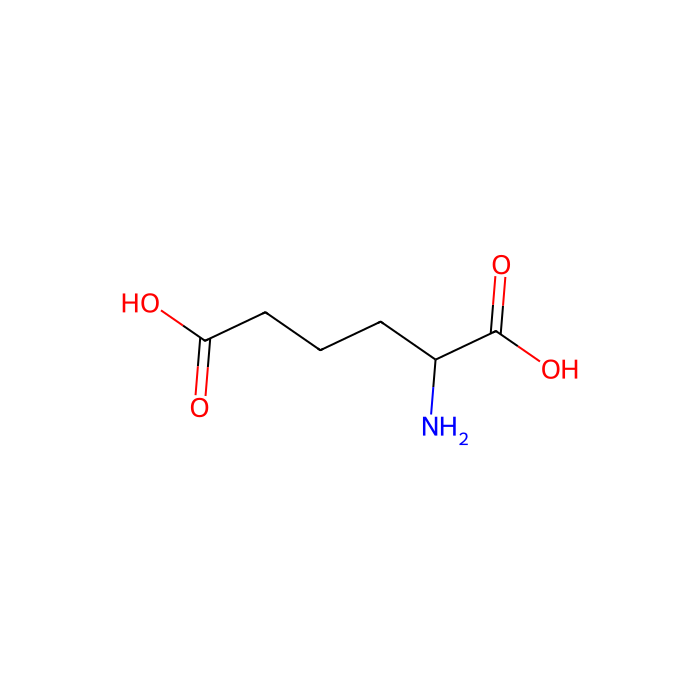
DL-α-Aminoadipic acid is a non-proteinogenic, dicarboxylic α-amino acid (racemate) structurally related to glutamic acid, with an additional methylene unit in the side chain.
Product Data identifiers
CAS: 542-32-5
InChIKey (Product Data): 270724
PubChem CID: 469
SKU: A117210
Names and synonyms (literature): 2-aminohexanedioic acid; 2-aminoadipic acid; DL-2-aminoadipate
2D structural description (literature): A six-carbon backbone bearing an α-amino group on C2, a terminal carboxylate at C1 (α-carboxyl), and a distal carboxylate at C6 (ω-carboxyl). In DL material, the α-center is racemic (no defined stereochemistry overall).
Functional groups/features (literature):
α-amino (primary amine) capable of protonation/Schiff base formation
Two carboxylic acids (α- and ω-), enabling di-acid chemistry (esterification, amidation)
Zwitterionic behavior near neutral pH
Note: Item-specific structural constants not specified for this item; refer to CoA/Spec Sheet for any definitive identifiers beyond Product Data.
Synthetic Utility
DL-α-Aminoadipic acid provides orthogonal synthetic handles—one α-amine and two carboxyl groups—enabling diverse transformations.
Functional group reactivity (literature):
Carboxyl groups: Esterification (MeOH/HCl, BnBr/base, DCC or CDI-mediated), amidation (EDC/HOBt, HATU, PyBOP), anhydride formation, and selective activation with mixed anhydrides.
Amine: Protection with Boc, Cbz, Fmoc; acylation; reductive amination; conversion to isocyanate/urea derivatives after suitable activation.
Chemoselectivity: Spatial separation of α- and ω-CO2H allows stepwise protection to build asymmetric di-amides or macrocycles.
Strategy examples (literature):
Orthogonal protection: Boc on amine, benzyl on ω-CO2H, methyl on α-CO2H, enabling sequential deprotection (hydrogenolysis vs. saponification vs. TFA cleavage).
Macrocyclization and lactam formation via intramolecular amidation upon selective activation of one carboxyl group, creating 6-membered nitrogen heterocycles.
Conversion to aminoadipate semialdehyde or 2-oxo derivatives via controlled reduction/oxidation for pathway-mimetic chemistry.
Stereochemical considerations:
Racemic input (DL) is useful for non-enantioselective targets; for chiral products, resolve or start from enantiopure D/L-2-aminoadipic acid to avoid racemization during α-activation steps.
Workup/purification tips:
Highly polar; use ion-exchange chromatography or reverse-phase preparative HPLC for free acids.
Protect to increase organic-phase solubility when employing silica chromatography.
Together, these features make aminoadipate a flexible node in constructing diacids, diamides, peptidomimetics, and N-heterocyclic scaffolds.
Target Specificity
This product is a small-molecule amino acid, not a biological affinity reagent. No antigen/epitope specificity, clone, isotype, or species reactivity applies.
Targeting data: Not applicable to this compound class.
Item-specific immunological attributes: Not applicable.
For functional studies, see the Biological Roles and Reaction & Applications sections for context on enzymatic pathways and assay use.
Usamos cookies para garantir o funcionamento adequado do site e, quando permitido, para melhorar a sua experiência. Você pode gerenciar suas preferências a qualquer momento nas Configurações. Saiba mais em nossa Política de Cookies.
Deseja que lhe enviemos uma mensagem quando tivermos descontos disponíveis?
Lembrar-me mais tarde
Obrigado! Por favor, verifique a sua caixa de entrada de e-mail para confirmar.
Products are supplied to verified businesses, institutions, and qualified professionals for research and development use only. Not for use in humans, animals, diagnosis, or therapy.

 I2622235