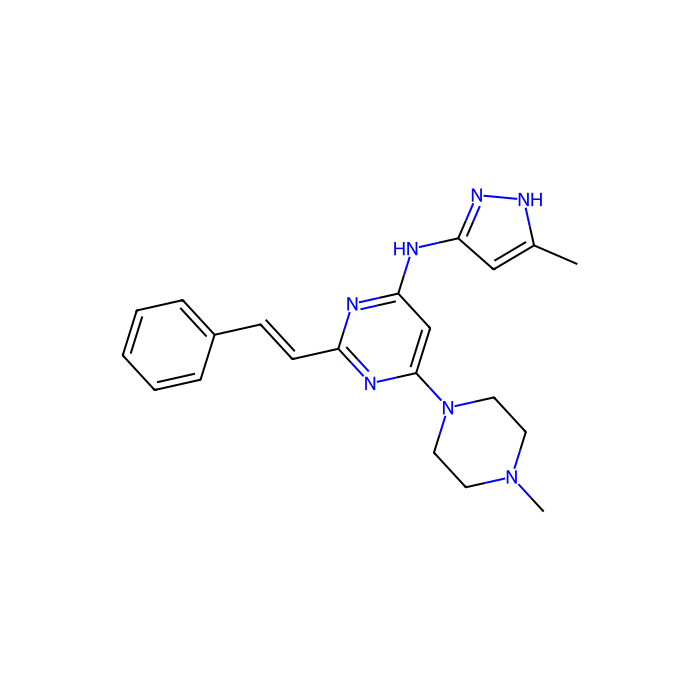
ENMD-2076 - Moligand™, 10mM in DMSO , Macrophage colony stimulating factor receptor inhibitor, CAS No.934353-76-1, Macrophage colony stimulating factor receptor inhibitor

CAS: 934353-76-1 Cat. No.: E408042 Fórmula: C21H25N7 Peso molecular: 375.47
Disponível para encomenda
GRADE & PURITY Moligand™ ? Moligand™ — Aladdin's line of ligands and bioactive small molecules. Use for receptor, pathway, and binding studies needing defined small-molecule tools. 10mM in DMSO
Synonyms
(E)-N-(5-methyl-1H-pyrazol-3-yl)-6-(4-methylpiperazin-1-yl)-2-styrylpyrimidin-4-amine
Storage
Store at -80°C
Shipped In
Dry ice packs + Cold packs
★
Size
USA
Alemanha (EU)*
Price
Qty
1ml
E408042-1ml
1 Em stock
—

262,90US$

383,90US$
Gravar 121,00 US$ (31.52%)
Enter a quantity for the sizes you want to add.
🧪

Why this grade

Moligand™, 10mM in DMSO Moligand™ for sensitive chromatographic and analytical workflows requiring minimal baseline interference.

🌡

Storage & shipping

Store at -80°C Ships Dry ice packs + Cold packs Check lot-specific COA for exact specifications.

📋

Quality documents

SDS, COA, datasheet, and spec sheet available for download. Lot-specific COA accessible via lot number lookup.

📚

Literature proof

Cited in 0 peer-reviewed publications across chromatography, organic synthesis, and cross-coupling reactions.

Visão geral

Information

ENMD-2076 has selective activity againstAurora AandFlt3withIC50of 14 nM and 1.86 nM, 25-fold selective for Aurora A than over Aurora B and less potent to RET, SRC, NTRK1/TRKA, CSF1R/FMS, VEGFR2/KDR, FGFR and PDGFRα. ENMD-2076 inhibits the growth of a wide
In vitro

ENMD-2076 indicates activity against multiple kinases involved in angiogenesis, including FLT3, RET, FLT4/VEGFR3, SRC, NTRK1, CSF1R/FMS, LCK, VEGFR2/KDR, FGFR1/2, and PDGFRα with IC50 from 1.86-120 nM. ENMD-2076 inhibits the growth of a wide range of human solid tumor and hematopoietic cancer cell lines with IC50 from 0.025 to 0.7 μM, which induces apoptosis and G2/M phase arrest. ENMD-2076 induces regression or complete inhibition of tumor growth in tumor xenograft models derived from breast, colon, melanoma, leukemia, and multiple myeloma cell lines. ENMD-2076 is the L (+) tartrate salt of ENMD-981693. ENMD-2076 shows significant cytotoxicity against myeloma cell lines (IM9, ARH-77, U266, RPMI 8226, MM.1S, MM.1R, NCI-H929) and primary cells with IC50 from 2.99 to 7.06 μM, which induces apoptosis. ENMD-2076 indicates low cytotoxicity to haematopoietic progenitors. ENMD-2076 inhibits the phosphoinositide 3-kinase/Akt pathway and downregulates survivin and X-linked inhibitor of apoptosis. ENMD-2076 also inhibits aurora A and B kinases, and induces G2/M cell cycle arrest.

In vivo

ENMD-2076 has sustained inhibitory effects on the activation of Flt3 as well as VEGFR2/KDR and FGFR1/2 in HT29 xenograft model. ENMD-2076 could prevent the formation of new blood vessels and regress formed vessels in MDA-MB-231 xenograft model. Oral treatment with ENMD-2076 (50, 100, 200 mg/kg per day) inhibits the tumour growth in H929 human plasmacytoma xenografts, with significant reduction in phospho-Histone 3 (pH3), Ki-67, and angiogenesis, and also a significant increase in cleaved caspase-3.
Cell Data

cell lines:

Concentrations:0.3 nM - 125 μM

Incubation Time:48 or 96 hours

Powder Purity:≥99%

Specifications

Sinónimos
(E)-N-(5-methyl-1H-pyrazol-3-yl)-6-(4-methylpiperazin-1-yl)-2-styrylpyrimidin-4-amine
Especificações e pureza
Moligand™, 10mM in DMSO
Mecanismos bioquímicos e fisiológicos
ENMD-2076 has selective activity against Aurora A and Flt3 with IC50 of 14 nM and 1.86 nM, 25-fold selective for Aurora A than over Aurora B and less potent to RET, SRC, NTRK1/TRKA, CSF1R/FMS, VEGFR2/KDR, FGFR and PDGFRα. ENMD-2076 inhibits the growth of
Condições de armazenamento de armazenamento
Store at -80°C
Enviado em
Dry ice packs + Cold packs
Este produto requer transporte de cadeia fria. Serviços terrestres e outros serviços econômicos não estão disponíveis.
Grau
Moligand™
Tipo de ação
INHIBITOR
Mecanismo de ação
Macrophage colony stimulating factor receptor inhibitor
Propriedades do produto
ALogP3.7
Nomes e identificadores
SMILES isoméricas CC1=CC(=NN1)NC2=CC(=NC(=N2)/C=C/C3=CC=CC=C3)N4CCN(CC4)C
Peso molecular 375.47
Reaxy-Rn 24925441
Reaxys-RN_link_address https://www.reaxys.com/reaxys/secured/hopinto.do?context=S&query=IDE.XRN=24925441&ln=

Documentation

📋 Safety Data Sheet (SDS)

Comprehensive hazard, handling, storage, and regulatory compliance document.

Download SDS →

✅ Certificate of Analysis (COA)

Lot-specific quality data. Enter your lot number to retrieve the exact COA.

Look up COA →

📊 Datasheet

Quick-reference summary of product specifications and applications.

View datasheet →

🔬 Specification Sheet

Full quality attributes and acceptance criteria for this grade.

View spec sheet →

Advanced Data

Alvos associados (humanos)
PTK2 Tclin Focal adhesion kinase 1 (1 Activities)
Activity TypeActivity Value -log(M)Mechanism of ActionActivity ReferencePublications (PubMed IDs)
CSF1R Tclin Macrophage colony-stimulating factor 1 receptor (1 Activities)
Activity TypeActivity Value -log(M)Mechanism of ActionActivity ReferencePublications (PubMed IDs)
RET Tclin Proto-oncogene tyrosine-protein kinase receptor Ret (1 Activities)
Activity TypeActivity Value -log(M)Mechanism of ActionActivity ReferencePublications (PubMed IDs)
SRPRA Tchem Signal recognition particle receptor subunit alpha (1 Activities)
Activity TypeActivity Value -log(M)Mechanism of ActionActivity ReferencePublications (PubMed IDs)
SRC Tclin Proto-oncogene tyrosine-protein kinase Src (3 Activities)
Activity TypeActivity Value -log(M)Mechanism of ActionActivity ReferencePublications (PubMed IDs)
FLT3 Tclin Receptor-type tyrosine-protein kinase FLT3 (5 Activities)
Activity TypeActivity Value -log(M)Mechanism of ActionActivity ReferencePublications (PubMed IDs)
PDGFRA Tclin Platelet-derived growth factor receptor alpha (2 Activities)
Activity TypeActivity Value -log(M)Mechanism of ActionActivity ReferencePublications (PubMed IDs)
AURKA Tchem Aurora kinase A (11 Activities)
Activity TypeActivity Value -log(M)Mechanism of ActionActivity ReferencePublications (PubMed IDs)
KDR Tclin Vascular endothelial growth factor receptor 2 (2 Activities)
Activity TypeActivity Value -log(M)Mechanism of ActionActivity ReferencePublications (PubMed IDs)
Certificados(CoA,COO,BSE/TSE e Mapa de Análise)
C of A & Other Certificates(BSE/TSE, COO):
Analytical Chart:

Find and download the COA for your product by matching the lot number on the packaging.

1 results found

Lot NumberCertificate TypeDataItem
L2214622Certificate of AnalysisJul 22, 2026 E408042
Propriedades químicas e físicas
SolubilidadeSolubility (25°C) In vitro DMSO: 50 mg/mL (200.59 mM); Ethanol: 5 mg/mL (20.05 mM); Water: Insoluble;
Calculadoras de soluções
Revisões

Avaliações dos Clientes

Application Protocols

No vendor-validated application protocols are specified for this item. The following are general, non-binding guidelines for handling small-molecule screening compounds.

Stock preparation (general):

  • Equilibrate the vial to room temperature in a desiccator before opening to avoid condensation.
  • Prepare a concentrated DMSO stock (e.g., 10–50 mM) based on your solubility assessment. Filter through 0.22 µm PTFE if particulates persist.
  • Aliquot into low-bind tubes (e.g., 10–50 µL) to minimize freeze–thaw.

Biochemical assay setup (example framework):

  • Keep final DMSO constant (e.g., 0.1–0.5% v/v across wells).
  • Run an 8–12 point half-log dilution series to estimate IC50, with triplicates.
  • Include vehicle control, positive control inhibitor, and no-enzyme control for background.

Cell-based testing (example framework):

  • Titrate in complete medium with matched vehicle controls.
  • Assess pathway modulation using phospho-protein readouts; run a parallel viability assay.

Data quality:

  • Track lot numbers and plate maps; use Z′-factor and control signal windows to qualify assays.

These guidelines are for research use only and should be adapted to your specific system.

Biological Roles

Context for research use only (literature-based, non-clinical): ENMD-2076 is widely described in the literature as a multi-kinase inhibitor, often noted for activity against cell-cycle–associated and angiogenesis-related kinases. Specific targets and potencies can vary by study and assay system; consult primary sources for exact values and methodologies.

Potential research themes (literature/general):

  • Kinase pathway interrogation: Employed to probe signaling cascades downstream of mitotic and pro-angiogenic kinases in biochemical and cellular models.
  • Cell cycle and mitosis studies: Useful in dissecting roles of kinases regulating G2/M transition, spindle assembly, and checkpoint control.
  • Angiogenesis and microenvironment: Applied to evaluate endothelial signaling and paracrine interactions in co-culture or 3D models.
  • Systems profiling: Kinome-wide selectivity profiling may reveal off-target networks, aiding chemoproteomics and target deconvolution.

Important notes:

  • This product is supplied strictly for research use; it is not intended for diagnostic, therapeutic, or human/animal administration.
  • Actual biological behavior depends on cell type, assay format, ATP concentration, serum content, and compound handling. Always include appropriate positive/negative controls and vehicle controls.
  • For definitive target lists, kinetic parameters, and structure–activity relationships, consult peer-reviewed publications and verify in your own system.
Buffer Applications

ENMD-2076 is a bioactive research compound rather than a buffering agent. It is not used to establish or maintain pH.

Practical tips for assay buffers (general guidance):

  • Common assay buffers: HEPES (pH 7.2–7.5), Tris (pH 7.4–8.0), or PBS, optionally with 0.01–0.05% Tween-20 to reduce nonspecific binding.
  • Protein-containing buffers: Inclusion of 0.1–0.5% BSA can mitigate adsorption to plastics for hydrophobic ligands.
  • Solubilization: Prepare a DMSO stock, then dilute into buffer with gentle mixing; keep final DMSO low (e.g., ≤0.1–0.5% v/v) unless higher levels are validated by controls.
  • Stability checks: Monitor for precipitation after dilution; pre-warm or add co-solvent if necessary within assay tolerance.

For pH buffering recipes and calibration, refer to standard buffer-making references; this product does not serve as a buffering component.

Green Alternatives

As a screening-grade bioactive, ENMD-2076 is primarily handled in micro- to millimolar DMSO solutions. Green considerations therefore revolve around solvent selection, waste minimization, and assay design rather than replacing the molecule itself.

Greener practice suggestions (general):

  • Minimize DMSO load: Keep final assay DMSO at or below the minimum tolerable level (often ≤0.1–0.5% v/v) to reduce solvent waste and biological interference.
  • Right-size experiments: Use microscale plate formats (384- or 1536-well) to reduce solvent and compound consumption.
  • Aqueous-first: When feasible, co-solubilize with aqueous buffers using minimal DMSO, aided by gentle heating/sonication and surfactants compatible with your assay.
  • Waste segregation: Collect DMSO-organic waste separately for appropriate disposal; avoid halogenated solvents unless necessary for analytics.

Comparison of common solvents (general):

  • DMSO (benchmark): Excellent solvency; biodegradable but high COD—use sparingly.
  • Ethanol: More sustainable but may not solubilize hydrophobic ligands sufficiently; higher assay volatility.
  • PEG-400 or cyclodextrins: Can enhance aqueous solubility in some contexts; verify assay compatibility.

Trade-offs:

  • Greener co-solvents may compromise solubility or assay performance. Validate with small pilot tests and vehicle controls.
Pharmaceutical Uses

This product is supplied strictly for laboratory research use and is not intended for human or veterinary applications.

Relevant research/industrial contexts (non-clinical):

  • Reference material: May be used as a research reference in development of analytical methods (e.g., LC–MS/MS quantitation) for kinase inhibitors in discovery workflows. No pharmacopeial status is indicated.
  • Formulation screening (in vitro only): Solubility and stability studies in discovery settings (co-solvents, pH adjustment, complexation) to support assay compatibility; not for any clinical formulation use.
  • In vitro DMPK workflows: Assessment of physicochemical properties (permeability, stability) for structure–property insights. These are research evaluations and not product specifications.

Item-specific regulatory/compendial information:

  • Pharmacopoeia listing: Not specified for this item; refer to CoA/Spec Sheet.
  • Residual solvent/elemental impurity compliance: Not specified for this item; refer to CoA/Spec Sheet.

Note: No therapeutic or clinical claims are made or implied for this product.

Physical Properties

Only item-verified physical data are listed as specifications. Literature values are noted explicitly when provided.

Item-specific specifications:

  • Appearance: Not specified for this item; refer to CoA/Spec Sheet.
  • Molecular Weight: Not specified for this item; refer to CoA/Spec Sheet.
  • Molecular Formula: Not specified for this item; refer to CoA/Spec Sheet.
  • Melting Point, Boiling Point, Density, Refractive Index, pKa, logP/logD, UV cutoff: Not specified for this item; refer to CoA/Spec Sheet.
  • Solubility (spec): Not specified for this item; refer to CoA/Spec Sheet.

General guidance (non-spec, typical for kinase-targeted small molecules):

  • Solubility practice (literature/common lab): Often prepared as concentrated DMSO stocks (e.g., 10–50 mM), then diluted into aqueous assay buffers. Actual solubility must be determined empirically for your lot.
  • Solid-state form: Bioactive screening compounds are frequently supplied as solids or film-coated vials; confirm the supplied form on your CoA.
  • Stability: Store at low temperature and protect from moisture and light; observe any lot-specific stability notes on the CoA/SDS.

Always rely on the CoA and SDS for authoritative, lot-specific physical data.

Quality and Grades
  • Grade/Purity: Moligand™.

About Moligand™ (general description):

  • The Moligand™ line is intended for research and screening applications with small-molecule ligands. Products are suitable for exploratory assays, target profiling, and medicinal chemistry research. Lot-specific quality attributes (e.g., assay purity, identity confirmation techniques, residual solvents) are documented on the CoA.

What to expect and verify (item-specific guidance):

  • Identity & Purity: Not specified for this item; refer to CoA/Spec Sheet for analytical results (e.g., LC–MS, HPLC, NMR where applicable).
  • Impurities / Residual solvents / Water content: Not specified for this item; refer to CoA/Spec Sheet.
  • Stabilizers/Additives: Not specified for this item; refer to CoA/Spec Sheet.

Best practices for screening-grade compounds:

  • Review chromatographic purity and identity data on the CoA before critical experiments.
  • Prepare fresh DMSO stocks and filter if necessary (0.22 µm PTFE) to remove particulates.
  • Track lot numbers in SAR or screening databases to correlate biological readouts with analytical quality.

Note: In the absence of an explicit “pharmacopoeial” or “analytical reagent” designation, treat Moligand™ items as research-grade chemicals not intended for human or veterinary use.

Reaction and Applications

This product is positioned for discovery and screening rather than as a synthetic reagent. Accordingly, applications typically focus on biochemical and cell-based experimentation rather than chemical transformations.

Research applications (general, non-clinical):

  • Target engagement studies: Use thermal shift assays (DSF) or ligand-observed NMR to evaluate binding interactions with recombinant kinases or kinase domains.
  • In vitro enzyme inhibition: Determine IC50/Ki values against chosen kinase panels using ADP-Glo, radiometric, or mobility shift assays. Maintain consistent DMSO vehicle across controls and test wells.
  • Cell-based readouts: Probe downstream signaling modulation with phospho-specific immunoassays or reporter systems. Include cytotoxicity counterscreens (e.g., resazurin/CellTiter-Glo) to decouple target effects from general viability loss.
  • Selectivity profiling: Leverage broad kinase panels to construct selectivity heatmaps across concentrations, controlling for ATP concentration near Km to reveal ATP-competitive behavior.
  • Mechanistic investigation: Test time-dependence, reversibility (washout or dilution assays), and competition with ATP/peptide substrates.
  • ADME-in-vitro: For medicinal chemistry support, assess solubility, microsomal stability, and plasma protein binding; these are not product specifications but common research evaluations.

Note: No medical or clinical use is intended. Ensure compliance with institutional biosafety and chemical safety procedures. For synthetic chemistry applications, this molecule is not typically used as a building block; see Synthetic Utility for further notes.

Reaction Conditions

Not typically applicable. ENMD-2076 is a finished small-molecule ligand intended for screening and biological experimentation rather than as a reagent in synthetic transformations.

If chemical modification is pursued in a research context (general, non-spec):

  • Reactions should be designed with mild conditions to preserve sensitive heteroaromatic motifs common to kinase inhibitors (e.g., avoid strong acids/bases and high temperatures unless stability is verified).
  • Use anhydrous, oxygen-free conditions as needed and validate stability by LC–MS time courses.

These points are general guidance only and not item specifications.

Safety and Handling

Use standard small-molecule handling precautions. Hazard classification for this specific item is not provided below; consult the SDS accompanying your shipment for authoritative safety information.

  • GHS Classification / Signal Word / H-Statements / Pictograms: Not specified for this item; refer to SDS.
  • Primary risks (general for bioactive small molecules): Potential irritation to skin/eyes/respiratory tract. Avoid ingestion, inhalation of dust, and skin contact. Handle in a chemical fume hood.
  • PPE: Lab coat, safety glasses or splash goggles, and appropriate chemical-resistant gloves (e.g., nitrile). Use dust mask or respirator if powders/aerosols may form and engineering controls are insufficient.
  • Handling: Minimize exposure; avoid repeated freeze–thaw of stock solutions. When opening lyophilized or powdered materials, allow vial to equilibrate to room temperature in a desiccator to prevent condensation.
  • Incompatibilities (general): Strong oxidizers and strong acids/bases may degrade many organic small molecules. Avoid prolonged exposure to light and moisture unless otherwise specified.
  • First aid (overview):
    • Inhalation: Move to fresh air; seek medical attention if symptoms persist.
    • Skin contact: Wash with soap and water; remove contaminated clothing.
    • Eye contact: Rinse cautiously with water for several minutes; remove contact lenses if present and easy.
    • Ingestion: Rinse mouth; seek medical advice.
  • Waste disposal: Dispose of according to institutional guidelines and local regulations for organic laboratory waste and bioactive compounds.
  • Authoritative references: Always defer to the SDS and institutional EHS policies.
Solvent Selection

For ENMD-2076, solvent choice is driven by assay compatibility and compound solubility. Item-specific solubility metrics are not provided and must be confirmed experimentally.

  • Primary stock solvent (common practice): DMSO is typically used to prepare concentrated stocks for kinase-directed small molecules due to broad solvating power and compatibility with biochemical assays at ≤0.1–1% v/v final DMSO.
  • Aqueous dilution: Dilute DMSO stocks into assay buffers (e.g., HEPES, PBS, Tris) containing carrier proteins or surfactants as needed to mitigate precipitation and nonspecific binding. Pre-warm and vortex during dilution.
  • Alternative co-solvents (if justified by your data): DMF, ethanol, or aqueous buffer with co-solvent blends; verify target compatibility and background effects.
  • Solvent screening tips:
    • Start with small test dissolutions (1–5 mg/mL) in DMSO, then serially dilute to working concentrations while monitoring clarity.
    • Assess stability by short-term storage (24–72 h) at room temperature and 4 °C, and by multiple freeze–thaw cycles.
    • Evaluate assay interference from solvent by running matched vehicle controls.

Comparison (general):

  • DMSO: Highest likelihood of solubilizing; widely accepted in screening. Tradeoff: potential effects on membranes/enzymes at higher %.
  • DMF/EtOH: Useful alternatives but can have higher assay interference or volatility; confirm tolerance in your system.

Always confirm actual solubility and compatibility for your lot.

Storage and Reconstitution
  • Storage Conditions (item-specific): Store at −80 °C.
  • Shipping (item-specific): Shipped on dry ice packs + cold packs.

General handling and reconstitution (guidance):

  • Allow the sealed container to warm to room temperature in a desiccator before opening to prevent moisture condensation.
  • Reconstitute in anhydrous DMSO to prepare a concentrated stock appropriate for your assays (e.g., 10–50 mM, depending on solubility). Actual solubility is not specified; verify empirically.
  • Vortex and, if needed, gently sonicate to aid dissolution. Avoid aqueous exposure until ready to use.
  • Aliquoting: Dispense single-use aliquots (e.g., 10–50 µL) in low-bind tubes to avoid repeated freeze–thaw.
  • Storage of solutions: Store DMSO stocks at −20 to −80 °C, protected from light and moisture. Record preparation date and concentration on each aliquot.
  • Freeze–thaw: Minimize cycles; discard aliquots showing precipitation or discoloration upon thawing.
  • Aqueous dilutions: Prepare immediately before use; maintain consistent DMSO concentration across samples and controls.

Item-specific details such as appearance, exact solubility, and stability in various matrices are not specified for this item; refer to the CoA/Spec Sheet and SDS for authoritative instructions.

Structure and Identity

Brief overview: ENMD-2076 is supplied as a research-use small molecule in Aladdin’s Moligand™ line, commonly referenced in the literature as a multi-kinase inhibitor. Structure-specific identifiers for this catalog item are not disclosed below and should be confirmed from the accompanying CoA/Spec Sheet.

  • Product Name: ENMD-2076 (research-grade small molecule)
  • CAS: 934353-76-1 (literature identifier; confirm on CoA for this lot)
  • PubChem CID: 16041424 (literature)
  • Molecular Formula: Not specified for this item; refer to CoA/Spec Sheet.
  • Molecular Weight: Not specified for this item; refer to CoA/Spec Sheet.
  • SMILES: Not specified for this item; refer to CoA/Spec Sheet.
  • InChIKey: Not specified for this item; refer to CoA/Spec Sheet.

Structural features (general, literature-based):

  • ENMD-2076 is reported as a heteroaromatic small molecule typical of ATP-competitive kinase ligands. Specific ring systems and stereochemistry are not provided here; consult primary literature or the CoA for definitive structural details.

2D structure description (general):

  • Kinase-directed chemotypes often feature fused or linked aromatic/heteroaromatic systems bearing H-bond donor/acceptor motifs aligned to the adenine pocket; exact motif for ENMD-2076 should be verified from the CoA or primary references.
Synthetic Utility

ENMD-2076 is supplied as a bioactive small molecule, not as a synthetic building block or reagent. Consequently, it is not typically used as a precursor in organic synthesis.

If employed in chemical biology or probe development (general considerations):

  • Derivatization caution: Modifications (e.g., linkers for affinity probes) can significantly alter potency and selectivity. Any conjugation site should be chosen based on known structure–activity relationships from primary literature.
  • Analytical characterization: If analogs are prepared, confirm identity and purity by orthogonal methods (LC–MS, HRMS, NMR) and reassess bioactivity post-modification.

For routine synthetic transformations and building-block strategies, refer instead to functionalized reagents specifically designed for coupling, cross-coupling, or heterocycle construction; ENMD-2076 itself is not typically leveraged for such reactions.

Target Specificity

Item-specific target data are not provided in the Product Data.

  • Targets, potency, and selectivity for this lot: Not specified for this item; refer to CoA/Spec Sheet and primary literature.

General note (literature context):

  • ENMD-2076 is commonly described as a multi-kinase inhibitor in the literature. Actual target panels and numerical potencies vary across studies and assay formats; verify against your assay conditions.

For experimental planning:

  • Perform a pilot concentration–response series against your kinase(s) of interest under ATP concentrations near Km.
  • Include orthogonal target engagement assays (e.g., thermal shift or CETSA) to corroborate biochemical findings.

Need help choosing the grade?

Our grade selection guide covers purity, stabilizer status, and application suitability for all variants in our catalog.

View Moligand™ grade guide →

Shall we send you a message when we have discounts available?

Remind me later

Thank you! Please check your email inbox to confirm.

Oops! Notifications are disabled.