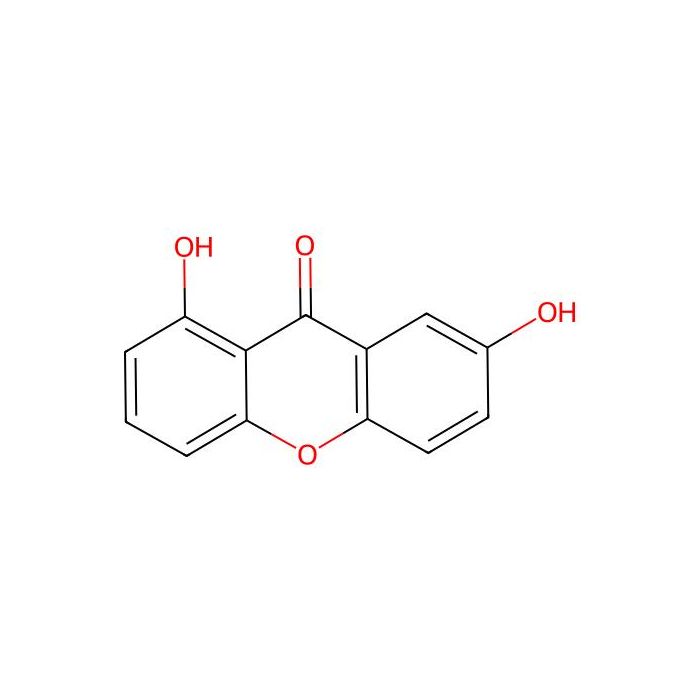
This compound belongs to the class of organic compounds known as xanthones. These are polycyclic aromatic compounds containing a xanthene moiety conjugated to a ketone group at carbon 9. Xanthene is a tricyclic compound made up of two benzene rings linearly fused to each other through a pyran ring.
External Descriptors
xanthenes
1. Djoumbou Feunang Y, Eisner R, Knox C, Chepelev L, Hastings J, Owen G, Fahy E, Steinbeck C, Subramanian S, Bolton E, Greiner R, and Wishart DS. ClassyFire: Automated Chemical Classification With A Comprehensive, Computable Taxonomy. Journal of Cheminformatics, 2016, 8:61.
Determine the necessary mass, volume, or concentration for preparing a solution.
Dilution Calculator
Determine the dilution needed to prepare a stock solution.
Reconstitution Calculator
Revisões
Avaliações dos Clientes
Application Protocols
No vendor-validated biological assay protocols are provided for this item. General research-use examples (literature-inspired; adapt as needed):
HPLC reference standard preparation:
Dissolve accurately weighed euxanthone in HPLC-grade methanol or DMSO to prepare a 1.0 mg/mL stock. Filter (0.22 µm PTFE) before injection. Store aliquots at −20°C protected from light.
Fluorescence spectroscopy:
Prepare 10–50 µM solutions in ethanol or aqueous buffer with ≤1% DMSO. Record excitation/emission spectra across pH 5–10 to assess solvatochromism; use quartz cuvettes and minimize inner-filter effects.
O-acylation example setup:
Combine euxanthone (1.0 eq), acyl chloride (1.2 eq), pyridine (2.0 eq), and catalytic DMAP (5 mol%) in dry DCM (0.05–0.1 M) at 0°C; warm to rt and stir 2–4 h. Quench with sat. NaHCO3, extract, and purify by column chromatography.
These are non-validated, literature-style procedures intended as starting points. Optimize to your system and follow institutional safety/SOP requirements.
Biological Roles
Euxanthone is a plant-derived polyphenolic xanthone reported in the phytochemistry literature. The following points summarize general biochemical context (not clinical claims):
Natural occurrence (literature): Found in various higher plants where xanthones can function as defense metabolites and pigments. Hydroxylation pattern influences antioxidant capacity and metal chelation.
Chemical biology properties (literature/general):
Phenolic groups can undergo reversible oxidation to quinone-like species, participate in radical scavenging assays, and bind proteins via hydrogen bonding and π–π interactions.
The xanthone chromophore displays intrinsic fluorescence, enabling use as a reporter for binding and microenvironment studies.
Metabolism (general insights):
In biological systems, phenolic xanthones may undergo phase II conjugation (glucuronidation/sulfation) and oxidative metabolism; exact pathways depend on substitution and organism.
Assay relevance:
Utilized as a reference analyte for evaluating extraction, chromatographic separation, and detection methods for xanthones in botanical research.
This product is designated for research use only. No claims are made regarding biological activity or therapeutic use of this item.
Buffer Applications
Not typically used as a buffer or buffering agent. As a hydrophobic polyphenol, euxanthone does not define a useful conjugate acid/base pair for laboratory buffering across physiological pH ranges.
Practical notes:
If dissolved for assays, prepare organic cosolvent stocks (e.g., DMSO) and dilute into buffered aqueous solutions (phosphate, HEPES, Tris) while monitoring for precipitation.
Adjusting buffer pH to slightly basic can increase apparent solubility via phenolate formation, but this alters the chemical state; confirm assay compatibility.
No item-specific buffer recipes or pKa values are provided in the Product Data.
Green Alternatives
As a solid analyte/building block, “green alternatives” focus on solvent and process choices rather than replacing the compound itself.
Greener solvent considerations for handling euxanthone (literature/general):
Prefer ethanol or 2-propanol over acetonitrile/DMF where solubility permits.
For extractions from matrices, consider ethyl acetate or ethanol–water mixtures before resorting to chlorinated solvents.
For O-alkylation/acylation, use carbonate bases in green solvents (e.g., 2-MeTHF, CPME, or acetone/EtOAc) where feasible; evaluate phase-transfer catalysis to avoid DMF.
Comparison (general guidance):
DMSO vs EtOH: DMSO gives higher solubility but is harder to remove; ethanol is greener and readily recoverable but may limit concentration.
DMF vs 2-MeTHF/CPME: DMF offers strong solvating power; 2-MeTHF/CPME are bio-derived/low-tox alternatives with safer profiles but may not fully dissolve polyphenolic xanthones.
Trade-offs:
Greener media can impact reaction rates and selectivity for phenolic functionalization. Perform small-scale screenings to optimize yield and impurity profile.
Note: No item-specific solvent restrictions are provided; adapt choices to your EHS program and method requirements.
Pharmaceutical Uses
No pharmaceutical-grade designation or excipient role is provided in the Product Data. This product is supplied for research use only.
Relevant non-clinical uses (literature/general):
Analytical standard: Employed as a reference material for method development and quality assessment of botanical/xanthone-containing materials by HPLC–UV/FLD or LC–MS.
Formulation research: Model polyphenolic compound for studying solubilization strategies (cyclodextrin inclusion, micelles, co-solvents) and stability under ICH-like stress conditions.
Compliance notes:
Pharmacopeial status: Not specified for this item; refer to CoA/Spec Sheet and applicable pharmacopeias if considering compendial methods.
Residual solvent, elemental impurities, and microbiological limits: Not specified for this item; consult the CoA if required for method validation or system suitability.
No therapeutic or clinical claims are made for this product.
Physical Properties
Item-specific physical specifications (bp, mp, density, UV cutoff, metal limits, etc.) are not provided in the Product Data. Do not treat literature values as specifications for QC release.
Literature/typical properties for euxanthone (reference only):
Appearance: typically a yellow crystalline solid (literature; not item-specific).
Molecular formula: C13H8O5 (literature).
Molecular weight: ~244.20 g/mol (literature).
Acid–base: multiple phenolic OH groups; expected pKa values for phenolic sites generally in the ~7–10 range depending on substitution and solvent (literature/general chemistry; specific pKa values for each site vary across reports).
Solubility profile (qualitative, literature):
Low aqueous solubility at neutral pH; increased solubility in basic aqueous media via phenolate formation.
Good solubility in polar aprotic solvents (DMSO, DMF) and moderate in alcohols (MeOH, EtOH); limited in nonpolar hydrocarbons.
Spectroscopic behavior (literature): conjugated xanthone core exhibits strong UV absorption and blue-green fluorescence; exact λmax/ε depend on solvent and pH.
Item-specific values not provided:
Melting point: Not specified for this item; refer to CoA/Spec Sheet.
Boiling point: Not applicable (decomposes before bp) in practice for solids; Not specified for this item; refer to CoA/Spec Sheet.
Density, refractive index, logP: Not specified for this item; refer to CoA/Spec Sheet.
Quality and Grades
Item-specific grade, purity, and stabilizer information are not provided in the Product Data for SKU E1073045.
What this means for users:
Grade/purity: Not specified for this item; refer to CoA/Spec Sheet. The CoA will detail assay/identification tests (e.g., HPLC area %, NMR identity), and any residual solvent limits.
Stabilizers: Not specified for this item; refer to CoA/Spec Sheet. Polyphenolic solids are commonly shipped without stabilizers; verify on the CoA.
UV/LC suitability: If intended for chromatographic reference use, request a low-UV-impurity grade. "Analytical standard" or "HPLC" designations (if present on your CoA) indicate low background absorbance and tight impurity profiles for quantitative work.
Metal/ionic impurities: Not specified for this item; refer to CoA/Spec Sheet. Phenolic chelation can complicate trace metals analysis; request elemental profile if relevant to your method validation.
Practical guidance:
For quantitative assays, verify potency (assay, water/volatile content) on the specific lot CoA and use mass correction factors if reporting on anhydrous basis.
For fluorescence or UHPLC-UV applications, inquire about UV cutoff and fluorescence background (if critical) and inspect baseline behavior with a blank run.
Reaction and Applications
This xanthone derivative is used as a reference standard, a fluorescent probe scaffold, and a polyphenolic building block.
Suitable as a standard for profiling xanthones in natural product extracts by HPLC–UV/FLD due to strong absorbance/fluorescence (literature rationale). Verify assay/purity on lot-specific CoA.
Photophysical applications (literature):
Xanthone cores display fast intersystem crossing and notable fluorescence; euxanthone’s hydroxylation modulates emission. Useful for studying solvent/pH effects on spectra.
Reactivity (general synthetic chemistry):
Phenolic OH groups undergo O-alkylation (e.g., RX/K2CO3, DMF), O-acylation (acyl chlorides/anhydrides, pyridine or DMAP catalysis), and etherification to tune solubility and electronics.
Aromatic ring electrophilic substitution (nitration, halogenation) is directed by phenolic activation; conditions must avoid over-oxidation.
Carbonyl chemistry at the xanthone ketone: reduction (NaBH4/Lewis acid variants) or nucleophilic addition in strongly activated systems.
Chelation to metals via adjacent phenoxide/carbonyl can form coordination complexes—relevant for sensing studies (literature).
Sample preparation tips:
Dry solvents and exclude strong bases if preserving phenolic pattern; protect from strong light during photophysical measurements.
For LC–MS, ammonium formate/acetate buffers at mild pH help maintain peak shape while limiting ion suppression.
No specific application performance claims are made for this item beyond research use.
Reaction Conditions
General literature guidance for transforming polyhydroxy xanthones (not item-specific specifications):
O-alkylation of phenols:
Typical: K2CO3 (2–3 eq) in dry DMF or acetone, 0.05–0.2 M, 20–60°C, 2–24 h, alkyl bromide/iodide (1.2–2 eq). Cesium carbonate can enhance reactivity for hindered sites.
Alternative: Mitsunobu (DIAD/DEAD, PPh3) in THF or toluene at 0–25°C for inversion-sensitive alcohol partners; manage waste and safety accordingly.
O-acylation/carbamate formation:
Acyl chloride/anhydride (1.2–1.5 eq), pyridine or Et3N base, catalytic DMAP (5–10 mol%), DCM or EtOAc, 0–25°C, 1–6 h; monitor by TLC/HPLC.
Electrophilic aromatic substitution:
Halogenation with NBS/NCS (1.05–1.2 eq) in MeCN or AcOH at 0–25°C; protect sensitive phenols if regioselectivity is critical.
Reductive chemistry at the xanthone carbonyl (where applicable):
NaBH4 with Lewis acid activation (e.g., BF3·Et2O) in THF/MeOH at 0–25°C can reduce the carbonyl; over-reduction risk requires careful quench.
Metal complexation studies:
Generate phenolates with mild base (Na2CO3, pH 9–10 in aqueous/MeOH) before adding metal salts; monitor by UV–vis/fluorescence.
Expected yields vary with substitution pattern; consult primary literature for your exact conditions. Always perform small-scale trials and orthogonal analytics (NMR, LC–MS).
Safety and Handling
Follow standard laboratory safety procedures. The authoritative source for hazard classification is the product SDS.
GHS/Signal word/pictograms: Not specified for this item; refer to SDS.
Primary hazards (general for phenolic, polyaromatic solids):
May cause irritation to skin, eyes, and respiratory tract upon contact or dust inhalation (general precaution; consult SDS for classification).
Dust may be combustible; avoid dust accumulation and ignition sources.
Personal protective equipment (PPE):
Lab coat, safety glasses or goggles, and appropriate chemical-resistant gloves (e.g., nitrile). Use a fume hood to minimize dust/particle exposure.
Handling guidance:
Avoid generating dust. Use antistatic measures when weighing fine powders.
Prepare concentrated stock solutions in DMSO/DMF/EtOH to minimize airborne particulate.
Protect from excessive light if tracking fluorescence or preventing photodegradation (general photostability caution for xanthones).
Incompatibilities (general):
Strong oxidizers and strong bases/acids may induce degradation or phenolate formation; segregate accordingly.
Reactive acylating/alkylating agents can modify phenolic OH groups.
First-aid overview (consult SDS):
Skin/eye contact: Rinse with water for several minutes; remove contaminated clothing; seek medical attention if irritation persists.
Inhalation: Move to fresh air; seek medical attention if symptoms occur.
Ingestion: Rinse mouth; do not induce vomiting; seek medical attention.
Disposal: Follow institutional and local regulations for organic laboratory solids; avoid drain disposal.
Solvent Selection
Euxanthone is an aromatic polyphenol with limited aqueous solubility and good affinity for polar organic solvents.
Polarity/miscibility (general):
Readily soluble in DMSO and DMF (polar aprotic); moderate in acetone, acetonitrile, and alcohols (MeOH, EtOH).
Sparingly soluble in water at neutral pH; solubility increases in basic aqueous media by phenolate formation.
Poorly soluble in nonpolar solvents (hexanes, toluene) without derivatization.
Stock solution practices:
Prepare 10–100 mM stocks in dry DMSO for biological assays; dilute into aqueous buffers with vigorous mixing and ≤1% final DMSO to minimize precipitation (optimize per assay).
For spectroscopic work, ethanol or methanol can minimize DMSO background in UV–vis.
Choosing among solvents (considerations):
DMSO: maximum solubility, broad compatibility; high boiling point can complicate solvent removal.
MeOH/EtOH: lower toxicity profile, easy removal; solubility may be limited.
DMF/Acetonitrile: good solvation of polyaromatics; consider toxicity and waste classification.
pH control:
For aqueous systems, adjust pH above the lowest phenolic pKa to improve apparent solubility; avoid strong base if preserving native structure is critical.
All solvent choices should be validated in your method; no item-specific solubility values are provided in the Product Data.
Storage and Reconstitution
Storage conditions (Product Data): Store at −20°C. Shipments are made in an ice chest with ice pads.
Container recommendations:
Keep tightly closed in an amber glass vial to limit moisture uptake and photodegradation. Purge headspace with inert gas if long-term storage is planned.
Stability notes:
Avoid repeated warming/cooling cycles; dispense single-use aliquots upon receipt.
Protect from strong light during storage and handling to preserve chromophore integrity (general guidance for xanthones).
Reconstitution guidance (general):
Prepare concentrated stock solutions in dry DMSO (e.g., 10–100 mM) or ethanol. Mix thoroughly (vortex/sonicate) to ensure complete dissolution.
For aqueous applications, dilute the organic stock into buffer slowly with vigorous stirring; consider adding a small amount of co-solvent (≤1–2%) or using pH adjustment to minimize precipitation.
Spec-driven parameters:
Water content, residual solvents, and purity specifications: Not specified for this item; refer to CoA/Spec Sheet.
Always refer to the lot-specific CoA and SDS for definitive guidance on stability, handling, and safety.
Structure and Identity
Euxanthone is a polyhydroxy xanthone natural product standard with a tricyclic dibenzo-γ-pyrone (xanthone) core.
Item-specific identifiers (Product Data):
CAS: 529-61-3
CID: 5281631
InChIKey: 177537 (as provided)
SMILES: Not specified for this item; refer to CoA/Spec Sheet.
Literature identity (for reference; not item-specific specs):
Common structural assignment: 1,3,8-trihydroxyxanthone (a xanthone bearing three phenolic OH groups)
Core scaffold: xanthone (anthracen-9-one isostere with an intracyclic ether oxygen).
Functional groups: one aryl ketone (conjugated), one aryl–O–aryl ether within the xanthone ring system, and multiple phenolic hydroxyls capable of hydrogen bonding and metal chelation.
2D description: Two fused benzene rings flank a central pyran-2-one; phenolic OH substituents decorate the aromatic rings (positions 1, 3, and 8 in the canonical numbering for the literature structure).
Notes: Exact structural descriptors for this catalog item should be confirmed against the CoA/SDS. All non-provided identifiers above are labeled as literature for clarity.
Synthetic Utility
Euxanthone is a versatile polyfunctional scaffold for derivatization and SAR exploration in xanthone chemistry.
Functional group handles (general):
Multiple phenolic OH groups enable selective or global O-alkylation/acylation to modulate lipophilicity and electronic properties.
The xanthone carbonyl participates in reductions or condensation chemistry under carefully controlled conditions.
Common transformations (literature):
O-alkylation: RX (alkyl halides) or Mitsunobu conditions for difficult substrates; carbonate bases (K2CO3/Cs2CO3) in DMF/acetone.
O-acylation/carbamate formation: Acyl chlorides/anhydrides or CDI-mediated couplings; DMAP catalysis to enhance selectivity.
Electrophilic aromatic substitution: Halogenation/nitration directed by phenolic activation; subsequent cross-couplings (e.g., Suzuki–Miyaura, Buchwald–Hartwig on suitably halogenated derivatives).
Metal complexation: Phenoxide/ketone chelation provides access to luminescent or sensing complexes (Al3+, Zn2+, etc.), useful for probe development.
Retrosynthetic value:
Xanthone frameworks serve as rigid, planar chromophores for probe and materials chemistry; selective protection (benzyl/ TBDMS) strategies allow orthogonal installation of substituents.
These are literature/general strategies; adapt conditions to the specific substitution pattern of your material. No item-specific reactivity data are provided.
Target Specificity
Not applicable. This product is a small-molecule xanthone, not an antibody, enzyme, or targeted bioreagent. No antigen/epitope or species reactivity applies.
Usamos cookies para garantir o funcionamento adequado do site e, quando permitido, para melhorar a sua experiência. Você pode gerenciar suas preferências a qualquer momento nas Configurações. Saiba mais em nossa Política de Cookies.
Deseja que lhe enviemos uma mensagem quando tivermos descontos disponíveis?
Lembrar-me mais tarde
Obrigado! Por favor, verifique a sua caixa de entrada de e-mail para confirmar.
Products are supplied to verified businesses, institutions, and qualified professionals for research and development use only. Not for use in humans, animals, diagnosis, or therapy.