GRAU & PUREZACarrier Free?Carrier-free — supplied without added carrier protein/stabilizer. Use when carriers (e.g. BSA) would interfere with conjugation or sensitive assays.ExactAb™?ExactAb™ — Aladdin's antibody line emphasizing precision and validated quality. Use for reliable, specificity-validated antibody applications.Validated?Validated grade — performance confirmed in defined applications before release. Use when you want documented assurance the reagent works as stated.0.5 mg/mL
Carrier Free, ExactAb™, Validated, 0.5 mg/mL Carrier Free,ExactAb™,Validated para fluxos de trabalho cromatográficos e analíticos sensíveis que exigem interferência mínima da linha de base.
🌡
Armazenamento e envio
Store at -20°C,Avoid repeated freezing and thawing Envio Ice chest + Ice pads. Consulte o COA específico do lote para obter as especificações exatas.
📋
Documentos de qualidade
SDS, COA, ficha técnica e folha de especificações disponíveis para download. COA específico do lote acessível por meio de pesquisa por número de lote.
📚
Comprovação documental
Citado em 0 publicações revisadas por pares nas áreas de cromatografia, síntese orgânica e reações de acoplamento cruzado.
Visão geral
Mouse anti Human HACE1 Antibody, Monoclonal (K54S757), could be used for WB and so on.
Especificações
Product Name
HACE1 Mouse mAb - Anticorpo primário, specific to HACE1, Mouse IgG1
Sinónimos
E3 ubiquitin-protein ligase HACE1 antibody | HACE 1 antibody | HECT domain and ankyrin repeat-containing E3 ubiquitin-protein ligase 1 antibody | KIAA1320 antibody | SPPRS | E3 ubiquitin-protein ligase HACE1 antibody | HACE 1 antibody | HECT domain and an
Especificações e pureza
Carrier Free, ExactAb™, Validated, 0.5 mg/mL
Espécie hospedeira
Rato
Especificidade
HACE1
Imunogénio
Recombinant protein of human HACE1.
Controlo positivo
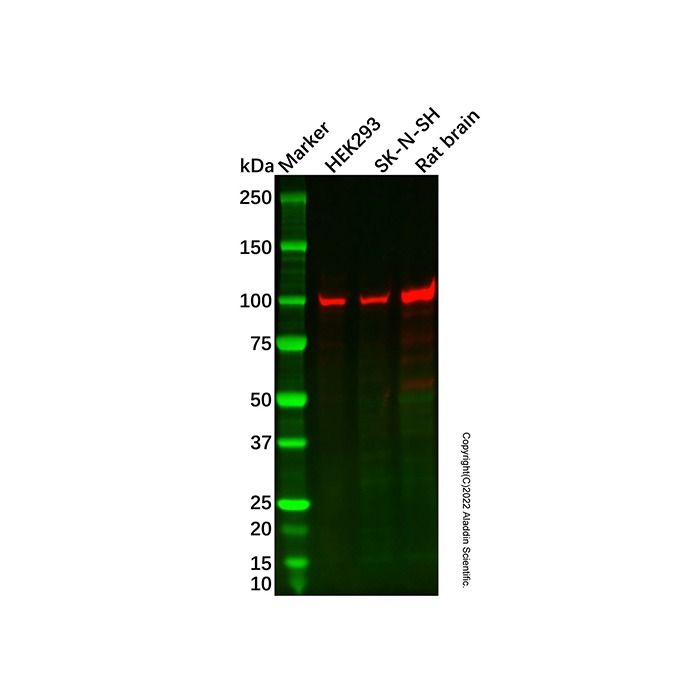
WB: Rat brain, HEK293 and SK-N-SH lysates.
Conjugação
Unconjugated
Grau
Carrier Free, ExactAb™, Validated
Isótipo
Mouse IgG1
Tipo de corrente de luz
kappa
SDS-PAGE
150 kDa
Método de purificação
Protein G purified
Concentração
0.5 mg/mL
Product Line
Produtos biológicos
Armazenamento e envio
Forma
Liquid
Condições de armazenamento de armazenamento
Store at -20°C,Avoid repeated freezing and thawing
Enviado em
Ice chest + Ice pads
Estabilidade e armazenamento
Store at 4℃ short term (1-2 weeks). Store at -20℃ long term (12 months). Upon receipt, it is recommended to aliquot. Avoid freeze/thaw cycle.
Imagens
HACE1 Mouse mAb (Ab106793) - Western Blot All lanes: HACE1 Mouse mAb (Ab106793) at 1/500 dilution Samples: Lysates at 20 µg per lane Secondary: Goat Anti-Mouse IgG H&L (HRP) (Ab179001) at 1/10000 dilution Predicted band size: 102 kDa Observed band size: 99 kDa Exposure time: 72.4 s
Aplicação
Aplicação
Dilution info
WB
1/500-1/1000
Documentação
📋 Ficha de dados de segurança (FDS)
Documento abrangente sobre perigos, manuseamento, armazenamento e conformidade regulamentar.
Determine the necessary mass, volume, or concentration for preparing a solution.
Dilution Calculator
Determine the dilution needed to prepare a stock solution.
Reconstitution Calculator
Revisões
Avaliações dos Clientes
Application Protocols
Item-specific tested applications, suggested dilutions, and positive controls: Not specified for this item; refer to CoA/Spec Sheet.
General protocol outlines (for guidance only)
Western blot (WB): Prepare denatured lysates (RIPA or SDS buffer), run SDS-PAGE, transfer to PVDF, block 1 h (5% milk/BSA), incubate with primary anti-HACE1 (optimize dilution, e.g., 1:500–1:5,000 range), wash 3× in TBS-T, incubate with species-appropriate HRP- or fluorophore-conjugated secondary, develop or image.
Immunoprecipitation (IP): Incubate clarified lysate with primary antibody (1–5 µg per mg lysate protein, optimize) 1–4 h at 4°C, add Protein A/G beads matched to isotype, rotate 1 h, wash in high-salt buffer, elute by low pH or SDS sample buffer.
Immunofluorescence (IF/ICC): Fix cells (e.g., 4% PFA), permeabilize (0.1–0.2% Triton X-100), block (5% serum), incubate with primary (optimize), wash, apply fluorescent secondary, counterstain nuclei (DAPI), mount and image.
IHC (FFPE): Perform antigen retrieval (citrate pH 6 or Tris-EDTA pH 9), block endogenous peroxidase, apply primary, then HRP polymer secondary; develop with DAB and counterstain.
Always include appropriate controls and titrate conditions for your system.
Biological Roles
Target overview (literature)
HACE1 (HECT domain and ankyrin repeat containing E3 ubiquitin protein ligase 1) is a HECT-type E3 ubiquitin ligase. It contains N-terminal ankyrin repeats for protein–protein interactions and a C-terminal HECT catalytic domain that forms a thioester intermediate with ubiquitin.
Cellular functions (literature)
Protein quality control: HACE1 catalyzes ubiquitination of specific substrates, targeting them for proteasomal or lysosomal pathways depending on chain topology.
Signaling regulation: Reported to regulate small GTPase pathways and cellular stress responses by ubiquitinating key regulators; contributes to maintenance of cellular homeostasis.
Developmental and tissue expression: HACE1 is expressed in multiple tissues with context-dependent regulation; subcellular localization can be cytosolic and membrane-associated, consistent with roles in trafficking and signaling.
Research relevance (literature)
Model systems: Studies employ gene knockouts/knockdowns and overexpression to dissect HACE1 function in ubiquitin-mediated networks. Antibodies against HACE1 support detection, quantification, and immuno-enrichment of native or tagged HACE1 in cells and tissues.
Item-specific claims regarding biological activity, species reactivity, or epitope: Not specified for this item; refer to CoA/Spec Sheet.
Buffer Applications
Not typically applicable
This product is an analyte-specific antibody reagent, not a buffering compound. It is used within buffer systems rather than forming them.
Practical notes (general)
Common buffers for immunoassays include PBS or TBS (pH 7.2–7.6) with 0.05% Tween-20 for washing; blocking buffers may include 1–5% BSA, casein, or serum (optimize to reduce background).
For storage and handling of carrier-free antibodies, low-ionic-strength PBS or HEPES at pH ~7.2 with added trehalose (2–5%) can improve freeze–thaw stability (general guidance). Item-specific buffer composition: Not specified for this item; refer to CoA/Spec Sheet.
Green Alternatives
Perspective
Antibodies themselves are not solvents or bulk chemicals; “green” considerations focus on formulation, workflow design, and waste minimization.
Greener choices and practices (general)
Carrier-free benefit: Eliminating glycerol and carrier proteins can reduce cold-chain mass and downstream waste in desalting/exchange steps. It also enables direct conjugation, reducing extra purification cycles.
Buffer selection: Favor phosphate- or HEPES-based buffers prepared with RO/DI water. Avoid azide when possible; use sterile filtration and low-temperature storage to maintain bioburden control.
Packaging/waste: Aliquot upon receipt to avoid freeze–thaw and product loss. Use recyclable secondary packaging and minimize single-use plastics when feasible.
Assay design: Employ microplate formats and miniaturized blots to reduce reagent consumption; use fluorescent detection to avoid chemiluminescent substrates and repeated exposures.
Energy footprint: Store at -20°C as recommended. If short-term use allows, keep working aliquots at 4°C to decrease ultra-cold door openings (while monitoring stability).
Comparison (general)
Recombinant monoclonal vs hybridoma-derived: Recombinant production can offer batch-to-batch consistency and potentially reduced animal use; hybridoma lines require animal origin. Item-specific production method for this antibody is not specified.
Conjugated secondaries vs direct labels: Directly labeled primaries can reduce incubation/wash steps and secondary antibody waste, but may require higher amounts of primary; weigh trade-offs.
Pharmaceutical Uses
Not applicable for therapeutic or diagnostic use
This product is labeled for research use only and is not intended for human or veterinary applications. No pharmacopeial status is claimed.
Research/manufacturing context (general)
Antibodies of defined specificity are sometimes used as analytical reagents in bioprocess development and QC assays (e.g., immunocapture before MS, ELISA-based impurity monitoring). Any such use requires user validation under appropriate quality systems.
Item-specific regulatory status, residuals, or endotoxin specifications: Not specified for this item; refer to CoA/Spec Sheet.
Physical Properties
Item-specific properties
Appearance, concentration, buffer composition, pH, excipients/preservatives: Not specified for this item; refer to CoA/Spec Sheet.
Molecular weight (exact): Not specified for this item; refer to CoA/Spec Sheet.
General/literature values for monoclonal IgG antibodies (for context only)
Isoelectric point (pI): Commonly pI ~6–9 depending on sequence and glycosylation (literature).
Solubility: Highly soluble in aqueous buffers; stability and aggregation depend on pH/ionic strength (literature). Typical storage buffers include PBS or HEPES with stabilizers (if present) (literature).
Extinction coefficient: ε280 varies by sequence; a rule-of-thumb for generic IgG is A280 of 1.0 ≈ 0.7–1.5 mg/mL depending on composition (literature). Item-specific ε280: Not specified for this item; refer to CoA/Spec Sheet.
Physical state: Aqueous solution or lyophilized solid are common formats; actual format: Not specified for this item; refer to CoA/Spec Sheet.
Handling-related physical notes
Viscosity increases with concentration; avoid excessive shear and foaming to minimize aggregation (general guidance).
Avoid repeated freeze–thaw cycles (item-specific), as they can cause denaturation/aggregation.
Carrier Free: Indicates the antibody preparation lacks common carrier proteins (e.g., BSA, gelatin) and typically lacks glycerol or other additives. Advantages include reduced background in conjugations and mass-spec, and precise control over formulation. For this item, the exact excipient profile is not specified; refer to CoA/Spec Sheet.
ExactAb™: Branded designation denoting stringent identity and performance verification at Aladdin Scientific. Exact criteria and assays used are proprietary; consult product documentation for specifics.
Validated: Indicates that functional testing has been performed to confirm target recognition. The exact validated applications, species reactivity, and positive controls are not specified for this item; refer to CoA/Spec Sheet.
General quality context (literature/industry)
Typical QC for monoclonals includes SDS-PAGE (reduced/non-reduced), SEC-HPLC for monomer content, endotoxin testing (esp. for cell work), concentration by A280, and functional immunoassays (ELISA, WB, IHC, IF, IP). Exact metrics for this lot are not specified for this item.
Carrier-free antibodies are typically preferred for labeling reactions (e.g., NHS ester fluorophores, biotinylation) to avoid competing amines/proteins. Validate with a small pilot conjugation to confirm performance.
Reaction and Applications
Applicability to this product
As an analytical/affinity reagent, this monoclonal antibody is used in immunochemical assays rather than chemical synthesis. No small-molecule reactions apply.
Research applications (general/literature)
Immunodetection: Western blotting (WB) to detect denatured HACE1; immunofluorescence (IF) or immunocytochemistry (ICC) for cellular localization; immunohistochemistry (IHC) on tissues; ELISA for quantitative assays using recombinant HACE1 or capture/detection formats.
Affinity techniques: Immunoprecipitation (IP) or co-IP to enrich HACE1 and binding partners; proximity ligation assays; pulldowns prior to mass spectrometry (carrier-free format facilitates MS).
Protein labeling: Carrier-free antibodies are suitable for site- or lysine-directed conjugation (e.g., NHS-ester fluorophores, maleimide linkers after mild reduction) to generate custom probes. Validate degree of labeling (DOL) by UV-Vis.
Practical tips (general)
Blocking and diluents: Optimize with serum, BSA, or casein (unless interfering with downstream readouts). For carrier-free stocks, users can add 0.05% Tween-20 to reduce nonspecific binding in WB/ELISA.
Antigen retrieval (IHC): Optimize citrate or EDTA buffers, pH 6–9, with controlled heating.
Controls: Include isotype controls, no-primary, and positive cell/tissue controls relevant to HACE1 expression.
Item-specific tested applications, recommended dilutions, and positive controls: Not specified for this item; refer to CoA/Spec Sheet.
Reaction Conditions
Not applicable to chemical reaction conditions
This product is not used to carry out chemical reactions in the conventional sense.
Immunoassay condition considerations (general)
Western blot: Typical primary incubation 1–16 h at 4–25°C in blocking buffer; antibody dilution must be empirically determined. Wash with TBS-T or PBS-T to reduce background.
IHC/IF: Optimize fixation (e.g., 4% PFA), antigen retrieval (citrate pH 6 or Tris-EDTA pH 9), and permeabilization (0.1–0.5% Triton X-100) as appropriate. Temperature and incubation times depend on signal-to-noise balance.
IP/Co-IP: Incubate clarified lysates with antibody for 1–4 h at 4°C, capture with Protein A/G resin matched to the antibody isotype, wash stringently, and elute under gentle (pH shift) or denaturing conditions as needed.
Item-specific recommended conditions, dilutions, and buffers: Not specified for this item; refer to CoA/Spec Sheet.
Safety and Handling
Item-specific safety information
GHS classification, signal word, hazard statements, pictograms: Not specified for this item; refer to SDS.
Research use only: Yes (from Product Data). Not for human or veterinary use.
Storage conditions: Store at -20°C. Avoid repeated freezing and thawing (from Product Data).
General safety guidance for laboratory antibodies (literature/best practice)
PPE: Use lab coat, disposable nitrile gloves, and safety glasses when handling solutions or lyophilizate. Work in a clean area to avoid microbial contamination.
Incompatibilities: Avoid strong oxidizers and extreme pH (<3 or >10) unless validated for your protocol. Avoid metal-catalyzed oxidation (trace metals) and interfacial stress (vigorous vortexing, air–liquid interfaces).
Biological origin caution: Although purified, treat as a biologically derived material; follow institutional biosafety procedures.
First aid (overview; defer to SDS): In case of skin/eye contact, rinse with water. If inhaled (powder/aerosol), move to fresh air. If ingested, rinse mouth. Seek medical attention as needed.
Spill response: Absorb aqueous spills with inert material; disinfect surfaces with appropriate agent. Dispose of in accordance with local regulations.
Special risks: Preservatives such as sodium azide are often present in some antibodies, but this product is carrier-free; preservative content (if any) is not specified for this item—consult the CoA/SDS before disposing into copper/lead plumbing.
Solvent Selection
Applicability to this product
This is a protein bioreagent intended for use in aqueous biological buffers. Organic solvent selection (e.g., for small-molecule solvation) is not typically applicable.
General guidance (literature)
Suitable media: PBS, TBS, or HEPES-based buffers are commonly used for handling and assays. Maintain isotonicity and moderate ionic strength (e.g., 150 mM NaCl) to minimize aggregation.
pH considerations: Many IgGs are most stable around pH 6.5–7.5. Avoid extremes unless protocol-specific (e.g., acidic elution during immunoprecipitation should be neutralized promptly).
Additives: When carrier-free, users may add stabilizers after receipt if compatible with the application (e.g., 0.05–0.1% nonionic detergent to reduce nonspecific binding; 2–5% trehalose for freeze–thaw resistance). For enzyme-conjugation workflows, avoid amine-containing buffers (e.g., Tris) during NHS labeling.
Organic cosolvents: Keep DMSO/DMF minimal or absent; brief exposure at low percentages may be tolerated for certain labeling reactions but can destabilize proteins.
Item-specific buffer composition and recommended diluent: Not specified for this item; refer to CoA/Spec Sheet.
Storage and Reconstitution
Item-specific storage and shipping
Storage: Store at -20°C (from Product Data). Avoid repeated freezing and thawing (from Product Data).
Shipping: Shipped in an ice chest with ice pads (from Product Data).
Format, buffer composition, concentration, and preservative content: Not specified for this item; refer to CoA/Spec Sheet.
General guidance for carrier-free antibodies (literature)
Upon receipt: Briefly centrifuge vial to collect contents. If lyophilized, allow to equilibrate to room temperature before opening to minimize condensation.
Reconstitution (if lyophilized; general): Reconstitute with sterile, antibody-grade water or PBS to a convenient stock concentration (e.g., 0.5–1 mg/mL). Gently mix without vortexing. Let sit on ice to dissolve fully.
Aliquoting: Prepare small working aliquots to avoid freeze–thaw. Use low-bind tubes. Consider adding 2–5% trehalose to enhance stability if compatible with downstream use.
Short-term storage: 2–8°C for days to 1–2 weeks, depending on concentration and buffer; monitor for turbidity or loss of activity.
Long-term storage: -20°C per item-specific guidance. For very long-term storage, -80°C may further preserve activity (general). Avoid frost-free freezers.
Thawing: Thaw on ice, mix gently, and keep on ice during setup. Do not refreeze partially thawed vials; refreeze only after promptly aliquoting.
Always refer to the product CoA/Spec Sheet and SDS for definitive, lot-specific instructions.
Structure and Identity
Item-specific facts (from Product Data)
Product name: HACE1 Mouse mAb (SKU: Ab106793)
Type: Mouse monoclonal antibody (carrier-free). Further compositional details (clone ID, isotype, light chain type, concentration, buffer): Not specified for this item; refer to CoA/Spec Sheet.
CAS, CID, InChIKey, SMILES: Not applicable for antibodies; not provided for this item.
General description (literature)
Molecular class: Immunoglobulin G (IgG) monoclonal antibody protein produced in mouse (typical format unless otherwise specified). Antibodies are heterotetrameric glycoproteins composed of two heavy chains and two light chains linked by disulfide bonds.
Structural features: Two antigen-binding fragments (Fabs) containing variable domains (VH/VL) that recognize HACE1 epitopes, and one crystallizable fragment (Fc) mediating effector interactions (exact Fc subclass/isotype not specified for this item). Flexible hinge enables antigen engagement.
2D/primary structure in words: Linear polypeptide chains with immunoglobulin domains (β-sandwich folds) arranged as VH–CH1–Hinge–CH2–CH3 (heavy) and VL–CL (light), with interchain disulfides; N-linked glycans typically at Asn297 in Fc (presence/structure may vary by clone and production method).
Identity and epitope specificity
Target antigen: HACE1 (HECT domain and ankyrin repeat containing E3 ubiquitin protein ligase 1). Item-specific epitope mapping and cross-reactivity: Not specified for this item; refer to CoA/Spec Sheet.
Synthetic Utility
Not applicable to small-molecule synthesis
As a monoclonal antibody reagent, this product is not a synthetic building block or catalyst for organic reactions.
Relevant laboratory utility (general)
Functions as an affinity reagent for capture, detection, and quantification of the protein HACE1 in complex biological matrices.
Can be chemically modified (user-performed) for specialized applications: fluorescent labeling, biotinylation, or immobilization on solid supports for affinity chromatography. Such modifications should be optimized and validated by the user.
Target Specificity
Item-specific details
Antigen/Target: HACE1 (HECT domain and ankyrin repeat containing E3 ubiquitin protein ligase 1). Epitope, species reactivity, clone, and isotype: Not specified for this item; refer to CoA/Spec Sheet.
General context (literature)
HACE1 is a ubiquitin E3 ligase with ankyrin repeats (protein interaction) and a C-terminal HECT catalytic domain. Antibodies may recognize linear or conformational epitopes located in these regions; cross-reactivity depends on sequence conservation across species.
Verification recommendations
Confirm species reactivity by sequence alignment of the immunogen region to your model organism.
Validate specificity with multiple approaches: peptide/blocking control (if epitope known), knockout/knockdown cell lines, and orthogonal antibodies recognizing distinct epitopes.
Perguntas frequentes
What does ExactAb? mean?
ExactAb? indicates the product has been validated for use in rigorous antibody validation workflows. Validation may include positive/negative control samples, signal-to-noise testing, and protocol-specific QC. Lot-specific test data is published on the Certificate of Analysis where available.
What does Carrier Free mean?
Carrier Free indicates that the material has been processed and tested for specialty industrial processing. Specifications focus on the impurities that affect performance in that application — for example, metal content for electronics, particle size for batteries, refractive index for optics, or moisture content for moisture-sensitive processes.
How should this product be stored?
Store at ?20 °C. Avoid repeated freeze–thaw cycles. Aliquot into single-use volumes before freezing.
How is this product shipped?
This product ships in an insulated container with ice pads. Unpack on arrival and transfer it to the storage condition stated above.
What documentation is provided?
Available product documentation, including Certificates of Analysis (COA), Safety Data Sheets (SDS), and specification sheets, is shown in the product document area. Document availability and access follow the current site policy.
Which species reactivity has this antibody been validated against?
Validated reactivity is listed on the PDP and on each lot's datasheet. We validate against the most commonly tested species for the target (HACE1 Mouse mAb); cross-reactivity in untested species may exist but is not guaranteed. Contact technical support for specific species inquiries.
Precisa de ajuda para escolher o grau?
O nosso guia de seleção de graus abrange pureza, estado do estabilizador e adequação à aplicação para todas as variantes do nosso catálogo.
Usamos cookies para garantir o funcionamento adequado do site e, quando permitido, para melhorar a sua experiência. Você pode gerenciar suas preferências a qualquer momento nas Configurações. Saiba mais em nossa Política de Cookies.
Deseja que lhe enviemos uma mensagem quando tivermos descontos disponíveis?
Lembrar-me mais tarde
Obrigado! Por favor, verifique a sua caixa de entrada de e-mail para confirmar.
Products are supplied to verified businesses, institutions, and qualified professionals for research and development use only. Not for use in humans, animals, diagnosis, or therapy.

 ZJ24F1012551