
Determine the necessary mass, volume, or concentration for preparing a solution.
| Activity Type | Activity Value -log(M) | Mechanism of Action | Activity Reference | Publications (PubMed IDs) |
|---|
Moligand™, 10mM in DMSO Moligand™ para fluxos de trabalho cromatográficos e analíticos sensíveis que exigem interferência mínima da linha de base.
Store at -80°C Envio Dry ice packs + Cold packs. Consulte o COA específico do lote para obter as especificações exatas.
SDS, COA, ficha técnica e folha de especificações disponíveis para download. COA específico do lote acessível por meio de pesquisa por número de lote.
Citado em 0 publicações revisadas por pares nas áreas de cromatografia, síntese orgânica e reações de acoplamento cruzado.
Information
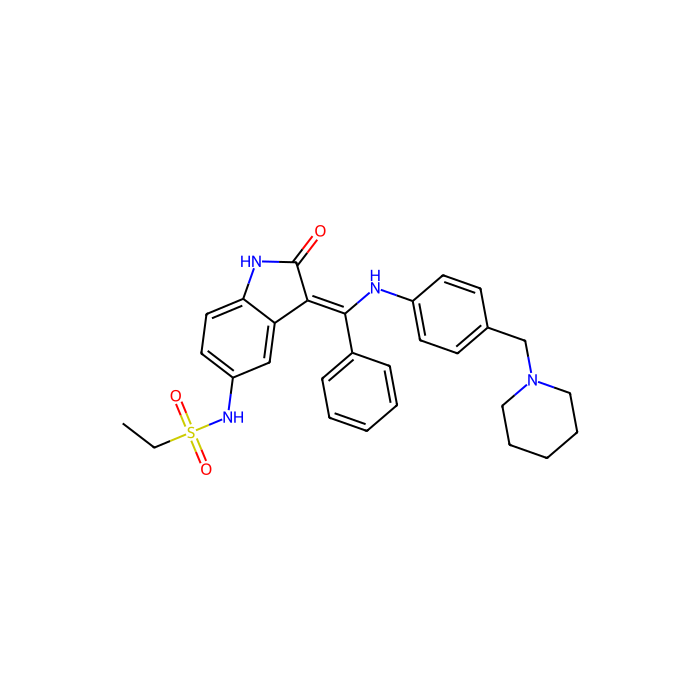
Hesperadin potently inhibitsAurora BwithIC50of 250 nM in a cell-free assay. It markedly reduces the activity of AMPK, Lck, MKK1, MAPKAP-K1, CHK1 and PHK while it does not inhibit MKK1 activity in vivo.
In vitro
Hesperadin inhibits the ability of immunoprecipitated Aurora B to phosphorylate histone H3 with IC50 of 250 nM and markedly reduces the activity of other kinases (AMPK, Lck, MKK1, MAPKAP-K1, CHK1, and PHK) at a concentration of 1 μM. In contrast, only 20-100 nM of Hesperadin is sufficient to induce the loss of mitotic histone H3-Ser10 phosphorylation in HeLa cells. Hesperadin treatment causes defects in mitosis and cytokinesis, leading to stoppage of proliferation of HeLa cells and polyploidization, which can be specifically ascribed to the inhibition of Aurora B function during the process of chromosome attachment. Hesperadin (100 nM) quickly overrides the mitotic arrest induced by taxol or monastrol but not by nocodazole. Hesperadin and nocodazole treatment in HeLa cells abolishes kinetochore localization of BubR1 and diminishes the intensity of Bub1 at kinetochores, suggesting that Aurora B function is required for efficient kinetochore recruitment of BubR1 and Bub1, which in turn might be necessary for prolonged checkpoint signaling. Hesperadin prevents the phosphorylation of recombinant trypanosome histone H3 by the T. brucei Aurora kinase-1 (TbAUK1) from pathogenic Trypanosoma brucei with IC50 of 40 nM in vitro kinase assays. Hesperadin significantly inhibits cell growth of cultured infectious bloodstream forms (BF) with IC50 of 48 nM, and only weakly inhibits cell growth of insect stage procyclic forms (PF) with IC50 of 550 nM.
In vivo
Cell Data
cell lines:
Concentrations:Final concentration ~500 nM
Incubation Time:24 and 48 hours
Powder Purity:≥99%
Documento abrangente sobre perigos, manuseamento, armazenamento e conformidade regulamentar.
<<<<<<< HEAD Baixar SDS → ======= Baixar SDS → >>>>>>> release248-p3Dados de qualidade específicos do lote. Introduza o número de lote para obter o COA exato.
Consultar COA →Resumo de referência rápida das especificações e aplicações do produto.
Ver ficha técnica →Atributos de qualidade completos e critérios de aceitação para este grau.
Ver folha de especificações →| Activity Type | Activity Value -log(M) | Mechanism of Action | Activity Reference | Publications (PubMed IDs) |
|---|
| Solubilidade | Solubility (25°C) In vitro DMSO: 86 mg/mL (200.22 mM); Ethanol: 86 mg/mL (200.22 mM); Water: Insoluble; |
|---|---|
| Ponto de fusão (°C) | >226°C |
No vendor-validated protocols are provided for this specific item. The following is general, non-item-specific guidance for deploying small-molecule ligands in research assays. Optimize for your system.
These procedures are suggestions only and should be validated in your laboratory.
Scope: The following provides general, literature-level context for small-molecule ligands used to interrogate mitotic kinase pathways. It is not item-specific potency/target data. Consult primary literature and perform in-house validation for your system.
Important: No medical or therapeutic claims are made. This product is for research use only. For precise target identity, selectivity metrics, and potency values for the specific lot, consult the CoA and independently curated literature sources.
This item is not a buffering reagent. However, appropriate buffer systems are critical when deploying it in biochemical or cell-based assays.
General buffer guidance (assay context; not item-specific):
Always validate that buffer components do not chelate essential cofactors or interfere with detection (fluorescence/absorbance) in your specific assay.
Because this product is a bioactive small molecule primarily used as a research ligand, “green alternatives” relate to solvent and workflow choices rather than replacing the compound itself.
Greener solvent considerations for solution preparation (general):
Comparison (general guidance):
Operational practices to enhance sustainability:
This product is supplied strictly for research use only and is not intended for human or veterinary use in drugs, diagnostics, or clinical applications.
Formulation and development context (general, non-clinical):
Regulatory note:
Item-specific properties provided in Product Data:
Literature/general expectations for small-molecule screening compounds (for planning only; verify with CoA/SDS):
Practical notes for handling small-molecule library members (general):
Always defer to the SDS for authoritative physical/chemical hazard data and the CoA for lot-specific specs.
What Moligand™ implies (general description of grade and intended use):
Analytical considerations for users:
Regulatory note: This product is for research use only and is not intended for human or animal therapeutic, diagnostic, or clinical applications.
This product is supplied as a bioactive small molecule for screening and target interrogation, not as a synthetic reagent. Consequently, traditional organic reaction applications (e.g., cross-coupling, Grignard, oxidations) are not the primary use case for this item.
Research application contexts (general, non-clinical):
If you require a reagent for synthetic transformations, consider selecting from our catalog of building blocks, catalysts, and solvents designed for preparative chemistry. For this item, prioritize sections on Solvent Selection, Biological Roles, Application Protocols, and Storage.
Not primarily applicable: This product is a bioactive small molecule intended for screening and assay use, not for performing synthetic transformations.
Assay preparation conditions (general guidance; not item-specific):
For information on actual chemical reaction conditions (solvent, catalysts, temperatures) pertaining to the synthesis of related scaffolds, consult medicinal chemistry literature; such data are not part of this product specification.
GHS/Hazard details in Product Data:
General laboratory safety guidance for small-molecule bioactives (not substance-specific; follow your institution’s EHS policies):
Authoritative information (hazards, exposure limits, spill/cleanup, disposal) must be taken from the substance-specific SDS accompanying this product.
Applicability: As a bioactive small molecule for screening, solvent selection centers on reliable stock solution preparation and compatible assay dilution.
General solvent guidance for small-molecule ligands (literature/practice-based):
Comparison (general):
Practical tips:
Item-specific storage/shipping (from Product Data):
General guidance for reconstitution and handling (not item-specific; follow CoA/SDS and internal SOPs):
For any lot-specific reconstitution solvent recommendations, concentration limits, or stability windows, consult the accompanying CoA and SDS.
Brief overview: Hesperadin is a bioactive small molecule supplied as part of Aladdin's Moligand™ collection for research and screening.
Note: Do not use literature depictions as a substitute for the CoA/Spec Sheet when performing calculations or regulatory documentation.
This material is provided as a finished small-molecule ligand for biological research. It is not commonly employed as a synthetic reagent or building block.
General synthetic chemistry perspective (informational):
If you require building blocks or catalysts for assembling related scaffolds, browse Aladdin’s heteroaryl halides, amide coupling reagents, and cross-coupling ligands.
Item-specific target, selectivity, and potency details are Not specified for this item; refer to CoA/Spec Sheet and primary literature.
General note:
User guidance:
No claims are made here regarding specific biological targets for this catalog item.
O nosso guia de seleção de graus abrange pureza, estado do estabilizador e adequação à aplicação para todas as variantes do nosso catálogo.
Ver o guia de graus Moligand™ →