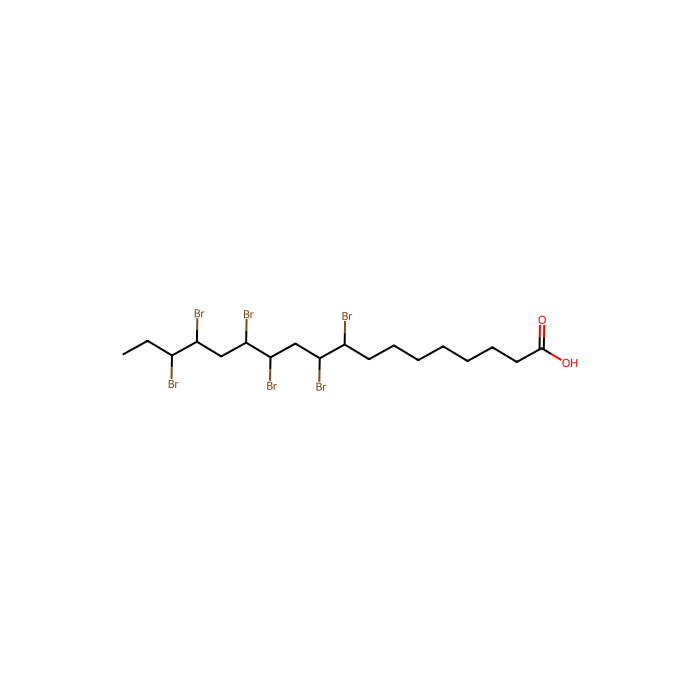
This compound belongs to the class of organic compounds known as long-chain fatty acids. These are fatty acids with an aliphatic tail that contains between 13 and 21 carbon atoms.
External Descriptors
Not available
1. Djoumbou Feunang Y, Eisner R, Knox C, Chepelev L, Hastings J, Owen G, Fahy E, Steinbeck C, Subramanian S, Bolton E, Greiner R, and Wishart DS. ClassyFire: Automated Chemical Classification With A Comprehensive, Computable Taxonomy. Journal of Cheminformatics, 2016, 8:61.
Determine the necessary mass, volume, or concentration for preparing a solution.
Dilution Calculator
Determine the dilution needed to prepare a stock solution.
Reconstitution Calculator
Revisões
Avaliações dos Clientes
Application Protocols
Not applicable. No tested biological assay applications (e.g., WB, IHC, IF, FC) are associated with this chemical. For chemical transformations, see the Synthetic Utility and Reaction Conditions sections for general laboratory guidance.
If preparing solutions or formulations for materials testing:
Weigh accurately under a dry atmosphere if hygroscopicity is a concern (not specified for this item; refer to CoA/Spec Sheet).
Dissolve in an appropriate organic solvent (e.g., DCM, DMF, toluene) with mild warming and stirring; filter through PTFE if clarity is required.
Record exact solvent composition, concentration, and any additives to ensure reproducibility.
Biological Roles
This product is a synthetic, highly brominated long‑chain carboxylic acid and is not an endogenous metabolite.
General considerations (literature/general):
Endogenous relevance: Stearic acid is a natural fatty acid, but extensive bromination creates a non‑natural molecule lacking known physiological roles in primary metabolism.
Biophysical behavior: Like other long‑chain amphiphiles, the carboxylate salt forms could associate with membranes or micelles in model systems; however, the presence of multiple bromine atoms markedly alters lipophilicity, polarizability, and possible interactions compared with natural fatty acids.
Biodegradation/persistence: Polybrominated organics often display reduced biodegradability. Environmental fate and bioconcentration potential should be evaluated experimentally for any specific application; manage strictly as a research chemical with appropriate containment.
Use guidance:
No medical, diagnostic, or therapeutic uses are indicated. For research use only (as provided in the product data). If employing in biochemical or biophysical assays (e.g., studying halogen effects on membrane analogs), validate purity and confirm absence of interfering stabilizers or residual reagents.
Documentation:
If any biological testing is planned, consult institutional biosafety committees and ensure compliance with chemical safety policies for halogenated compounds. Generate fresh working solutions and dispose of all residues as hazardous chemical waste.
Buffer Applications
Not typically applicable. Hexabromostearic Acid is a hydrophobic, brominated fatty acid derivative with negligible aqueous solubility in its free acid form, and it is not used as a buffering agent.
Practical notes (if aqueous work is required in research contexts):
To handle in water‑based systems, convert to a soluble salt (e.g., sodium/potassium carboxylate) or prepare emulsions/micelles using surfactants/organic cosolvents. Control pH > pKa of the carboxyl group to favor ionic forms, recognizing that heavy halogenation can influence apparent acidity and aggregation.
For any pH‑controlled studies, choose a conventional buffer system appropriate to your pH (e.g., phosphate, Tris, HEPES) and dissolve Hexabromostearic Acid in a compatible cosolvent (DMSO, DMF) prior to dilution, keeping final organic content within assay limits.
For buffer recipes, capacities, and ionic strengths, rely on standard buffering agents; this compound itself is not recommended for buffering purposes.
Green Alternatives
Context: Brominated organics are scrutinized for persistence and ecotoxicity. When project goals allow, consider alternatives or design choices that minimize environmental burden while meeting performance targets.
Potential alternatives (literature/general):
Non‑halogenated flame‑retardant strategies: Phosphorus‑based (e.g., DOPO derivatives), nitrogen‑phosphorus synergists, inorganic hydroxides (Al(OH)3, Mg(OH)2), or mineral/char‑promoting fillers. These may reduce concerns associated with brominated additives.
Structural alternatives: Long‑chain carboxylic acids bearing phosphorus or silicon functionalities to impart flame retardancy without halogens.
Process alternatives: Reactive incorporation (covalently attach FR units into polymer backbones) to reduce migration compared with additive brominated systems.
Comparison highlights (general):
Efficacy: Brominated systems often achieve flame performance at lower loadings but may raise concerns about smoke/toxic byproducts; phosphorus/inorganic systems may require higher loadings but can reduce halogenated emissions.
Compatibility: Brominated fatty acid esters can be compatible with hydrophobic matrices; inorganic fillers may impact mechanical properties and processing temperatures.
Regulatory landscape: Many organizations encourage halogen‑free designs in consumer applications; align material choices with your end‑use compliance requirements (RoHS/REACH, eco‑labels).
Practical approach:
If Hexabromostearic Acid is used purely as a chemical intermediate in a closed system, evaluate waste minimization and HBr scrubbing. For formulation screening, benchmark halogen‑free candidates in parallel and document trade‑offs in loading, mechanicals, and thermal stability.
Pharmaceutical Uses
Not used as a pharmaceutical active ingredient, and no pharmacopeial monograph is indicated for this product.
General formulation/context (literature/general):
Halogenated long‑chain carboxylic acids are not common excipients due to safety, environmental, and regulatory considerations. If investigated in pre‑formulation or materials R&D (e.g., as a reactive intermediate for specialty polymers or coatings associated with devices), usage should remain in nonclinical, non‑therapeutic contexts.
If exploring material compatibility (e.g., brominated fatty acid esters in polymer matrices), assess extractables/leachables, thermal stability, and potential for halogen release under processing conditions.
Compliance note:
Research Use Only (as stated in the product data). Not for human or veterinary use, diagnostic procedures, or as a component in drug products.
Physical Properties
Item-specific numerical specifications:
Appearance: Not specified for this item; refer to CoA/Spec Sheet.
Molecular weight: Not specified for this item; refer to CoA/Spec Sheet.
Melting point: Not specified for this item; refer to CoA/Spec Sheet.
Boiling point: Not specified for this item; refer to CoA/Spec Sheet.
Density: Not specified for this item; refer to CoA/Spec Sheet.
Refractive index: Not applicable for a solid; if liquid/soft solid, not specified for this item; refer to CoA/Spec Sheet.
Solubility (water/organic): Not specified for this item; refer to CoA/Spec Sheet.
LogP, pKa: Not specified for this item; refer to CoA/Spec Sheet.
General/literature expectations for brominated long‑chain fatty acids (for context only):
Physical state: Typically high‑melting waxy solid or brittle solid owing to heavy bromination and increased intermolecular interactions.
Solubility profile: Expected to be essentially insoluble in water; soluble in chlorinated solvents (e.g., chloroform, dichloromethane), moderately soluble in aromatic hydrocarbons (toluene), and in polar aprotic media like DMF/DMSO upon mild warming. Solubility in low‑polarity ethers/alkanes is often limited compared with the nonbrominated parent.
Thermal behavior: Bromination elevates formula mass and often raises melting range while reducing volatility; thermal decomposition may release HBr/Br2 at elevated temperatures.
Practical notes:
For accurate handling parameters (melting point, assay, residual solvents), consult the item’s Certificate of Analysis (CoA)/Spec Sheet. Validate solubility at small scale; gently warm and sonicate if preparing concentrated stock solutions in high‑boiling polar aprotic solvents.
Quality and Grades
Grade/Purity: Not specified for this item; refer to CoA/Spec Sheet.
Interpretation and guidance (general):
For heavily brominated organics used in R&D and materials development, relevant quality indicators typically include: assay/purity by HPLC/GC or quantitative NMR, bromine content (elemental analysis), acid number (mg KOH/g), residual solvent content (GC), and moisture (Karl Fischer). Because multiple positional/stereoisomers may exist, purity may be reported as “total hexabromostearic acid content” rather than a single isomer—verify the reporting basis in the CoA.
Low‑UV absorbance grades (e.g., HPLC grade solvents) are not applicable here; however, if this material is to be used in polymer/oligomer synthesis or analytical standards, ensure the following (where applicable):
Stabilizers/inhibitors: Not specified for this item; refer to CoA/Spec Sheet. If present, note implications for downstream reactions.
Metals/ash: Not specified for this item; refer to CoA/Spec Sheet. Trace metals can affect catalyzed processes; request data if critical.
Particle size and flow: Not specified; may affect blending into polymer matrices.
Documentation: For regulated research settings, retain batch CoA, SDS, and any method validation used to qualify the material (e.g., NMR spectrum, HRMS). If you require a defined isomer ratio or specific specification limits, contact us for available lots or custom sourcing.
Reaction and Applications
Item-specific manufacturer applications: Not specified for this item; refer to CoA/Spec Sheet.
General research/materials applications (literature/general):
Flame‑retardant chemistry: Hexabrominated fatty acids and their esters have been examined as bromine‑containing components or precursors in polymer formulations and additive packages. The high bromine content provides radical‑trapping in the vapor phase and char promotion when appropriately formulated. Use only for research and evaluation; observe all environmental and safety regulations.
Derivatization platform: The terminal carboxyl group enables straightforward conversion to:
Esters (acid catalysis or coupling reagents; useful for polymerizable monomers when combined with diols/allylic alcohols).
Amides (peptide‑type coupling; surfactant/interfacial studies with brominated tails).
Acid chlorides (SOCl2, oxalyl chloride) for subsequent acylations under mild conditions.
Transformations at C—Br sites: Under controlled conditions, the aliphatic bromides can undergo nucleophilic substitutions (e.g., SN1/SN2 depending on substitution pattern), eliminations (to regenerate alkenes), or reductive debrominations, allowing access to partially brominated analogs or functional handles.
Analytical standards/method development: As a model polybrominated compound for validating extraction, cleanup, and LC/GC‑MS methods (e.g., isotopic patterns of Br for MS tuning), with proper waste management.
Practical tips:
Maintain anhydrous conditions for coupling chemistry; use base scavengers to neutralize HBr released in substitutions/eliminations. When scaling, monitor exotherms due to high halogen content and potential HBr evolution.
Reaction Conditions
Item-specific conditions are not provided for this product; the following are general literature‑style guidelines for transformations of brominated long‑chain carboxylic acids.
Esterification (Fischer):
Solvent: Toluene or toluene/ROH; acid catalyst (p‑TsOH, H2SO4, or sulfonated resin).
Conditions: Reflux with Dean–Stark water removal for 4–24 h. Monitor by IR (disappearance of broad O—H) or GC/MS after derivatization.
Coupling reagent ester/amide formation:
Solvent: DCM, DMF, or mixtures; 0–25 °C for activation, then 25–50 °C.
Reagents: DCC/DMAP or EDCI/DMAP for esters; HATU/DIPEA or EDCI/HOBt (observe safety with azabenzotriazoles) for amides.
Notes: Maintain anhydrous conditions; filter urea byproducts (for DCC). Typical times 1–12 h depending on solubility.
Acid chloride route:
SOCl2 (2–5 equiv) with catalytic DMF in DCM or neat; 0–reflux until gas evolution ceases (2–6 h). Distill/exchange solvent, then acylate alcohols/amines at 0–25 °C with base (TEA, pyridine).
Nucleophilic substitution at C—Br:
Solvent: Polar aprotic (DMF/DMSO/MeCN). Nucleophile: RO−, RS−, CN−, N3−, etc.
Conditions: 25–100 °C; times 2–24 h. Add phase‑transfer catalysts for heterogeneous systems. Control for competing eliminations with weaker bases and lower temperatures.
Reductive debromination:
Zn/AcOH (rt–reflux), catalytic hydrogenation (H2, Pd/C, rt–50 °C), or radical conditions (AIBN, Bu3SnH; tin‑free alternatives preferred for greener practice).
Always validate on small scale; characterize products carefully due to possible isomer mixtures. Safety note: neutralize or scrub HBr generated; conduct reactions under efficient ventilation.
Safety and Handling
Item-specific hazard information provided: Not specified for this item; refer to SDS.
Signal word: Not specified for this item; refer to SDS.
GHS classification/pictograms/H‑statements: Not specified for this item; refer to SDS.
General safety guidance for brominated long‑chain carboxylic acids (literature/general):
Potential hazards: May cause skin/eye irritation; dust may cause respiratory irritation. Brominated organics can be harmful to aquatic life. Thermal decomposition can release HBr/Br2 and irritating fumes.
PPE: Laboratory coat, nitrile gloves (change regularly), safety goggles/face shield. Handle powders in a fume hood to avoid dust inhalation.
Handling: Avoid generating dust. Use local exhaust ventilation. Prevent environmental release; collect waste in halogenated‑organic waste streams.
Incompatibilities: Strong bases (can form soaps and promote elimination), strong oxidizers, strong reducing agents. Avoid prolonged heating above decomposition temperatures.
First aid (overview; follow institutional SOPs):
Skin: Wash with soap/water; remove contaminated clothing.
Eyes: Rinse cautiously with water for several minutes; seek medical attention.
Inhalation: Move to fresh air; seek medical advice if symptoms persist.
Ingestion: Rinse mouth; do not induce vomiting; seek medical attention.
Fire response: Use CO2, dry chemical, or foam. Combustion/overheating may release HBr/Br2—firefighters should use self‑contained breathing apparatus.
Always consult the product’s SDS for authoritative hazard classification, exposure limits, and emergency procedures.
Solvent Selection
Applicability: As a brominated, long‑chain carboxylic acid, solvent choice governs processability, derivatization (ester/amide formation), and analytical workups.
General solvent behavior (literature/general):
Polarity class: Low to medium polarity solute with a polar headgroup and a highly polarizable, heavy halogenated tail.
Expected miscibility/solubility trends:
Water: Negligible solubility; forms soaps/salts with bases.
Good solvents: CHCl3, CH2Cl2, 1,2‑dichloroethane, chlorobenzene; DMF, DMSO, NMP (often with warming); pyridine for acylation chemistry.
Moderate: Toluene/xylene (improve with heat); ethyl acetate may dissolve esters more readily than the free acid.
For coupling reactions (ester/amide): Use polar aprotic media (DMF, DCM) with a base or coupling reagent; pyridine or triethylamine can aid solubilization by forming transient salts.
For purifications: Normal‑phase chromatography with gradient from hexanes/toluene to ethyl acetate/CH2Cl2; add 0.1–1% acetic acid to suppress tailing of the acid.
For analysis: Prepare stock solutions in chlorinated solvents or DMF; filter particulates through PTFE. For potentiometric titrations (acid number), use nonaqueous solvents (isopropanol/toluene mixtures) per ASTM methods.
Comparison (general): Relative to nonbrominated stearic acid, the hexabromo derivative is less soluble in low‑polarity hydrocarbons but more soluble in polarizable chlorinated media due to enhanced dispersion interactions.
Storage and Reconstitution
Storage conditions (from product data): Room temperature. Store tightly closed in a dry, well‑ventilated place away from incompatible materials. Protect from excessive heat and direct sunlight. If long‑term storage is planned, consider desiccation and inert gas headspace as good laboratory practice for halogenated organics.
Shipped in (from product data): Normal.
Appearance: Not specified for this item; refer to CoA/Spec Sheet.
General guidance (literature/general):
Container: Use amber glass with PTFE‑lined cap to minimize moisture ingress and potential interaction with closures.
Stability: Brominated long‑chain acids are typically stable at ambient conditions when dry. Avoid prolonged exposure to bases (can form soaps and promote eliminations) and strong oxidizers/reductants. Thermal decomposition may release HBr/Br2.
Reconstitution/solution preparation:
Choose solvent based on intended use: DCM/CHCl3 for stock solutions; DMF/DMSO for polar applications. Warm gently (30–40 °C) and sonicate if needed.
Target concentrations: Prepare trial stocks (e.g., 10–100 mg/mL) to confirm solubility before scale‑up. Filter through 0.2–0.45 µm PTFE if particulate is present.
For aqueous systems, pre‑dissolve in an organic cosolvent or convert to a salt; add slowly to vigorous stirring to avoid precipitation.
Always consult the product’s CoA and SDS for lot‑specific stability, purity, and handling details. Research use only (as stated).
SMILES: Not specified for this item; refer to CoA/Spec Sheet.
Molecular formula: Not specified for this item; refer to CoA/Spec Sheet.
Molecular weight: Not specified for this item; refer to CoA/Spec Sheet.
General structural description (literature/general):
Hexabromostearic acid is a heavily brominated derivative of a C18 fatty acid backbone. The parent “stearic acid” motif comprises an 18‑carbon, saturated aliphatic chain bearing a terminal carboxylic acid (—CO2H). In hexabromostearic acid, six hydrogens on the hydrocarbon chain are replaced by bromine atoms, yielding multiple C—Br centers distributed along the chain while retaining a terminal carboxyl group.
Functional groups/features: a carboxylic acid headgroup (protic, capable of salt/ester/amide formation) and multiple alkyl bromides (polarizable C—Br bonds, good leaving groups for substitution/elimination under appropriate conditions). No aromatic rings; aliphatic scaffold.
Stereochemistry: Depending on the substitution pattern (literature reports vary by positional isomer), one may encounter vicinal dibromide motifs and new stereocenters at brominated carbons. Commercial materials can be mixtures of positional/stereoisomers unless otherwise specified (not specified for this item).
Notes:
Identity should be confirmed by orthogonal methods appropriate for brominated long‑chain acids (e.g., HRMS with isotopic pattern for Br, 13C/1H NMR in appropriate solvent, IR showing strong C=O ~1700 cm−1, and titration for acid number).
Synthetic Utility
General reactivity profile (literature/general):
Carboxylic acid handle:
Esterification: Fischer esterification (ROH/H+, Dean–Stark) or coupling reagents (DCC/DMAP, EDCI, T3P) to give esters tailored for polymerization (e.g., diols) or surface modification.
Amide formation: Carbodiimide/HOBt or uronium/phosphonium reagents (HATU, PyBOP) with amines; base (DIPEA) improves rates/solubility. Pre‑activation as the acid chloride (SOCl2, (COCl)2) is often effective for hindered substrates.
Anhydride/mixed anhydride formation for onward acylations.
C—Br transformations along the chain:
Nucleophilic substitution: Displace bromide with O/N/S/C nucleophiles under SN2 conditions where accessible; neighboring stereocenters and substitution patterns govern reactivity.
Elimination: Base‑promoted dehydrohalogenation to generate internal alkenes; control of E/Z and polyene formation depends on base strength, solvent, and temperature.
Reductive debromination: Use Zn/AcOH, Bu3SnH/AIBN (radical), or catalytic hydrogenation (Pd/C) to tune bromine content.
Analytical/synthetic handle: The heavy Br isotopic signature simplifies MS tracking during multistep sequences.
Practical guidance:
Solubility can limit homogeneous coupling; employ polar aprotic solvents (DMF, DCM) and phase‑transfer additives if needed. Scavenge HBr with tertiary amines to prevent acid‑catalyzed side reactions.
When targeting defined architectures (e.g., dibromide spacing), consider partial debromination or selective substitution, and rigorously characterize isomer distributions by NMR (including 2D) and HRMS.
Target Specificity
Not applicable. This product is a small‑molecule brominated fatty acid derivative, not an antibody, enzyme, nucleic acid, or affinity reagent. No antigen/epitope specificity, clone, isotype, or species reactivity applies.
We use cookies to ensure the website functions properly and, where permitted, to improve your experience. You can manage your preferences at any time in Settings. Learn more in our Cookie Policy.
Shall we send you a message when we have discounts available?
Remind me later
Thank you! Please check your email inbox to confirm.
Products are supplied to verified businesses, institutions, and qualified professionals for research and development use only. Not for use in humans, animals, diagnosis, or therapy.