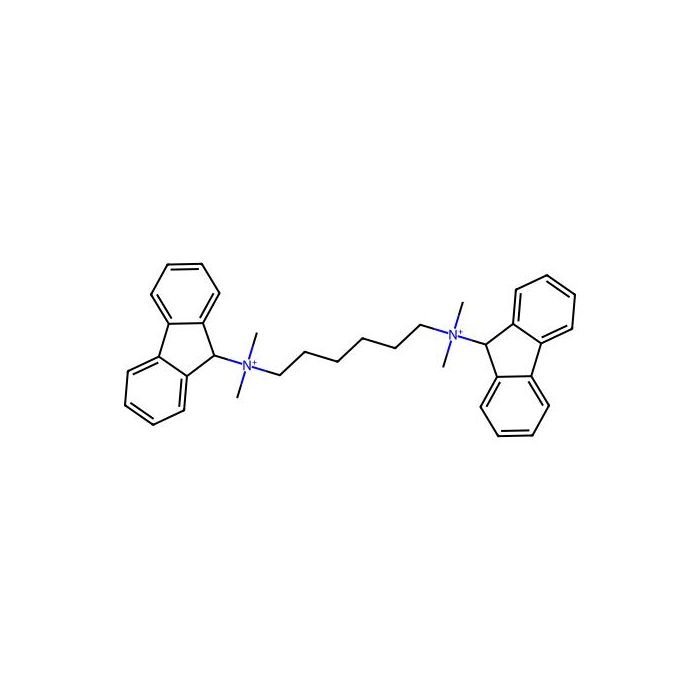
Hexafluronium , CAS No.4844-10-4

CAS: 4844-10-4 Cat. No.: H667796 Fórmula: C36H42N2⁺2 Peso molecular: 502.7 PubChem CID: 3601
Disponível para encomenda
Synonyms
Hexafluronium|hexafluorenium|Hexafluorenium ion|Hexafluorenium cation|1,6-Hexanediaminium, N,N'-di-9H-fluoren-9-yl-N,N,N',N'-tetramethyl-|Hexamethylenebis(fluoren-9-yldimethylammonium)|HEXAFLUORENIUM [VANDF]|HEXAFLURONIUM [WHO-DD]|Ammonium, hexamethylenebis(fluoren-9-yldimethyl-|1,6-Hexanediaminium,N,N'-di-9H-fluoren-9-yl-N,N,N',N'-tetramethyl|N1,N6-di(9H-fluoren-9-yl)-N1,N1,N6,N6-tetramethylhexane-1,6-diaminium
Storage
Room temperature
★
Tamanho
USA
Alemanha (EU)*
Preço
Qtd
1mg
H667796-1mg
Sob encomenda · 8–12 semanas

571,90US$

857,90US$
Gravar 286,00 US$ (33.34%)
5mg
H667796-5mg
Sob encomenda · 8–12 semanas

1999,90US$

2999,90US$
Gravar 1 000,00 US$ (33.33%)
Enter a quantity for the sizes you want to add.

Especificações

Sinónimos
Hexafluronium | hexafluorenium | Hexafluorenium ion | Hexafluorenium cation | 1,6-Hexanediaminium, N,N'-di-9H-fluoren-9-yl-N,N,N',N'-tetramethyl- | Hexamethylenebis(fluoren-9-yldimethylammonium) | HEXAFLUORENIUM [VANDF] | HEXAFLURONIUM [WHO-DD] | Ammonium, hexamethylenebis(fluoren-9-yldimethyl- | 1,6-Hexanediaminium,N,N'-di-9H-fluoren-9-y Show more
Condições de armazenamento de armazenamento
Room temperature
Propriedades do produto
ALogP
7.6
Nomes e identificadores
Sorrisos canónicos
C[N+](C)(CCCCCC[N+](C)(C)C1C2=CC=CC=C2C3=CC=CC=C13)C4C5=CC=CC=C5C6=CC=CC=C46
IUPAC Name
9H-fluoren-9-yl-[6-[9H-fluoren-9-yl(dimethyl)azaniumyl]hexyl]-dimethylazanium
InChIKey
HDZAQYPYABGTCL-UHFFFAOYSA-N
INCHI
1S/C36H42N2/c1-37(2,35-31-21-11-7-17-27(31)28-18-8-12-22-32(28)35)25-15-5-6-16-26-38(3,4)36-33-23-13-9-19-29(33)30-20-10-14-24-34(30)36/h7-14,17-24,35-36H,5-6,15-16,25-26H2,1-4H3/q+2
SMILES isoméricas
C[N+](C)(CCCCCC[N+](C)(C)C1C2=CC=CC=C2C3=CC=CC=C13)C4C5=CC=CC=C5C6=CC=CC=C46
PubChem CID
3601
Peso molecular
502.7

Dados avançados

Taxonomic Classification

Taxonomy Tree

KingdomOrganic compounds
SuperclassOrganic nitrogen compounds
ClasseOrganonitrogen compounds
SubclassQuaternary ammonium salts
Intermediate Tree Nodes Not available
Direct ParentHexamethonium compounds
Alternative Parents Fluorenes  Aralkylamines  Tetraalkylammonium salts  Organopnictogen compounds  Organic salts  Hydrocarbon derivatives  Organic cations  
Molecular FrameworkAromatic homopolycyclic compounds
Substituents Hexamethonium - Fluorene - Aralkylamine - Benzenoid - Tetraalkylammonium salt - Organopnictogen compound - Hydrocarbon derivative - Organic salt - Amine - Organic cation - Aromatic homopolycyclic compound
DescriçãoThis compound belongs to the class of organic compounds known as hexamethonium compounds. These are organic compounds containing a N,N,N,N',N',N'-hexamethylhexane-1,6-diaminium moiety.
External Descriptors Not available
Estrutura 3D
Modelo de Estrutura Química Interativa


Alvos associados (humanos)
F2 Tclin Thrombin (11687 Activities)
Activity TypeRelationActivity valueUnitsAction TypeJournalPubMed IddoiAssay Aladdin ID
ESR1 Tclin Estrogen receptor alpha (17718 Activities)
Activity TypeRelationActivity valueUnitsAction TypeJournalPubMed IddoiAssay Aladdin ID
PGR Tclin Progesterone receptor (8562 Activities)
Activity TypeRelationActivity valueUnitsAction TypeJournalPubMed IddoiAssay Aladdin ID
CHRM2 Tclin Muscarinic acetylcholine receptor M2 (10671 Activities)
Activity TypeRelationActivity valueUnitsAction TypeJournalPubMed IddoiAssay Aladdin ID
HTR1A Tclin Serotonin 1a (5-HT1a) receptor (14969 Activities)
Activity TypeRelationActivity valueUnitsAction TypeJournalPubMed IddoiAssay Aladdin ID
ADRA2A Tclin Alpha-2a adrenergic receptor (9450 Activities)
Activity TypeRelationActivity valueUnitsAction TypeJournalPubMed IddoiAssay Aladdin ID
AR Tclin Androgen Receptor (11781 Activities)
Activity TypeRelationActivity valueUnitsAction TypeJournalPubMed IddoiAssay Aladdin ID
CHRM1 Tclin Muscarinic acetylcholine receptor M1 (12690 Activities)
Activity TypeRelationActivity valueUnitsAction TypeJournalPubMed IddoiAssay Aladdin ID
GABRA1 Tclin GABA receptor alpha-1 subunit (399 Activities)
Activity TypeRelationActivity valueUnitsAction TypeJournalPubMed IddoiAssay Aladdin ID
MAOA Tclin Monoamine oxidase A (11911 Activities)
Activity TypeRelationActivity valueUnitsAction TypeJournalPubMed IddoiAssay Aladdin ID
DRD1 Tclin Dopamine D1 receptor (9720 Activities)
Activity TypeRelationActivity valueUnitsAction TypeJournalPubMed IddoiAssay Aladdin ID
ACHE Tclin Acetylcholinesterase (18204 Activities)
Activity TypeRelationActivity valueUnitsAction TypeJournalPubMed IddoiAssay Aladdin ID
PTGS1 Tclin Cyclooxygenase-1 (9233 Activities)
Activity TypeRelationActivity valueUnitsAction TypeJournalPubMed IddoiAssay Aladdin ID
SLC6A2 Tclin Norepinephrine transporter (10102 Activities)
Activity TypeRelationActivity valueUnitsAction TypeJournalPubMed IddoiAssay Aladdin ID
ADORA1 Tclin Adenosine A1 receptor (17603 Activities)
Activity TypeRelationActivity valueUnitsAction TypeJournalPubMed IddoiAssay Aladdin ID
SLC6A4 Tclin Serotonin transporter (12625 Activities)
Activity TypeRelationActivity valueUnitsAction TypeJournalPubMed IddoiAssay Aladdin ID
ADRA1A Tclin Alpha-1a adrenergic receptor (8359 Activities)
Activity TypeRelationActivity valueUnitsAction TypeJournalPubMed IddoiAssay Aladdin ID
OPRM1 Tclin Mu opioid receptor (19785 Activities)
Activity TypeRelationActivity valueUnitsAction TypeJournalPubMed IddoiAssay Aladdin ID
DRD3 Tclin Dopamine D3 receptor (14368 Activities)
Activity TypeRelationActivity valueUnitsAction TypeJournalPubMed IddoiAssay Aladdin ID
SLC6A3 Tclin Dopamine transporter (10535 Activities)
Activity TypeRelationActivity valueUnitsAction TypeJournalPubMed IddoiAssay Aladdin ID
PDE3A Tclin Phosphodiesterase 3A (3309 Activities)
Activity TypeRelationActivity valueUnitsAction TypeJournalPubMed IddoiAssay Aladdin ID
HTR2B Tclin Serotonin 2b (5-HT2b) receptor (10323 Activities)
Activity TypeRelationActivity valueUnitsAction TypeJournalPubMed IddoiAssay Aladdin ID
TBXA2R Tclin Thromboxane A2 receptor (5717 Activities)
Activity TypeRelationActivity valueUnitsAction TypeJournalPubMed IddoiAssay Aladdin ID
PDE4A Tclin Phosphodiesterase 4A (1943 Activities)
Activity TypeRelationActivity valueUnitsAction TypeJournalPubMed IddoiAssay Aladdin ID
ADORA3 Tchem Adenosine A3 receptor (15931 Activities)
Activity TypeRelationActivity valueUnitsAction TypeJournalPubMed IddoiAssay Aladdin ID
HRH3 Tclin Histamine H3 receptor (10389 Activities)
Activity TypeRelationActivity valueUnitsAction TypeJournalPubMed IddoiAssay Aladdin ID
Mecanismos de ação
Certificados(CoA,COO,BSE/TSE e Mapa de Análise)
C of A & Other Certificates(BSE/TSE, COO):
Analytical Chart:
Propriedades químicas e físicas
Peso molecular502.700 g/mol
XLogP37.600
Hydrogen Bond Donor Count0
Hydrogen Bond Acceptor Count0
Rotatable Bond Count9
Exact Mass502.335 Da
Monoisotopic Mass502.335 Da
Topological Polar Surface Area0.000 Ų
Heavy Atom Count38
Formal Charge2
Complexity663.000
Isotope Atom Count0
Defined Atom Stereocenter Count0
Undefined Atom Stereocenter Count0
Defined Bond Stereocenter Count0
Undefined Bond Stereocenter Count0
The total count of all stereochemical bonds0
Covalently-Bonded Unit Count1
Calculadoras de soluções
Revisões

Avaliações dos Clientes

Application Protocols

No tested applications or recommended dilutions are provided for this item.

General laboratory guidance (tool compound context):

  • Stock solutions: Prepare at 10–100 mM in water or DMSO depending on solubility; sterile-filter if using in cell-based systems. Record exact concentration by gravimetry and confirm by LC where feasible.
  • Working solutions: Dilute into assay buffer immediately before use; keep DMSO ≤0.5–1% v/v in biological assays to minimize solvent effects.
  • Controls: Include vehicle controls and, where relevant, a known comparator compound from the same mechanistic class.
  • Adsorption/containers: Use low-binding polypropylene or glass; verify recovery by analyzing pre- and post-transfer concentrations.

For analytical use:

  • LC method development: Consider ion-pairing or mixed-mode stationary phases to retain highly cationic analytes; adjust mobile-phase ionic strength and pH accordingly.

Please contact technical support with your intended application to receive tailored protocol suggestions.

Biological Roles

Item-specific biological details are not provided in the Product Data. The following reflects general, literature-level context for quaternary ammonium tool compounds such as hexafluronium, for research use only.

  • Mechanistic class (literature/general): Bis-quaternary ammonium cations can interact with anionic sites on biomolecules and membranes. Certain members of this class are studied as modulators of cholinergic neurotransmission in vitro due to their ability to bind nicotinic acetylcholine receptor-associated sites. No therapeutic claims are made for this catalog item.
  • Physicochemical behavior: Permanent positive charge restricts passive membrane permeation; observed biological effects in cells/tissues often reflect extracellular or junctional interactions unless active transport or barrier disruption is present.
  • Binding considerations: Ionic strength, presence of competing cations, and polyanions (e.g., heparin, nucleic acids) can significantly alter apparent potency via ion pairing.
  • Assay implications: Careful control of buffer composition (pH, salts), temperature, and surfactants is essential to obtain reproducible pharmacological readouts with cationic tool compounds.

Important notes:

  • Exact potency, selectivity, and receptor subtype interactions for this SKU are not specified; consult primary literature and validate in your system.
  • For biochemical and electrophysiological studies, document lot details and verify concentration by analytical methods to avoid adsorption losses or ion-pair artifacts.
Buffer Applications

This product is not a buffering agent and is not typically used to prepare buffer systems.

Practical guidance (general):

  • When using hexafluronium in biochemical assays, select a buffer that maintains ionic strength without precipitating cationic species. HEPES, MOPS, or Tris at 10–50 mM are common choices. Avoid high concentrations of phosphate or anionic detergents if precipitation or loss of free cation is observed.
  • Maintain pH near physiological (e.g., 7.2–7.4) for receptor-binding studies, unless your experimental design dictates otherwise.

Item-specific buffer recipes, pKa data, and buffering ranges do not apply to this compound.

Green Alternatives

Green chemistry considerations for quaternary ammonium salts focus on solvent selection, process mass intensity, and aquatic toxicity.

  • Safer solvents: Prefer water or aqueous buffers over aprotic polar solvents when feasible. If organic solvent is needed, ethanol or isopropanol are generally greener than DMF/DMSO (use only where compatible with stability/solubility).
  • Minimizing environmental release: Quaternary ammonium compounds may show aquatic toxicity. Implement closed handling, spill prevention, and appropriate waste segregation (do not discharge to drains).

Comparison (general guidance):

  • Water vs DMSO: Water offers best EHS profile; DMSO provides superior solubility but is less preferred from a green standpoint. Balance assay needs with minimal DMSO carryover (<0.5–1% v/v typical in bioassays).
  • Ethanol vs acetonitrile: Ethanol is preferable environmentally; acetonitrile may be needed for LC methods—minimize volumes and recover via solvent management.

Operational tips:

  • Use small-scale stock solutions with high concentration to reduce total solvent use.
  • Evaluate solid dispensing (gravimetric dosing) to avoid pre-dissolution where practical.
  • Consider alternative tool compounds with comparable mechanistic utility but improved biodegradability when your research question allows (screen literature for cationic motifs with lower inherent aquatic hazard).
Pharmaceutical Uses

No excipient or pharmacopeial status is provided for this item, and it is offered strictly for research use only.

General formulation context (not specific to this SKU):

  • Quaternary ammonium compounds may be explored as reference standards or process controls in analytical methods supporting pharmaceutical research.
  • Their permanent charge and water solubility can make them suitable for aqueous stock solutions evaluated in vitro; however, they are not typical formulation excipients.

Compliance notes:

  • Do not use in human or veterinary applications.
  • No claims are made regarding GMP status, compendial compliance (USP/EP/JP), or suitability for clinical manufacturing.

If you require a certified reference material (CRM) or pharmacopeial-grade standard, please contact us with your regulatory requirements.

Physical Properties

Item-specific specifications have not been provided in the Product Data. Use the CoA/Spec Sheet for definitive values measured for this lot.

  • Appearance: Not specified for this item; refer to CoA/Spec Sheet.
  • Grade/Purity: Not specified for this item; refer to CoA/Spec Sheet.
  • Molecular weight (item-specific): Not specified for this item; refer to CoA/Spec Sheet.
  • Molecular formula (item-specific): Not specified for this item; refer to CoA/Spec Sheet.
  • Melting point (literature): Quaternary ammonium halide salts are often crystalline solids with moderate-to-high melting points; specific value for hexafluronium salt form varies by counterion and hydrate state (consult primary literature and the SDS).
  • Boiling point: Not applicable for ionic salts; decomposition typically occurs before boiling (general).
  • Density: Not specified for this item; refer to CoA/Spec Sheet.
  • Solubility (general/literature): Bis-quaternary ammonium salts typically show high solubility in water and polar protic solvents (e.g., water, methanol, ethanol) and poor solubility in nonpolar media; the exact profile depends on the counterion and hydration.
  • LogP/logD (general): Permanently cationic salts display low logP; distribution ratios are pH- and counterion-dependent for paired systems.
  • pKa: Not applicable to the quaternary centers (permanently charged). Any ancillary acid/base functionality would define additional equilibria (literature-dependent).
  • Refractive index: Not applicable to solids; not specified for this item.

Important: For use-planning and safety, rely on the item’s CoA/Spec Sheet and SDS rather than literature generalizations.

Quality and Grades

Item-specific quality attributes have not been provided in the Product Data.

  • Grade/Purity: Not specified for this item; refer to CoA/Spec Sheet.
  • Stabilizers/Inhibitors: Not specified for this item; refer to CoA/Spec Sheet.

Guidance (general chemistry knowledge):

  • Analytical vs. bio-reagent grade: For bioassay or receptor-binding research, higher purity with stringent controls on residual halides/organic impurities and low bioburden is preferred. Analytical reagent (AR) grade focuses on assay purity and inorganic impurity limits.
  • Counterion form: Hexafluronium is typically supplied as a defined halide (e.g., bromide). Identity of the counterion impacts assay conditions (ionic strength, solubility) and should match your experimental design.
  • Documentation: Request CoA including identity confirmation (NMR, HRMS/elemental analysis, halide assay), residual solvent profile, and water content, where relevant to your workflow.

Best practices:

  • Verify salt form and hydration state before quantitative studies.
  • If using for chromatography reference or as a pharmacological tool compound, ensure UV profile and impurity limits align with method sensitivity.
  • For reproducibility, document lot number and any pre-use conditioning (e.g., drying, trituration) applied in your lab.
Reaction and Applications

Hexafluronium is most commonly used as a research tool compound rather than as a synthetic intermediate. Item-specific application notes are not provided; the following are general considerations for quaternary ammonium salts.

Applications (general chemistry knowledge):

  • Ion-pairing agent: Permanently charged cations can modulate retention in ion-pair chromatography or facilitate phase-transfer of anionic species (though bis-quaternary structures can be too hydrophilic for classical PTC in nonpolar media).
  • Probe/standard: Used as a reference standard or positive control in receptor-binding and functional assays (strictly for research use; no medical claims).
  • Counterion exchange studies: Useful for assessing halide/counterion effects on solubility and interaction with polyanions.

Analytical/assay tips:

  • Prepare fresh aqueous or DMSO stocks; filter (0.22 µm) to remove particulates.
  • Avoid anionic detergents (e.g., SDS) that may form tight ion pairs and reduce free concentration.
  • Monitor concentration by LC-UV if the cation has a suitable chromophore; otherwise use LC-MS.

Not typical uses:

  • It is not commonly employed as a nucleophile/electrophile or radical precursor in synthesis due to the deactivated, fully quaternized nitrogen centers.

Manufacturer applications: Not specified for this item; if you require application verification (bioassay type, reference protocols), contact technical support with your intended use.

Reaction Conditions

No item-specific reaction conditions are provided for this SKU. Hexafluronium is typically a target compound/tool rather than a reagent.

General handling and solution preparation (good laboratory practice):

  • Dissolution: Start with water or DMSO (analytical grade). Sonication or gentle warming (≤40 °C) can aid dissolution if needed; avoid prolonged heating.
  • Filtration: 0.22 µm PTFE or PES filters are suitable for aqueous or DMSO solutions.
  • Stability: Store working solutions refrigerated if used over several days; monitor by LC to detect degradation.

If employing quaternary ammonium salts in catalysis or ion-pair applications (literature guidance):

  • Solvent: Polar protic (water/alcohols) or polar aprotic (DMSO/DMF) depending on the role; avoid strong nucleophiles that may effect counterion exchange leading to impurities in analytical contexts.
  • Temperature: Ambient to mildly elevated (20–50 °C) for dissolution or ion-exchange processes; avoid high temperatures that could induce decomposition.
  • Time: Prepare fresh solutions for bioassays to minimize time-dependent loss via adsorption to plastics or glass.

Always validate any new protocol with a pilot experiment and refer to the SDS and CoA for compatibility limits.

Safety and Handling

Follow institutional chemical hygiene practices when handling quaternary ammonium salts and consult the SDS for authoritative guidance.

  • GHS classification: Not specified for this item; refer to SDS.
  • Signal word / H-statements / Pictograms: Not specified for this item; refer to SDS.

General precautions for cationic surfactant-like, quaternary ammonium compounds (general chemistry knowledge):

  • Potential hazards: May cause irritation to skin, eyes, and respiratory tract. Avoid dust generation. Some quaternary ammonium compounds show aquatic toxicity—prevent environmental release.
  • Personal protective equipment: Lab coat, nitrile gloves, and splash-resistant safety glasses as a baseline; use a fume hood when weighing powders or preparing concentrated solutions.
  • Handling: Minimize dust, avoid inhalation and contact. Use appropriate engineering controls.
  • Incompatibilities: Strong oxidizers and strong bases/acids that may promote degradation of counterions or decomposition. Avoid mixing with anionic surfactants that can form inactive ion pairs/precipitates.
  • First aid (overview): In case of skin/eye contact, rinse with water for at least 15 minutes; remove contaminated clothing. If inhaled, move to fresh air. If ingested, rinse mouth; do not induce vomiting; seek medical attention. Always follow your institution’s protocols.
  • Spill/leak: Avoid dust; collect mechanically and dispose of according to local regulations. Prevent entry to waterways.

Note: Ethers’ peroxide risk, pyrophoricity, etc., do not apply here; the compound class is ionic/quaternary ammonium.

Solvent Selection

Hexafluronium, as a bis-quaternary ammonium salt, is expected to be highly polar and generally water/aqueous-buffer compatible (general chemistry knowledge). Item-specific solubility for this SKU is not provided—confirm with small-scale tests.

Solubility/miscibility tendencies (general):

  • High: Water, aqueous buffers (ionic strength dependent), methanol, ethanol, formamide/DMF, DMSO.
  • Moderate/variable: Acetonitrile, isopropanol (salt- and hydration-dependent).
  • Low: Nonpolar solvents (e.g., hexanes, toluene, diethyl ether).

Selection tips:

  • For bioassay stock solutions, DMSO or water are typical first choices. Prepare concentrated DMSO stocks (e.g., 10–100 mM) then dilute into buffer; monitor for precipitation near the CMC or at high ionic strength.
  • If buffers precipitate the salt (e.g., with high phosphate or in the presence of anionic surfactants), adjust ionic strength or switch to HEPES/Tris.
  • Avoid basic solvents that may promote counterion exchange or decomposition.

Quick comparison (general):

  • Water: preferred for immediate aqueous use; minimal cosolvent artifacts.
  • DMSO: maximal solubilization for stocks; mind final DMSO % in biological assays.
  • Methanol/Ethanol: convenient for analytical prep and LC injections; verify detector compatibility.

Always confirm solubility and stability by a small test, UV, or LC before scaling.

Storage and Reconstitution

Storage conditions for this SKU per Product Data:

  • Storage temperature: Room temperature.
  • Shipped in: Not specified for this item; refer to CoA/Spec Sheet.

General guidance for quaternary ammonium salts:

  • Container: Keep tightly closed in original, light-protective container if supplied; protect from moisture to avoid clumping or hydration changes.
  • Shelf life: Follow the date on the label/CoA. Periodically re-check purity by LC or NMR if the material is stored long term.

Reconstitution (general):

  • Solvents: Water or DMSO are typical first choices. Begin with a small aliquot to confirm solubility, then scale. If preparing aqueous stocks for bioassays, consider sterile filtration (0.22 µm) and store at 2–8 °C for short-term use.
  • Freeze–thaw: If freezing solutions (e.g., at −20 °C in aliquots), avoid repeated freeze–thaw cycles; aliquot into single-use vials.
  • Labeling: Record solvent, concentration, date, and lot number on every aliquot.

Note: Any item-specific attributes such as hydrate form, counterion identity, and water content are not specified here; consult the CoA/Spec Sheet for precise handling directions.

Structure and Identity

Hexafluronium is a synthetic small-molecule, quaternary ammonium-type compound commonly encountered as a halide salt in research settings.

  • SKU: H667796
  • Product name: Hexafluronium
  • CAS: 4844-10-4
  • PubChem CID: 3601 (literature identifier)
  • InChIKey: Not specified for this item; refer to CoA/Spec Sheet.
  • SMILES: Not specified for this item; refer to CoA/Spec Sheet.
  • Molecular formula: Not specified for this item; refer to CoA/Spec Sheet.
  • Molecular weight: Not specified for this item; refer to CoA/Spec Sheet.

Structural features (general chemistry knowledge):

  • Hexafluronium is known in the literature as a bis-quaternary ammonium framework bearing multiple fluorine substituents (hence the name), typically handled as a bromide or similar counterion salt. The cation carries permanent positive charge(s), rendering it highly polar and water-compatible as a salt.
  • 2D description: Two quaternary ammonium centers connected through an aliphatic/heteroatom linker; multiple –CF3 or fluorinated substituents appear on acyl or aryl fragments depending on the salt form reported in literature.

Notes:

  • Exact stereochemistry, ring systems (if any), and definitive atom connectivity for this catalog item are not specified in the provided Product Data. Consult the CoA/Spec Sheet and SDS for the precise structure corresponding to this SKU.
Synthetic Utility

Hexafluronium is not commonly used as a building block for multistep synthesis because its nitrogen centers are fully quaternized and therefore inert to typical nucleophilic/electrophilic transformations.

General roles for quaternary ammonium salts in synthesis (literature):

  • Phase-transfer catalysis (PTC): Many quaternary ammonium salts facilitate transfer of anions between phases; however, highly hydrophilic bis-quaternary structures may be less effective in nonpolar organic media.
  • Ion-pairing in separations: Useful for modulating retention in ion-exchange and ion-pair chromatography during method development.
  • Counterion exchange: Employed in salt metathesis to access alternative counterions with tailored solubility (e.g., exchanging halides for PF6−, BF4−, or organic sulfonates), which may be relevant for materials or analytical applications.

Limitations:

  • Lack of nucleophilicity/basicity due to permanent cationic charge.
  • Thermal decomposition can occur before any constructive chemical transformation.

If your intent is synthetic manipulation, consider using a tertiary amine precursor or structurally related neutral analogs amenable to quaternization in a later step.

Target Specificity

Target/epitope specificity, clone/isotype, and species reactivity are applicable to biological macromolecules (e.g., antibodies), not small molecules. For this product (a small-molecule quaternary ammonium compound), no target specificity data are provided in the Product Data.

  • Item-specific target data: Not specified for this item; refer to literature and validate in your assay system.
  • Recommendation: If using as a pharmacological tool, establish concentration–response relationships and verify off-target profiles appropriate to your research question.

Perguntas frequentes

How should this product be stored?
Store at room temperature.
What are the CAS number, molecular formula and molecular weight?
The CAS Number is 4844-10-4, the molecular formula is C36H42N2?2, and the molecular weight is 502.7 g/mol. InChIKey HDZAQYPYABGTCL-UHFFFAOYSA-N.
What documentation is provided?
Available product documentation, including Certificates of Analysis (COA), Safety Data Sheets (SDS), and specification sheets, is shown in the product document area. Document availability and access follow the current site policy.

Deseja que lhe enviemos uma mensagem quando tivermos descontos disponíveis?

Lembrar-me mais tarde

Obrigado! Por favor, verifique a sua caixa de entrada de e-mail para confirmar.

Ops! As notificações estão desativadas.