GRAU & PUREZAMoligand™?Moligand™ — Aladdin's line of ligands and bioactive small molecules. Use for receptor, pathway, and binding studies needing defined small-molecule tools.≥99%
K-756 is a direct and selective tankyrase ( TNKS ) inhibitor, which inhibits the ADP-ribosylation activity of TNKS1 and TNKS2 with IC 50 s of 31 and 36 nM, respectively.
In Vitro
K-756 is a novel and selective Wnt/β-catenin pathway inhibitor targeting tankyrase (TNKS). TNKS is one of the members of the PARP family (it is also known as PARP5). K-756 binds to the induced pocket of TNKS and inhibits its enzyme activity. To study the isoform selectivity of K-756, the PARP family enzyme inhibitory activity at 10 μM is evaluated. K-756 inhibits TNKS1 and TNKS2 by 97% and 100%, respectively. In contrast, the inhibitory activity of K-756 against PARP1, PARP2, PARP3, PARP6, PARP7, and PARP11 is less than 13%. K-756 inhibits the cell growth of APC-mutant colorectal cancer COLO 320DM and SW403 cells by inhibiting the Wnt/β-catenin pathway. K-756 strongly inhibits the reporter activity in DLD-1/TCF-Luc cells with an IC 50 of 110 nM, but does not inhibit DLD-1/mtTCF-Luc cells, even at 1,000 nM. APC-mutant colorectal cancer cell line COLO 320DM and SW403 cells are treated with K-756 and after 144 hours, cell growth inhibition is measured by an XTT assay. The application of K-756 inhibits the cell growth of COLO 320DM with a GI 50 of 780 nM. K-756 also inhibits SW403 with a GI 50 of 270 nM. MCE has not independently confirmed the accuracy of these methods. They are for reference only.
In Vivo
DLD-1/TCF-Luc cell xenografts are created in SCID mice. Vehicle (0.5% MC400) or K-756 is administered orally once a day for 3 days at 100, 200, and 400 mg/kg. The Wnt/β-catenin signal inhibition in the tumor is detected by measuring FGF20 and LGR5 and luciferase activity. The expression of FGF20 and reporter activity are significantly decreased at doses of 100 mg/kg and above at 3-day administration. The expression of LGR5 is significantly decreased at doses of 200 mg/kg and above at 3-day administration. The maximum inhibitory activity is reached with the administration of K-756 at a dose of 400 mg/kg at 3-day administration. The Wnt/β-catenin signal inhibition at a dose of 400 mg/kg is observed from 1-day administration . MCE has not independently confirmed the accuracy of these methods. They are for reference only.
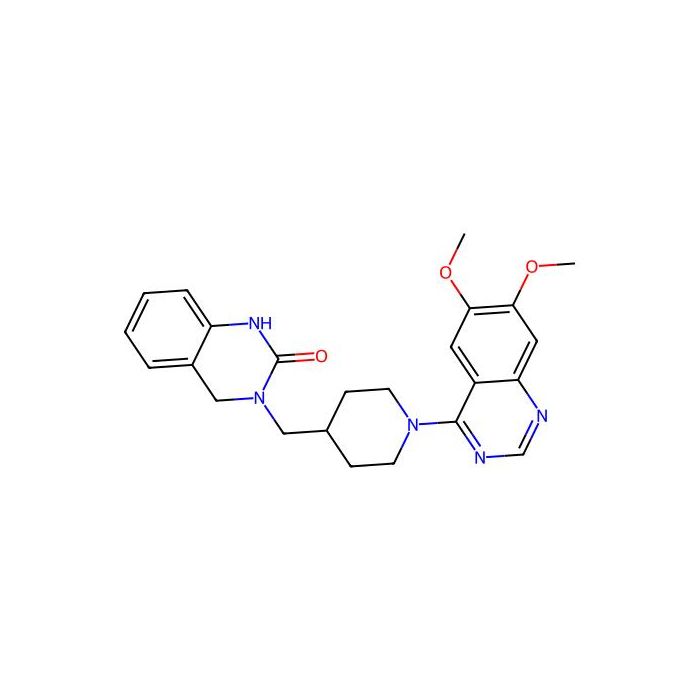
3-{[1-(6,7-dimethoxyquinazolin-4-yl)piperidin-4-yl]methyl}-3,4-dihydroquinazolin-2(1H)-one | 3-[1-(6,7-Dimethoxy-quinazolin-4-yl)-piperidin-4-ylmethyl]-3,4-dihydro-1H-quinazolin-2-one | 3-[[1-(6,7-Dimethoxyquinazolin-4-Yl)piperidin-4-Yl]methyl]-1,4-Dihydroquinazolin-2-One | K-756 | 3-[[1-(6,7-Dimethoxy-4-quinazolinyl)-4-piperidinyl]methyl Show more
Especificações e pureza
Moligand™,≥99%
Mecanismos bioquímicos e fisiológicos
K-756 is a direct and selective tankyrase ( TNKS ) inhibitor, which inhibits the ADP-ribosylation activity of TNKS1 and TNKS2 with IC 50 s of 31 and 36 nM, respectively.
Condições de armazenamento de armazenamento
Store at -20°C
Enviado em
Ice chest + Ice pads
Este produto requer transporte de cadeia fria. Serviços terrestres e outros serviços econômicos não estão disponíveis.
This compound belongs to the class of organic compounds known as quinazolinamines. These are heterocyclic aromatic compounds containing a quianazoline moiety substituted by one or more amine groups.
External Descriptors
Not available
1. Djoumbou Feunang Y, Eisner R, Knox C, Chepelev L, Hastings J, Owen G, Fahy E, Steinbeck C, Subramanian S, Bolton E, Greiner R, and Wishart DS. ClassyFire: Automated Chemical Classification With A Comprehensive, Computable Taxonomy. Journal of Cheminformatics, 2016, 8:61.
Determine the necessary mass, volume, or concentration for preparing a solution.
Dilution Calculator
Determine the dilution needed to prepare a stock solution.
Reconstitution Calculator
Revisões
Avaliações dos Clientes
Application Protocols
No tested applications or recommended protocols are provided for K-756 in the Product Data.
Assay types (WB, IHC, IF, FC, enzymatic, cellular), working concentrations, and positive controls: Not specified for this item; refer to CoA/Spec Sheet and develop assay-specific SOPs.
Please design protocols aligned with your platform standards and validate performance empirically.
Biological Roles
Item-specific biological targets or pathways are not provided for K-756. The following notes describe general roles of small-molecule ligands in research settings (not item-specific claims).
Target modulation: Small molecules can act as reversible binders that modulate protein conformation and activity, enabling functional interrogation of enzymes, receptors, ion channels, and transporters.
Pathway mapping: Perturbation with chemical ligands supports chemical genetics, allowing temporal control not readily achieved with genetic knockouts.
Probe development: Screening ligands can be elaborated into affinity probes (e.g., with photo-crosslinkers or biotin/alkyne tags) for target identification by chemoproteomics.
Pharmacology surrogates: Preclinical models (biochemical and cellular) use ligands to assess on-target vs off-target effects and to establish exposure–response relationships.
Complementarity to biologics: Small molecules access intracellular targets and allosteric sites often inaccessible to macromolecules, offering orthogonal mechanism exploration.
Caveats
Without target specificity, implement broad counterscreens (cytotoxicity, redox/thiol reactivity, aggregation, reporter interference) before drawing mechanistic conclusions.
Verify chemical stability in assay buffers and biological matrices to avoid misattribution of activity to degradation products.
Buffer Applications
No dedicated buffer system is specified for K-756.
General assay-buffer guidance for small-molecule ligands (not item-specific)
Maintain DMSO carryover at ≤0.1–1% v/v depending on cell/assay tolerance.
Choose buffers that maintain solubility and target stability: HEPES (pH 7.2–7.6), PBS (pH 7.2–7.4), Tris (pH 7.4–8.0) are common. Avoid buffers that strongly interact with metal-dependent enzymes if metal chelation is suspected.
Include 0.005–0.05% non-ionic surfactant (e.g., Tween-20) where acceptable to mitigate compound aggregation.
For pH-sensitive scaffolds, conduct a pH solubility profile (e.g., pH 5.5, 7.4, 8.5) to guide buffer choice.
Recipes (generic)
Example HEPES buffer: 25–50 mM HEPES, 100–150 mM NaCl, pH 7.5, 0.5–1 mM TCEP or DTT if reducing conditions are required (verify target compatibility), 0.01% Tween-20 as needed.
Note
These are general practices; no item-specific buffer composition is claimed. Validate buffer conditions empirically for your target and assay format.
Green Alternatives
As a screening ligand, the major sustainability leverage is in the choice of solvents and assay logistics rather than replacing the compound itself.
Greener handling strategies (general guidance)
Prefer water-rich assay buffers with minimal DMSO (≤0.1–0.5% v/v) where activity and solubility allow.
Use bio-based/safer solvents for any preparative workup or re-purification (e.g., EtOAc over chlorinated solvents, 2-MeTHF/CPME as alternatives to THF/Et2O when appropriate).
Implement miniaturized assay volumes (e.g., 384-/1536-well formats) to substantially reduce DMSO usage and waste.
Consolidate plate logistics to minimize dead volumes and compound evaporation losses.
Illustrative comparison (general; not item-specific)
Traditional: DMSO at 1–2% v/v in 96-well assays; ACN for interim solubilization; chlorinated solvents for cleanup.
Greener shift: DMSO at 0.1–0.5% v/v with validated tolerance; EtOH/PEG-400 (low %) as co-solvents if bioassay-compatible; EtOAc/2-MeTHF for any bench purification.
Waste and safety
Segregate DMSO-containing aqueous waste per local regulations.
Choose low-toxicity surfactants when evaluating aggregation to reduce environmental impact.
Note
Any solvent change must be qualified for the specific biological assay to avoid confounding readouts.
Pharmaceutical Uses
No pharmacopeial status, excipient role, or formulation use is specified for K-756. This product is supplied strictly for research use only.
General context (not item-specific claims)
Screening ligands are commonly used in discovery-stage research to explore structure–activity relationships and target tractability, not for human or veterinary administration.
If a ligand later progresses, separate GMP-compliant synthesis, impurity profiling, and ICH stability studies are required—outside the scope of this research-grade material.
Do not use in
Human or animal therapeutic, diagnostic, or clinical applications.
Food, cosmetic, or household product formulations.
For any translational work, obtain appropriate GMP-grade materials and regulatory documentation through qualified channels.
Physical Properties
Item-specific physicochemical specifications have not been disclosed in the Product Data.
Appearance: Not specified for this item; refer to CoA/Spec Sheet.
Molecular Weight (spec): Not specified for this item; refer to CoA/Spec Sheet.
Molecular Formula (spec): Not specified for this item; refer to CoA/Spec Sheet.
Melting point / Boiling point (spec): Not specified for this item; refer to CoA/Spec Sheet.
Density / Refractive index (spec): Not specified for this item; refer to CoA/Spec Sheet.
Solubility (spec): Not specified for this item; refer to CoA/Spec Sheet.
Partitioning (logP/logD), pKa (spec): Not specified for this item; refer to CoA/Spec Sheet.
General guidance for small-molecule screening ligands (literature/general, not item-specific)
Many library ligands are DMSO-soluble at 10–50 mM; aqueous solubility varies with ionization state and functional groups.
pKa/logD strongly influence assay buffer behavior; weak bases may show reduced solubility in basic media and enhanced solubility in acidic media (and vice versa for acids).
If crystalline, observed mp can aid rapid ID checks; however, polymorphism and residual solvent can shift apparent values.
Recommendation
For experimental planning, perform a quick solubility screen (water, PBS, assay buffer ± 0.5–2% DMSO; MeOH; ACN) and document stability over relevant temperature/time windows. Use the CoA/SDS for authoritative physical data when available.
Item-specific purity, residual solvents, water/peroxide content, metals, and chromatographic limits: Not specified for this item; refer to CoA/Spec Sheet.
What Moligand-type grading typically implies (general guidance; not a specification)
Designed for screening and profiling in chemical biology and medicinal chemistry.
Typically supplied with identity confirmation (e.g., MS/HRMS, sometimes 1H NMR) and a chromatographic purity target suitable for HTS/biochemical assays.
UV background and fluorescence characteristics may not be minimized to HPLC/LC–MS grade solvent standards; evaluate if your readout is optical.
Fit-for-purpose considerations
For HTS/primary screening, library grade is often sufficient. For hit validation, consider re-purification, re-characterization, or re-synthesis to analytical grade as needed.
If conducting quantitative biophysics (ITC, SPR, MST) or in-depth cellular mechanism studies, verify lot-specific purity and counter-screens for pan-assay interference (PAINS), redox cycling, or aggregation.
Documentation
Request and retain the CoA for the specific lot for audit trails and data reproducibility. If needed, Aladdin can provide guidance on additional QC options (e.g., orthogonal purity checks).
Reaction and Applications
This product is positioned as a Moligand™ screening ligand rather than a general synthetic reagent.
Applications (research use only)
Primary/secondary screening: Evaluate biochemical/biophysical activity in enzyme or receptor assays.
Chemical biology probes: Candidate for target engagement studies (e.g., CETSA, DARTS) after orthogonal validation (general guidance, not item-specific claims).
SAR development: Use as a starting point for analog design once structure is confirmed from CoA.
Verify absence of colloidal aggregation at working concentrations using detergent supplementation (e.g., 0.01% Triton X-100) or light scattering where appropriate.
Check for assay interference (intrinsic fluorescence/absorbance, redox cycling) by running counter-assays.
Synthetic context
If derivatization is planned, determine exact functional handles (amines, acids, halides) from the CoA; standard transformations (amide coupling, Suzuki, Buchwald–Hartwig, reductive amination) may be leveraged depending on the scaffold (general, not item-specific).
Note
No target class or mode-of-action is specified in the Product Data; design unbiased screening cascades accordingly.
Reaction Conditions
No reaction conditions are specified for K-756 as it is offered as a screening ligand rather than a reagent.
General preparative notes for potential analog synthesis (not item-specific)
Solvents: Dry DMF, DCM, THF, MeCN, or 2-MeTHF depending on transformation; monitor with LC–MS.
Temperatures: 0–100°C typical; heat-sensitive motifs may require ≤40°C and mild bases (e.g., DIPEA).
Catalysts: Pd for cross-coupling (Suzuki/Buchwald–Hartwig), Cu for Ullmann or click (CuAAC), Rh/Ru/Ir for selective hydrogenation or C–H activation where applicable.
Bases: K2CO3, Cs2CO3, NaOtBu, DIPEA as compatible with electrophiles/nucleophiles.
Yields: Highly scaffold-dependent; parallel synthesis often targets 40–80% crude-to-pure after straightforward workup (literature ranges; not item-specific).
For biological assays (general)
Prepare 10–20 mM DMSO stocks, dilute into buffer to final working concentrations (nM–tens of µM) while maintaining acceptable DMSO %.
Confirm stability over assay time (1–24 h) by LC–MS to rule out degradation.
These are general practices; consult the CoA and your internal methods for any K-756–specific conditions.
Safety and Handling
Safety details are not provided in the Product Data. Treat as a research chemical with unknown hazards.
Item-specific hazard data
Signal Word: Not specified for this item; refer to SDS.
H-Statements: Not specified for this item; refer to SDS.
GHS Classification/Pictograms: Not specified for this item; refer to SDS.
General laboratory precautions (not item-specific; follow institutional EHS policy)
Use standard PPE: lab coat, safety glasses, appropriate gloves (e.g., nitrile). Work in a chemical fume hood, especially during weighing, dissolution in volatile solvents, or sonication.
Avoid inhalation of dust/aerosols and contact with skin/eyes. Prevent ingestion and environmental release.
Assume potential for unknown toxicity and organ irritation typical of bioactive ligands; minimize exposure.
Incompatibilities: strong oxidizers/reducers and reactive acylation/alkylation agents may pose risks depending on functional groups (confirm from CoA/SDS once identity is verified).
First-aid overview (general)
Eye/skin contact: Rinse with water for ≥15 min; remove contaminated clothing. Seek medical attention as needed.
Inhalation: Move to fresh air; provide oxygen if trained and necessary. Seek medical attention if symptoms develop.
Ingestion: Rinse mouth; do not induce vomiting unless directed by medical personnel; seek medical attention.
Always consult the SDS for authoritative hazard, exposure controls, and spill/accident response procedures.
Solvent Selection
Item-specific solubility is not provided; use a conservative, staged approach common to screening ligands.
General guidance (not item-specific)
Primary stock solvent: DMSO is typically preferred; aim for 10–20 mM stocks when solubility permits. Filter (0.22 µm) if feasible.
Assay delivery: Dilute into aqueous buffers maintaining final DMSO ≤0.1–1% v/v, consistent with assay tolerance.
Co-solvents: If needed, MeOH or ACN (≤1–2% v/v) can assist with difficult solubilization; verify assay compatibility.
pH leverage: Adjust buffer pH to favor ionization of acidic/basic groups when compatible with the biology to enhance solubility.
Polarity/miscibility context (general)
DMSO, DMF, and NMP dissolve diverse scaffolds but may affect biological systems; prefer DMSO for HTS logistics.
Avoid non-anhydrous protic solvents if hydrolysis-sensitive functionalities are suspected (e.g., esters, lactams, sulfonyl chlorides).
Small comparison (general)
DMSO: maximal solubilizing power; good freeze–thaw stability; cell-compatible at low %.
MeOH: volatile, miscible with water; may denature proteins at higher %.
ACN: strong eluent, low viscosity; can stress some biological assays.
Recommendation
Perform a tiered solubility screen (DMSO → buffered aqueous with 0.5–1% DMSO → buffered with co-solvent). Document precipitation thresholds at assay temperature.
Storage and Reconstitution
Item-specific storage and shipping
Storage Conditions (provided): Store at -20°C.
Shipped In (provided): Ice chest + ice pads.
Additional item-specific details (appearance, stabilizers, buffers): Not specified for this item; refer to CoA/Spec Sheet.
General guidance for small-molecule screening ligands (not item-specific)
Upon receipt, allow container to equilibrate to room temperature in a desiccator before opening to avoid moisture condensation.
For reconstitution, prepare concentrated DMSO stock solutions (e.g., 10–20 mM) in amber vials; mix by gentle vortex and, if needed, brief sonication. Filter through 0.22 µm PTFE if particulate persists.
Aliquot stocks to single-use volumes to minimize freeze–thaw; store aliquots at -20°C (or -80°C for long-term), protected from light and moisture.
Avoid repeated thaw/refreeze; thaw on ice and promptly return unused portions to cold storage.
Track lot, concentration, and freeze–thaw count; confirm integrity periodically by LC–MS/HPLC.
Stability note
Actual stability, hygroscopicity, and light sensitivity are not specified for this item. If instability is suspected, use inert atmosphere, amber glass, and desiccants, and perform short-term stress tests (light, ambient humidity, 37°C) with analytical follow-up.
Research Use Only: Not for human or veterinary use.
Structure and Identity
Quick description: K-756 (SKU K648317) is supplied as a Moligand™ small-molecule library member for research screening.
Product Name: K-756
SKU: K648317
CAS: 130017-40-2
PubChem CID: 14668434
InChIKey (as provided): 113709 (note: format appears non-standard/truncated; verify against CoA/SDS)
SMILES: Not specified for this item; refer to CoA/Spec Sheet.
IUPAC/Chemical Name: Not specified for this item; refer to CoA/Spec Sheet.
Molecular Formula: Not specified for this item; refer to CoA/Spec Sheet.
Molecular Weight: Not specified for this item; refer to CoA/Spec Sheet.
Structural features
Item-specific structural features (ring systems, heteroatoms, stereochemistry) are not specified in the provided data.
Typical for Moligand-type screening ligands, structural motifs may include heteroaromatics, amide/urea linkages, or other pharmacophore-bearing groups (general guidance, not item-specific). Confirm with spectral data on the CoA.
2D structure (descriptive)
Without a provided SMILES/InChI, a reliable 2D description cannot be rendered. Please consult the item’s spectral package (NMR/MS/HRMS and, when available, HPLC trace) for definitive identity confirmation prior to use in structure–activity studies.
Synthetic Utility
Specific functional groups for K-756 are not provided, so no item-specific reactivity guidance can be given.
General considerations for turning screening hits into synthetic handles (not item-specific)
If the scaffold bears amine/acid/alcohol/halide functionalities, it can be diversified via standard reactions: amide coupling (HATU/EDC), esterification, Suzuki or Buchwald–Hartwig couplings, reductive amination, urea/thiourea formation, or late-stage C–H functionalization.
For SAR programs, prioritize positions distal to essential pharmacophores; use protecting groups sparingly to facilitate parallel synthesis.
Incorporate click handles (alkyne/azide) to create pull-down probes or fluorescent conjugates for target engagement studies.
Quality controls (general)
Verify each analog by LC–MS and 1H NMR; check purity at the assay wavelength range to avoid interference.
Assess chiral integrity if stereocenters are present (chiral HPLC or Mosher ester analysis).
Note
Prior to any derivatization, obtain/confirm the full structure of K-756 from the CoA or supplier to ensure retrosynthetic strategies are appropriate.
Target Specificity
No target information is provided for K-756 in the Product Data.
Target class, binding site/epitope, species reactivity, or selectivity profile: Not specified for this item; refer to CoA/Spec Sheet or your internal screening data.
Note: Because target specificity is not supplied, users should implement broad counter-screening and orthogonal validation to establish selectivity and mechanism of action where relevant (general recommendation, not item-specific data).
Perguntas frequentes
What is the purity of this product?
This product is supplied at ≥99% purity (chemical assay). Lot-specific values are stated on the Certificate of Analysis.
How should this product be stored?
Store at ?20 °C. Freezer storage is required to maintain the specified shelf life.
What is Moligand??
Moligand? is one of Aladdin Scientific's premium product lines, formulated for high-purity applications across multiple workflows. Compared to standard grades in the same workflow, Moligand? products typically offer tighter specifications, more rigorous QC, and stronger lot-to-lot consistency.
How is this product shipped?
This product ships in an insulated container with ice pads. Unpack on arrival and transfer it to the storage condition stated above.
What are the CAS number, molecular formula and molecular weight?
The CAS Number is 130017-40-2, the molecular formula is C24H27N5O3, and the molecular weight is 433.50 g/mol. InChIKey GWXCGEJJQFHPPA-UHFFFAOYSA-N.
What documentation is provided?
Available product documentation, including Certificates of Analysis (COA), Safety Data Sheets (SDS), and specification sheets, is shown in the product document area. Document availability and access follow the current site policy.
Precisa de ajuda para escolher o grau?
O nosso guia de seleção de graus abrange pureza, estado do estabilizador e adequação à aplicação para todas as variantes do nosso catálogo.
Usamos cookies para garantir o funcionamento adequado do site e, quando permitido, para melhorar a sua experiência. Você pode gerenciar suas preferências a qualquer momento nas Configurações. Saiba mais em nossa Política de Cookies.
Deseja que lhe enviemos uma mensagem quando tivermos descontos disponíveis?
Lembrar-me mais tarde
Obrigado! Por favor, verifique a sua caixa de entrada de e-mail para confirmar.
Products are supplied to verified businesses, institutions, and qualified professionals for research and development use only. Not for use in humans, animals, diagnosis, or therapy.

 H2628328