H-HoPro-OH is a breakdown product of lysine, accumulates in body fluids of infants with generalized genetic peroxisomal disorders, such as Zellweger syndrome, neonatal adrenoleukodystrophy.
This compound belongs to the class of organic compounds known as l-alpha-amino acids. These are alpha amino acids which have the L-configuration of the alpha-carbon atom.
External Descriptors
Piperidine alkaloids
1. Djoumbou Feunang Y, Eisner R, Knox C, Chepelev L, Hastings J, Owen G, Fahy E, Steinbeck C, Subramanian S, Bolton E, Greiner R, and Wishart DS. ClassyFire: Automated Chemical Classification With A Comprehensive, Computable Taxonomy. Journal of Cheminformatics, 2016, 8:61.
Determine the necessary mass, volume, or concentration for preparing a solution.
Dilution Calculator
Determine the dilution needed to prepare a stock solution.
Reconstitution Calculator
Revisões
Avaliações dos Clientes
Application Protocols
No vendor-validated bioassay protocols are specified for this item. Typical laboratory uses include:
Preparation of stock solutions:
Dissolve in water or buffer to 0.1–1.0 M; adjust pH with HCl or NaOH to ensure full dissolution away from the isoelectric point. Filter sterilize through 0.22 µm if sterility is required.
General coupling (solution-phase) procedure (example framework; adjust per project):
Dissolve L-pipecolic acid (1.0 eq) and the amine partner (1.1 eq) in anhydrous DMF.
Add Oxyma (1.1 eq) and DIPEA (2–3 eq), cool to 0–5 °C.
Add HATU (1.1 eq) portion-wise, stir 1–4 h at 0–25 °C.
Quench with water, extract (if protected, use EtOAc), or precipitate into cold ether; purify by chromatography or crystallization.
N-Boc protection (framework):
Suspend L-pipecolic acid in aqueous NaHCO3, cool, add (Boc)2O (1.2 eq) in dioxane, stir 0–25 °C to completion; isolate by concentration and crystallization.
These are general templates derived from literature practice and should be optimized and validated in your laboratory. For application-specific SOPs, consult primary references.
Biological Roles
General context (biochemistry; not medical/clinical):
L-Pipecolic acid is a cyclic analog of L-proline and participates in lysine catabolism pathways in many organisms. In plants and microbes, pipecolate and its oxidized derivatives are intermediates in metabolic and signaling processes related to stress responses (literature).
In animals, L-pipecolate arises from L-lysine via saccharopine-independent pathways; it can be further metabolized by peroxisomal oxidases to Δ1-piperideine-6-carboxylate, feeding into downstream metabolism (literature).
Physicochemical/biological features:
Zwitterionic nature near neutral pH influences transport across membranes; dedicated amino acid transporters or active transport mechanisms are commonly required (organism-dependent; literature).
The piperidine nitrogen is more basic than in proline, which can alter enzyme binding and reactivity compared with open-chain analogs.
Utility in biological experiments (research use only):
Employed as a standard, substrate, or reference in studies of lysine degradation and peroxisomal metabolism.
Used to probe structure–activity relationships in proline-dependent enzymes or peptidomimetics where ring size modulates binding.
Incorporated into peptides to modulate secondary structure and proteolytic stability; cyclic residue can bias cis/trans amide preferences relative to proline.
Note: Any biological use must be confined to non-clinical research. Verify cell/tissue compatibility and adjust pH/osmolality when preparing solutions.
Buffer Applications
Not a standard buffering reagent. As a zwitterionic amino acid analog, L-pipecolic acid exhibits acid/base behavior (pKa ~2.3 for –COOH; pKa ~10.8 for –NH2+; literature), but it is not used as a canonical Good’s buffer or analytical buffer.
If used for exploratory buffering (research only):
Effective buffering regions would lie roughly within ±1 pH unit of the pKa values (very acidic or strongly basic), which is rarely desirable for routine biochemical assays.
For physiological pH buffering, choose established systems (e.g., phosphate, HEPES, MOPS). L-pipecolic acid may be added as a component or cosolute to study specific biochemical effects rather than to control pH.
Practical preparation (if used as a solute):
Dissolve in water to the desired molarity; adjust pH with HCl or NaOH. Filter-sterilize if needed. Monitor ionic strength if high concentrations are used, as the zwitterion can influence conductivity.
Conclusion: Consider this compound as a substrate/solute rather than a buffer. Use dedicated buffering agents for precise pH control.
Green Alternatives
Context: L-Pipecolic acid is a solid building block rather than a process solvent. “Green alternatives” considerations therefore focus on sourcing, protecting-group strategy, and solvent choices in transformations using this substrate.
Sourcing (literature/general):
Biobased routes: L-Pipecolic acid can be prepared enzymatically or via biotransformation from L-lysine (chiral pool), reducing reliance on petrochemical chiral resolution.
Salt/solvate minimization: Selecting the free acid vs salt can reduce neutralization steps and salt waste, depending on the synthesis plan.
Solvent and reagent choices:
Prefer water or water-miscible green solvents (e.g., ethanol, 2-MeTHF, CPME) for workups and couplings when compatible.
For amide couplings, use greener coupling systems (e.g., DMTMM in water or EtOH) instead of DMF/HATU where feasible; consider ethyl chloroformate-free activation to reduce hazards.
Comparison of solvent options (general guidance):
DMF/NMP: high performance but reproductive-tox classification; consider minimizing or substituting with DMC, PC, or EtOAc + additives when workable.
DCM: effective for Boc-protection but volatile organic pollutant; replace with EtOAc or Me-THF when possible.
Waste minimization:
Use solid-supported scavengers for excess coupling reagents.
Apply aqueous crystallization of protected pipecolic derivatives to avoid chlorinated solvent extractions.
Note: Optimize alternatives case-by-case to meet performance and EHS targets without compromising stereochemical fidelity.
Pharmaceutical Uses
No therapeutic claims are made. This product is for research use only.
Formulation/excipient role: L-Pipecolic acid is not a common pharmaceutical excipient.
Process chemistry and intermediate roles (literature/general):
Chiral building block for synthesis of piperidine-containing active ingredient intermediates and peptidomimetics.
Incorporated into constrained peptides and small molecules to enhance metabolic stability or modulate receptor interactions during lead optimization.
Precursor to N-protected pipecolates (e.g., Boc-, Cbz-, Fmoc-protected) used in solid-phase and solution-phase amide couplings.
Regulatory considerations:
If used in GMP settings, control attributes typically include identity (NMR, IR), assay, optical rotation/chiral purity, residual solvents (ICH Q3C), elemental impurities (ICH Q3D), water content (Karl Fischer), and bioburden/endotoxin when relevant to process streams. For this catalog item, such specifications are not provided here; consult CoA/Spec Sheet or qualify in-house.
Handling in process development:
Salt selection (free acid vs HCl salt) may be used to tune solubility and crystallinity for isolation of intermediates.
Protecting group strategy is pivotal for chemoselectivity and minimizing racemization during scale-up.
Physical Properties
Item-specific specifications: Not specified for this item; refer to CoA/Spec Sheet.
Literature/typical values for L-pipecolic acid (for reference only; not product specifications):
Appearance: white to off-white crystalline solid (literature)
Melting point: commonly reported ~260–270 °C, often with decomposition (literature; values vary by source and enantiopurity)
Density: not widely tabulated; solid density not routinely used (literature)
Solubility: high in water; soluble in dilute mineral acids and bases; low solubility in most nonpolar organic solvents; limited in alcohols unless ionized (literature)
pKa (carboxyl): ~2.2–2.4 (literature)
pKa (aminium, ring N): ~10.6–11.2 (literature)
Isoelectric point (pI): ~6.3–6.7 (estimated from pKa; literature)
LogP (neutral form): negative/very low; logD is strongly pH-dependent (literature)
Optical rotation: sign and magnitude depend on solvent/concentration; reported [α]D values vary in water/acidic media (literature)
Practical notes (general chemistry knowledge):
As a zwitterionic α-amino acid analog, solubility increases at pH below ~2.5 (fully protonated) or above ~11 (deprotonated carboxylate with protonated amine). Near pI, aqueous solubility can decrease relative to acidic/basic media.
Hygroscopicity is typically low-to-moderate for cyclic amino acids, but minimize exposure to humid air to maintain mass accuracy for weighing (good laboratory practice).
Quality and Grades
Item-specific grade/purity: Not specified for this item; refer to CoA/Spec Sheet for assay, enantiomeric excess, residual solvents, and trace metals if controlled.
What “grade” typically implies (general guidance):
Research/biochemical grade: suitable for most synthetic and biochemical experiments; typical characterization includes NMR, HPLC, and optical rotation. Low levels of inorganic salts and residual solvents are expected.
Chiral quality: For L-pipecolic acid, the enantiomeric purity (ee or enantiomeric ratio) is often a critical attribute. Vendors may certify optical rotation and/or chiral HPLC—verify on the CoA.
Chromatography suitability: If intended for chiral pool synthesis or peptide coupling, low UV impurities and low water content are beneficial; when required, choose material labeled for peptide synthesis or >98–99% assay. If not specified, perform in-house qualification.
Stabilizers/additives: None are typically required for solid amino acids. If any stabilizer or salt form (e.g., hydrochloride) is supplied, it will be declared on the label/CoA; none are specified for this item.
Batch-to-batch consistency: For stereodefined building blocks like L-pipecolic acid, confirm identity by 1H/13C NMR, HRMS, IR (COOH ~1700 cm−1), and specific rotation. Chiral HPLC or derivatization (Marfey’s or Mosher-type) may be used to verify configuration if critical.
Reaction and Applications
Chiral pool building block (general/literature): L-Pipecolic acid is a versatile chiral source for constructing piperidine-containing scaffolds and for transferring (S) stereochemistry at C2 through amide formation, reductions, and ring transformations.
Representative applications:
Amide/peptide coupling: Formation of N-acyl pipecolamides using HATU/HBTU/EDC with bases (DIPEA, NMM) in DMF or NMP; protecting groups (Boc, Cbz, Fmoc) commonly used on the ring nitrogen to control chemoselectivity.
Lactam/lactamization strategies: Intramolecular cyclizations from pipecolic derivatives to access bicyclic alkaloid frameworks.
Reductive transformations: Conversion of the carboxylic acid to alcohol (via BH3·THF or LiAlH4 after activation) or to aldehyde (via mixed anhydride and mild reductants), enabling further elaboration.
Decarboxylative couplings: Activation (e.g., via N-hydroxyphthalimide esters) can enable radical-mediated C–C bond formations under photoredox or Ni catalysis (literature trend for amino acid derivatives).
Organocatalysis analogue: Although L-proline is canonical, L-pipecolic acid and its derivatives function in enamine/iminium catalysis, offering altered enantioselectivity and rate profiles due to ring size and basicity differences (literature).
Practical tips:
Protecting group strategy: Boc-protection on the ring N (Boc2O, base) enhances solubility in organic media and directs acylation to the carboxyl.
Salt forms: Temporary conversion to hydrochloride can improve handling and define stoichiometry for N-alkylation steps.
Stereointegrity: Avoid racemization during couplings by using uronium/oxyma systems and maintaining low basicity/temperature where possible.
Reaction Conditions
General conditions below are literature guidance for L-pipecolic acid and related amino acids; they are not specifications for this item.
Amide/peptide coupling:
Solvent: DMF or NMP (anhydrous); greener alternatives include EtOAc or mixed aqueous media with DMTMM.
Reagents: HATU (1.1–1.5 eq) or EDC·HCl (1.2–1.5 eq) + Oxyma/HOBt; base DIPEA (2–3 eq).
Temperature/time: 0–25 °C, 1–16 h. Minimize base and time to limit racemization.
Typical outcomes: high conversions to amides with minimal epimerization when oxyma-type additives are used (literature).
Boc protection of ring N:
Solvent: DCM, THF, or acetonitrile; water/MeOH possible with phase transfer.
Reagents: (Boc)2O (1.1–1.5 eq), base Na2CO3 or NaHCO3 (aq) or DIPEA (org.).
Coupling: Photoredox (Ir(ppy)3, blue LEDs) + Ni catalyst with alkyl/aryl halides in MeCN/DMF, rt–40 °C, 6–24 h (literature examples).
Reduction to alcohol/amine derivatives:
Convert to acid chloride (SOCl2) or mixed anhydride, then reduce with NaBH4 (for aldehyde) or LiAlH4/BH3·THF (to alcohol) at 0–25 °C (caution: gas evolution).
Always dry solvents/reagents as needed and verify stereochemistry post-reaction.
Safety and Handling
Item-specific hazard data (from Product Data): Not specified; GHS classification, signal word, H-statements, and pictograms are not provided for this item. Always consult the SDS for authoritative safety information.
General safety guidance (general chemistry knowledge):
Expected hazard profile: Many amino acids are of low acute toxicity and often nonhazardous under GHS; however, classification can vary by supplier and impurity profile. Defer to the SDS supplied with the lot.
Personal protective equipment (PPE): laboratory coat, safety glasses, and appropriate gloves (e.g., nitrile). Use dust control (avoid aerosol formation) and handle on a clean bench or in a fume hood if dusting.
Incompatibilities: strong oxidizers may degrade amines; strong acids/bases can alter form but are commonly used for dissolution. Avoid mixing with nitrosating agents (general amine precaution).
First aid measures (overview; consult SDS):
Inhalation: move to fresh air; seek medical attention if symptoms persist.
Skin/eye contact: rinse with water for several minutes; remove contaminated clothing; obtain medical advice if irritation develops.
Ingestion: rinse mouth; do not induce vomiting; seek medical attention as needed.
Fire safety: Organic solid; use water fog, CO2, dry chemical, or foam appropriate for surrounding materials. Combustion may produce NOx/COx.
Handling/storage: Keep container tightly closed, dry, and at room temperature (per Product Data). Avoid prolonged exposure to heat/humidity. Good housekeeping to prevent residue buildup.
Solvent Selection
This product is a solid, zwitterionic cyclic amino acid; solvent selection focuses on dissolution for reactions or biochemical use rather than extraction.
General solubility profile (literature/general):
Water: high solubility, increasing in acidic (pH <2.5) or basic (pH >10.5) media
Alcohols: limited solubility unless ion-paired or with co-solvents
Polar aprotic (DMSO, DMF): good solubility; useful for stock solutions
For synthetic coupling: dissolve in water, MeOH/H2O, or DMF; adjust pH with base (e.g., NaHCO3) to generate the carboxylate for phase-transfer strategies, or keep slightly acidic to suppress amine reactivity until activation.
For peptide/amide couplings: anhydrous DMF, NMP, or DCM/DMF mixtures with coupling reagents (e.g., HATU/DIPEA) are standard.
For biochemical stocks: prepare 0.1–1.0 M in water or buffer; filter sterilize (0.22 µm) if sterility is needed.
Comparison (general):
L-Pipecolic acid vs L-proline: L-proline is more soluble in some organics and more commonly used as an organocatalyst; L-pipecolic acid offers a higher basicity (piperidine N) and different steric environment, which can be advantageous in select transformations.
General storage guidance (small-molecule amino acid; not a specification):
Keep container tightly closed in a dry place. Protect from excessive humidity to maintain accurate mass and prevent surface caking.
If long-term storage is anticipated, a desiccator or dry cabinet is recommended. Avoid strong light/heat.
Reconstitution and solution stability (general/literature):
Solvents: Water, dilute acid (e.g., 0.1 M HCl), dilute base (e.g., 0.1 M NaOH), or polar aprotic solvents (DMF/DMSO).
Concentrations: Commonly 0.1–1.0 M for stock solutions, depending on application and pH.
pH adjustment: For rapid dissolution, acidify slightly (pH 2–3) or basify (pH 10–11). Return to target pH after mixing with buffers/solutions.
Sterile use: Pass through 0.22 µm filter into sterile vials. Prepare fresh as needed to minimize bioburden.
Stability: Aqueous solutions are generally stable for days at 2–8 °C; for longer storage, aliquot and freeze at −20 °C to reduce microbial growth. Avoid repeated freeze–thaw of the same aliquot.
Labeling reminder: For research use only. Refer to the lot-specific CoA and SDS for definitive guidance on quality attributes and safe handling.
Structure and Identity
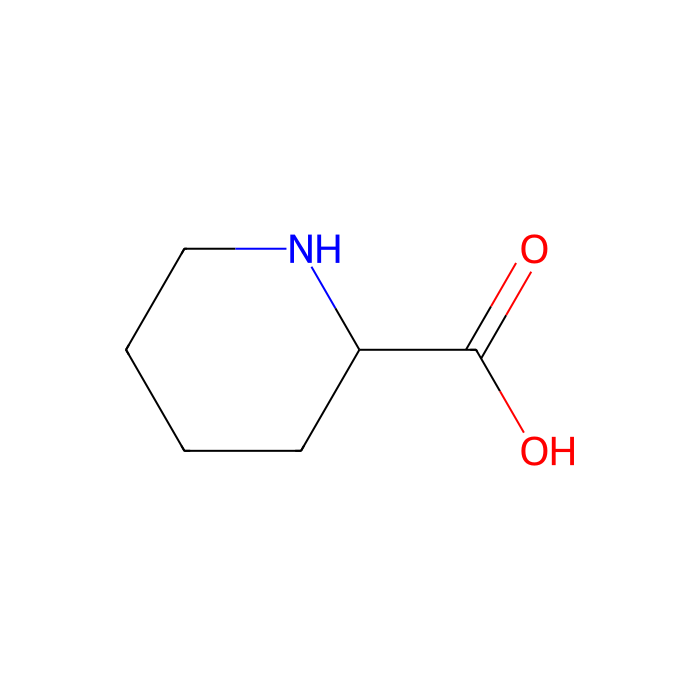
Brief overview: L-Pipecolic acid (also called (S)-piperidine-2-carboxylic acid) is a six-membered cyclic amino acid, the homolog of L-proline with an additional methylene in the ring. The chiral center is at C2 bearing the carboxyl group and the ring nitrogen.
Item-specific (from Product Data):
SKU: P106214
CAS: 3105-95-1
Storage: Room temperature; shipped under normal conditions
Research use: For research use only
Other identifiers (InChIKey, SMILES, MF, MW): Not specified for this item; refer to CoA/Spec Sheet.
Literature identity values (for reference; not item-specific specifications):
A saturated six-membered piperidine ring (chair conformation) containing one ring nitrogen. At the carbon adjacent to nitrogen (C2), a carboxylate-bearing stereocenter is present with L-configuration. In neutral drawings, the molecule exists as a zwitterion with –NH2+ and –COO− depending on pH. The ring resembles proline’s pyrrolidine but with one extra –CH2– unit, affecting basicity and conformational preferences.
Synthetic Utility
Functional group set:
Carboxylic acid (α to a chiral center) enables amide couplings, esterifications, decarboxylations, and activation to acyl derivatives.
Secondary amine embedded in a six-membered ring allows N-acylation, N-alkylation, protection (Boc/Cbz/Fmoc), and quaternization.
Retrosynthetic value (general/literature):
Serves as a chiral pool starting material for piperidine frameworks prevalent in alkaloids and drug-like scaffolds. Transformations that conserve stereochemistry at C2 enable rapid assembly of substituted pipecolates and bicyclic systems.
Named/representative reactions:
Amide bond formation with HATU/HBTU/EDC+DIC/HOBt or Oxyma to give pipecolamides.
Curtius/Schmidt-type rearrangements of activated carboxyl derivatives to access ureas/carbamates.
Formation of N-hydroxyphthalimide (NHPI) esters for decarboxylative cross-coupling (photoredox/Ni) to forge C(sp3)–C bonds from the α-position (literature trend for amino acid derivatives).
Esterification (Fischer/Steglich) to tunable pipecolate esters for subsequent manipulations (e.g., SN2′, hydrogenations).
Selectivity/control tips:
Protect the more nucleophilic ring nitrogen to avoid competitive N-acylation during activation of the acid.
Avoid high-temperature, strongly basic conditions that may epimerize the stereocenter; use mild bases (DIPEA, NMM) and low temperatures.
For N-alkylation, pre-form the hydrochloride and liberate base in situ, or use Mitsunobu-type approaches on suitable alcohol partners to control over-alkylation.
Target Specificity
Not applicable. This product is a small-molecule amino acid derivative, not an antibody, enzyme, or affinity reagent. No antigen/epitope or species reactivity is relevant. For biochemical pathway context, see the Biological Roles section.
Perguntas frequentes
What is the purity of this product?
This product is supplied at ≥98% purity (chemical assay). Lot-specific values are stated on the Certificate of Analysis.
How should this product be stored?
Store at room temperature.
How is this product shipped?
This product ships under standard ambient conditions. No temperature-controlled packaging is required.
What are the CAS number, molecular formula and molecular weight?
The CAS Number is 3105-95-1, the molecular formula is C6H11NO2, and the molecular weight is 129.16 g/mol. InChIKey HXEACLLIILLPRG-YFKPBYRVSA-N.
What documentation is provided?
Available product documentation, including Certificates of Analysis (COA), Safety Data Sheets (SDS), and specification sheets, is shown in the product document area. Document availability and access follow the current site policy.
Usamos cookies para garantir o funcionamento adequado do site e, quando permitido, para melhorar a sua experiência. Você pode gerenciar suas preferências a qualquer momento nas Configurações. Saiba mais em nossa Política de Cookies.
Deseja que lhe enviemos uma mensagem quando tivermos descontos disponíveis?
Lembrar-me mais tarde
Obrigado! Por favor, verifique a sua caixa de entrada de e-mail para confirmar.
Products are supplied to verified businesses, institutions, and qualified professionals for research and development use only. Not for use in humans, animals, diagnosis, or therapy.

 K2108080