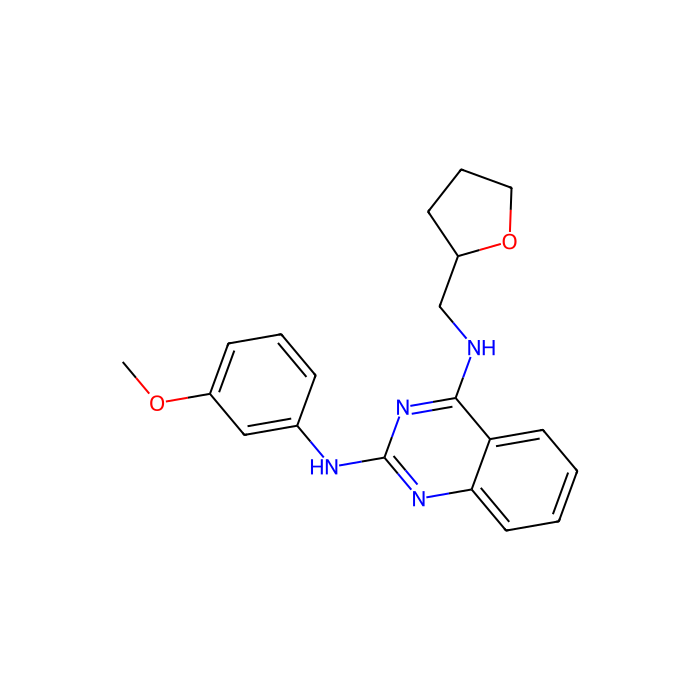
This compound belongs to the class of organic compounds known as quinazolinamines. These are heterocyclic aromatic compounds containing a quianazoline moiety substituted by one or more amine groups.
External Descriptors
Not available
1. Djoumbou Feunang Y, Eisner R, Knox C, Chepelev L, Hastings J, Owen G, Fahy E, Steinbeck C, Subramanian S, Bolton E, Greiner R, and Wishart DS. ClassyFire: Automated Chemical Classification With A Comprehensive, Computable Taxonomy. Journal of Cheminformatics, 2016, 8:61.
Determine the necessary mass, volume, or concentration for preparing a solution.
Dilution Calculator
Determine the dilution needed to prepare a stock solution.
Reconstitution Calculator
Revisões
Avaliações dos Clientes
Application Protocols
Validated application protocols are not provided for this listing.
Item-specific facts (from Product Data):
Tested applications and recommended conditions: Not specified for this item; refer to CoA/Spec Sheet.
General example workflow for screening use (not item-specific):
Prepare a 10 mM stock in anhydrous DMSO.
Create a serial dilution (e.g., 1:3 or 1:2) across a 384-well source plate using acoustic or tip-based dispensing.
Transfer to assay plate to achieve final concentrations spanning the desired dose–response range, matching final DMSO (e.g., 0.1% v/v) across all wells including controls.
Incubate per assay SOP; read out via the relevant detection modality (fluorescence, luminescence, absorbance, label-free), monitoring for interference.
Analyze with a four-parameter logistic model; flag atypical curves for follow-up and orthogonal confirmation.
Documentation: Record batch/lot, preparation date, solvent, and final concentration; attach CoA and SDS to the assay record.
Biological Roles
This product is a synthetic small molecule provided for research use; no endogenous biological role is specified.
Item-specific facts (from Product Data):
Biological/target information: Not specified for this item; refer to CoA/Spec Sheet.
Research Use Note: For research use only.
General considerations for screening compounds (general guidance):
Compounds may modulate enzymes, receptors, ion channels, or protein–protein interactions; specific target(s) must be determined experimentally.
Hit compounds can show context-dependent activity, off-target effects, or assay interference; confirm activity across orthogonal assays and counter-screens.
ADME-relevant properties (permeability, metabolic stability, plasma protein binding) should be profiled if biological follow-up is planned.
Biochemical usage tips (general guidance):
Maintain consistent DMSO content across wells to avoid solvent-driven artifacts.
Evaluate colloidal aggregation using detergent controls and dynamic light scattering where feasible.
Disclaimer: No biological mechanism, pathway association, or target specificity is assigned to this item in the listing. Avoid inferring therapeutic relevance; this product is intended solely for laboratory research.
Buffer Applications
This item is not a buffer component. However, small-molecule stocks are commonly introduced into buffer systems for biochemical and cell-based assays.
Item-specific facts (from Product Data):
No buffer specifications are provided for this item.
Practical guidance (general, not item-specific):
Prepare concentrated stock in DMSO (e.g., 10–50 mM), then dilute into assay buffer (e.g., PBS, HEPES, Tris) to the desired final concentration.
Keep final DMSO ≤0.1–1.0% v/v depending on assay tolerance; match vehicle controls.
If precipitation occurs upon dilution, increase co-solvent fraction (e.g., to 2–5% DMSO) if biologically acceptable, or pre-dissolve with a miscible co-solvent (DMF, EtOH) before buffer addition.
For pH-sensitive compounds, use well-buffered media (HEPES pH 7.2–7.6 or appropriate pH range) and avoid extreme pH that may cause degradation.
Filtration and sterility (general guidance):
For cell assays, sterile-filter (0.22 µm) final working solutions if solubility allows.
Not applicable elements:
No defined buffering capacity, pKa set, or standard buffer recipes exist for this listing; refer to assay-specific SOPs.
Green Alternatives
In the absence of item-specific solvent/handling constraints, greener practice focuses on solvent selection, energy use, and waste minimization (general guidance).
Greener solvent choices for stocks and assays (general guidance):
Favor aqueous buffers with minimal co-solvent where feasible; limit DMSO to the lowest assay-compatible level (often ≤0.1–0.5% v/v).
Consider ethanol or propylene carbonate as alternatives for certain assays; evaluate biological compatibility carefully.
Process considerations:
Use miniaturized assay volumes (384/1536-well) to reduce solvent use and waste.
Implement plate maps that minimize repeats and concentrate confirmatory testing to reduce consumables.
Comparison (general guidance):
DMSO: excellent solvency, low volatility, widely compatible; environmental persistence is moderate; use sparingly.
Ethanol: renewable origins possible, rapidly biodegradable, but less solvating power and potential assay perturbation at >0.5% v/v.
Acetonitrile: high volatility and flammability; useful analytically but less green; capture vapors with proper ventilation and recover via solvent recycling when possible.
Waste and energy:
Consolidate organic wastes for solvent recycling; adopt cold-storage sparingly if stability at room temperature is confirmed (this item lists room temperature storage).
Item-specific green notes: No dedicated green profile is provided for this item; refer to SDS/CoA for any stabilizer or solvent information that may influence greener handling.
Pharmaceutical Uses
No pharmaceutical or excipient use is specified. This item is supplied strictly for research use only.
Item-specific facts (from Product Data):
Research Use Note: For research use only.
Pharmacopeial status (USP/EP/JP): Not specified for this item; refer to CoA/Spec Sheet.
General context (not item-specific):
Screening compounds may be used in discovery workflows (hit ID, SAR, mechanism studies) but are not intended for formulation or clinical use.
If transitioning a research hit toward development, extensive qualification is required (impurity profiling, polymorph assessment, residual solvent/water content, stability indicating methods) under appropriate quality systems.
Start with a 10–50 mM stock in dry DMSO; inspect for complete dissolution by visual check and analytical HPLC.
If solubility is limited, test co-solvents (DMF, NMP, ethanol) or add surfactant (e.g., 0.01–0.05% Tween 80) to aqueous assay buffers.
Record exact concentration by UV-Vis (if chromophore present with known ε) or quantitative NMR against an internal standard.
Note: Specific numerical values for BP/MP, density, solubility, pKa, logP, and refractive index are not specified for this item; refer to CoA/Spec Sheet.
Quality and Grades
Quality and grade designations are not specified for this catalog entry.
Item-specific facts (from Product Data):
Grade/Purity: Not specified for this item; refer to CoA/Spec Sheet.
What to expect for screening-library small molecules (general guidance):
Typical purity thresholds are ≥95% (HPLC/UPLC, UV or ELSD) for screening-grade materials; confirm on the CoA.
Identity confirmation by LC–MS (±0.5–5 ppm HRMS when available) and 1H NMR; some libraries include 13C NMR and elemental analysis.
Residual solvent and water contents may be reported by GC and KF, respectively; if critical for your use, request the latest CoA.
UV profile and stabilizers (general guidance):
HPLC/UPLC chromatograms at multiple wavelengths (e.g., 210/254/280 nm) are useful when planning analytical methods.
Stabilizers/antioxidants are generally not added to screening compounds; if any stabilizer is used, it will be declared on the spec. Not specified for this item; refer to CoA/Spec Sheet.
Batch-to-batch consistency:
For biological screening, verify lot-to-lot purity and identity before hit confirmation.
Store aliquoted to minimize freeze–thaw or moisture uptake; see Storage & Reconstitution.
Reaction and Applications
This product is categorized as a small-molecule library member intended for research screening rather than as a synthetic reagent.
Item-specific facts (from Product Data):
Category: Small molecules and compound libraries (screening context).
Manufacturer Applications: Not specified in the listing.
Research applications (general guidance):
Primary use in high-throughput screening (HTS), fragment or lead discovery, and target deconvolution workflows.
Suitable for phenotypic assays, biochemical inhibition/activation screens, and binding assays (e.g., thermal shift, SPR, MST), subject to assay compatibility.
Use in orthogonal assay panels to confirm activity and reduce interference risk (e.g., redox cycling, aggregation).
Practical considerations (general guidance):
Prepare mother plates at 10 mM (DMSO) and create daughter plates by serial dilution under low-humidity to limit DMSO evaporation.
Include DMSO-only controls at matching concentrations; monitor for assay artifacts (inner-filter effects, fluorescence interference).
Test for compound aggregation (e.g., with 0.01–0.05% nonionic detergent) and redox activity (e.g., Amplex Red counter-screens) when signals are ambiguous.
Note: This item is not positioned as a reagent for named organic reactions; if you intend to derivatize or use it synthetically, obtain the full structure and compatibility data from the CoA/Spec Sheet.
Reaction Conditions
No synthetic reaction usage is specified for this catalog entry. If the compound is to be used as a substrate or intermediate, consult the complete structural information first.
Item-specific facts (from Product Data):
No reaction or processing conditions are provided.
General guidance (not item-specific):
For solution preparation: dissolve in dry DMSO (10–50 mM), optionally warm (≤40–50°C) and sonicate to aid dissolution; avoid moisture-sensitive handling unless the CoA indicates sensitivity.
For assay incubation: typical exposure times vary from minutes to hours at ambient to physiological temperatures (25–37°C) depending on the assay design; confirm stability over the assay window.
Photostability: in the absence of data, minimize light exposure during preparation and storage as a conservative practice.
Expected yields, catalysts, and temperatures for chemical reactions are not applicable here due to lack of structural/functional group data.
Please refer to the CoA/Spec Sheet and SDS for any constraints (e.g., sensitivity to acid/base, oxidants, or air) that would influence handling.
Safety and Handling
Safety information specific to this item is not provided in the listing. Always consult the product SDS for authoritative guidance.
Item-specific facts (from Product Data):
GHS Classification, Signal Word, H-Statements, Pictograms: Not specified for this item; refer to SDS.
Storage: Room temperature (as supplied).
General laboratory precautions for small-molecule library compounds (general guidance):
Handle in a chemical fume hood; avoid inhalation of powders and contact with skin/eyes.
DMF or NMP for highly apolar or crystalline compounds; subsequently dilute into aqueous buffers.
Acetonitrile or ethanol as co-solvents for LC compatibility or volatile removal.
Aqueous buffers (e.g., PBS, HEPES) with 0.1–20% DMSO or 1–10% ethanol, as permitted by the assay.
Practical workflow:
Start with 10–50 mM DMSO stock; if insoluble, warm gently (≤40–50°C) and sonicate; avoid prolonged heating.
Check clarity after dilution into assay buffer; if precipitation occurs, increase co-solvent fraction or reduce final concentration.
Filter 0.22 µm before high-precision assays to remove particulates.
Comparison notes (general guidance):
DMSO vs DMF: DMSO is more biocompatible; DMF may extract plastics and is less preferred for cell assays.
DMSO vs ethanol: ethanol is more volatile and can affect membrane integrity; limit final ethanol below typical cytotoxic thresholds (often ≤0.5% v/v, assay-dependent).
Storage and Reconstitution
Item-specific storage is provided; reconstitution details are not specified.
Item-specific facts (from Product Data):
Storage Conditions: Room temperature.
Shipped In: Not specified for this item; refer to CoA/Spec Sheet.
General storage guidance for small molecules (not item-specific):
Store tightly sealed, dry, and protected from excessive heat and humidity. Consider desiccation and amber containment to minimize hydrolysis/photolysis when structure is unknown.
For long-term use, prepare single-use aliquots of DMSO stocks (e.g., 10–50 mM) and store at −20°C to −80°C to minimize freeze–thaw; validate stability experimentally.
Allow frozen DMSO stocks to thaw at room temperature; vortex and briefly centrifuge to collect condensate; inspect for precipitation or color change before use.
Reconstitution (general guidance):
Dissolve the material in anhydrous DMSO to prepare a concentrated stock; confirm concentration by mass and volume or analytical assay (UV-Vis if chromophore known, or qNMR).
Filter (0.22 µm PTFE) if particulate is present and solubility permits.
Note: Any specific stabilizers, hydrates/solvates, or reconstitution requirements are not specified for this item; refer to CoA/Spec Sheet and SDS for definitive instructions.
Structure and Identity
Brief overview: This listing corresponds to a small-molecule screening compound from a chemical library. Item-specific structural identifiers are largely not provided in the product data.
Item-specific facts (from Product Data):
CAS: 796888-12-5
CID: 2951910
InChIKey: "78702" (as provided; note: this is an atypical/non-standard InChIKey format)
SMILES: Not specified for this item; refer to CoA/Spec Sheet.
Molecular Formula: Not specified for this item; refer to CoA/Spec Sheet.
Molecular Weight: Not specified for this item; refer to CoA/Spec Sheet.
Structural features (general guidance):
Without a provided SMILES or structure diagram, ring systems, functional groups, and stereochemistry cannot be enumerated for this specific item.
How to verify identity (general practice):
Cross-check the CAS and CID in authoritative databases (e.g., CAS Registry, PubChem) to retrieve the canonical SMILES, InChI, and 2D/3D structures (literature/general guidance).
Confirm identity by LC–MS and 1H/13C NMR against the vendor CoA/Spec Sheet and reference spectra (general guidance).
2D structure description: Not available due to missing structural data in the listing. Please consult the CoA, SDS, or Spec Sheet for the definitive structural depiction.
Synthetic Utility
This product is positioned as a screening compound rather than a synthetic building block; therefore, routine use as a reagent is not anticipated.
Item-specific facts (from Product Data):
Structure and functional groups: Not specified for this item; refer to CoA/Spec Sheet.
General considerations if derivatization is contemplated (general guidance):
Obtain the full structure (SMILES/InChI) and identify functional handles (e.g., aryl halides, amines, acids) before planning transformations.
Verify stability to common conditions (acid/base, oxidative, reductive, thermal) and assess protecting-group needs.
For SAR expansion, retain the core scaffold while varying substituents via cross-coupling, amide coupling, or heterocycle substitutions as appropriate—contingent on the actual functional groups present.
Analytical control (general guidance):
Employ LC–MS and NMR to track reaction progress and purity; use orthogonal methods (HRMS, HPLC-ELSD) for non-UV-active products.
Note: Without a declared structure, specific reaction pathways, named reactions, or reactivity predictions cannot be provided for this item.
Target Specificity
No target or specificity information is provided for this item.
Item-specific facts (from Product Data):
Target, pathway, species selectivity, and mechanism: Not specified for this item; refer to CoA/Spec Sheet.
General guidance for researchers:
Use orthogonal assays (biochemical and cellular) to define on-target activity.
Profile off-target liabilities via counterscreens (e.g., frequent hitters, PAINS, colloidal aggregation tests) and broad panels if advancing as a probe.
Determine binding via biophysical methods (SPR, ITC, DSF) and confirm functional outcome in mechanistic assays.
Note: Any claims of target specificity must be derived from your experimental data or authoritative references; none are assigned in this listing.
Perguntas frequentes
What is the purity of this product?
This product is supplied at ≥98% purity (chemical assay). Lot-specific values are stated on the Certificate of Analysis.
How should this product be stored?
Store at room temperature.
What are the CAS number, molecular formula and molecular weight?
The CAS Number is 796888-12-5, the molecular formula is C20H22N4O2, and the molecular weight is 350.41 g/mol. InChIKey FBWZAFQEOKNGQL-UHFFFAOYSA-N.
What documentation is provided?
Available product documentation, including Certificates of Analysis (COA), Safety Data Sheets (SDS), and specification sheets, is shown in the product document area. Document availability and access follow the current site policy.
Usamos cookies para garantir o funcionamento adequado do site e, quando permitido, para melhorar a sua experiência. Você pode gerenciar suas preferências a qualquer momento nas Configurações. Saiba mais em nossa Política de Cookies.
Deseja que lhe enviemos uma mensagem quando tivermos descontos disponíveis?
Lembrar-me mais tarde
Obrigado! Por favor, verifique a sua caixa de entrada de e-mail para confirmar.
Products are supplied to verified businesses, institutions, and qualified professionals for research and development use only. Not for use in humans, animals, diagnosis, or therapy.

 J22181130